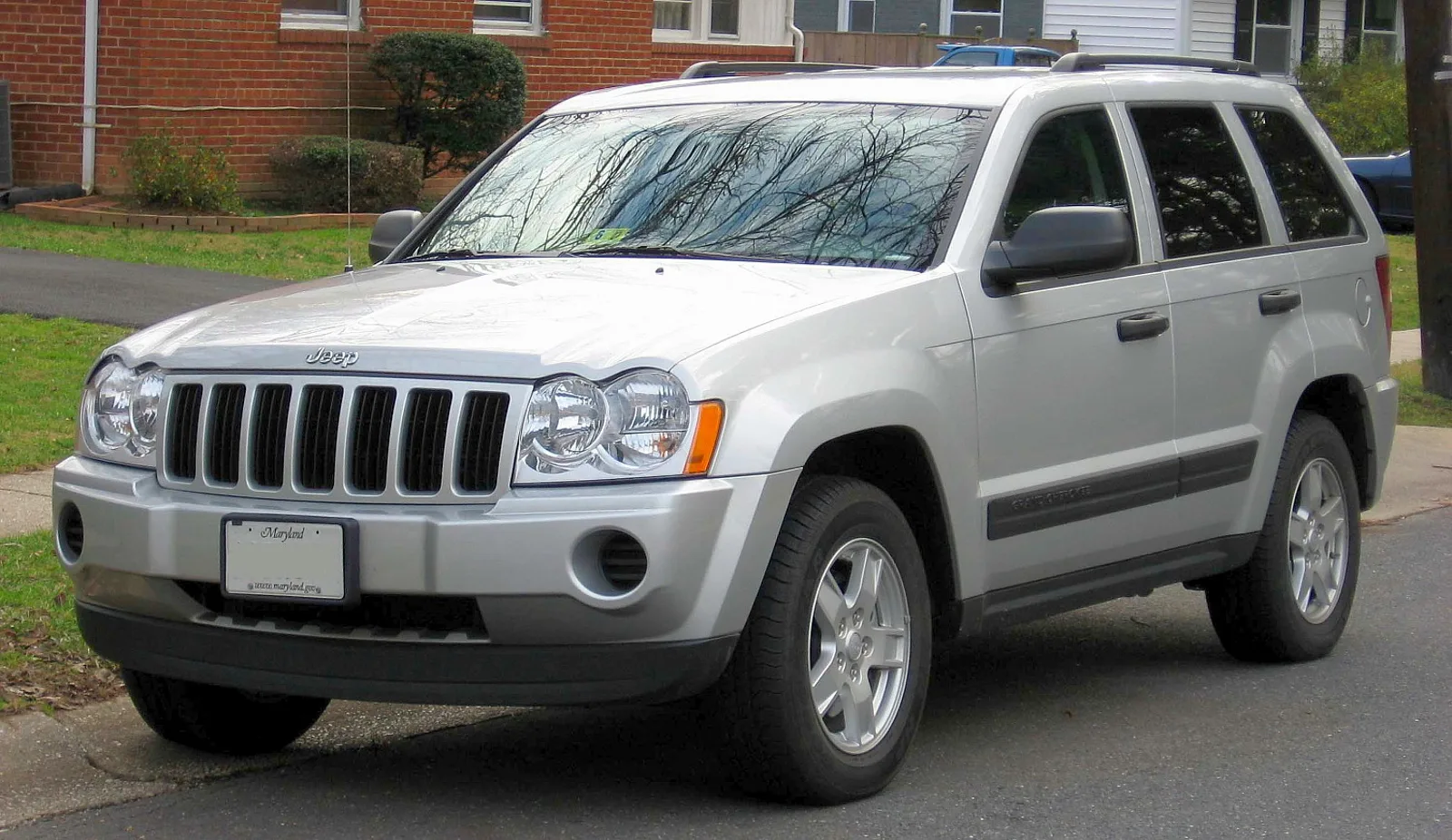
Independent front suspension, V6, V8 and diesel engines, and an SRT8 that closed a five-model-year run from 2005 to 2010.
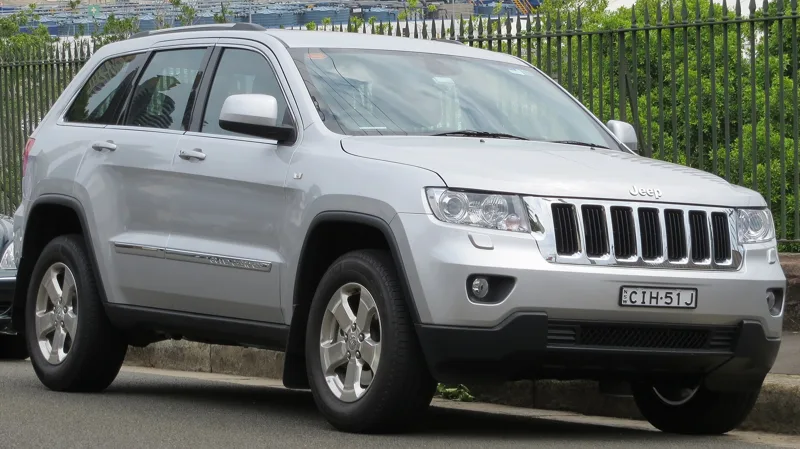
The Jeep Grand Cherokee WK was the third generation of the model, built from 2005 to 2010. It offered V6, V8 and diesel engines, independent front suspension and, at the top, an SRT8 with 20-inch wheels that ran 0-97 km/h in 4.6 seconds.
The 2005 Jeep Grand Cherokee WK ran for five model years and finished with a 313 kW (420 hp) SRT8 that Road & Track timed from 0-97 km/h (0-60 mph) in 4.6 seconds. Its line-up ran from a plain Laredo up to that performance model.
Jeep sold the WK from the 2005 to 2010 model years. The 2010 model year cycle began on 17 August 2009, and WK production finished on 12 March 2010.
Where did the WK Grand Cherokee come from?
Jeep launched the WK on 19 September 2004 as a 2005 model, after a development process that ran from 1999 to 2004. The car was unveiled at the 2004 New York International Auto Show, and Jeep also presented it in Europe at Euro Camp Jeep in Ardeche, France. Outside the United States it was sold as the WH.
Jeep described the WK as all-new, and most of its engines were new as well. The 4.7-litre V8 was the exception, having carried over from the WJ generation.
An SUV that ended its run with an SRT8 able to cover 0-97 km/h in 4.6 seconds.
What equipment and technology came with the WK?
The WK brought a full-colour 5.8-inch GPS navigation system, UConnect hands-free Bluetooth, SiriusXM Satellite Radio and a rear-seat Video Entertainment System with wireless headphones. A six-speaker, 276-watt Boston Acoustics system replaced the Infinity Gold unit as the standard sound system, and the Electronic Vehicle Information Center also moved into the instrument cluster.
Four-wheel drive was reworked too. Quadra-Drive II became available on most Grand Cherokees, the older Selec-Trac manual system was discontinued, and every four-wheel-drive system gained computer-assisted traction control. Drivers could also adjust the settings more easily while moving, because the controls sat in the centre stack.
Which engines did the WK offer?
At launch the WK offered a 3.7-litre Power-Tech V6 rated at 210 hp, a 4.7-litre V8 carried over from the WJ with 235 hp, and a 5.7-litre Hemi V8 rated at 345 hp. The 6.1-litre Hemi of the SRT8 arrived later, in the performance model.
The V6 replaced a 4.0-litre inline six and was offered only on the base Laredo. The new unit produced a full 210 hp, which was 15 hp more than the engine it replaced.
The 4.7-litre V8 had first appeared in the WJ Grand Cherokee as a High Output engine. Jeep dropped the dedicated High Output version after the 2008 revision, and the same engine was used in the Dodge Dakota and Dodge Ram 1500, which kept it in the Dodge line-up.
The 5.7-litre Hemi was the Limited's engine and used Multi-Displacement System, which lets the car run on four cylinders at cruising speeds to help fuel economy. From 2009 the Hemi also gained variable valve timing, and its rating then was 365 PS (268 kW; 360 hp) with 529 Nm (390 lb ft) of torque.
The gearbox depended on the engine. The V6 and the SRT8 used a Mercedes-Benz sourced five-speed automatic, while the 545RFE five-speed automatic carried over from the previous generation with the 4.7-litre and 5.7-litre V8s.
How did the 2008 facelift change the WK?
The 2008 model year brought a mid-cycle restyle with a new grille, revised headlamps, a new front bumper and new tail lamps. The seats, steering wheel and instrument cluster were redesigned as well, and SiriusXM Satellite Radio became standard across the range.
High-intensity discharge headlamps with auto-leveling were part of the update, and the lower section of the front bumper became removable to increase the approach angle. Select models also gained heated outboard rear seats and a 115-volt household-style outlet.
Power rose midyear. The 4.7-litre became 305 hp (227 kW; 309 PS) with 453 Nm (334 lb ft) of torque, a gain of 70 hp, and the 5.7 climbed to 360 hp, up 15 hp.
Inside, a FOBIK keyless remote replaced the integrated key and remote unit, and the ignition slot was redesigned. Select radios gained a touchscreen display, with a top-tier GPS navigation unit that added SiriusXM Travel Link, voice activation and integrated UConnect Bluetooth telephone. The rear DVD system received a larger LCD and SiriusXM Backseat TV compatibility.
What did the Laredo, Limited and Overland trims offer?
The Laredo was the entry trim, with a 3.7-litre V6, 17-inch alloy wheels, a full-size spare, cloth seats and six speakers. The Limited added dual power front bucket seats, premium leather and a 276-watt Boston Acoustics sound system, while the Overland sat at the top of the range from 2006 to 2009.
Laredo buyers also got a five-speed automatic, a six-way power driver's seat, a CD player and keyless entry as standard. Power windows, power door locks, power side mirrors and tinted glass came with it too. The Limited added a six-disc CD and MP3 changer, a leather-wrapped steering wheel and two-position driver memory. Its standard engine was the 4.7-litre V8 between 2005 and 2009, and the 2010 standard became the 3.7-litre V6. The Limited also brought heated front bucket seats, a full-size matching spare, chrome body-side and bumper inserts and a rear-mounted console that folds down.
The Overland added a GPS navigation radio, Bluetooth with voice command, side airbags, leather and suede seats with Overland embroidery, a sunroof and the 5.7-litre Hemi. Its 18-inch chrome-clad wheels could be swapped for 17-inch alloys from 2007 to 2009. Overland badges marked the tailgate. The Overland skipped the 2010 model year and returned on the WK2 for 2011.
Was the SRT8 a genuine performance SUV?
The SRT8 answered that question with a 6.1-litre Hemi rated at 313 kW (420 hp). Road & Track measured 4.6 seconds from 0-97 km/h (0-60 mph) on a 2006 production car, and the quarter mile took 13.2 seconds at 167.5 km/h (104.1 mph). Only the Dodge Viper SRT10 accelerated more quickly across the SRT family.
Off-road gear was removed to sharpen on-road handling and cut weight. The NV146 transfer case sent 0-50% of torque to the front axle through an electronically applied clutch pack, with no low range and no manual controls. Both differentials were open, the ride sat lower, and the front spoiler kept 178 mm (7 inches) of ground clearance.
Brembo brakes, Bilstein gas-charged shocks and a fortified Dana 44 rear differential sat beneath the body. The car used 285 mm (11.2 inches) wide tyres at the rear and 255 mm (10 inches) at the front, and it paired its engine with a Mercedes-Benz NAG1 five-speed automatic.
The sports-tuned suspension let the SRT8 reach 0.92 g on the skidpad. With no electronic speed governor, the top speed was set by the rev limiter, which put it at 274 km/h (170 mph) in top gear. Jeep built 14,921 SRT8s.
The SRT8 debuted at the 2005 New York International Auto Show. Production started on 5 November 2005, and the car went on sale on 20 December 2005, so it arrived part way through the MY2006 cycle.
Did the WK offer a diesel?
The diesel was a 3.0-litre CRD V6 built by Mercedes-Benz, with a variable geometry turbocharger. It produced 215 hp (160 kW; 218 PS) and 510 Nm (376 lb ft) between 1,600 and 2,800 rpm, and it returned 17 mpg-US (14 L/100 km; 20 mpg-imp) in the city and 22 mpg-US (11 L/100 km; 26 mpg-imp) on the highway.
Outside North America the engine was offered for the whole production life of the car from 2005, and European combined consumption was quoted at 10.2 L/100 km (27.7 mpg-imp; 23.1 mpg-US). It met Euro 4 without a particulate filter, while the North American version added one. In North America the engine debuted in mid-2006 on the Limited and Overland, and it was offered only for 2007 and 2008. It was not sold new in California or certain Northeast states, although used examples could still be bought there because the rules covered new vehicles only.
The same Mercedes-Benz V6 powered many of the German maker's own vehicles, including the C-Class, E-Class, S-Class, G-Class and the Sprinter van. Late diesel cars built in 2008 are often called 2008.5 models, because they could not carry a 2009 badge under tighter diesel emissions rules.
How did production run from 2005 to 2010?
Each model year had its own build cycle, starting in July or August and ending the following year. The MY2006 cycle ran from 5 July 2005 to 30 June 2006, and the MY2010 cycle began on 17 August 2009 before WK output stopped on 12 March 2010.
- MY2006: the Overland trim arrived, and the SRT8 entered production on 5 November 2005.
- MY2007: the Laredo gained colour-keyed door handles and revised tail lamps, and the 4.7-litre V8 became E85 capable in some states.
- MY2008: the mid-cycle restyle went on sale from 1 September 2007.
- MY2009: the S Limited trim, previously sold in Europe, arrived in the United States.
- MY2010: the 4.7-litre V8, Overland, S Limited and Rocky Mountain Edition were dropped, while the Laredo gained a 5.7-litre option and the Limited a 3.7-litre one.
Model years did not line up with calendar years. MY2008 production started on 16 July 2007, so a car built in late 2007 carried a 2008 badge. Likewise the MY2010 run began on 17 August 2009, so builds in the second half of 2009 were already 2010 models.
Which special editions were built?
The Rocky Mountain Edition went into production on 1 March 2005 and ended at 9,500 examples on 31 May 2005. The 65th Anniversary Edition replaced it for 2006, and the Rocky Mountain name returned for the 2007, 2008 and 2009 model years.
Both value-added trims were built on the Laredo. They added a power driver's bucket seat, embroidered carpeted floor mats, chrome body-side inserts, a CD changer with MP3 playback, a 276-watt Boston Acoustics system, 17-inch alloy wheels, fog lights and a power double-function sunroof.
The S Limited was a European model until it reached the United States for 2009. It was built on the Limited and added unique alloy wheels, S emblems on the front doors, the 5.7-litre Hemi, perforated leather and suede seats and a GPS navigation stereo. At launch the 5.7-litre Hemi had been limited to the Limited, so the S trim was a Limited with the stronger engine and its own styling cues.
Jeep Grand Cherokee WK specifications
| Specification | Detail |
|---|---|
| Body | Mid-size SUV, third generation (WK) |
| Model years | 2005 to 2010 |
| Launch | 19 September 2004, unveiled at the 2004 New York International Auto Show |
| Entry engine | 3.7 L Power-Tech V6, 210 hp |
| Mid-range V8 | 4.7 L Power-Tech V8, 305 hp (227 kW; 309 PS) from 2008 |
| Top petrol V8 | 5.7 L Hemi, 365 PS (268 kW; 360 hp) and 529 Nm (390 lb ft) from 2009 |
| Diesel | 3.0 L CRD V6, 215 hp (160 kW; 218 PS), 510 Nm (376 lb ft) |
| SRT8 engine | 6.1 L Hemi, 313 kW (420 hp) |
| SRT8 0-97 km/h | 4.6 seconds (0-60 mph), road test of a 2006 car |
| SRT8 quarter mile | 13.2 seconds at 167.5 km/h (104.1 mph) |
| SRT8 top speed | 274 km/h (170 mph), rev-limited |
| SRT8 production | 14,921 built |