Built from 1986 to 1994, the XJ40 brought modern styling and a long development story, but electrical faults and fast rivals blunted its impact.
The Jaguar XJ40 was a full-size luxury saloon that Jaguar Cars built from 1986 to 1994, replacing the Series III XJ. It was the last car Jaguar developed independently before Ford's takeover, and it was often criticised for electrical faults and early build quality problems.
Jaguar Cars built the XJ40, a full-size luxury saloon, between 1986 and 1994. It replaced the Series III XJ, though the two shared the showroom floor for several years. Its long gestation, angular styling and early reliability problems made it one of the most debated Jaguars of its era.
How was the XJ40 developed?
Work on Project XJ40 began in the 1970s, with the aim of replacing the original XJ6, and scale models existed by 1972. The 1973 oil crisis and the difficulties at parent company British Leyland pushed the car back again and again, and Jaguar eventually chose an internal design over proposals from its own designers and Pininfarina.
The British Leyland board signed off 80 million pounds for the car in February 1981, when the launch was still due in 1984. After Jaguar was de-merged from British Leyland and privatised that year, its chief executive, John Egan, used strong sales of the Series III in North America to justify a two-year delay for more development time.
Up to that point the XJ40 was the most thoroughly tested vehicle built by the company. Its development also introduced new ways of designing, building and assembling Jaguars.
The last Jaguar developed without Ford, and a platform that carried the marque's saloons into the mid-1990s.
What engines did the XJ40 have?
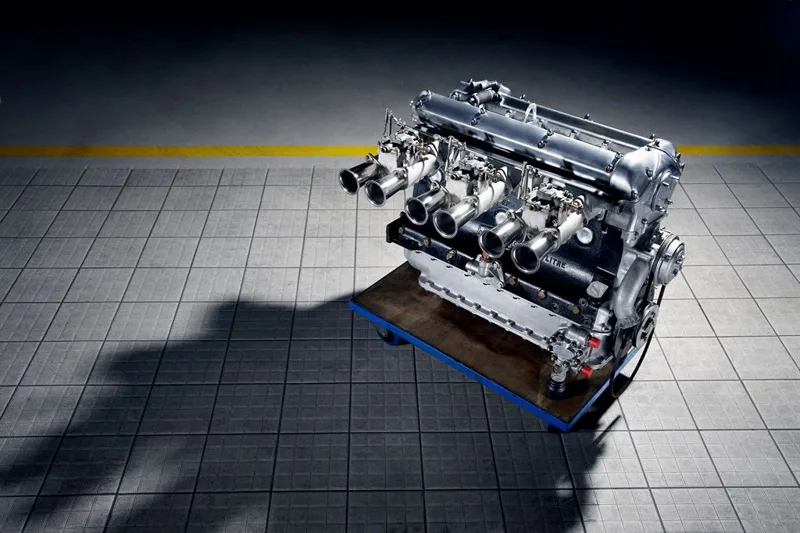
At launch the XJ40 offered two versions of Jaguar's AJ6 inline-six, a 2.9-litre and a 3.6-litre. A 4.0-litre replaced the 3.6 in 1990, and a 3.2-litre replaced the 2.9 in 1991. A 6.0-litre V12 came later, in the XJ12 and Daimler Double Six of 1993.
| Engine | Period | Gearbox and notes |
|---|---|---|
| 2.9-litre AJ6 six | 1986 to 1991 | ZF 4HP22 automatic; replaced by the 3.2 |
| 3.6-litre AJ6 six | 1986 to 1990 | ZF 4HP22 automatic; five-speed Getrag 265 manual on early cars |
| 4.0-litre AJ6 six | From 1990 | ZF 4HP24 automatic |
| 3.2-litre six | From 1991 | ZF 4HP22 automatic; later manuals were Getrag 290 |
| 6.0-litre V12 | XJ12 and Daimler Double Six, from 1993 | GM 4L80E four-speed automatic |
British Leyland had considered giving the XJ40 the Rover V8, which would have ended the need for new Jaguar engine production. Reports say the bodyshell was engineered to rule out V-configuration engines, and that choice delayed the V12 car until 1993, because the front structure had to be redesigned at length.
The Series III V12 therefore stayed in production until 1992 to meet demand for a large V12 saloon. The automatic selector was redesigned so drivers could choose forward gears without accidentally landing in neutral or reverse, a feature called J-Gate that lasted until the 2008 Jaguar XF.
How did the XJ40 look?
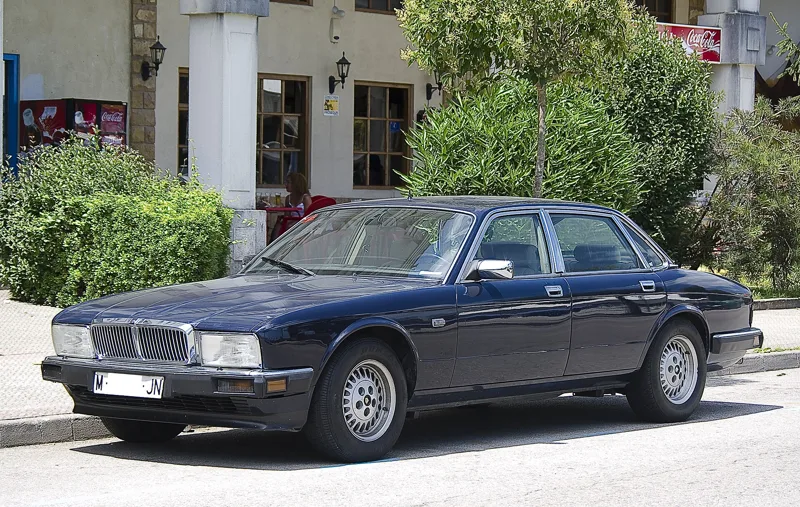
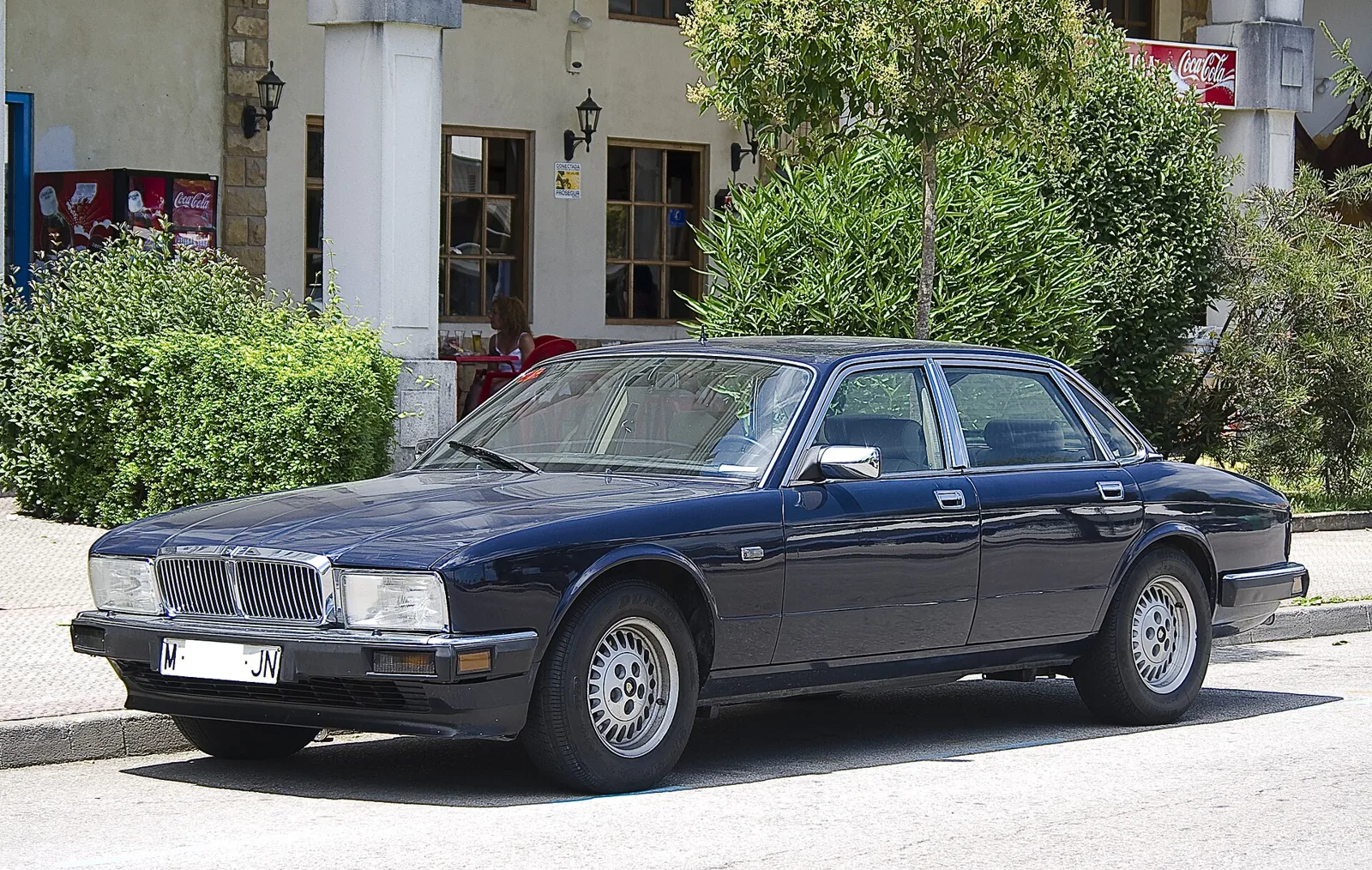
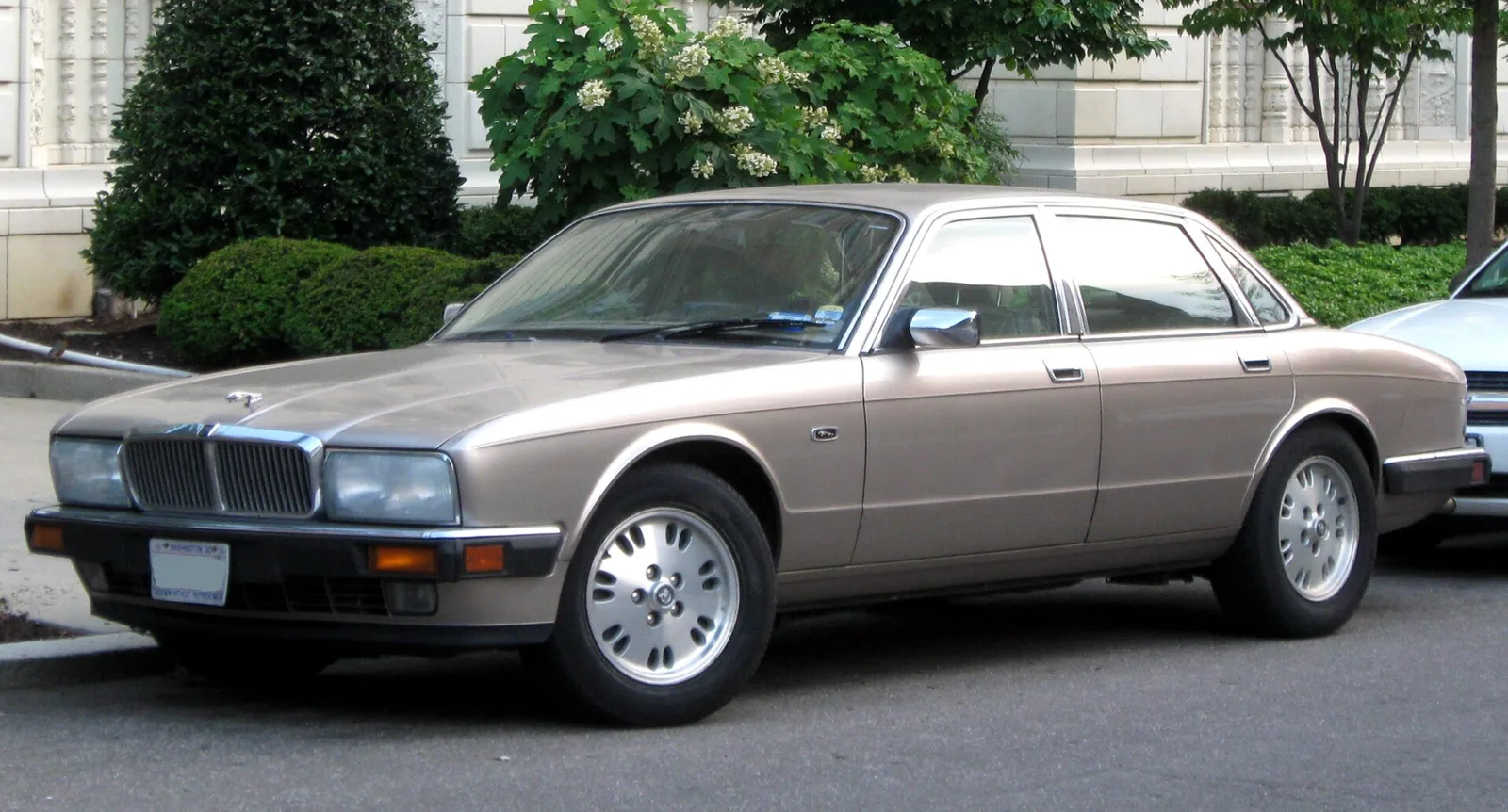
The XJ40 traded the curvaceous Series XJ lines for a more angular, geometric shape. Its black rubber bumper ran the full width of the car and held the sidelights and indicators, and the bonnet hinged at the front. Window frames were either chrome or black, depending on the model.
The first cars had two choices of headlamp: round lamps in chrome housings, or composite rectangular units with power-wash sprayers. The lower trim had painted bezels, while the Sovereign and Daimler carried the rectangular lamps. US safety rules allowed composite headlamps from 1983, but the lead time for American approval meant the US cars missed the launch.
The 1990 model year refresh gave US cars rectangular headlamps across the range. The refresh also brought a larger door handle pull and Tibbe 8 disc locks in place of the earlier Ford 6 disc type. Early low-specification cars had metric steel wheels with plastic covers, and from 1991 the wheels changed to imperial sizing.
What was inside the XJ40?
The interior was trimmed in walnut or rosewood, with cloth or leather upholstery depending on the model. Until 1990 the instrument binnacle used digital readouts for the smaller gauges, while the tachometer and speedometer stayed analogue. A vacuum fluorescent display called the Vehicle Condition Monitor sat in the binnacle.
The Vehicle Condition Monitor used a 32x32 dot-matrix screen and could show 34 functions. It flagged dead bulbs, worn brake pads, open doors or boot lids and low coolant. The binnacle earned a poor name, and false bulb failure warnings were a common complaint, so from 1990 the cluster was redesigned with analogue gauges.
Early cars had a two-spoke steering wheel, later replaced by a four-spoke airbag wheel. The glovebox disappeared from later cars to make room for the passenger airbag. US models gained automatic three-point seatbelts in 1989, and traditional belts returned from 1993.
Which XJ40 models were offered?
The base XJ6 was modestly equipped, and buyers paid extra for alloys, ABS, air conditioning, leather and an automatic gearbox. It had paired round headlamps and black powder-coated window frames.
The Sovereign, built from 1986 to 1994, came with far more standard kit: climate control, headlamp washers, six speakers, rear self-levelling suspension and anti-lock brakes. Before the 1991 model year it also had inlaid burl walnut trim, and it used stainless steel window frames.
The Sport arrived late in the run, from 1993 to 1994, on the 3.2S and 4.0S. It had rosewood trim, colour-keyed door mirrors and grille vanes, twin coachlines and five-spoke alloy wheels. Wider tyres completed the look, and it was only offered with the six-cylinder engines.
What were the Majestic and Gold models?
The Majestic was a rare long-wheelbase XJ40, produced in 1993 and 1994. Each car began life as a short-wheelbase body, was pulled from the line before being lengthened by Project Aerospace in Coventry, then returned for paint and final assembly at Browns Lane under Jaguar Special Vehicle Operations. That process gave it a significant price premium.
The Majestic was offered in every market except the United States and Canada. A separate short-wheelbase Vanden Plas Majestic was sold in the US from 1989 to 1992, mostly in Regency Red. Owners and collectors can tell the two apart by the fourth letter of the VIN, which is M on the American short-wheelbase car, and the seventh digit on the long-wheelbase cars.
The Gold model arrived in 1994, pared back and priced modestly. It was offered in fewer colours than other XJ40s and was identified by a gold-plated boot badge and a gold growler on the grille. Gold cars wore Kiwi-style wheels and twin coachlines.
What was the Insignia?
In 1992 Jaguar closed its DS420 Limo workshop, leaving the craftsmen idle. Jaguar responded with Insignia, a made-to-order programme covering the XJ40, XJ81 and XJS. Buyers could choose paint, trim, wood and wheels as they liked, paying extra.
Some 318 XJ40 Insignias were produced. Most carry an oblong gold-on-black Insignia badge on the front wings, and they were fitted with leather trim where regular cars used leather-vinyl combinations. Special paint colours were introduced for the programme, including Mahogany, Amethyst Blue and Saturn Orange, and a demonstrator fleet toured dealerships to show the range.
Where did XJ40 police cars serve?
As with the Series III XJ, a number of XJ40s became police cars for motorway duty in the United Kingdom. These Police Special cars had mainly plastic interiors without luxury fittings. The most notable operator was Staffordshire Police, which ran several on the M6 motorway until 1999, the year the last XJ40 left UK police use.
Other forces used marked and unmarked XJ40 Police Specials, including Derbyshire, Cumbria, Durham, Sussex and the West Midlands. Jaguar also turned some Police Special demonstrators into fast fire tenders, which served Donington Park and Silverstone.
What was the XJR?
The XJR, launched in 1988, was a fast XJ40 finished by JaguarSport. JaguarSport was a joint venture between Jaguar and the Tom Walkinshaw Racing team, and the cars were completed at TWR's Kidlington factory alongside the XJ220. Based on the Sovereign, the XJR had uprated suspension with Bilstein dampers.
A revised power steering valve raised the steering weight by 40%. Early XJRs used the 3.6-litre AJ6 in standard tune, and later cars had a TWR-tuned 4.0-litre with new inlet manifolds, uprated camshafts and a tweaked ECU. The body kit used fibreglass valances and side skirts, with Speedline alloys and wider tyres.
Later XJRs had ducting in the front valance to feed cool air to the brake discs. The interior added a MOMO wheel in leather, JaguarSport logos on the dials and embossed headrests. In 1991 the car switched to the Sovereign's rectangular headlights, and production ended in 1994, with only a few hundred of each version built.
What were the XJ12 and Daimler Double Six?
Coded XJ81, the XJ12 and Daimler Double Six debuted at Amsterdam in February 1993. They used a 6.0-litre take on Jaguar's V12, mated to a GM 4L80E four-speed automatic. The XJ12 had quad round headlamps, while the Daimler had rectangular units.
The Daimler-branded cars sat at the top of the trim ladder and were sold as the Vanden Plas in the United States. They had a fluted radiator grille surround, a boot-lid plinth and fold-out picnic tables for rear passengers. The rear seat was a two-passenger item, unlike the flat, three-passenger bench in the Jaguars.
Who used the XJ40 as a prime ministerial car?
Two British prime ministers, John Major and Tony Blair, drove the car in the early 1990s. The tradition went back to the Series III XJ used by Margaret Thatcher, and later XJs served as the prime ministerial car for Brown, Cameron, May and Johnson.
How did reliability and rivals affect the XJ40?
Early cars were plagued by faults, mainly in the electrical systems and build quality. That damaged the car's reputation and reinforced Jaguar's wider image for quality, despite the extensive testing and engineering effort that went into the car.
The protracted development meant the XJ40 dated more quickly than its rivals. It was overtaken technologically by the E32 BMW 7-Series of 1986, the Lexus LS400 (1989) and the Mercedes-Benz W140 S-Class (1991).
What replaced the XJ40?
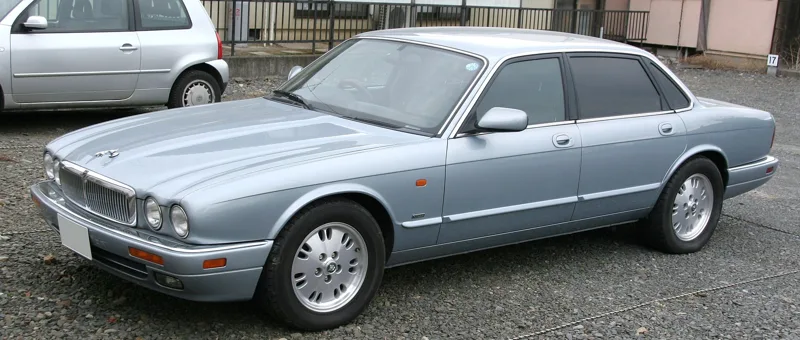
Ford took over Jaguar in 1990, and the XJ40 was replaced by the X300. That car was based on the XJ40 platform but was highly revised in almost all areas. Jaguar had planned a fresh saloon, using a new V8, to follow the XJ40, codenamed XJ90, but Ford halted its development.
Ford proposed fitting its own V8 and new front and rear ends to the centre section of the XJ40, but that engine was not ready. The XJ40 and its derivatives ran for 17 years, which makes it the second-longest running XJ platform to date.