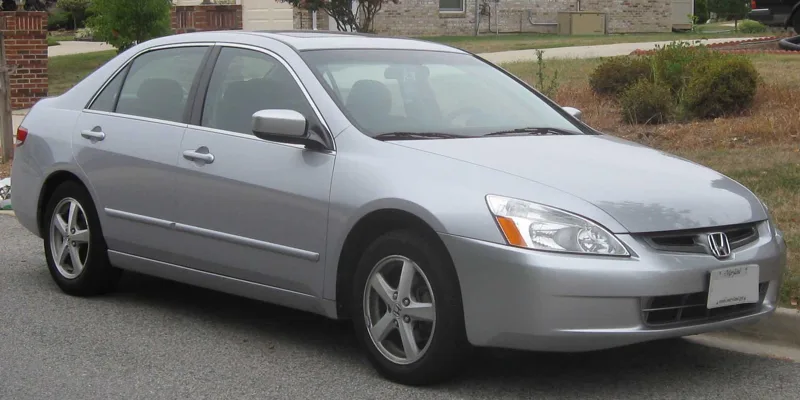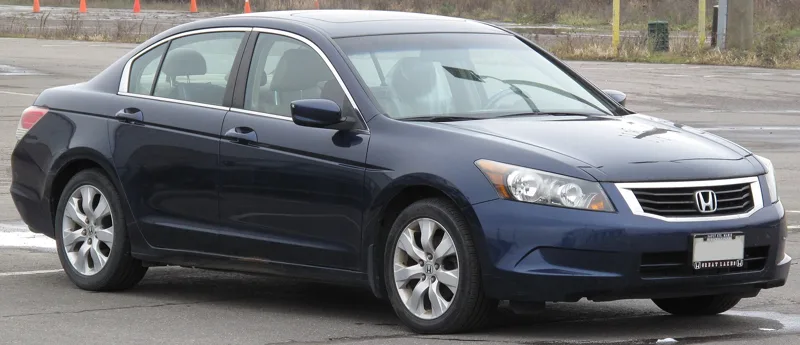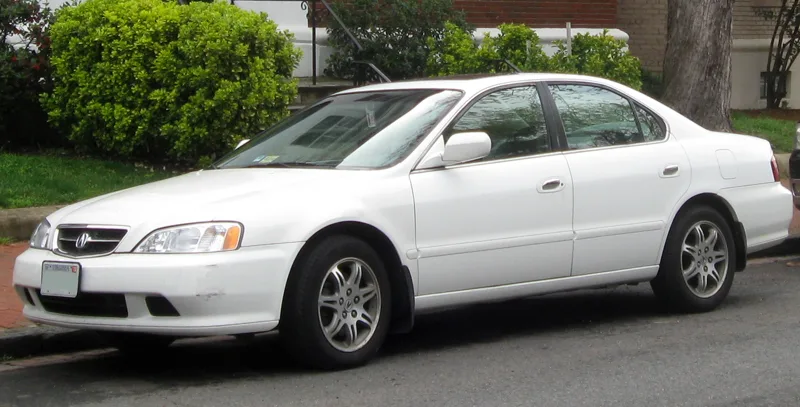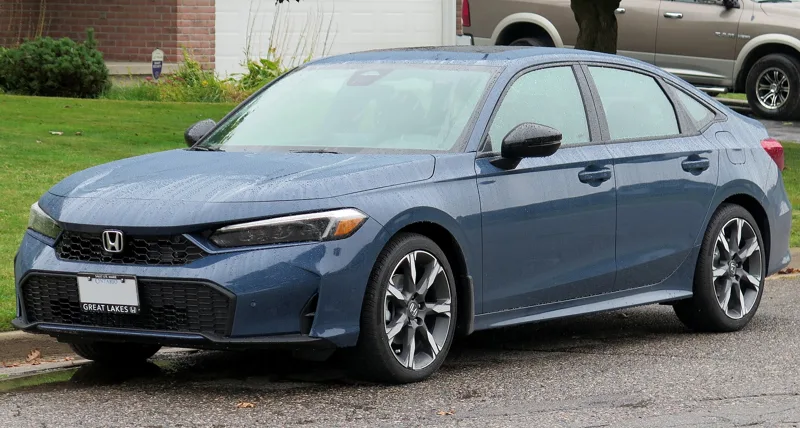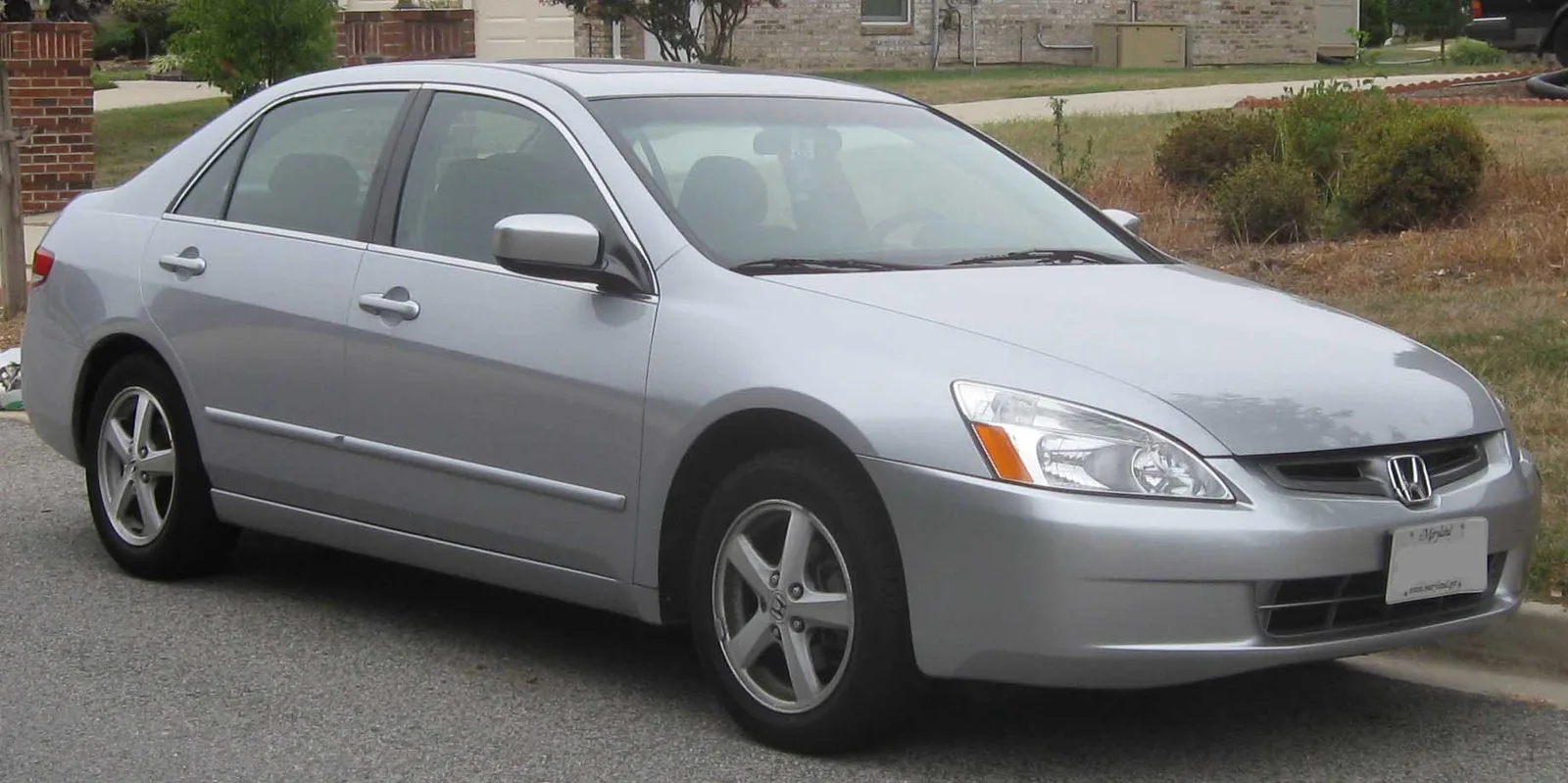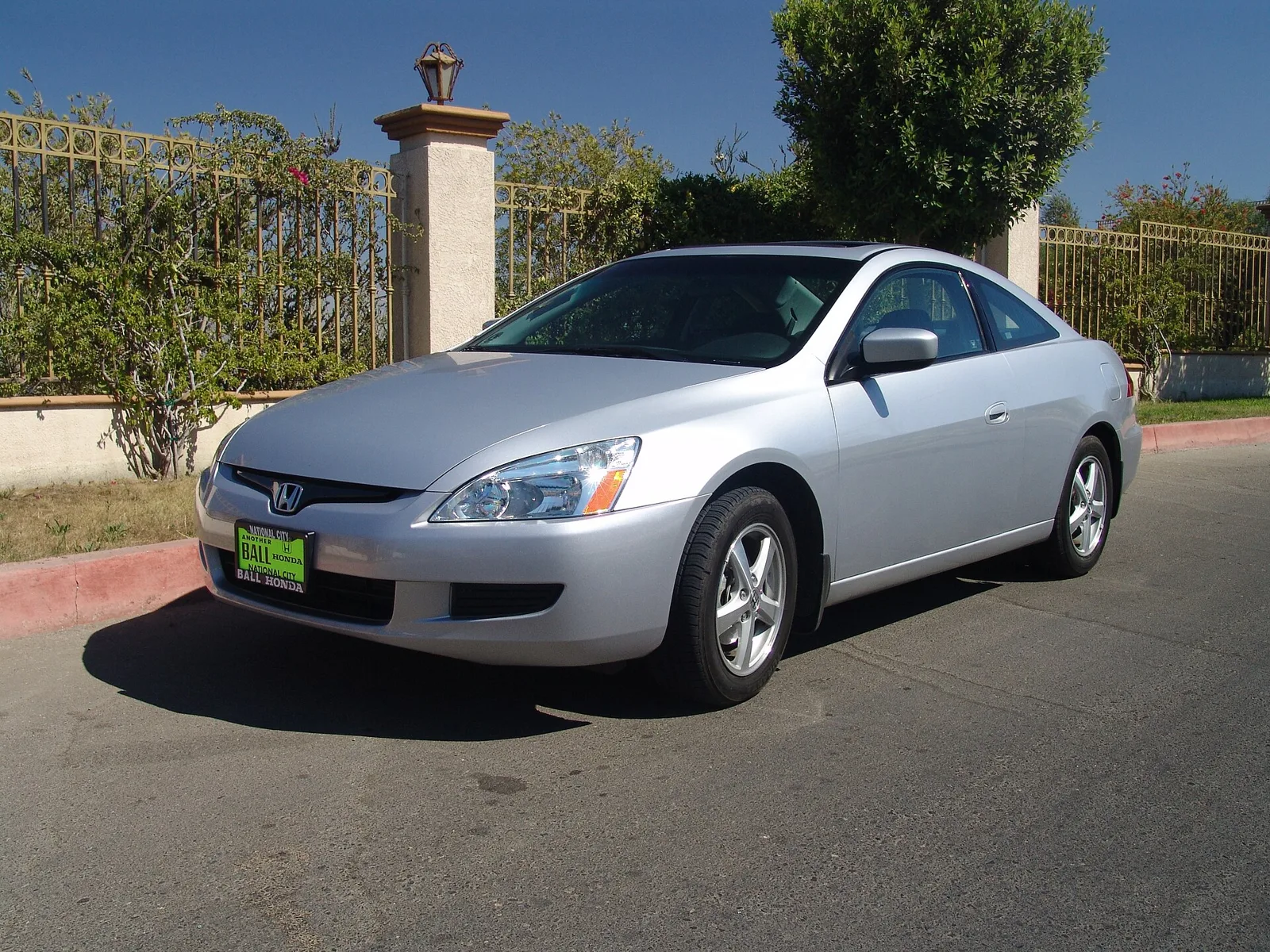
A larger K-series sedan and coupe, a 2006 refresh that enthusiasts called 7.5, an early Accord Hybrid and a run of recalls.
Sold from 2002 to 2007 as a sedan or coupe, this Accord used an all-new K-series four-cylinder and a 240 hp V6. A 2005 hybrid and a 2006 refresh were the notable changes during the run.
The seventh-generation North American Honda Accord was a mid-size car sold as a four-door sedan or two-door coupe from 2002 to 2007. It was larger and more refined than the car it replaced, and it carried the first all-new K-series four-cylinder engine in the range. The sedan was also sold in several other markets, and it was known as the Inspire in Japan.
What changed in the 2003 Accord?
The first 2003 Accord rolled off the Marysville, Ohio assembly line on 26 September 2002. Honda gave the car a new level of refinement, with chrome interior accents and higher-grade materials. The trim ladder carried over the same names as before: DX, LX, EX, LX-V6 and EX-V6.
The Accord was larger than the car it replaced, and it kept the same basic formula of a comfortable family sedan with a sporting option. The sedan could be bought in a wide range of trims, so buyers chose between economy and extra equipment without leaving the range.
A larger K-series sedan with an early hybrid and a 2006 refresh that enthusiasts treated as a generation of its own.
How did the Accord's engines and economy change?
The new four-cylinder was a K-series unit, and it was the first Accord four to use coil-on-plug direct ignition, a system previously used on the V6. Honda said it gave a slight gain in power and economy, as well as better long-term reliability than a distributor with spark plug wires.
Honda also recommended a lighter engine oil, 5W-20 instead of the previous 5W-30. The thinner oil reduced friction, and together with other changes it improved the four-cylinder's fuel economy, as the 2008 EPA ratings confirmed. One four-cylinder variant was also the first production car to meet California's Super Ultra Low Emissions standard.
The six-cylinder models kept the J-series V6 from the sixth generation. Revised intake and exhaust systems added 40 hp, taking total output to 240 hp. The exhaust manifold became part of the cylinder head casting, which tidied the layout.
Which transmissions did the Accord offer?
The four-cylinder could be paired with a 5-speed manual or a 5-speed automatic with overdrive, the overdrive automatic being new for 2003. Most six-cylinder Accords used the new 5-speed automatic, while the coupe could be bought with a 6-speed manual instead.
The 5-speed Hondamatic H5 replaced the previous 4-speed automatic. Its control logic reads throttle position, vehicle speed and acceleration, then compares those inputs with a stored map. That lets it spot an incline and hold a lower gear for climbing power, or use more engine braking on a downhill run.
What technology did the 2003 Accord bring?
This generation debuted Honda's GPS-assisted navigation as an option on the Accord. Before that, navigation appeared only on Acura's upper models and the Honda Odyssey. XM Satellite Radio also became a factory option in 2004.
The navigation system was later updated with a faster processor and more memory, and it gained restaurant information from Zagat. A revised maintenance minder also reminded owners of scheduled work such as oil changes, based on the conditions the car had seen.
What did the 2005 update add?
For 2005 the Accord received standard side-curtain airbags and front-seat side-impact airbags, bringing the total to six. The sedan's taillights became all red, although the coupe kept its own design. The grille gained more chrome, and new wheel designs appeared on LX, LX-V6 and EX-V6 models.
The 2005 update also brought the first Accord Hybrid, with new wheels, an EPA rating of 29 City and 37 HWY, and the same 3.0-litre V6 with more power. Its V6 produced 255 hp, 15 hp more than the regular car, which made it quicker than the standard V6 sedan but still behind the 6-speed manual coupe.
What did the Accord Coupe offer enthusiasts?
The coupe was the first Accord version Honda offered in the US as an enthusiast model. It had a sports suspension and a 6-speed manual borrowed from the Acura CL, though without the helical limited-slip front differential of the Type-S. Its 17-inch wheels wore 215/50R17 tyres, compared with 205/60R16 on the sedan, and both changes improved handling.
The coupe began life as a performance concept at the 2002 SEMA show. That concept had a 295 bhp (220 kW) 3.2L V6, a high-flow intake and exhaust, a limited-slip differential, prototype 8-piston Brembo brakes and a lowered racing suspension. Its carbon fibre body kit, 20-inch wheels and NSX Spa Yellow paint made it a show car rather than a production car.
Inside, the concept had an F1-style paddle shifter, a prototype multifunction display, Sparco bucket seats covered in Alcantara and a three-spoke racing wheel. Dealers could fit a Factory Performance Package based on that concept to 2003 LX-V6 and EX-V6 coupes, with performance suspension, an underbody aero kit, 17-inch alloys and a rear wing spoiler.
How did the 2006 refresh change the Accord?
For the 2006 model year, which marked the Accord's 30th anniversary, the North American car received a mid-generation refresh. It was significant enough that some enthusiasts called this generation 7.5. The new front grille was shared with the eighth-generation Civic, which debuted that year, and the rear gained triangular LED taillights.
The 2006 car also brought daytime running lights and heated side mirrors for US EX models, which had previously been available only on Canadian Accords. Vehicle Stability Assist, traction control and brake assist arrived on V6 models for the first time. The earlier TCS system had covered traction control and brake assist, but not stability control.
Power rose across the line. The V6 went to 244 bhp (182 kW), and the four-cylinder to 166 bhp (124 kW), after changes to the intake and exhaust. The V6 became the J30A5 and the four-cylinder the K24A8. For Brazil, the 2.4L engine was replaced by a smaller 2.0L i-VTEC K20A making 148 bhp (110 kW), to compete with the Ford Fusion.
The 2006 V6 sedan could finally be ordered with the 6-speed manual, and four-cylinder cars moved to drive-by-wire throttle control. A 2007 model year added the SE-V6 trim, and the Cool Blue Metallic colour became available on the sedan. Even in its final year the car still ranked highly with reviewers, scoring only slightly below the redesigned Toyota Camry in an Edmunds family sedan comparison.
How did the Accord Hybrid work?
Honda sold the Accord Hybrid in the US from the 2005 to 2007 model years. It was built exclusively in Sayama, Saitama, Japan, and it was Honda's third hybrid after the Insight and the Civic Hybrid. It cost US$3,000 more than the EX V6 model, and Honda placed it at the top of its non-Acura range in North America.
The hybrid's V6 came from the 2005 Honda Odyssey minivan and could shut off three of its six cylinders under certain conditions, a system Honda called VCM. The engine used iVTEC and drove a compact five-speed automatic, with room for an electric motor between the engine and gearbox. Power rose from 240 to 255 horsepower (179 to 190 kW), and torque from 212 to 232 pound-feet (287 to 315 N m).
The Hybrid reached 60 mph (97 km/h) in 6.5 seconds. Together with the Integrated Motor Assist, that made it slightly quicker than the conventional V6 Accord. The electric assistance added performance without using extra fuel, which is why the car was sometimes called a muscle hybrid.
The 2005 figures were first put at 30 mpg-US (7.8 L/100 km) in town and 37 mpg-US (6.4 L/100 km) on the highway. After standard moonroof and spare tyre fitments were added in 2006, the figures became 28 mpg-US (8.4 L/100 km) in town and 35 mpg-US (6.7 L/100 km) on the highway, because the car moved into a heavier EPA test class. The 2006 model was rated AT-PZEV by the California Air Resources Board.
Why did the Accord Hybrid struggle in the market?
The Hybrid did not win many buyers. It competed with the sixth-generation Toyota Camry Hybrid, which was priced close to the gasoline V6 Accord and Camry trims. The Accord Hybrid was comparatively more expensive, and its fuel economy matched the gasoline-only V6 Accord, while the Camry Hybrid was more efficient than its own petrol versions.
Honda discontinued the Accord Hybrid when the seventh-generation car ended production, and no hybrid was offered for the eighth generation. The Accord Hybrid returned for the 2014 model year with the ninth generation, with a new dual-motor system and a plug-in option, and a hybrid version of the 10th generation followed for 2018.
How did the Accord perform in safety testing?
Every model came with dual-stage front airbags as standard, along with driver and front passenger side airbags. Those side airbags were fitted to EX four-cylinder and all V6 models, and offered on LX four-cylinder cars. The passenger side bag used out-of-position sensing, with seven sensors in the seat back to judge the occupant's height and position.
Three-point front seatbelts with load-limiters and pre-tensioners were standard on all versions. Honda benchmarked the intermediate car class and more expensive segments when engineering the 2003 car. For chassis rigidity it measured the BMW 3-Series, the Audi A4 and A6 and the Mercedes-Benz S-Class. The seventh-generation Accord beat BMW, Audi and Mercedes-Benz in torsional rigidity and came second only to the S-Class in bending rigidity.
The Insurance Institute for Highway Safety also found that 2003 to 2004 Accords had the lowest fatality rates in the non-luxury mid-size sedan class.
Which recalls affected the seventh-generation Accord?
Recall 11v-395, dated 4 August 2011, targeted V6 Accords and other V6 Hondas fitted with automatic transmissions. Four-cylinder cars were outside its scope, and the affected total was estimated at 1,512,107 vehicles.
Honda's 1 October 2012 action covered 573,147 US Accords and 30,058 in Canada, all with V6 engines from 2003 to 2007. Because the Accord was added to the earlier Acura TL recall for 2007 and 2008 cars, the combined total in the US and Canada rose to 660,086. Recall 14v-351, initiated on 19 June 2014, covered many Hondas involved in the Takata airbag recall.
Where else was the Accord sold?
The sedan was marketed in parts of Latin America, Asia, the Middle East, the Caribbean, Australia and New Zealand. In Japan it was known as the Inspire from 2003. The North American car, with changes for local needs, was also the launch vehicle for Honda in South Korea, where sales began on 20 May 2004.
Production began at Honda's Marysville Auto Plant. In early 2005 the East Liberty Auto Plant started building the Accord sedan on the same line as the Civic and Element. That gave Honda more room to respond to demand, and the Acura TL was also assembled at Marysville.
What were the seventh-generation Accord specifications?
| Specification | Detail |
|---|---|
| Production | September 2002 (2003 model year) to 2007 |
| Four-cylinder | All-new K-series; 5-speed manual or 5-speed automatic with overdrive |
| Four-cylinder economy (2003) | Improved on the previous generation, as 2008 EPA ratings confirmed |
| V6 power | 240 hp in 2003; 244 bhp (182 kW) from 2006 |
| Hybrid power | 255 hp; torque 232 lb ft (315 N m) |
| Hybrid 0-60 mph | 6.5 seconds, equal to 97 km/h |
| Hybrid economy (2006) | 28 mpg-US (8.4 L/100 km) city; 35 mpg-US (6.7 L/100 km) highway |
| Hybrid price | US$3,000 above the EX V6 |
| Coupe SEMA concept | 295 bhp (220 kW) 3.2L V6; 20-inch wheels |
| Airbags (2005) | Six in total, including side-curtain airbags |