A Chrysler truck line that gave Dodge its first crew cab, a factory 426 V8 option, a Club Cab and a Warlock, before the Ram badge took over.
The Dodge D series was a Chrysler-built pickup line sold from 1960 to 1993, with 2WD D and 4WD W models. It was rebadged as the Dodge Ram in 1980 and replaced by a new Ram in 1993.
The Dodge D series was a line of pickup trucks that Dodge sold from October 1960 until 30 September 1993. The same basic design was kept until the Ram arrived in October 1993, and the trucks shared their AD platform with the Ramcharger and the Plymouth Trail Duster.
Two-wheel-drive models carried the D designation and four-wheel-drive trucks the W. Over more than three decades the line went head to head with the Ford F-Series and, later, the Chevrolet C/K, and it introduced a long list of firsts for the Dodge badge.
Where did the D series begin?
Dodge launched the D series in October 1960 to compete with the established full-size pickups. Its basic design was a sensible light-duty pickup with the Chrysler engine range behind it, and it was built at Warren, Michigan, under both the Dodge and Fargo names.
Several features came from the wider Chrysler parts bin. Dodge Division, part of the Chrysler Corporation, produced the trucks, and much of that engineering later carried into the Ram. Enthusiasts often refer to the D series and the W series together as the D/W line.
A Chrysler pickup that gave Dodge its first crew cab and a Club Cab, then gave way to the Ram.
What did the first generation offer?
The first generation ran from 1961 to 1965. The smallest V8 was the 318 cu in (5.2 L) Chrysler A engine, and most of the larger Chrysler engines were also available as factory options, with the notable exception of the Hemi.
Dodge gave the truck a four-door crew cab for 1963, which made it the first of the Big Three American makers to sell a factory truck with two rows of seats. International had introduced its Travelette in 1961, and Dodge followed as the first of the Big Three to offer such a truck from the factory.
Buyers could choose straight-sided Sweptline beds or step-sided Utiline beds. Utilines came in 6.5 ft (2.0 m) for the D-100, 8 ft (2.4 m) for the D-100 and D-200, and 9 ft (2.7 m) for the D-300 only.
A Perkins 354 cu in six-cylinder diesel was offered for 1962 but dropped because demand was weak. Only about 1,000 were built, mostly for the heavier PD500 and PD600 cab-chassis models. The original design lasted until spring 1965, when a facelifted single-headlamp version arrived.
What was the Custom Sports Special?
The Custom Sports Special arrived in 1964 as a sporty trim level. Its bucket seats, console, carpeting and racing stripes gave the truck a sportier character, and it was built from 1964 to 1967.
Buyers could also add a high-performance package to a CSS or a base model. For 1964 it brought a wedge-head V8 of 413 cu in (6.8 L) from Chrysler, and 1965 brought a 426 cu in (7.0 L) unit. Torque of 470 lb ft (637 N m) came with the bigger engine, alongside 365 hp (272 kW), in line with the muscle car boom then sweeping Detroit.
Alongside it came the LoadFlite automatic, a Sun tachometer rated to 6000 rpm, power steering, dual exhaust and traction bars borrowed from 1961 Imperials. Fitting it needed custom brackets, altered frame crossmembers and a bigger firewall, and it was offered only from 1964 to early 1966.
What changed in the second generation?
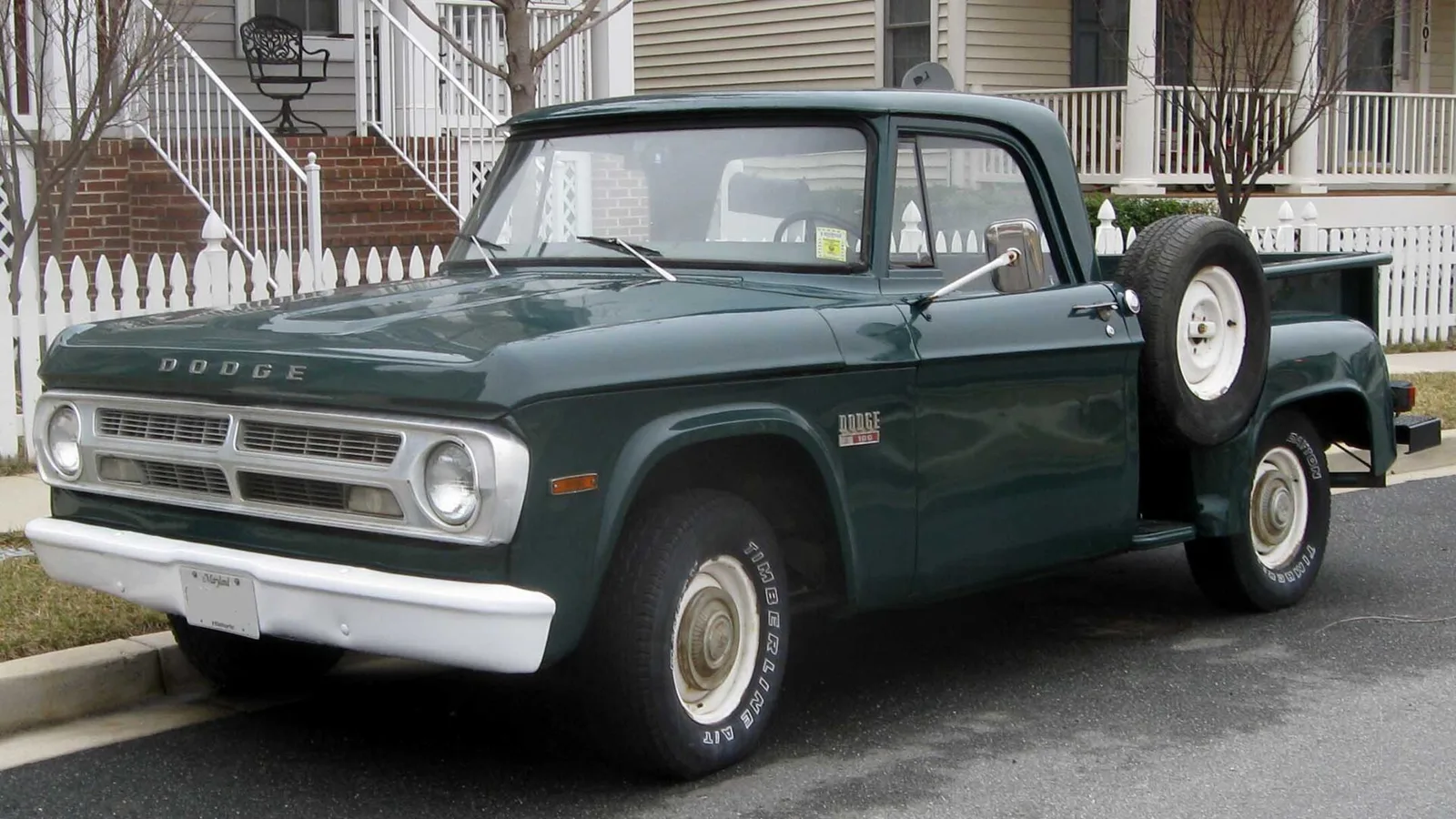
The second generation ran from 1965 to 1971. Dodge gave the D series a mild redesign in spring 1965, so some 1965 trucks had two headlamps and others had four. Changes brought a wider tailgate, the old A-series engines gave way to the updated LA series, and 8 ft bed models gained a six-inch wheelbase stretch.
A 383 cu in big-block two-barrel V8 became a standard option in 1967. From 1965 until the early 1980s, the Warren plant handled assembly for the American market, while trucks for the Israeli market came from a separate operation.
Automotive Industries Ltd. assembled the Israeli trucks in Nazareth-Illit, fitting straight-four and straight-six petrol engines and manual transmissions. The same plant assembled the Jeep Wagoneer for the Israeli army, along with Ford Escort and Transit vans for the civil market.
The Israeli models were the D100 and D200 light trucks, the D500, and the D600 with a straight six and on-demand four-wheel drive. A 20-seat bus was also built on the D500 chassis, using the straight-four engine and carrying front and rear hydraulic doors.
How did the 1968 to 1971 trims develop?
New for 1968 was a grille with two rows of four holes each. The Adventurer package took over from the Custom Sports Special, with a padded vinyl front seat, carpeting, extra chrome and courtesy lighting. The line still built in South Africa at this stage.
The lighter D300 used the 225 Slant-Six, and the heavier D500 had the 318 cu in V8. Measured net, the two engines gave 127 hp and 177 hp, or 95 and 132 kW. On the SAE scale the figures read 140 and 212 hp.
In 1970 the Adventurer name became three packages: a plain Adventurer, a sportier Adventurer Sport and an Adventurer SE at the top. The SE added a chrome grille, dashboard woodgrain, colour-keyed seatbelts, full courtesy lighting, dual horns, full carpeting and wheel discs, and the 1970 trucks also had a new four-section grille.
What was The Dude?
The Dude Sport Trim Package appeared in August 1969. It was a D100 with a black or white C stripe on the body side. Its extras were a Dodge Dude decal on the box, tail lamp bezel trim and dog-dish hubcaps with trim rings.
Its flat tailgate carried a Dodge decal rather than the usual embossed logo. The Dude ran only in 1970 and 1971, and between 1,500 and 2,000 were produced. Actor Don Knotts featured in its marketing.
How did the third generation rework the D series?
The third generation arrived for the 1972 model year with a rounder look, and the design lasted until 1980 with only minor changes. Two-wheel-drive models gained a double-wishbone independent front suspension in place of the leaf-sprung I-beam axle. The taillights were pocketed, with the reversing lamps sunk a quarter inch (6.4 mm) deep so they would not be struck in loading bays.
Scalloped bonnet and rounded wings echoed the 1971 Plymouth Satellite. Galvanised steel was used throughout to resist rust, and the interior received recessed gauges, larger pedals and a glovebox with a foot-operated parking brake as standard. Wheelbases grew by up to 5 inches. Air conditioning and cruise control were optional for the first time, and the trim ladder ran through Custom, Adventurer, Adventurer Sport and top-spec Adventurer SE.
The D300 chassis cab became the famous rescue vehicle in the television show Emergency!, appearing across all seven seasons of the series.
Dodge also pioneered the extended-cab pickup with the Club Cab for 1973. The two-door cab grew by 18 inches and gained small rear windows, with 34 cubic feet extra behind the front seats compared with the standard cab. Jump seats facing inward gave room for five passengers, and 2WD models gained front disc brakes that year.
Other 1974 changes included the Dyna-Trac dual-rear-wheel option on the D300 Sweptline, rated at 10,000 lb GVWR with a 6,900 lb rear axle. The 440 cu in engine replaced the 400 as an option, and electronic ignition became standard on all petrol Dodge trucks. The fuel tank was also shifted out of the cab and onto the frame.
For 1975 the front drum brakes on 4WD models were replaced by discs, and a full-time transfer case became standard. Trucks up to 6,000 lb GVWR received catalytic converters to meet emissions rules, and the nine-foot Utiline bed on the D/W 300 was discontinued.
The 1976 models brought a raised fuel tank, a glide-out spare carrier and a four-speed overdrive manual for the slant-six. The 400 V8 returned, and most models offered a Sky Lite sunroof with three settings.
What were the late 1970s models?
A facelift for 1977 gave the grille rectangular turn signals, with the DODGE name embossed across its top edge, and the Adventurer Sport trim was dropped. A Fuel Pacer display was added to help drivers track consumption. The W400 chassis cab, rated at 11,000 lb with dual rear wheels, arrived that year with the 360 cu in V8 as standard.
For 1978 a tilt steering wheel and a factory trailer hitch appeared, and a 243 cu in diesel was offered on the 150 and 200 models, but not in California. The RD200, built for railway service, used a heavier frame and the 360 V8 with automatic. The D400 chassis cab, rated at 10,500 lb, also joined the range that year.
The 1979 trucks gained quad rectangular headlights on higher trims and the first factory power door locks. The 400 and 440 engines were dropped, and all D/W 300 models received the 360 V8. The 1980 changes were modest, with black grille openings and the NP435 transmission replacing the three-speed manual after the 1979 oil crisis.
Special models gave the period its character. The Li'l Red Express ran from 1978 to 1979, and the Warlock was a short-wheelbase truck sold as part of Dodge's adult toys line, limited in 1976 and in regular production from 1977 to 1979. Warlocks had gold wheels, wide tyres, bucket seats and an oak-railed Utiline bed.
Dealer-installed for 1978, the Midnite Express was a package rather than a factory option. Dealers unable to move the Li'l Red Express repainted high-optioned Warlocks metallic black and fitted the Li'l Red Express parts, most of them with the 440 engine. Some 44,000 D-series trucks also went into military service between 1976 and 1977 as the M880 CUCV, based on the W200 with a 318 V8 and a Torqueflite automatic.
Which diesel engines did the D series offer?
The 1978 models brought Dodge's second diesel pickup, a Mitsubishi 6DR5 4.0-litre naturally aspirated inline six. It was offered as an economy option in the D/W 150 and 200, and its torque, 169 lb ft (229 N m) at 2200 rpm, came with a 105 hp (78 kW) peak at 3500 rpm.
Gearboxes came from Dodge's standard manual and automatic range, bolted on through an adapter plate that matched the big-block V8 bolt pattern. It was a rare factory option, identified by VIN code H, and a product of the 1973 oil crisis and the Chrysler and Mitsubishi collaboration. It was not sold in California.
Power was modest by American standards, which hurt its appeal despite good economy. It had been used in Japanese cab-over trucks, but low sales ended its run after only 2,835 examples. It was listed for 1979 too, though it is unclear whether any were built.
How did the D series become the Ram?
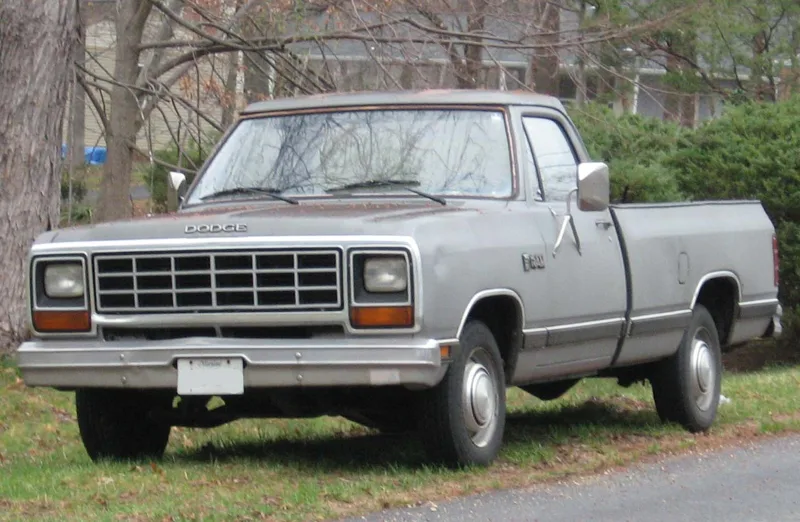
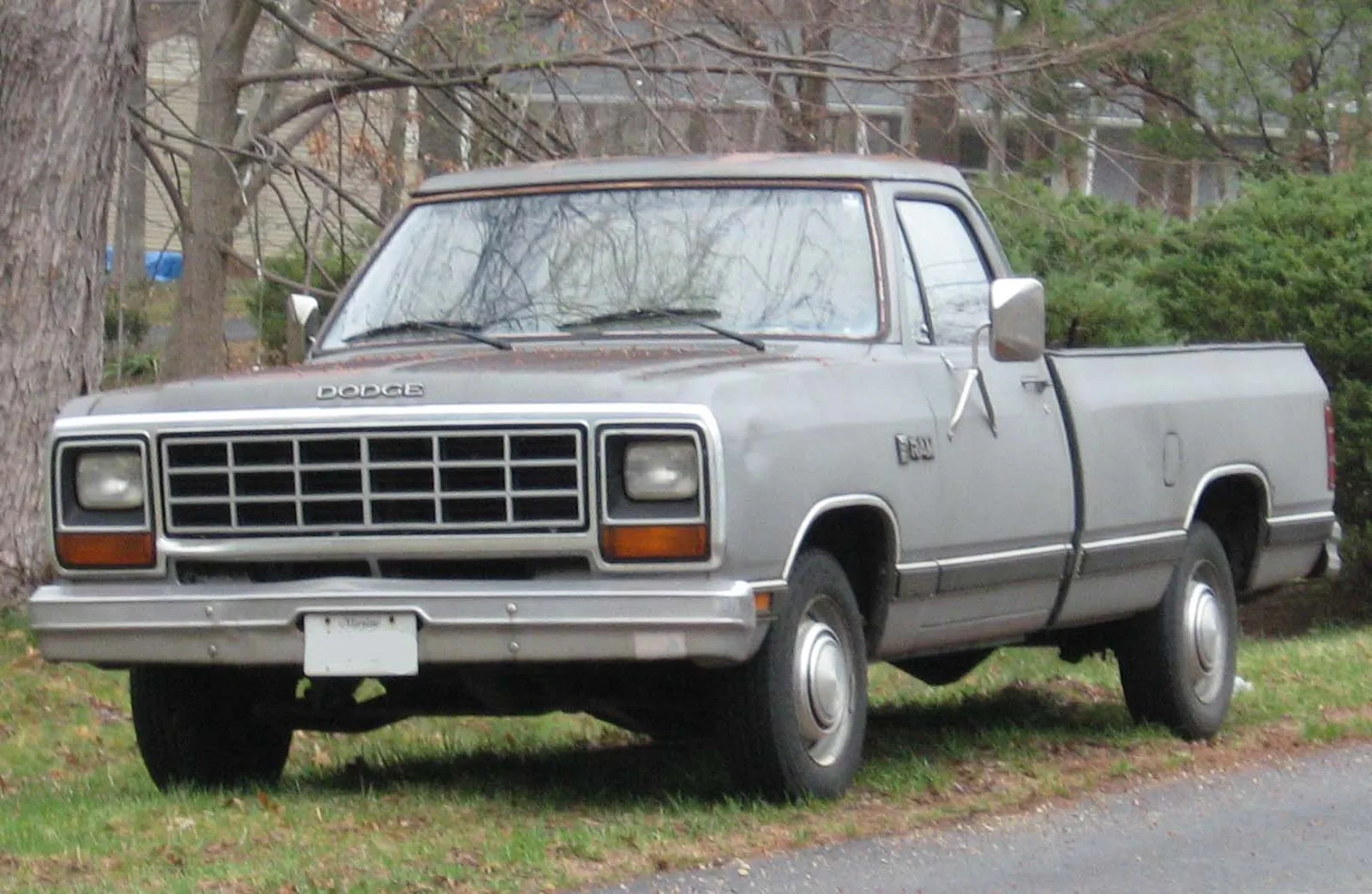
The final generation was updated in October 1980, when the D series took on the Dodge Ram badge. That change came around the time Lee Iacocca took charge of Chrysler. The tailgate carried an embossed DODGE RAM name, and the grille, bonnet, taillights and entire interior were all changed.
A shoulder line on the body recalled the GM competition, and from 1982 even more corrosion-resistant steel went into the body. The narrow Utiline bed, which dated back to the 1940s, was dropped in 1985, and throttle-body injection arrived in 1988. Many panels were interchangeable across models from 1971 to 1993, so hybrid trucks are common today.
The engine range narrowed. The entry engine was a 225 cu in (3.7 L) slant-six with hydraulic tappets, and larger buyers picked from LA-series V8s of 5.2 L (318 cu in) and 5.9 L (360 cu in). A 3.9 L (237 cu in) V6 replaced the slant-six for 1988, and in 1992 the V6 and V8s became Magnum engines. A 5.9 L Cummins diesel option followed in 1989.
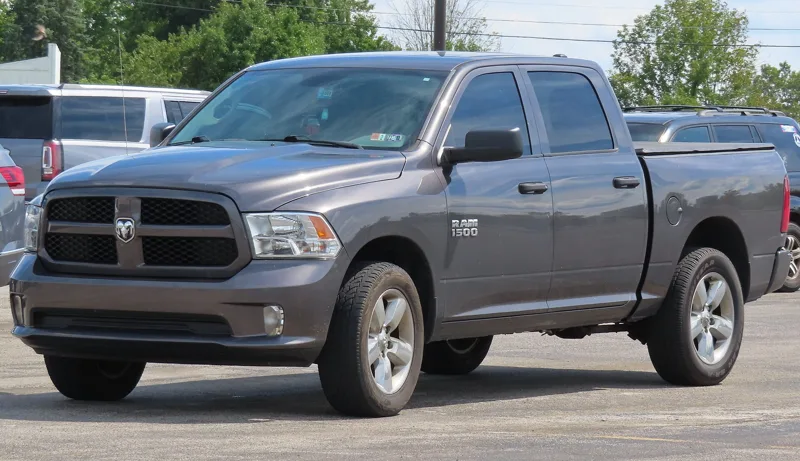
Sales were strong through the Sweptline years and into the late 1970s. Afterwards, a body close to two decades old, together with buyers' loyalty to Chevrolet and Ford in the 1980s and 1990s, cut volume. A wholly new Dodge Ram arrived for the 1994 model year.
Dodge D series generations at a glance
| Generation | Years | Notable change |
|---|---|---|
| First | 1961-1965 | Four-door crew cab for 1963; Perkins diesel option |
| Second | 1965-1971 | Israeli production; Adventurer trim; The Dude |
| Third | 1972-1980 | Independent front suspension; Club Cab from 1973 |
| Dodge Ram | 1981-1993 | Ram badge from October 1980; throttle-body injection 1988 |