A heavy full-size Chrysler that arrived just before the first oil shock, with lean-burn engines, a badge reshuffle and a five-year run of nearly 216,000 cars.
The 1974-1978 Chrysler New Yorker was a large full-size car from the Chrysler group, sold mainly in North America. Launched as the first oil crisis began, it had a big V8 engine and a three-speed automatic, and it sold poorly as fuel costs rose.
The 1974 to 1978 Chrysler New Yorker, a full-size car built by the American Chrysler group, was aimed mainly at North America. It reached showrooms just as the first oil crisis struck, and its heavy, large body and big V8 engines sold poorly as fuel prices kept climbing.
The literature calls these heavy cars the last mastodons. Its story is also a story of badge changes, because the New Yorker name moved between several models during the production run.
Where did the 1974 New Yorker come from?
By common count the 1974 car belongs to the seventh New Yorker generation. It was born in a period of serious economic trouble for the group. Chrysler had used the New Yorker name since 1938 for well-equipped cars.
From 1965 every full-size Chrysler had been built on the C platform. The sixth New Yorker generation, which ran from 1969 to 1973, had a fuselage design that seemed innovative at first. By the early 1970s it looked dated, and it had fallen out of step with the 1973 bumper regulations.
A full-size Chrysler described as one of the last mastodons, launched just before the first oil shock.
Why did the New Yorker name matter at Chrysler?
The New Yorker was usually the largest and most expensive Chrysler, though not always. Only the Imperial, sold from 1955 to 1975 under its own group brand, cost more. Below the New Yorker sat the Chrysler Newport, and the two models were largely identical, separated by equipment, styling details and trim.
What changed with the 1974 redesign?
For the 1974 model year Chrysler redesigned the bodies of all its group brands' full-size cars. Each brand received a version of one shared body: the Newport and New Yorker at Chrysler, the Monaco pair at Dodge, the Fury pair at Plymouth, and the LeBaron at Imperial. It was larger and heavier than the bodies it replaced, and the car kept the C platform almost unchanged.
The timing was poor, and as a result the New Yorker saw demand fall for a time, as did its siblings in the range. The new cars arrived with the first oil price crisis, which left American buyers facing an unfamiliar fuel shortage and clearly higher energy costs. Lawmakers responded with fleet fuel economy rules, known as Corporate Average Fuel Economy, or CAFE, which took effect in 1975 and pushed manufacturers to reduce how much fuel their vehicles burned.
How was the body built?
Under the skin the New Yorker shared its steel shell with the other C-body cars, and the shell was self-supporting. Only the outer panels, the roofline and the front and rear ends were drawn separately for each model. Two body styles were open to buyers, a hardtop coupe and a hardtop saloon with no continuous B pillar. A saloon with a fixed centre pillar was added for 1974 and 1975 only.
How did the 1974 and 1975 cars look?
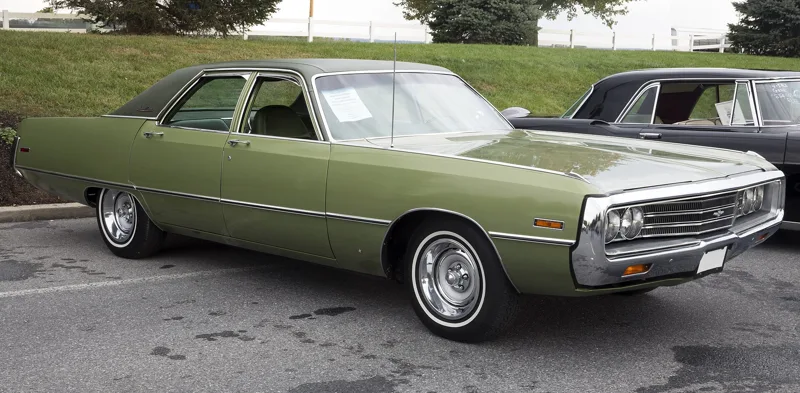
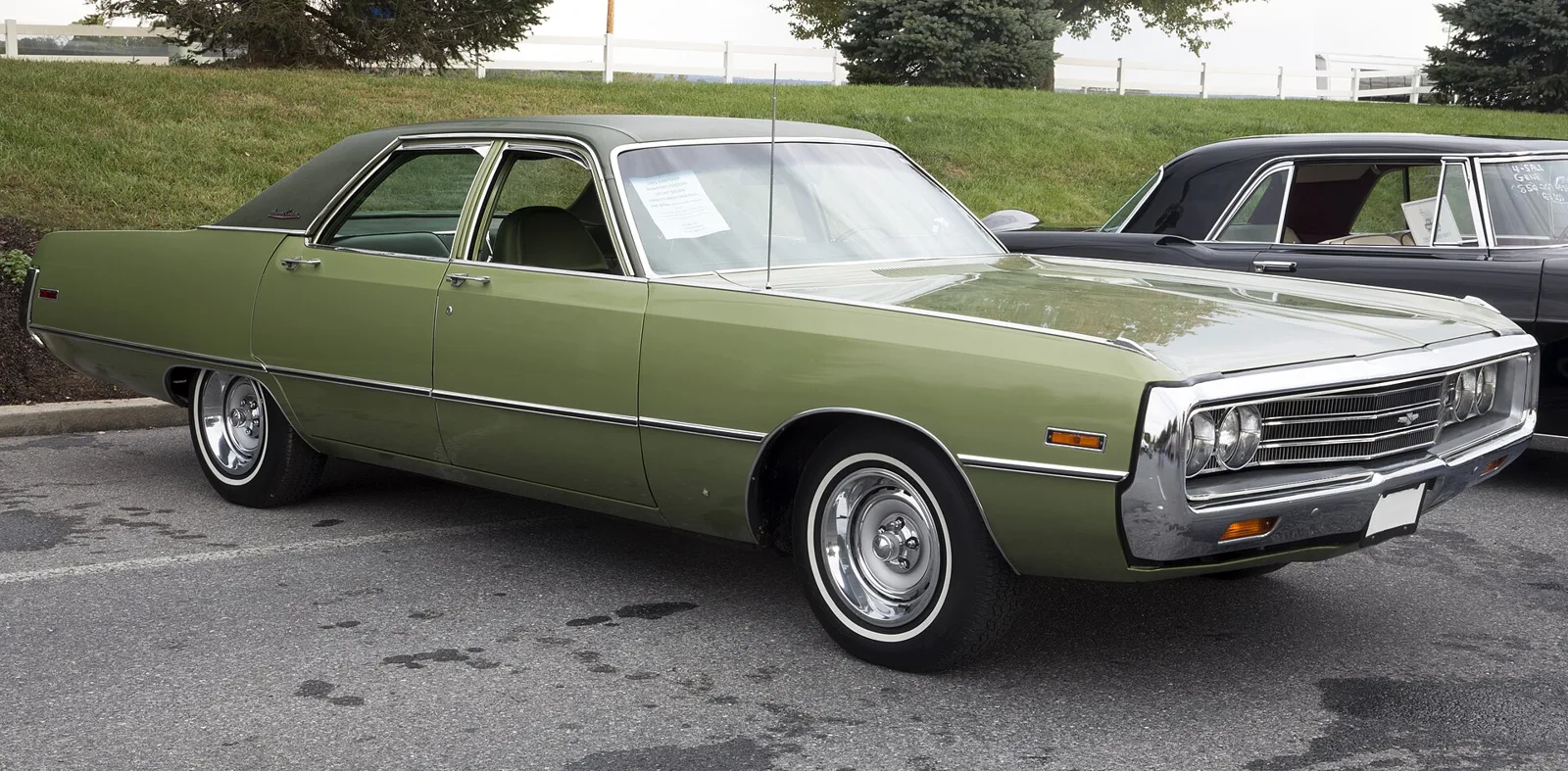
In 1974 and 1975 the New Yorker differed from the cheaper Newport mainly at the front and rear. The Newport and its Custom version used upright tail lamps. The New Yorker's C pillar sloped more steeply, and its tail lamps ran horizontally across the full width. The line-up included hardtop coupes and hardtop saloons without a continuous B pillar, plus a sedan with a centre pillar. The estate, sold as the Town & Country, looked outwardly like the Newport.
Spats, semicircular covers painted in body colour, enclosed the rear wheel openings as standard, which the Newport did not have. At the front, two exposed twin headlamps sat inside a chrome rectangle, with a chrome radiator grille in the middle.
What did the 1976 to 1978 Brougham change?
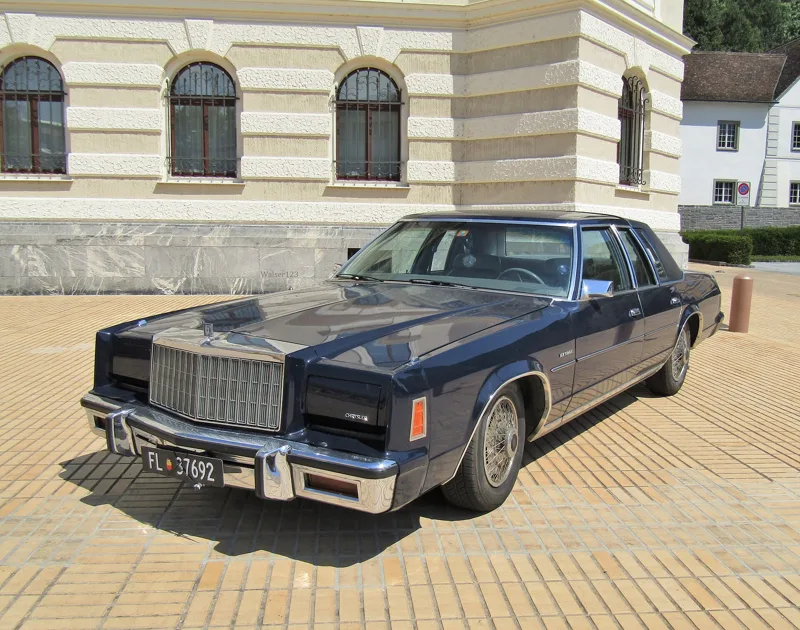
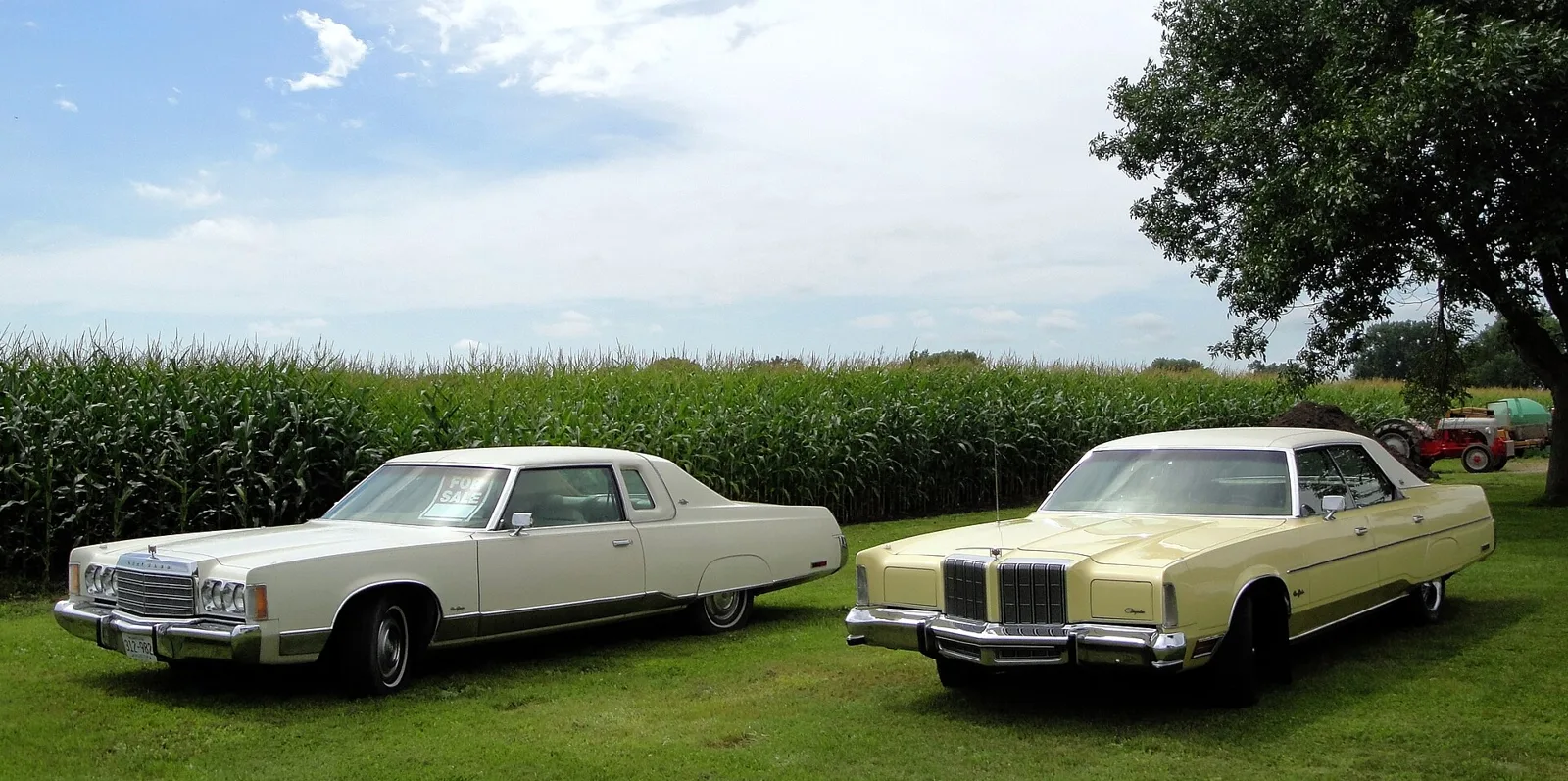
From the 1976 model year the New Yorker became a Brougham-only car, and the name moved around the group. The car previously known as the Imperial LeBaron became the New Yorker. The Imperial brand ended after the 1975 model year, which was one trigger for the changes. The old New Yorker became the Newport Custom, and the old Newport Custom became the plain Newport.
The new New Yorker had headlamps that retreated behind body-coloured flaps when not in use. Between them sat a zinc grille with a waterfall pattern, called the Waterfall Grill. At the rear there were upright, narrow tail lamps. Apart from rear disc brakes and anti-lock braking, the 1976 to 1978 cars were technically much like their immediate predecessors.
What was the St. Regis Option?
From 1974 to 1978 the two-door New Yorker coupe could be ordered with the St. Regis Option, a roof treatment that differed from the regular hardtop coupe. It had a fixed B pillar, and the vinyl covering ran over the front of the roof up to the rear side windows. The roof end at the C pillar was bare metal painted in body colour.
That reversed the usual landau roof, where the vinyl covered only the rear of the roof. The Imperial LeBaron offered a similar roof in 1974 and 1975, under the name Crown Coupe. The two-door cars were built at Chrysler, but their roofs were altered by the American Sunroof Corporation.
Which engines did the New Yorker use?
Every New Yorker of the period had an eight-cylinder V engine. Initially the 7,206 cc (440 cu in) big-block from the B series was the only choice, and it came in two power outputs. A 6,551 cc (400 cu in) variant arrived in 1975. It was an option only until 1976, then became the standard engine in 1977 and 1978.
As an option in the last model year, a 5,898 cc (360 cu in) small-block from Chrysler's LA family was available. Power outputs changed from year to year as emissions and consumption rules tightened.
How did lean-burn engines work and why did they fail?
A family of lean-burn engines, steered by computer-controlled ignition, arrived in 1976. The goal was lower fuel use, which would help meet fleet consumption limits. The system debuted on the 6.6-litre V8 and reached every eight-cylinder engine from 1977.
Against standard engines, lean burn cut fuel use noticeably. It failed often, though. A chief cause was the computer's poor heat protection, since it sat right beside the engine, and many Chrysler owners took the control system out after a brief period.
How were the chassis and transmission arranged?
The New Yorker's self-supporting body has a front subframe. The front wheels are individually suspended on torsion bars. At the rear there is a rigid axle with leaf springs. The engines sit lengthways at the front and drive the rear wheels. Every engine was paired with the same automatic, a three-speed TorqueFlite type.
Specifications
| Item | Detail |
|---|---|
| Layout | Front engine, rear-wheel drive, eight-cylinder V |
| Engine, first model year | 7,206 cc (440 cu in) big-block V8, two power outputs |
| Engine, from 1975 | 6,551 cc (400 cu in) V8, standard from 1977 |
| Engine, final model year option | 5,898 cc (360 cu in) small-block V8 |
| Transmission | Three-speed automatic, TorqueFlite type |
| Front suspension | Individual wheels, torsion bars |
| Rear suspension | Rigid axle with leaf springs |
| Brakes | Discs at the front, drums at the rear |
| Body | Self-supporting steel |
How did sales and production go?
The generation lasted five years, longer than any predecessor. Nearly 216,000 cars left the line, and 1977 was the strongest year, with over 76,000 built.
Production took place in Detroit, at the Jefferson Avenue Assembly, and at Belvidere, Illinois.
What came after the 1974 to 1978 cars?
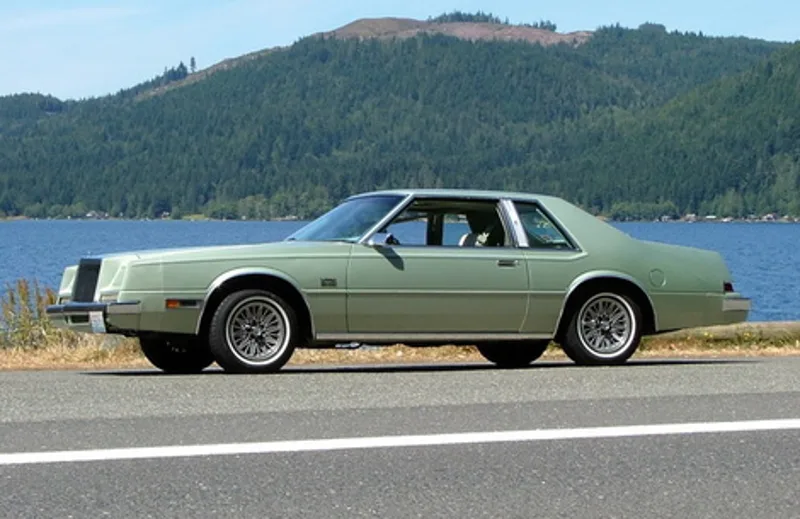
In 1979 Chrysler introduced a new New Yorker about 30 cm (11.8 in) shorter. It sat on the R platform, a reworked form of the B platform, which was 15 years old and had originally been designed for intermediate cars. The R-body New Yorker was intended only as a transitional model.
Under Lee Iacocca, Chrysler intended to shift its whole range to compact front-wheel-drive K-car models in the 1980s. That plan is why the R-body cars were a stopgap from the start.