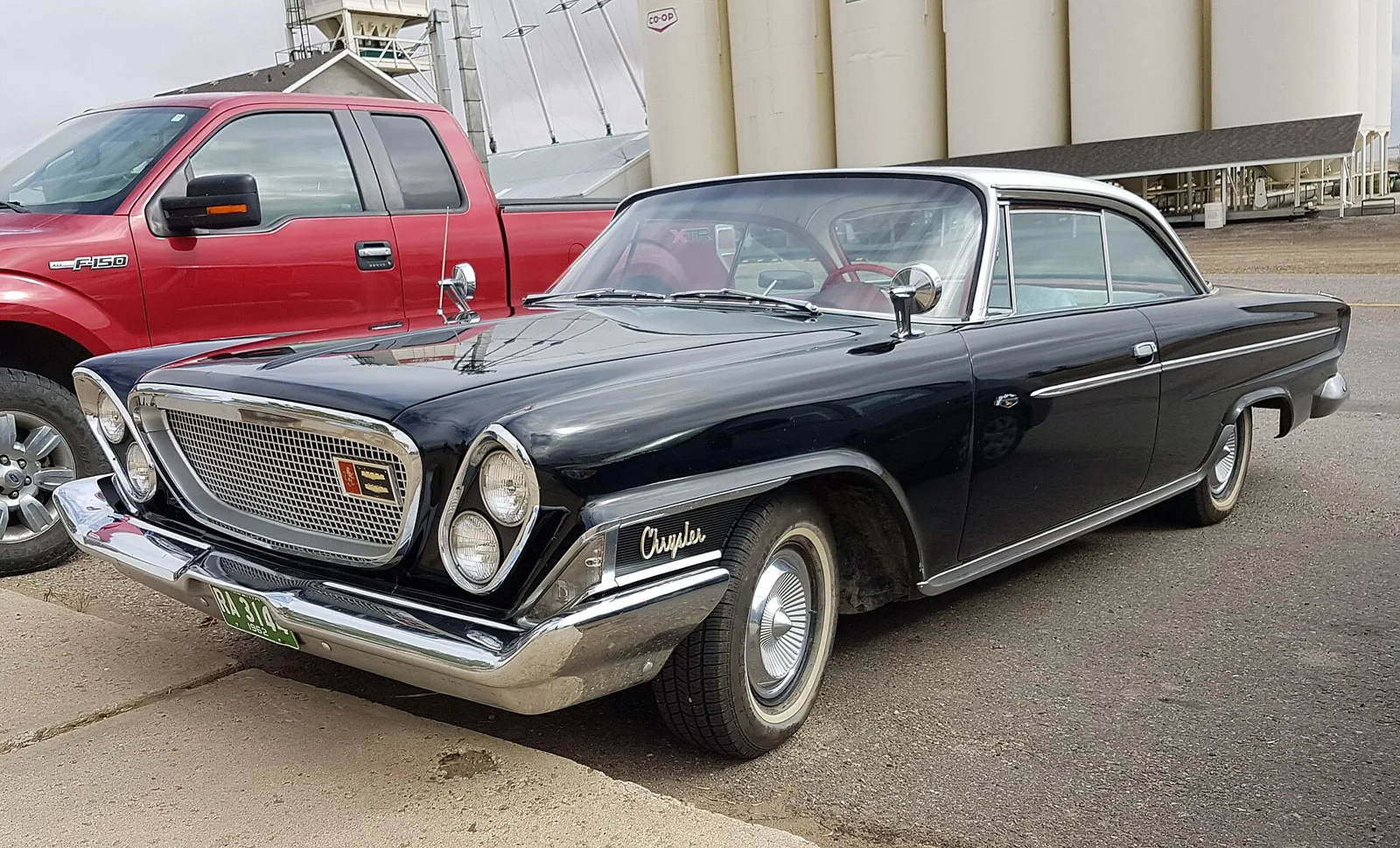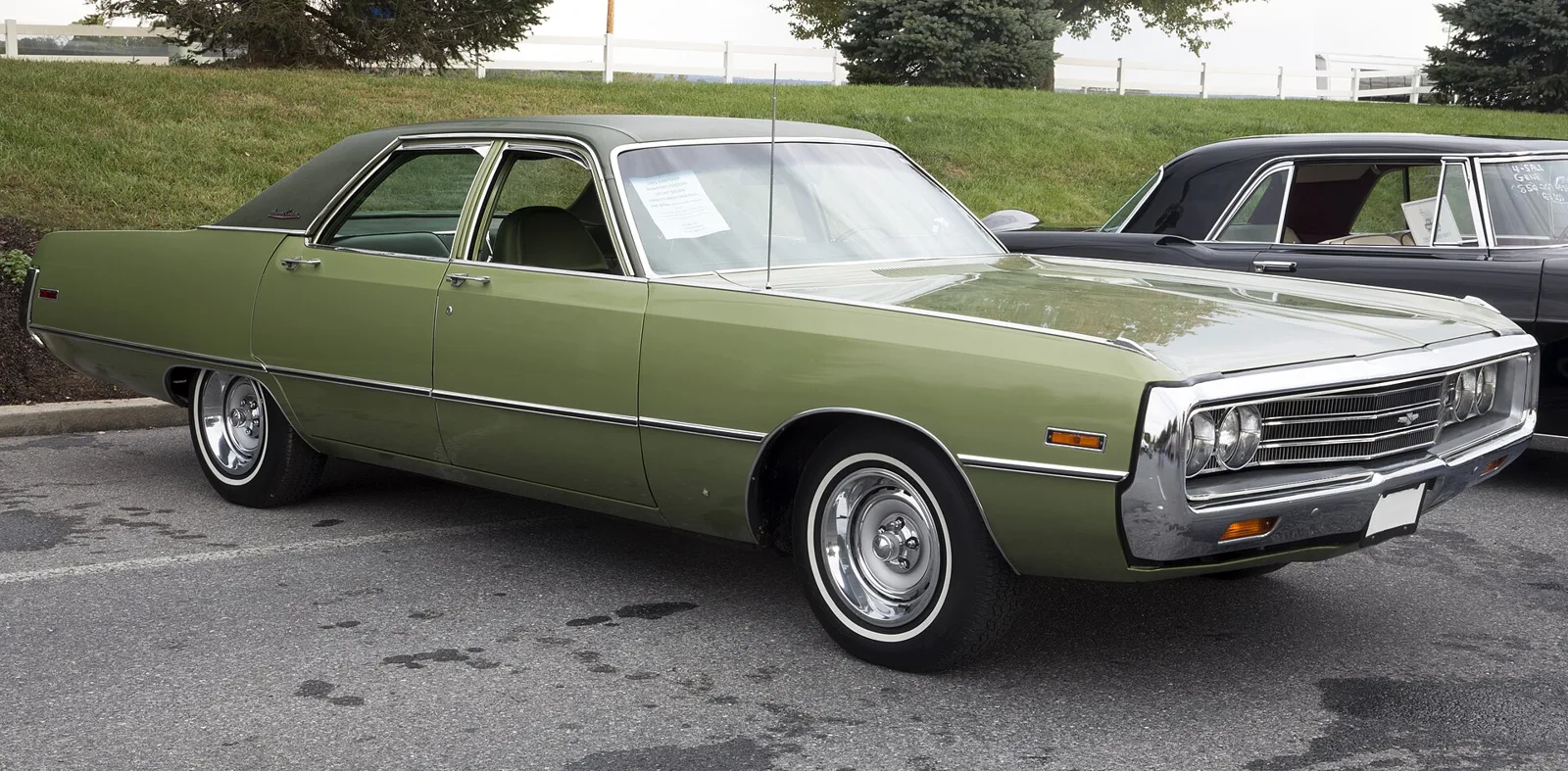
A full-size Chrysler built around Fuselage styling, with a 1973 nose redesign forced by new US safety rules and a 660,000-car run.
The 1969 to 1973 Chrysler Newport was a US full-size car in Fuselage styling, the third Newport generation. It used V8 engines only, cost from US$3,414 in 1969, and was built 661,157 times over five years, with a front redesign in 1973.
Chrysler's Newport of 1969 to 1973 was a full-size model from the American group, aimed mainly at buyers in North America. Counted as the third generation of the name, it wore Fuselage styling, a look built around a feeling of size and weight.
Over five years the car sold in large numbers. The company turned out 661,157 examples, and close relatives at Dodge, Plymouth and Imperial carried much the same underpinnings under their own badges.
Where did the Newport fit in Chrysler's line-up?
In the 1960s the Chrysler badge stood only for full-size cars. The Newport was regularly the cheapest choice, with the 300 and the New Yorker above it. All three were variations on one shared design, and the Newport acted as the entry point.
Dodge and Plymouth also sold compact and mid-size cars, which the Chrysler brand never did. In 1965 Chrysler introduced the C-platform for the full-size cars of its group brands, Imperial excepted, and the first generation of C-bodies ran until 1968.
The 1969 cars were the second C-body generation. Mechanically they barely changed, but the styling broke with the past. Elwood Engel's Fuselage concept, which the Newport adopted, stressed size and weight. The model stayed in production for five years and received small changes to its front and rear faces each year until 1972.
Legal requirements for 1973 forced a major rethink of the nose, and the next, fully redesigned Newport arrived in 1974.
Its bodies are styled in Fuselage design, a concept that stresses size and weight.
Who were the Newport's relatives?
The sister models were nearly identical under the skin and differed mainly in their styling. Chrysler's own relatives were the 300 and New Yorker, Dodge offered the Polara and Monaco, and Plymouth sold the Fury. Imperial's versions were the Crown and LeBaron series.
What made Fuselage styling distinctive?
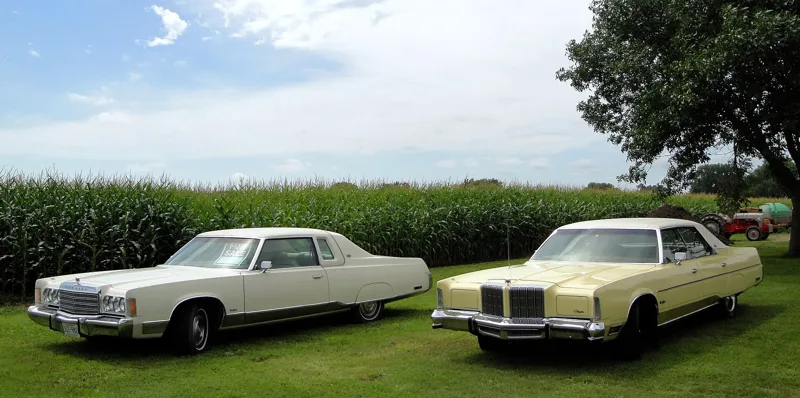
Fuselage styling used broad, gently bulging side panels, horizontal creases that drew the eye along the car, a high beltline and smaller windows. Steeply raked pillars made the cabin seem small, and the bumpers were built into the body at both ends.
Its bodies are styled in Fuselage design, a concept that stresses size and weight. At the front the bumpers ran around the whole nose in several variations, with the headlights and the radiator opening trim sitting inside them.
Rear wheel openings were cut down in height, and coupes had plastic spats partly covering them, which stretched the rear wings. On two-door cars a comparatively wide B-pillar made the cabin look smaller still.
What body styles were offered?
Chrysler offered four body versions in this generation. Two were four-door saloons, one with a continuous B-pillar and one a hardtop without it. The remaining two were a hardtop coupe and a convertible, both with two doors. Estates with six or nine seats were sold as the Town & Country.
- Sedan with four doors and a B-pillar running through
- Four-door hardtop sedan, no B-pillar
- Hardtop coupe with two doors
- Convertible, offered only in 1969 and 1970
Which engines went into the Newport?
Every Newport had a V8. The base engine for 1969 and 1970 was the 6,276 cc (383 cu in) B-series unit. The middle choice from 1971 was the 6,551 cc (400 cu in) B-series variant, and the top engines were the RB-series big blocks, measuring 7,206 cc (440 cu in).
In late 1970 Chrysler ended the 6,276 cc unit, and a 5,898 cc (360 cu in) small block from the LA series took its place for two years. The 5.9-litre small block then served as the base engine in the plain Newport and the Royal, in a range that also included 6.6-litre and 7.2-litre V8s.
For 1972 power was quoted as net rather than gross figures. Net figures are nominally lower, though the change did not bring any real loss of performance.
A three-speed manual was the standard gearbox, and the TorqueFlite automatic was optional at extra cost. The body had a subframe at the front, while the front wheels were independently suspended on torsion bars and the rear used a rigid axle on leaf springs.
What were the Newport's key specifications?
| Feature | Detail |
|---|---|
| Body | Unitary construction, pressed steel |
| Front suspension | Independent, with torsion-bar springs |
| Rear suspension | Rigid axle on leaf springs |
| Brakes | Discs at the front, drums at the rear |
| Entry engine | 6,276 cc (383 cu in) V8, 1969 and 1970 |
| Middle engine | 6,551 cc (400 cu in) from 1971 |
| Largest engine | 440 cu in (7,206 cc) big block in every year |
| Gearbox | Three-speed manual standard; TorqueFlite automatic optional |
| Power figures | Gross until 1971, net from 1972 |
How much did a Newport cost?
In 1969 the cheapest Newport was the sedan at US$3,414, and the convertible was the priciest at US$3,823. By 1971 the Royal sedan started at US$4,078, and the Custom hardtop sedan reached US$4,471.
The Custom was the best equipped and dearest version in every model year. Prices rose by about US$100 for 1970, about US$400 for 1971 and about US$120 for 1973, while 1972 prices were reduced slightly. In 1971 the Royal sat about US$100 under the plain Newport and US$200 under the Custom, and the Custom was roughly US$600 cheaper than the New Yorker.
How did each model year differ?
The plain Newport was the base model in 1969, 1970 and 1973. In 1971 and 1972 the Royal took that role, and in 1972 there was no plain Newport at all. 1969 cars wore round twin headlights and horizontal tail lights above the bumper, with a row of vertical struts across the light band. In 1970 the rear bumper became taller and wrapped around the tail lights, while the side marker lights moved higher in the wings. Styling otherwise changed little.
For 1971 the Royal became the new base model, the plain Newport moved into the middle, and the Custom topped the line. The convertible disappeared, output stayed close to 1970 levels, and the tail lights grew bigger and gained vertical struts again. In 1972 the grille was replaced by a centre-split mask with six rectangular boxes on each side, and the tail lights became narrow vertical units angled inwards.
Why was the 1973 nose redesigned?
New US rules from 1973 required front safety bumpers that would prevent body damage in impacts of up to five miles per hour. Chrysler could not integrate them into the chrome strips, so the Newport's nose was redrawn. The change also answered soaring insurance premiums linked to bodywork claims.
The new nose used a rectangular radiator grille that stood proud of the bonnet's front edge. Each headlight sat in a square housing, and the bumper hung beneath both grille and lights. Otherwise the body was unchanged, and the Royal disappeared for the year.
Buyers responded to the new look. Output passed 152,000 in the 1973 model year, a level not seen since 1969.
How many Newports were made, and where?
Output for 1969 stood at 155,876 Newports and Newport Customs, 2,196 of them convertibles. Output fell by about a third in 1970, to 110,292 vehicles, and the five-year total reached 661,157.
Two plants built the cars: Jefferson Avenue Assembly in Detroit, Michigan, and a works in Belvidere, Illinois, known as the Belvidere Assembly Plant. The 1970 convertible count of 1,124 again made it the rarest version.
What special versions did Chrysler sell?
The Newport Cordoba was a special series that Chrysler launched in spring 1970 to boost Newport sales before the model year ended. It came as a two-door hardtop coupe or sedan in gold metallic, with a pseudo-Aztec vinyl roof that Chrysler called the Espanol Roof.
By summer 1970 buyers had taken 1,868 hardtop coupes and 1,873 hardtop sedans from the Cordoba line. The name returned in 1975 on a new personal luxury coupe in the intermediate segment.
Two smaller packages also existed. The 1969 Sports Grain added wood-look film to the flanks of plain Newports, in low three-digit numbers. The 1973 Navajo Special Edition brought copper paint, a white vinyl roof and seat fabrics in a pseudo-indigenous style, offered on the coupe, hardtop sedan and four-door sedan.