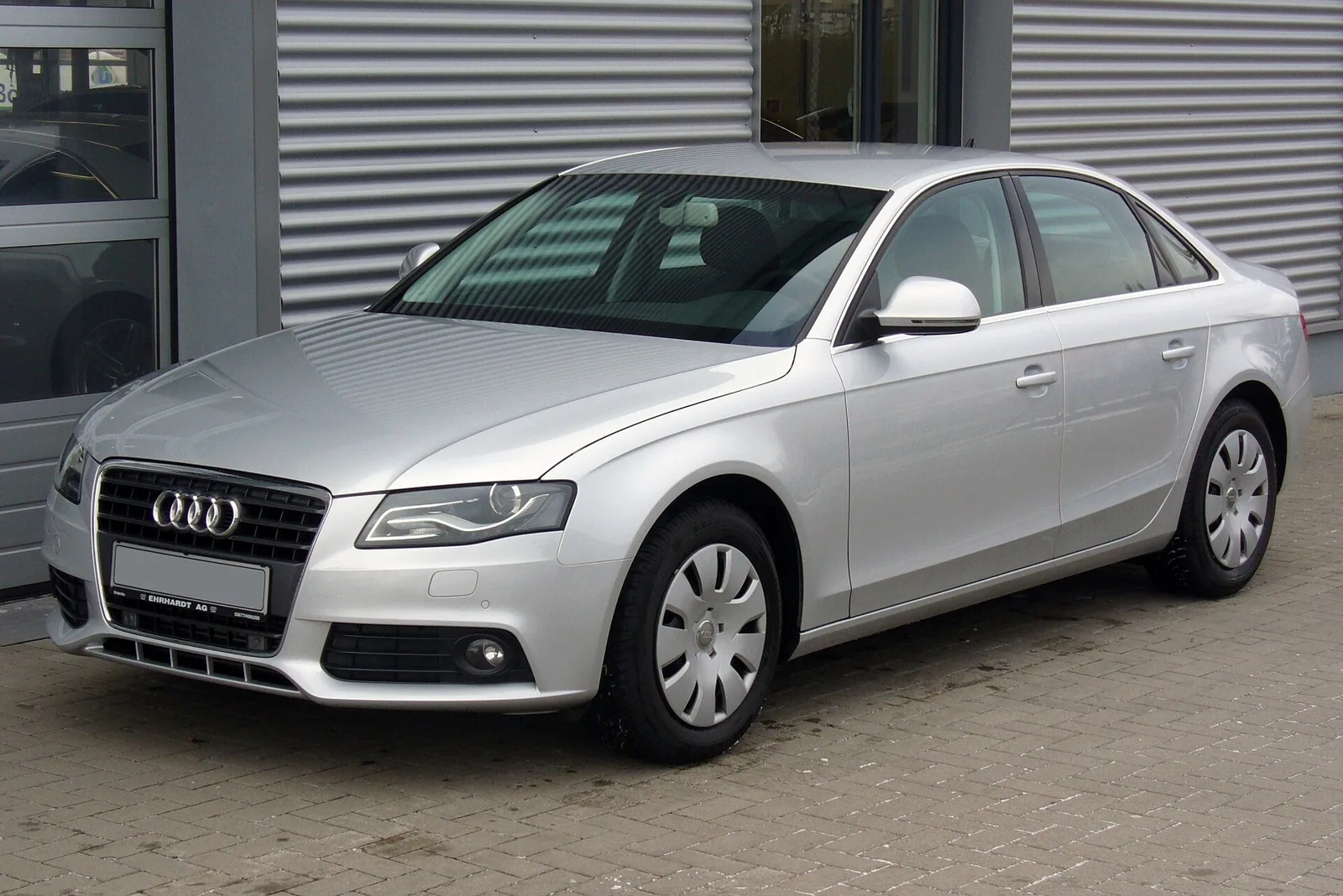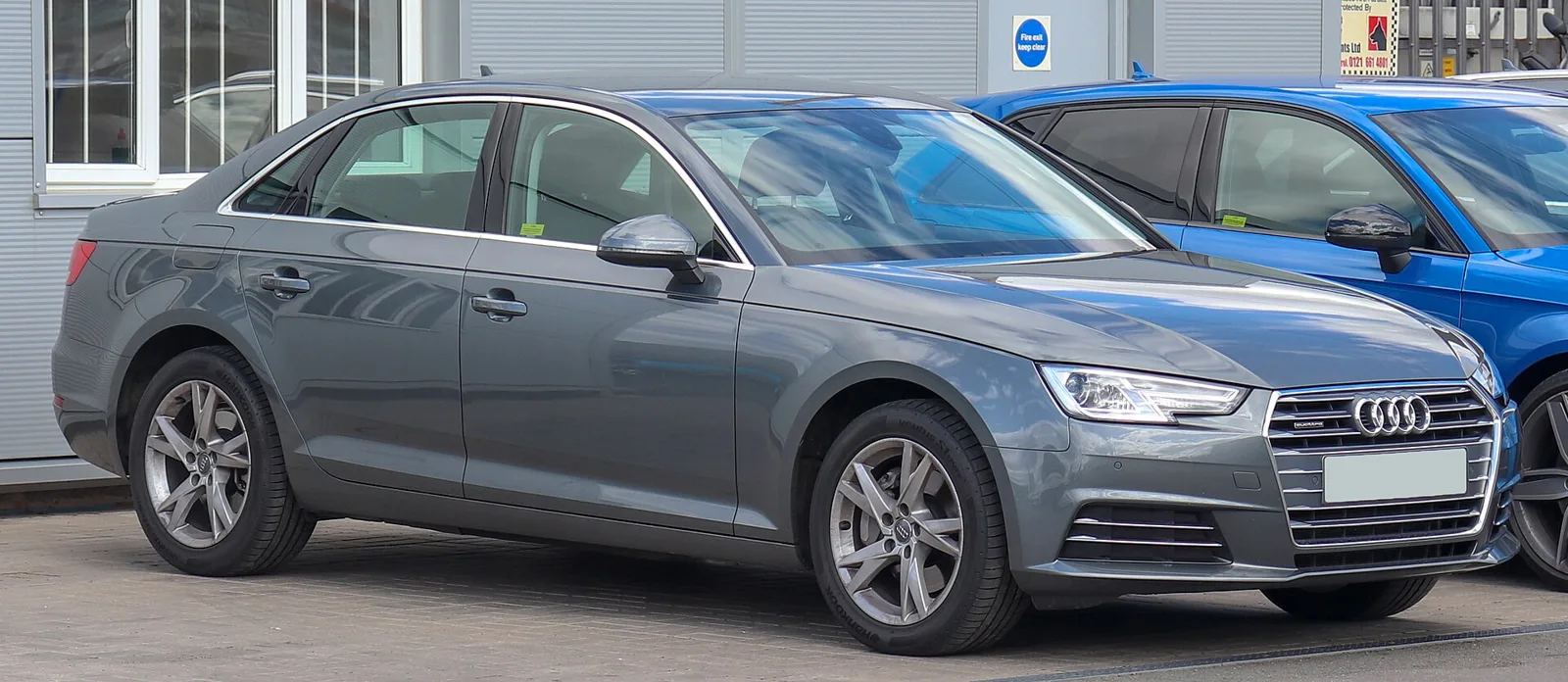
A saloon and Avant launched together, a new MLB Evo platform, a 1.4-litre turbo, a Golden Steering Wheel and a long run to 2024.
Launched in 2015 as the fifth A4 generation, the B9 used the Volkswagen Group's MLB Evo platform. Its engines ran from a 1.4-litre turbo up to a 3.0-litre V6 diesel, and production ran to July 2024, the month the A5 B10 successor was presented.
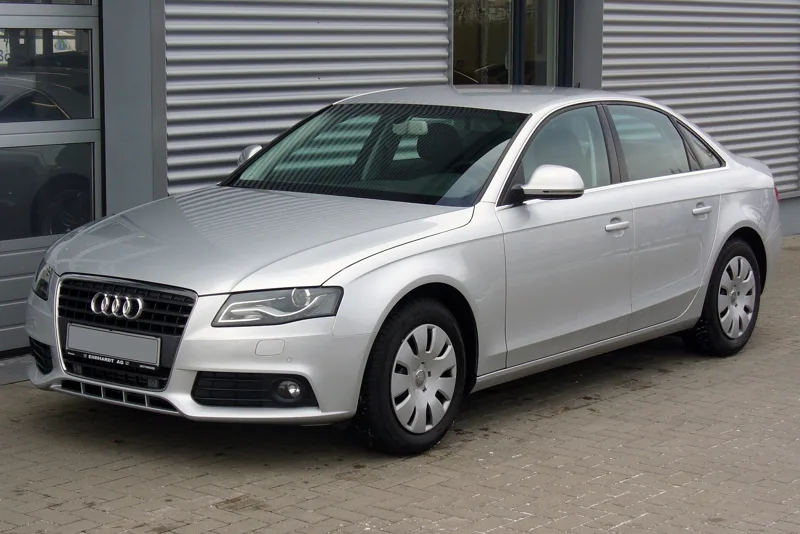
Internally coded 8W, the Audi A4 B9 was the fifth generation of Audi's mid-size A4. It was launched online at the end of June 2015 shown at the September motor show that year, and won the Golden Steering Wheel in its class the same year. For the first time in the nameplate's history, the saloon and the Avant estate arrived together.
When did the Audi A4 B9 go on sale?
The online debut came in late June 2015, and the public premiere followed at that September's International Motor Show. The first cars were delivered in October 2015, and it was the first A4 to appear with both bodies at launch.
The Golden Steering Wheel, which the car took in the mid-size class that same year, was an early mark of approval.
Saloon and estate arrived together, and the cabin borrowed from the Q7.
What platform does the B9 use?
The B9 rests on the MLB Evo platform, a further-developed modular longitudinal layout used across the Volkswagen Group. The same architecture underpins the second-generation Audi Q7, which had gone on sale in June 2015, so the two cars share a basic structure.
Production was split between two sites. Ingolstadt turned out the saloon, Avant and S models, whereas Neckarsulm built just the saloon. In the vehicle identification number the B9 carries the range code F4.
How was the B9 styled?
The fifth-generation car gained a lower, wider single-frame grille set into a revised front bumper. The side line begins at the bonnet and extends to the outer wing edge. Seen in profile, the B9 looks much like its predecessor, except that its door mirrors sit on the door shoulder.
The rear ends with narrow tail lamps, and separate reflectors sit low in the outer corners of the rear bumper. The most significant visual change was inside, where the cabin followed the layout of the second-generation Q7.
What changed in the cabin?
Depending on the trim, a freestanding but fixed colour screen of 7 or 8.3 inches sat on the dashboard. It showed navigation and infotainment data at 800 by 480 pixels or 1,024 by 480 pixels. The dashboard controls ran horizontally, with the climate panel directly beneath the air vents and a further row of switches below it for the main vehicle functions.
The interface was the newest generation of Audi's MMI system. It had fewer buttons, a reworked menu structure and eight quick-select keys that could be assigned freely. Some models added joystick and touchpad functions to the rotary-push dial. Where the MMI terminal sat depended on the gearbox: an automatic car put it in front of the selector, and a manual car put it behind the gear lever.
Where buyers chose the optional virtual cockpit, a 12.3-inch LCD at 1,440 x 540 pixels took the place of the analogue dials. It showed engine speed, road speed and other vehicle data, plus media and navigation information. For the first time in the A4, the colour of the LED interior lighting could be changed as a special extra.
What trim levels were offered?
Three new base trims came with the launch. The entry A4 came with 16-inch aluminium wheels and a multifunction wheel. The sporty A4 sport added a leather multifunction wheel, sport seats, the gloss package and 17-inch alloys. The A4 design went further, with a leather wheel, 17-inch wheels, a centre console covered in artificial leather and the light and gloss package.
On the sport and design trims, chrome-look trim adorned the air intake slats, the radiator grille surround and the rear diffuser insert. Keyless start and a speed limiter were standard on every model. Xenon lights and LED daytime running lamps also came as standard, and halogen headlamps were dropped. LED or Matrix LED headlamps were optional, and the Matrix units kept high beam glare-free by varying how the light is spread.
How much lighter was the B9?
Hot-formed steel and aluminium parts were used more widely. The manufacturer said this cut the Avant's weight by up to 120 kg (265 lb) against its predecessor, and the five-link front axle was reworked to become 6 kg (13 lb) lighter. The rear trapezoidal-link axle was replaced by a five-link unit that was 5 kg (11 lb) lighter, and the new electromechanical steering came in 3.5 kg (7.7 lb) lighter than the old system.
Aerodynamics were measured too, with a drag coefficient of 0.23 on the saloon and 0.26 on the Avant.
Which petrol engines did the A4 B9 offer?
The petrol line-up opened with a turbo of 1.4 litres (85 cu in), a size the A4 had never offered before. Its four-cylinder used direct injection to produce 110 kW (150 PS; 148 hp), and the maker claimed consumption up to 21 per cent lower than the predecessor's 1.8-litre turbo, rated 125 kW (170 PS; 168 hp).
The 2.0-litre turbo produced 140 kW (190 PS; 187 hp) and, in higher tune, 185 kW (252 PS; 249 hp). Its compression ratio went up from 9.7:1 in the predecessor to 11.7:1, a move meant to cut consumption. A natural gas version of the 2.0-litre, rated 125 kW (170 PS; 168 hp), arrived in August 2017 on the A4 Avant g-tron. The manufacturer put its gas range at 500 km (311 miles), with the 25-litre (5.5 gal imp) petrol tank adding another 450 km (280 miles).
What diesel engines were on offer?
The 2.0-litre four-cylinder diesel offered 110 kW (150 PS; 148 hp) or 140 kW (190 PS; 187 hp). It met Euro 6 through an SCR catalytic converter using AdBlue. The AdBlue tank held 12 litres, against 20.5 litres in the predecessor, and a 24-litre tank was available for an extra charge.
A further 2.0-litre TDI, rated 90 kW (122 PS; 120 hp), followed in 2016. The revised V6 diesel of 3.0 litres debuted at 200 kW (272 PS; 268 hp) with quattro all-wheel drive. A front-drive 160 kW (218 PS; 215 hp) version appeared at the market launch in October 2015, and a quattro version of it followed later. The V6 diesels also carried an NOx storage catalytic converter, an SCR particulate filter and an electrically adjustable turbocharger.
| Engine | Output | Notes |
|---|---|---|
| 1.4-litre (85 cu in) turbo petrol | 110 kW (150 PS; 148 hp) | Direct injection |
| 2.0-litre turbo petrol | 140 kW (190 PS; 187 hp) and 185 kW (252 PS; 249 hp) | Compression 11.7:1 |
| 2.0-litre CNG turbo | 125 kW (170 PS; 168 hp) | From the A4 Avant g-tron, August 2017 |
| 2.0-litre diesel | 110 kW (150 PS; 148 hp) and 140 kW (190 PS; 187 hp) | Euro 6 with SCR and AdBlue |
| 2.0-litre TDI | 90 kW (122 PS; 120 hp) | Added in 2016 |
| 3.0-litre V6 TDI | 200 kW (272 PS; 268 hp), quattro | Electrically adjustable turbocharger |
| 3.0-litre V6 TDI, front drive | 160 kW (218 PS; 215 hp) | Market launch, October 2015 |
Which gearboxes came with the B9?
The continuously variable Multitronic automatic was dropped with this generation. At launch almost every engine except the 200 kW V6 diesel came with the S tronic, a seven-speed dual-clutch unit. A six-speed manual was also offered, and its magnesium housing was 16 kg (35 lb) lighter than the old one.
The 200 kW V6 TDI was fitted as standard with a freshly developed eight-speed tiptronic, a torque converter automatic.
How much fuel could the car carry?
On the front-drive four-cylinder diesels the tank shrank to 40 litres, about 20 litres less than before. A 54-litre tank could be ordered for these engines, and it was standard on the front-drive petrols and on the 160 kW V6 TDI. Cars with all-wheel drive carried 58 litres.
In the A4 Avant g-tron the four carbon-fibre natural gas tanks held 19 kg (42 lb) of gas in total, and petrol operation used a 25-litre tank. Apart from the stronger 2.0 TFSI and the gas version, all front-drive four-cylinder engines could also be ordered as 'ultra' models, which Audi said used less fuel through a more slippery body, revised gearbox settings, low-rolling-resistance tyres and a limited top speed.
How did quattro work on the B9?
Quattro with ultra technology became available in early 2017 on the 2.0 TFSI at 185 kW and on the 2.0 TDI in its 110 or 140 kW forms, with a six-speed manual. It had first appeared in the A4 allroad quattro in 2016. Where the old system ran all-wheel drive permanently through a Torsen or crown-wheel centre differential, a claw clutch at the rear axle now disconnects the propeller shaft so it stops turning.
When the rear wheels are needed, electronics close a multi-plate clutch and engage the claw once the propeller shaft reaches the right speed. Audi said the system raised efficiency and saved fuel.
How safe was the A4 B9?
Euro NCAP, which tested the car in 2015, gave the A4 the maximum five stars. Adult occupants scored 90 per cent, child safety 87 per cent, and pedestrian protection 75 per cent.
The Pre Sense City emergency brake assist was standard on the B9. Working through a camera, it can apply full braking by itself up to 40 km/h (25 mph) if a crash looks likely. A brake warning, plus an impact-softening braking intervention, works up to 85 km/h (53 mph).
What driver assistance did the B9 launch with?
On automatic cars the adaptive cruise control covers 0 to 250 km/h (155 mph), while the manual car starts from 30 km/h (19 mph). With an automatic, the system could stop and restart the car by itself using the stop-start function. Its traffic jam assistant took over steering, braking and acceleration in slow-moving queues.
A predictive efficiency assistant used navigation data and traffic sign recognition, and Audi said it could cut fuel use on country roads by up to 10 per cent. Side assist and active lane assist added evasion, turning, cross-traffic and exit warnings. Head-up display, traffic sign recognition and self-steering parking assistance were offered on the A4 for the first time.
What changed when the A4 was updated in 2018?
At the end of June 2018 Audi presented an update that changed the front and rear bumpers. The round exhaust pipes at the back gave way to trapezoid trim pieces in the bumper, and the look of the front vents and the rear chrome strip was revised on the sport and design trims. Engine names dropped their capacity figures and used a number instead.
The equipment list changed little. The new items were an optional Audi connect key, which could lock and unlock the car with an NFC-capable Android phone, and Audi Matrix LED headlamps. Every engine met Euro 6d-TEMP and was certified under the WLTP cycle, which had become mandatory for new models from 1 September 2018. The 1.4-litre TFSI was replaced by a 2-litre TFSI, and the petrol engines gained particulate filters.
Deliveries of the updated car began at the end of October 2018. Launch engines were a pair of 2-litre petrol units and a pair of diesels. Problems with WLTP approval forced the factory holiday at the A4 and A5 lines to be extended by two weeks that summer.
What was the 2019 facelift?
The main facelift came in May 2019. Front and rear bumpers changed again, along with the headlamp and tail lamp designs. The side line was redrawn, and between the bonnet and the grille a suggested open gap was added, which Audi said recalled the Audi Sport quattro of the 1980s. LED headlamps and tail lamps became standard, with dynamic indicators or Matrix LED optional.
The facelifted range offered three 2-litre TFSI petrol fours at 110 kW (150 PS; 148 hp), 140 kW (190 PS; 187 hp) and 180 kW (245 PS; 242 hp). The diesels were four 2-litre TDI fours from 100 to 140 kW (136 to 190 PS; 134 to 187 hp), plus a 3-litre V6 TDI at 170 kW (231 PS; 228 hp) with all-wheel drive. The g-tron petrol tank shrank from 25 litres to 7 litres.
What was the S4 TDI?
The S4 TDI, with a 3-litre V6 diesel, was the range's top S model and was presented for European buyers in May 2019. Its unit delivers 255 kW (347 PS; 342 hp) and 700 Nm (516 lb ft) of torque. A 48-volt electrical system drives a compressor electrically. Other markets kept the 3-litre V6 TFSI petrol at 260 kW (354 PS; 349 hp), which had been available the year before.
Most engines use a mild hybrid: a belt-driven starter generator paired with a lithium-ion battery on a 12-volt network. It supports coasting on automatic gearboxes and the start-stop function. The S4 TDI and the 50 TDI and 45 TDI models did not use that setup.
What changed on the infotainment screen?
After the facelift, a 10.1-inch touchscreen with 1,520 x 720 pixels became standard and replaced the dashboard TFT screen. Because the screen was touch-operated, the rotary-push dial in the centre console disappeared. The 12.3-inch virtual cockpit climbed to 1,920 x 720 pixels, and the system switched to the third generation of Audi's modular infotainment kit, MIB3.
With the paid Audi connect package, MIB3 supported up to six driver profiles, and online services could supply traffic signs, hazards, traffic lights and parking details. Features could also be tested or rented through a subscription, or unlocked for good. Audi's 'functions on demand' then covered the standard MMI Radio plus, DAB+ reception and the Audi smartphone interface.
When was the A4 B9 built?
The A4 saloon and estate were built from August 2015 to July 2024. The S4 saloon and estate ran from November 2016 to June 2018, and again from May 2019 to February 2023. The RS4 estate was made from December 2017 to June 2018, and again from February 2019 to July 2024.
The successor arrived in July 2024 under the Audi A5 B10 label, a name that reflected the plan to give electric models even numbers.