How a transparent display that keeps the eyes forward grew from 1940s radar trials into airliner cockpits, production cars and helmet visors for tank crews.
A head-up display projects symbols onto a transparent combiner so the viewer can read them without looking down. Developed for wartime fighters and night interceptors, the technology now reaches airliners, production cars and motorcycle helmets, with collimated symbols that appear to sit at infinity.
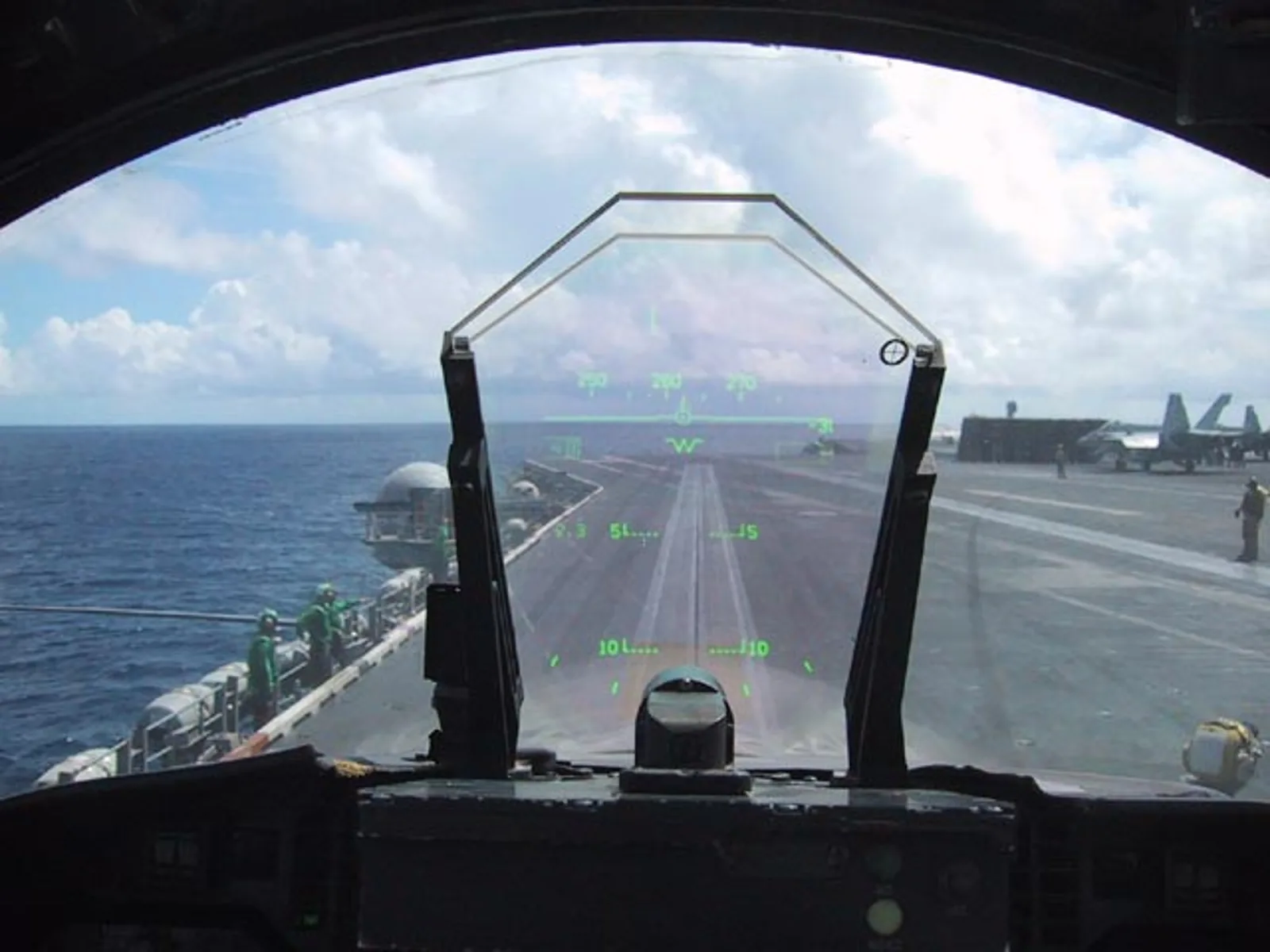
A head-up display, or HUD, is any transparent display that presents data without making the user look away from their normal viewpoint. The name comes from pilots who could keep their heads up and looking forward instead of angling down at the instruments. HUDs were developed for military aviation and now appear in airliners, production cars and motorcycle helmets.
What is a head-up display?
A head-up display is a transparent screen that overlays information on the view ahead. Because the pilot or driver keeps looking at the outside world, the eyes do not need to refocus between the instruments and the scene. HUDs are generally treated as a precursor to augmented reality, although they lack the precise tracking between virtual content and the real environment that full AR needs.
Most HUDs are fixed in place, while head-mounted displays move with the wearer's head. Helmet-mounted displays are a common form of the second type, and many modern fighters use a HUD and an HMD at the same time. The F-35 Lightning II was designed without a fixed HUD, relying solely on a helmet display, which made it the first modern fighter without one.
A transparent display that keeps the eyes forward, first built to help night fighter pilots and now projected onto airliners, cars and tank crews.
How does a HUD work?
A typical HUD has three main parts: a projector unit, a combiner and a video generation computer. The projector is an optical collimator: a lens or mirror with a display placed at its focal point, such as a small cathode-ray tube, an LED panel or an LCD screen. The design dates back to the reflector sight of 1900 and makes the image appear to sit at infinity.
The combiner is typically an angled flat sheet of glass that acts as a beam splitter. It reflects the projected image toward the viewer while letting the view ahead pass through. Some combiners carry coatings that reflect only the monochrome light from the projector, and some are curved to refocus the image. The computer takes data from aircraft or vehicle systems and generates the symbols shown by the projector.
Why does collimation matter so much?
Collimation makes the light rays parallel, so the eye focuses on infinity and the symbols appear to lie over the outside world. That lets the pilot read the display without refocusing, which saves precious seconds in the final stages of landing. Collimation is what separates high-performance HUDs from simple reflections on a car windscreen, which force drivers to refocus.
The projected light also forms a three-dimensional region called the eyebox. Modern aircraft eyeboxes are usually about 13x8x15 cm (5 by 3 by 6 inches). The pilot can see the whole display as long as one eye sits inside that box, though moving too far up, down or sideways makes the display vanish off the edge of the optics.
Accuracy matters as well. Aircraft HUD components are aligned with the aircraft's three axes in a process called boresighting, typically to within plus or minus 7.0 milliradians (24 minutes of arc). The display is scaled to a 1:1 relationship with the outside world, so a runway 3 degrees below the horizon must sit at the matching point on the HUD.
Where did the head-up display come from?
HUDs grew out of the reflector sight, a parallax-free optical sight developed for fighter aircraft before the Second World War. The gyro gunsight added a reticle that moved with speed and turn rate to show the lead needed to hit a manoeuvring target. The next step came from night fighting in Britain.
Royal Air Force night fighter pilots struggled to act on radar operators' instructions because they had to look away from their own displays into the dark sky. In October 1942 the Telecommunications Research Establishment managed to combine the radar image with a projection from a gyro gunsight on the windscreen. A later move to the AI Mk. VIII radar, found on the de Havilland Mosquito, produced an artificial horizon that eased head-up flying.
The Royal Navy then carried HUD work into the jet age. The Buccaneer prototype first flew on 30 April 1958, and the aircraft was designed to fly very low and fast while dropping bombs in engagements lasting seconds. Its Strike Sight combined altitude, airspeed and bombing information, and the Royal Aircraft Establishment's work on it may be the earliest use of the term head-up display. Production units were built by Rank Cintel, and 375 systems were made in all, the Mark III being the last version.
| Year | Milestone |
|---|---|
| 1900 | Reflector sight design that later underpins the HUD projector |
| October 1942 | Radar image combined with a gunsight projection on a windscreen |
| 1955 | US Navy research mockup with a sidestick controller |
| 30 April 1958 | Buccaneer prototype first flies with the Royal Navy HUD |
| 1959 | AIRPASS HUD fitted to the English Electric Lightning |
| 1975 | Modern HUD for instrument approaches to landing developed |
| 1988 | Oldsmobile Cutlass Supreme becomes the first production car with a HUD |
| 1999 | General Motors develops the first in-car HUD |
| 2012 | Pioneer introduces an AR-HUD using laser beam scanning |
Which aircraft use head-up displays?
In the 1960s Gilbert Klopfstein, a French test pilot, produced the first modern HUD along with a common symbol set, so pilots could switch aircraft without relearning the display. His work aimed to bring critical flight data into the centre of the pilot's view and reduce task saturation. Commercial aviation took up the technology in the 1970s.
The Embraer 190, Saab 2000 and several Boeing 737 and 727 variants were once the only passenger aircraft with HUDs. The technology is now spreading to the Canadair RJ, the Airbus A318 and various business jets, and HUDs are standard on the Boeing 787. The HUD also appeared on the Space Shuttle orbiter.
Aircraft HUDs run on dual, independent, redundant computers that read sensors directly and do their own calculations. On some types, the low-visibility take-off and approach guidance is produced by the flight guidance computer that also flies the autopilot. Connections run over data buses such as ARINC 429, ARINC 629 and MIL-STD-1553.
Boresighting is carried out when the aircraft is built, and on many aircraft it can also be repeated in the field. Compatibility is another design factor, because HUD components are built to work with other avionics and displays, so the symbols and sensor data arrive in a form the rest of the cockpit understands.
What data appears on a HUD?
Typical aircraft HUDs show airspeed, altitude, a horizon line, heading and turn, bank, slip and skid indicators. Those are the minimum instruments required by the US federal aviation rules for Part 91 operations. Other symbols depend on the installation, and many add the boresight symbol, which shows where the nose points.
The flight path vector shows where the aircraft is actually going, which can differ from where it points during high angle-of-attack flight or descent through sinking air. During approach and landing, the pilot can keep the flight path vector at the desired descent angle and touchdown point. An acceleration indicator sits beside it, above the vector when accelerating and below when slowing, and an angle-of-attack indicator shows the wing's angle to the airflow.
Military HUDs add weapons and sensor data, such as a target designation cue over a radar or inertial target, closing velocity, range to target or waypoint, the line of sight of a seeker and the status of selected weapons. Navigation cues based on instrument landing systems or augmented satellite positioning appear as a circle inside the flight path vector, and pilots fly along the path by flying to that guidance cue.
What are enhanced and synthetic vision HUDs?
More advanced systems overlay a real-world picture on the combiner. An infrared camera, often mounted in the nose, supplies an image that must line up with the view through the glass, a matching step called registration. Authorities check registration closely, because a misaligned image would mislead the crew. The US Federal Aviation Administration has relaxed operating rules for aircraft with enhanced vision, but only up to certain approach minimums, and unaided visibility limits still apply.
Synthetic vision systems use precise navigation, attitude and terrain databases to draw the outside world, typically in monochrome green on a HUD. Some can colour obstacles red after predicting the flight path. A purple tunnel symbol can show the optimum three-dimensional path for an approach, which helps with the tighter clearances needed for required navigation performance. A system like this might have helped avoid the American Airlines Flight 965 accident, in which an aircraft struck a mountain in December 1995.
Can a HUD be used in a car?
Automotive HUDs are increasingly common, usually showing speed, engine speed and navigation. Some show night-vision information. Unlike aircraft HUDs, car displays are not parallax-free, and some may be hard to see through polarised sunglasses. Add-on units project onto a combiner mounted above or below the windscreen, or use the windscreen itself.
General Motors developed the first in-car HUD in 1999 to show navigation directions in the driver's line of sight. In 2012 Pioneer introduced an AR-HUD that replaces the driver-side sun visor and overlays animations of conditions ahead. It used a direct-to-eye laser beam scanning method developed with MicroVision, which is also known as a virtual retinal display in that form. Motorcycle helmet HUDs are sold as well, and holographic systems from WayRay promise a wider field of view in a smaller package.
How are HUDs used in military and other settings?
Israel's Elbit planned trials of a helmet-mounted HUD for tanks in 2017, under the name Iron Vision. Cameras around the tank would project a 360-degree view onto the crew's visors, so they could see outside without opening the hatches. Elbit had already developed the helmet display for the F-35, and the same principle applied to ground vehicles.
A 2025 programme by Patria Technologies and Distance Technologies aims to place a head-up display on a vehicle's windshield without requiring a helmet, and it intends to use artificial intelligence for data display and processing. Other experiments include overlaying laser rangefinder output or squad positions for infantry, showing information inside a swimmer's goggles or a diver's mask, and projecting images directly onto the retina.