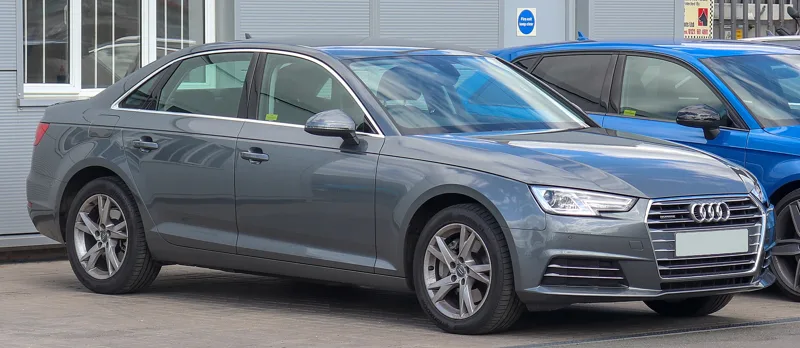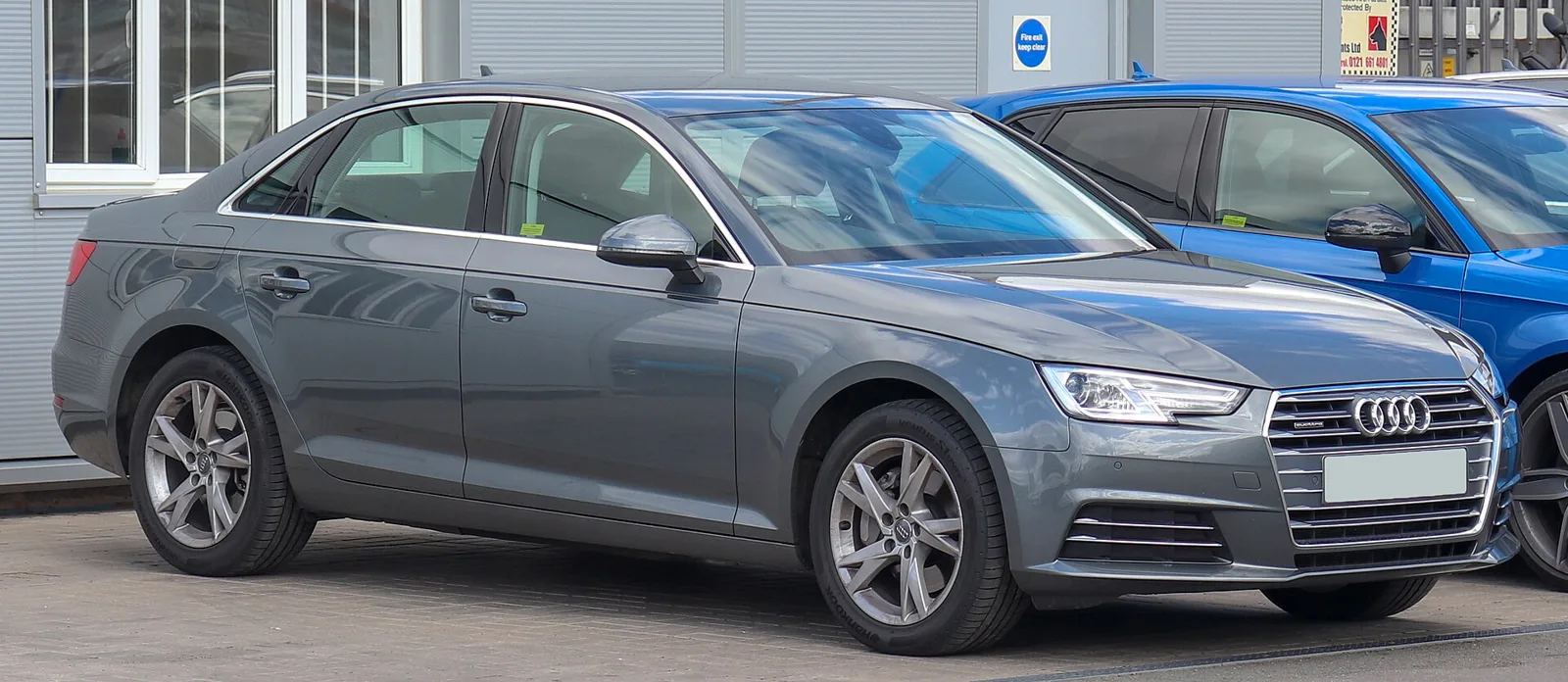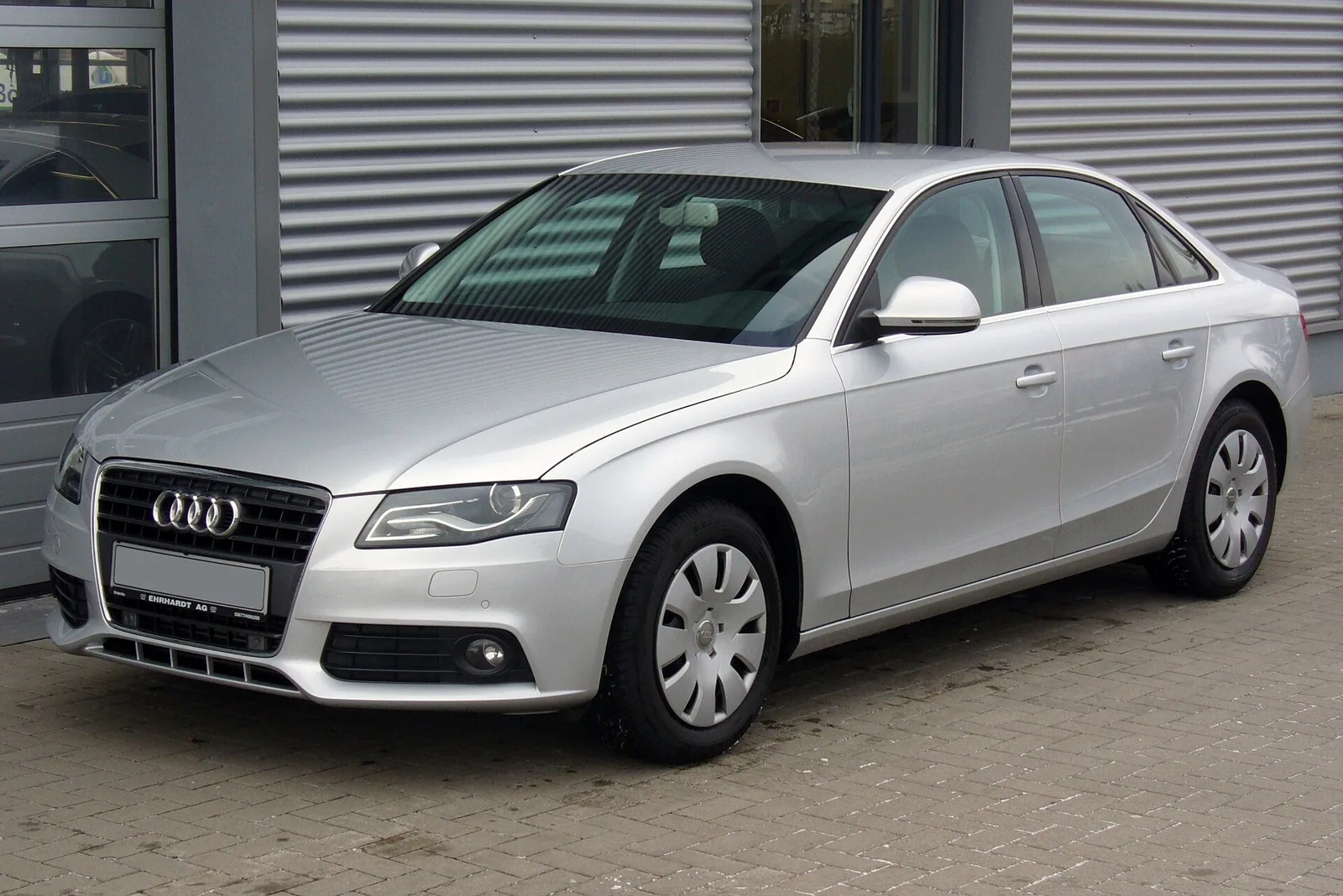
Fourth-generation A4 with a longer body, a supercharged S4 and an RS4 V8, built in saloon, estate and allroad forms from 2007.
Built from 2007 to 2015 as a saloon and estate, with the allroad quattro running to 2016, the A4 B8 was a mid-size Audi that shared its platform with the A5. Later versions added a supercharged S4 and an RS4 with a naturally aspirated 4.2-litre V8, which was sold only as an estate from autumn 2012.
The Audi A4 B8 was the fourth generation of Audi's mid-size car, sold as a saloon, an Avant estate and an allroad. It rode on a new platform that the Audi A5 already used, and its early engines were turbocharged petrol and diesel units. A seven-speed S tronic gearbox, a supercharged S4 and an RS4 V8 came later in its life.
What changed from the B7 to the B8?
The B8 was 117 mm longer and 54 mm wider than the B7 it replaced. Its front and rear resembled the Audi A5, which had been shown in March 2007, and the interior was angled towards the driver in the same way as the A5's.
Large exterior mirrors with integrated LED indicators stood out at the sides, and the daytime running lights used LED technology when the optional xenon lighting was fitted. A 6.5- or 7-inch screen sat in the middle of the dashboard, depending on the radio or navigation equipment.
Where navigation was fitted, a separate MMI unit in the centre console ran the system, and the normal radio could carry a replica of the MMI control logic as an alternative. Radio volume and air-conditioning controls worked independently of that interface.
There was no open A4, since the A5 Cabriolet filled that role from spring 2009. Other contenders against the A4 were the BMW 3 Series and Mercedes C-Class, with the Cadillac ATS, Infiniti Q50 and Citroen DS5 also competing.
A new platform, a supercharged S4 and an RS4 V8 gave the B8 a range that went well beyond the basic saloon.
What equipment came with the B8?
The B8 was the first A4 offered in three basic equipment lines, Attraction, Ambition and Ambiente, a system already used on the Audi A3. Some options were priced lower when bought with one of these lines. Compared with its predecessors the options list also grew, and a three-zone automatic climate control joined the standard unit.
- Attraction: the entry trim, with 16-inch wheels, or 17-inch on six-cylinder cars, plus platinum-look trim inlays.
- Ambition: the sporty line, adding sports seats, suspension, a sports wheel, 17-inch tyres, a driver information display and aluminium-look trim.
- Ambiente: the comfort line, building on Attraction with seat heating, cruise control, a rear parking sensor, an armrest in the centre, a multifunction wheel and the light-and-gloss pack.
Audi drive select, new in the B8, let the driver change the accelerator characteristic, the automatic gearbox tuning and the power steering assistance independently of one another. A suspension package with electronic damper control, called Continuous Damping Control, let the firmness of the suspension be set individually.
Dynamic steering was an option that came with that suspension package. It could widen or narrow the steering angle the driver set, and it could also steer independently, say when the car slid out of line. New comfort items on the B8 were a reversing camera or dashboard display as a parking aid, plus comfort seats with active ventilation.
What versions did the B8 come in?
The B8 came as a saloon, an Avant estate, an allroad quattro, an S4 and an RS4 Avant, and a longer version for China. That Chinese car, the A4L, had a wheelbase 60 mm longer and was produced from January 2009.
At first the A4L was offered with two petrol engines: a 2-litre turbo at 132 kW (180 PS) and a 3.2-litre V6 at 195 kW (265 PS). Later a 1.8-litre at 118 kW (160 PS) and a further 2-litre turbo at 155 kW (211 PS) were added for it.
Raised ground clearance set the allroad quattro apart; it arrived in early summer 2009 for driving off tarmac. It arrived a few months after the S4, and it was built until February 2016.
The S4 was unusual within the line. Its 3-litre V6 was supercharged, not turbocharged or naturally aspirated, which set it apart from the engines that the A4 had used before it.
Which engines did the A4 B8 use?
The range included a newly developed 1.8-litre turbo TFSI with direct injection, offered in 88 kW (120 PS) and 118 kW (160 PS) forms. The 2-litre diesel gained common-rail injection, the group's first in-line four-cylinder diesel of that type, and the V6 diesels were revised to give more power.
The 1.8-litre used a maintenance-free timing-chain camshaft drive and a flow-controlled oil pump. After the 2011 revision, port injection was added to direct injection at part load to reduce particle emissions, and a new thermal management system helped the engine reach operating temperature sooner.
Changes to the 3.2-litre V6 petrol included two-stage intake valve lift, a flow-regulated oil pump and a marginally bigger bore. That gave it 7 kW (10 PS) more power and 330 Nm of maximum torque from 3000 to 5000 rpm. It was dropped when the facelift arrived in November 2011.
Every diesel came with a particulate filter as standard. From 2014 the 2-litre diesels gained an SCR catalyst that used AUS-32 additive to reduce nitrogen oxides and meet Euro 6.
The Avant's 2008 arrival brought two 2-litre turbo models based on the 1.8, both using valvelift on the exhaust camshaft. Outputs stood at 132 kW (180 PS) for one and 155 kW (211 PS) for the other. In mid-2013 the 155 kW engine was raised to 165 kW (225 PS).
What were the S4 and RS4 models?
The S4 arrived in 2009 with a 3-litre V6 that used a Roots-type supercharger to produce 245 kW (333 PS). The RS4 Avant followed in mid-2012 with a naturally aspirated 4.2-litre V8 rated at 331 kW (450 PS), the most powerful A4 model.
From early 2012 a 200 kW (272 PS) version of the S4 V6 was offered for the other A4 models. It replaced the 3.2-litre V6 petrol that had been dropped in the facelift, and its supercharged layout came from the S4 itself.
That RS4 V8 had been in service in the RS5 coupe since 2010. From autumn 2012 the RS4 was sold only as an Avant, after it was first presented at the Geneva Motor Show in February 2012.
How did the gearboxes and quattro work?
Front-wheel drive was standard, and the quattro all-wheel-drive system was optional for various engines. From early 2009 a new seven-speed S tronic dual-clutch gearbox was available with the all-wheel-drive 2-litre petrol models, the 3.0 TDI and the S4, and it gradually replaced the Tiptronic torque-converter automatic.
The S tronic first appeared in the Q5 compact SUV, which had a longitudinally mounted engine and came out in autumn 2008. It had therefore been used in a different car before it reached the A4.
With the 2011 facelift, S tronic cars could have a sixth-generation quattro system with a crown-gear centre differential. For better traction it sent at most 70% of drive torque forward and 85% to the rear.
A sport differential was optional on quattro cars paired with S tronic plus the 3-litre engine. It used two multi-plate clutches to split engine power infinitely between the left and right rear wheels, which is known as torque vectoring.
Audi A4 B8 specifications and production dates
| Specification | Detail |
|---|---|
| Body versus B7 | 117 mm longer, 54 mm wider |
| Wheelbase | A wheelbase 160 mm longer was made possible by the new platform |
| Drag coefficient | 0.27 saloon; 0.31 Avant |
| Front axle | Moved 154 mm further forward |
| 1.8-litre petrol | 1.8-litre turbo TFSI at 88 kW (120 PS), up to 118 kW (160 PS) |
| Top petrol | RS4 naturally aspirated 4.2-litre V8, 331 kW (450 PS) |
| S4 | 3-litre supercharged V6, 245 kW (333 PS) |
| Diesel | 2-litre TDI up to 130 kW (177 PS); 3.0 TDI at 150 kW (204 PS) or 180 kW (245 PS) |
| Gearbox | Seven-speed S tronic dual-clutch |
| Saloon build | September 2007 to August 2015 |
| Avant build | March 2008 to August 2015 |
| Allroad quattro build | February 2009 to February 2016 |
| S4 build | November 2008 to June 2015 |
| RS4 build | June 2012 to June 2015 |
| Euro NCAP | Five stars in 2009 |
How did the facelifts change the A4?
The November 2011 facelift changed the front around the grille and headlights, gave the saloon new rear lights and revised the interior. It also brought a new electromechanical power steering, and stop-start systems became standard on every petrol and diesel engine.
The MMI navigation system lost four buttons, seat heating received its own button, and the on-board computer gained a break reminder. The 2.7-litre V6 diesel was discontinued; the 3-litre TDI replaced it in two tunes, 150 kW (204 PS) plus 180 kW (245 PS). The 3-litre TDI came only with automatic gearboxes at launch.
A mid-2013 update tuned the 2.0-litre TDI up to 110 kW (150 PS), and the 2.0-litre TFSI reached 165 kW (225 PS), up from 155 kW (211 PS). Both TFSI engines of that time also met the Euro 6 standard.
The 'A4 Ultra' name arrived in February 2014 with two 2.0-litre TDI engines, one rated 100 kW (136 PS) and one rated 120 kW (163 PS). Thanks to bodywork tweaks and a revised gear ratio, combined consumption dropped to 4 litres per 100 km at best.
Which special editions were sold?
The Austrian Nogaro Edition was limited to 100 units and sold only as an Avant. The package bundled S line interior trim, S line exterior trim and matching sport suspension, and the car used a 2.0 TDI quattro making 130 kW (177 PS) with S tronic.
Every Nogaro car was finished in Phantom Black pearl paint with Nogaro blue accents. Touches included Alcantara steering wheel inserts, blue mirror housings, quattro badges low on the doors and a numbered plate in the console.
The Black Edition sat above the S line trim in selected markets. Its black single-frame grille, black window trim and 19-inch alloy wheels in rotor design set it apart, and inside it had piano-black trim and a black headliner, with sport seats in S line leather and Alcantara. It was offered mostly with the stronger TFSI and TDI engines, and the Avant was the main focus in many markets.
How did the A4 B8 fare on safety?
The A4 won the highest Euro NCAP rating, five stars, in its 2009 crash test. In the breakdown, occupant protection reached 93%, child safety 84% and pedestrian protection 39%. The changed engine mounting was meant to help the last of these.
For the first time on an A4, the B8 offered driver assistance such as lane keeping, side assist and adaptive cruise. Lane keeping later gained corrective steering input, and adaptive cruise control performed a full automatic brake below 30 km/h when a collision threatened.
Child seats fit in every rear position, though three of them would not sit side by side in comfort. Outer rear seats could take Isofix mountings at no charge, while the front passenger mountings and a switchable airbag cost extra.
What did the B8 platform lead to?
The Modular Longitudinal Platform underpinned the Audi A5 and was intended as the base for all later Volkswagen Group models with longitudinal engines. The B8 therefore sat at the centre of a platform that the group planned to use widely.
Mounting the differential beneath the clutch or converter let the front axle move 154 mm forward. Better weight distribution sharpened the handling, and a wheelbase 160 mm longer became possible.
Audi connect, offered with the MMI Navigation plus system, gave access to traffic, weather and multimedia services through Bluetooth pairing with a mobile phone or a SIM card.