A front-drive family car from 1968 that was built 827,474 times, helped rescue Volkswagen in the early 1970s and was developed largely in secret.
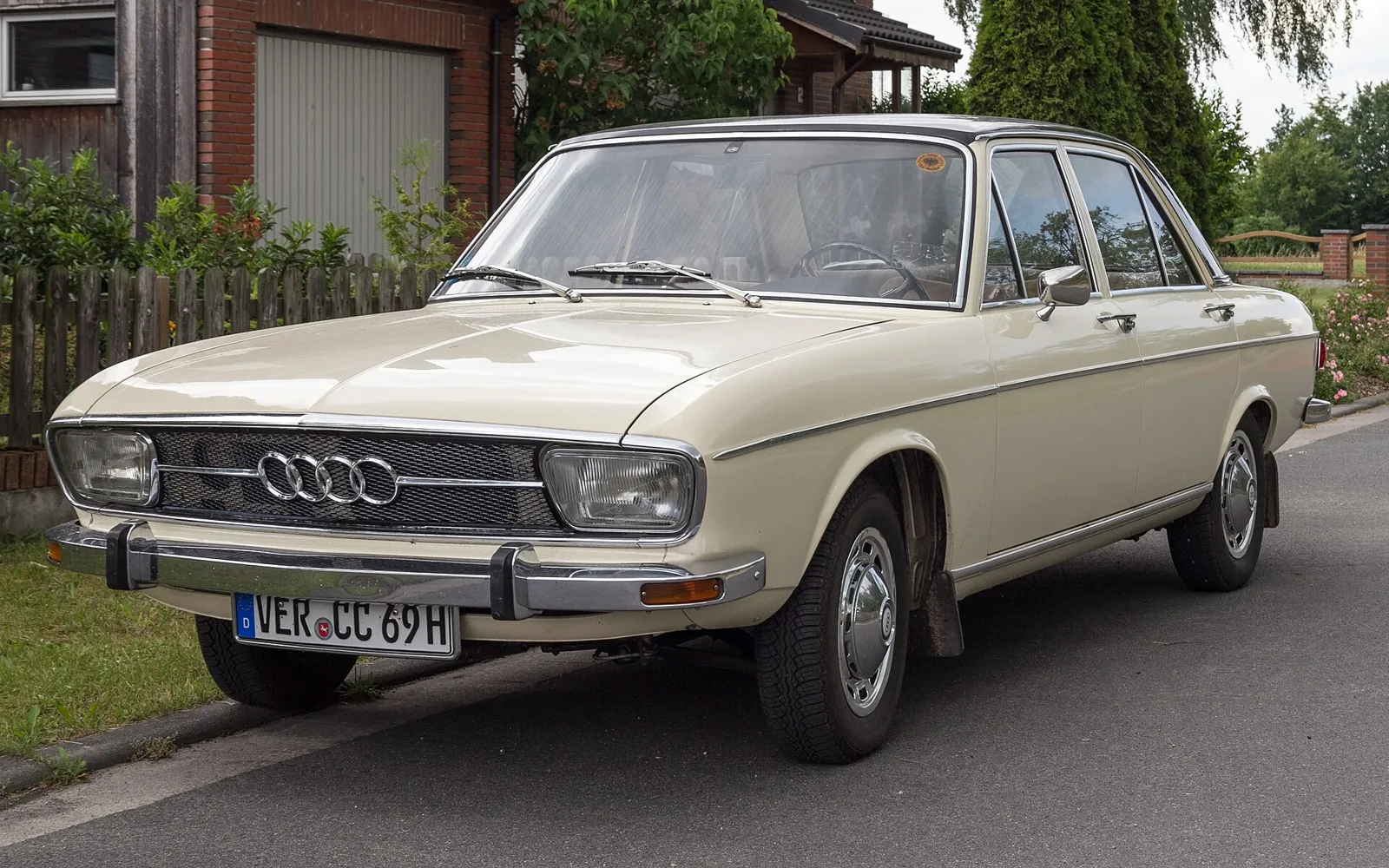
Built by Auto Union in Ingolstadt and later Neckarsulm from October 1968, the Audi 100 C1 was an upper-middle-class front-drive saloon. Two-door and coupe versions followed, and 827,474 cars were made in total before the C2 replaced it in 1976.
The Audi 100 C1 was a front-drive family car from the upper middle of the market, first built by Auto Union in October 1968. A two-door saloon and the Coupe S joined it later, and 827,474 cars left the line before the C2 took over in 1976. Developed largely out of sight of Volkswagen's management, it kept the Audi name alive as a separate brand.
What did Volkswagen need from Auto Union?
Volkswagen had acquired another assembly plant, at Ingolstadt, from Auto Union, a Daimler-Benz subsidiary threatened by bankruptcy in the mid-1960s. Empty capacity there was used for putting together the Beetle, which still sold strongly.
A poor-selling DKW F 102 was given a four-stroke engine and a thorough rework. Known inside the company as the Audi F 103, it brought back a brand name that had lain idle for decades. Chairman Heinrich Nordhoff then ruled that Ingolstadt should develop no further new models.
Developed largely out of sight, the Audi 100 gave the brand a future it might otherwise have lost.
How was the Audi 100 developed in secret?
Ludwig Kraus, who had been at Daimler-Benz until 1963, had little faith in the Beetle's long-term prospects. Working at Auto Union, he created the Audi 100 largely in his own time and without the Volkswagen board's knowledge. Nordhoff saw the car only once it was finished.
The Audi 100 also broke new ground. It was the first production car whose body was worked out by computer, using finite element analysis. The plan had been a single run of 100,000 cars, but the total ended at 827,474 once demand had been met.
Why did the Audi 100 matter to Volkswagen?
Volkswagen had boxed itself into a corner with the Beetle and its descendants, right up to the VW 411, whose air-cooled engine sat at the back. Audi's up-to-date, easy-to-sell cars helped pull the company out of its slump in the early 1970s. Drawing on developments from its group subsidiary Audi NSU, Volkswagen could quickly shift its range to front-mounted, water-cooled engines and front drive.
The VW K 70 came in 1970 and the Audi 80 in 1972, the latter also sold from 1973 as the VW Passat. The VW Golf and Scirocco arrived in 1974, and the Polo, built to the same structure as the Audi 50, followed in 1975.
This quiet development did more than fill a gap in the range. It is the reason the Audi brand survived as a company in its own right.
How was the Audi 100 engineered?
The C1 paired a longitudinal four-cylinder engine with front-wheel drive. Its body was welded to the floor-pan assembly, and its styling echoed the F 103 while being far larger. At the front, the torsion bars were replaced by raised coil springs.
Each front spring unit carried a concentric telescopic damper and an anti-roll bar. The change let the passenger compartment sit lower and improved handling. The rear axle kept its torsion bars until 1973. Steering was rack and pinion, and the brakes were dual-circuit, with discs in front and drums at the back.
The first engines were four-cylinder units of 1.8 to 1.9 litres, derived from the medium-pressure engine of the F 103, which Audi had acquired from Mercedes. Its side camshaft and pushrods made it dependable and frugal, if coarse. In 1974 the weakest 1,760 cc unit was swapped for a 1,588 cc EA827, which had an overhead camshaft borrowed from the new Audi 80.
What power did each version make?
The entry model used a 1.8-litre that produced 85 PS (63 kW; 84 hp) on regular petrol, while the Coupe S relied on a 1.9-litre rated at 115 PS (85 kW; 113 hp). Across the range, output ran from 80 PS on regular petrol up to the coupe's 115 PS.
| Model | Displacement | Output | Compression |
|---|---|---|---|
| Regular-petrol Audi 100 | 107.4 cu in (1,760 cc) | 80 PS (59 kW; 79 hp), 5,000 rpm | 9.1:1 |
| Audi 100 S (premium) | 107.4 cu in (1,760 cc) | 90 PS (66 kW; 89 hp), 5,500 rpm | 10.2:1 |
| Base engine from model year 1972 | 107.4 cu in (1,760 cc) | 85 PS (63 kW; 84 hp), 5,100 rpm | 8.5:1 |
| Audi 100 LS (premium) | 1,760 cc (107.4 cu in) | 100 PS (74 kW; 99 hp), 5,500 rpm | Lowered for quieter running |
| Audi 100 GL | 114.2 cu in (1,871 cc) | 112 PS (82 kW; 110 hp), 5,800 rpm | 10.0:1 |
| Audi 100 Coupe S | 114.2 cu in (1,871 cc) | 115 PS (85 kW; 113 hp), 5,500 rpm, later 112 PS | - |
The Coupe's 1.9-litre was a 1.8 bored out to the larger size. The bigger bore lifted output but left the engine turning at its old peak speed.
What changed in the 1974 and 1975 updates?
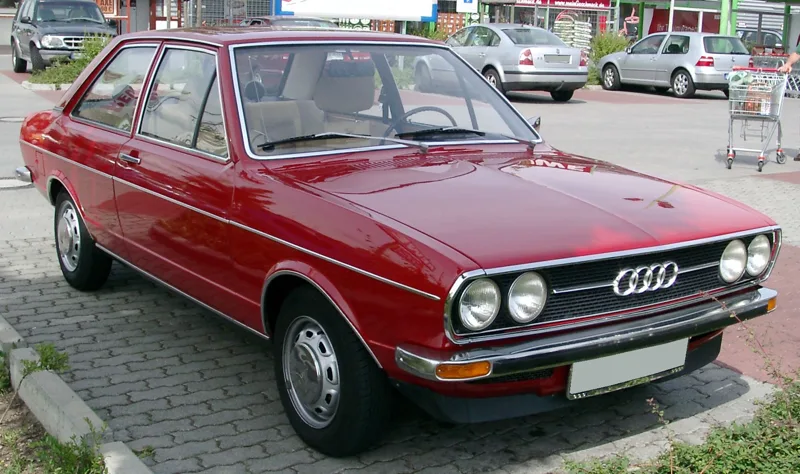
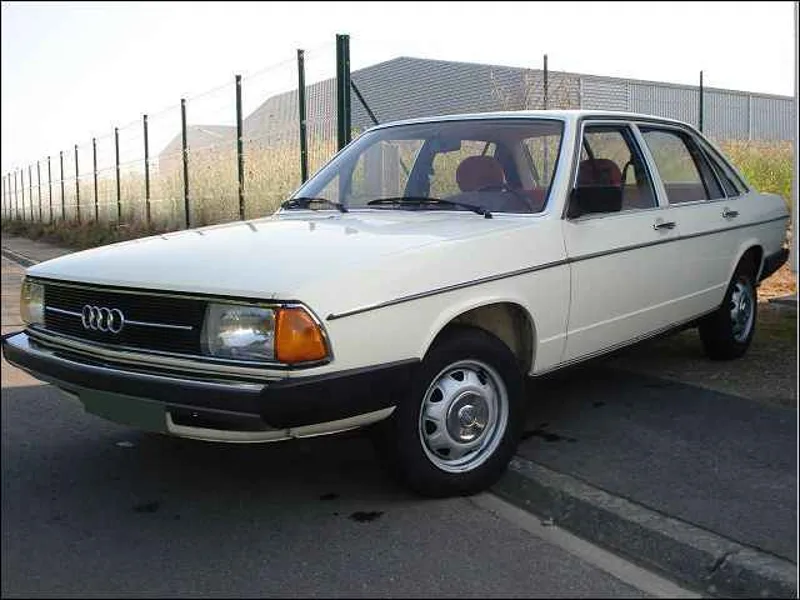
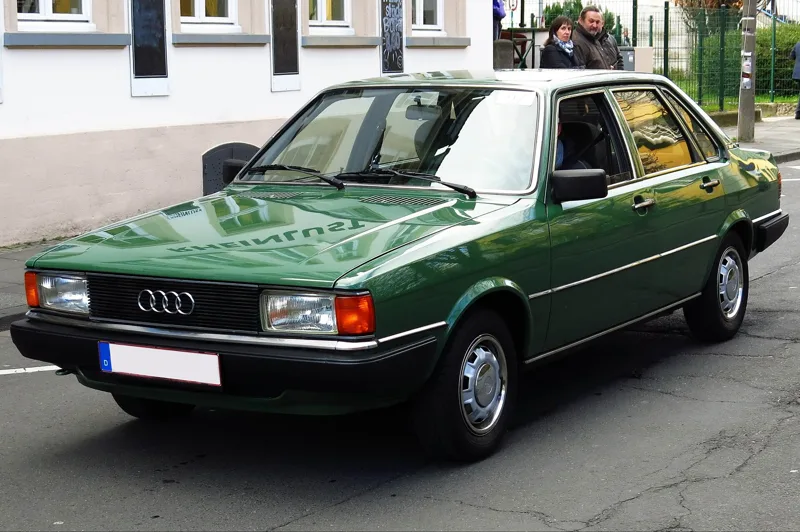
For 1974 the nose was redrawn with squarer wings and bonnet, the grille became plastic, and the saloon gained tail lights split into horizontal sections. The coupe kept its rear unchanged. The rear suspension moved from the transverse torsion bar to spring-damper units with coil springs.
The 1975 model year brought the front brake discs out from the gearbox and differential, where they had been prone to oil contamination, and onto the wheels. The discs shrank from 280 mm (291 mm on top models) to 257 mm, and the hydraulic circuits were split diagonally.
The same year brought wider 5J x 14 wheels to every version, previously reserved for the 1.9-litre cars, and saloons received revised bumpers with black plastic end caps. The entry 1.8 was replaced by a 1.6-litre EA827. That unit was weaker on torque, offered no power steering, and was hardly thriftier because it revved higher.
The 1.8-litre cars also lost their standard steering-column gearshift in 1975. A centre lever, which had previously been an extra, took its place.
What did the two-door and coupe cost?
From launch in October 1969 to January 1972, the two-door car matched the four-door's price. Period critics thought the two-door resembled an elegant coupe. The design effort for the two-door was unusually high, with very large doors and big rear side panels, and that may account for the pricing.
In November 1973 the 100 with 85 PS listed at DM 11,050, the Coupe S at DM 15,090, and the four-door saloon carried a DM 375 premium over the two-door.
Power steering reached every model as an option at DM 725. Buyers in upmarket classes had doubts about front drive, and the option helped answer them, because the drive's kick was by then barely felt through the wheel.
What was the Audi 100 Coupe S?
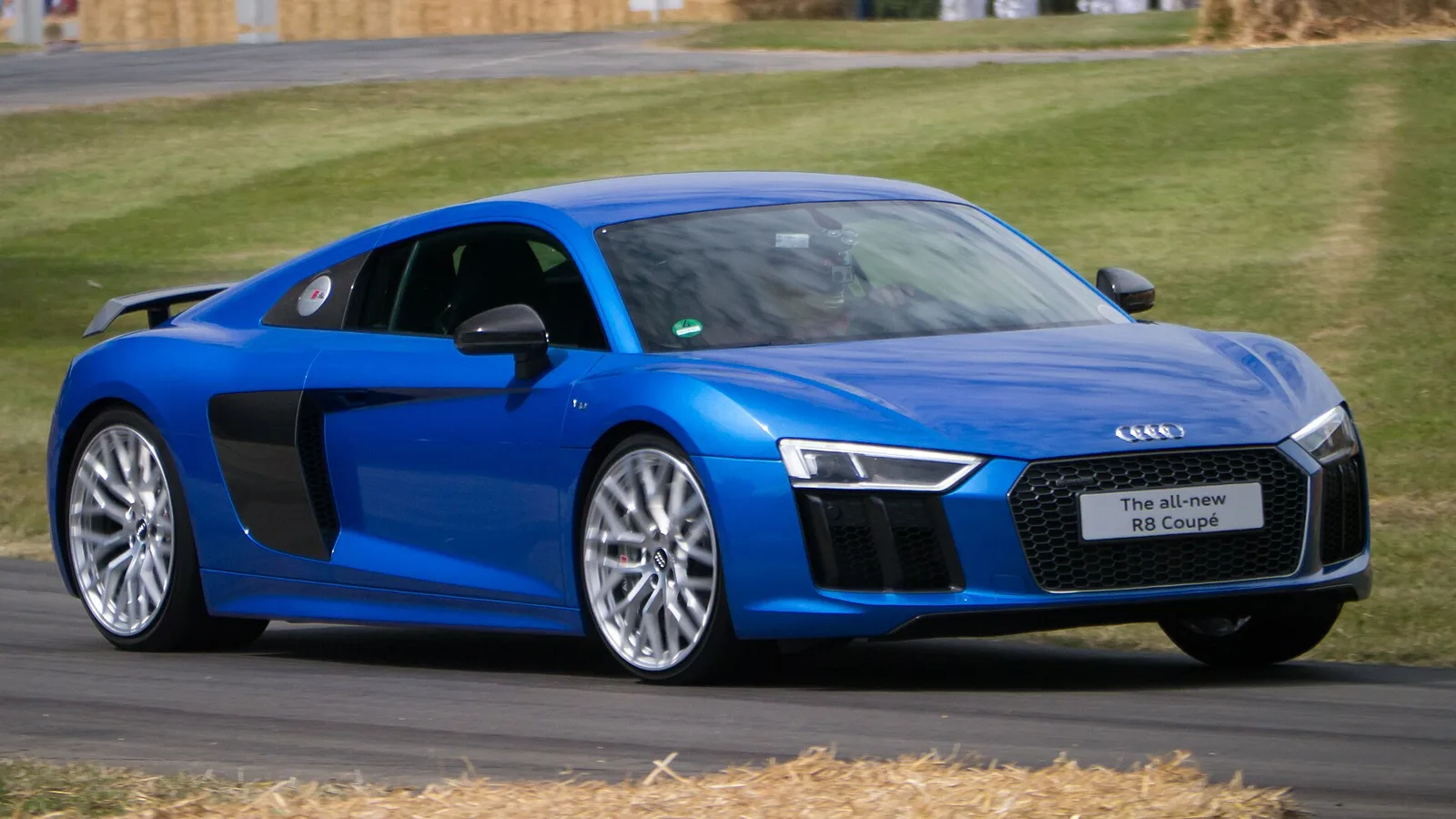
The Coupe S was a fastback built alongside the saloon. The IAA show in Frankfurt was where it first appeared, in September 1969, but sales only began in October 1970. The coupe's wheelbase was 2,560 mm (100.8 in), down from 2,675 mm (105.3 in) on the saloon, and the car stood 67 mm (2.6 in) lower than the saloon.
Creating the fastback required a new A-pillar and doors, although the floor pressings were reused, so no new tooling was needed there. Large vent slits sat in the rear pillar. The passenger cell was braced by a heavier bulkhead, rigid side members doubling as outer sills, and a crossmember at the back. Round headlights split into two units appeared first on the coupe and were offered on the saloon, on request, the following year.
Kraus had wanted a coupe for the revived Audi line. Hartmut Warkuss, then a young stylist who later headed Volkswagen design in the 1990s, helped shape the body. The team deliberately stayed close to the outline the saloon had established.
The coupe's cabin looked more finished than the saloon's, with a partly upholstered timber dashboard, head restraints and a four-spoke sports wheel. That wheel could also be raised or lowered a little, something no other model in the series offered.
From October 1971 the coupe could be ordered with a three-speed automatic. In the same period its 1.9-litre dropped one of its two carburettors, which cost a little output. The coupe was never sold in the United States, and the final one left Neckarsulm in summer 1976.
How many were built?
Between 1968 and 1976 a total of 827,474 vehicles were completed, of which 30,687 were Coupe S models, a little under 4 per cent of the output. The saloon accounted for almost all of the programme, so the coupe was a small niche within the family. The programme had been sized at 100,000, but demand carried the total far beyond that. The C2 replaced it in Europe in summer 1976, while production for the North American market carried on until March 1977.
How did the car sell in South Africa and the USA?
South African production started late in 1972 and had reached 33,000 units by October 1976, about 4 per cent of the 827,474 built. There the range included the L, LS, GL and S coupe, although by then the coupe was no longer made. Engines were rated in DIN: 75 kW (102 PS; 101 PS) for the 1,760 cc unit in the L and LS, and 84 kW (114 PS; 113 PS) for the 1,871 cc unit in the GL and GLS.
The car came to the United States in 1970 in LS trim, with a 1.8-litre SAE-rated engine and a choice of two or four doors. For 1972 capacity rose to 1.9 litres, though the SAE net figure dropped to 91 PS (68 kW; 90 hp). Fuel injection took the rating to 95 PS (71 kW; 94 hp) by 1975.
Until about May 1977 the Audi 100 was built only for America, running alongside its successor. In August 1977 the Audi 5000 succeeded it there, although 537 examples were still sold in 1978.
Model variants
- Audi 100 with a 1,760 cc engine, 80 PS and later 85 PS, on a single downdraught carburettor.
- Audi 100 S with 90 PS, designed for premium petrol.
- Audi 100 L, from October 1974, with a 1,577 cc engine and 85 PS.
- Audi 100 LS, offered with 85 PS or 100 PS, and from January 1976 a 1,577 cc version with 85 PS.
- Audi 100 GL, from August 1971, with a 1,871 cc engine, 112 PS and twin headlights.
- Audi 100 Coupe S, with a 1,871 cc engine and 115 PS, later 112 PS.
- Special bodies: an LS cabriolet from a coachbuilder in Osnabrueck, a second LS cabriolet from a Cologne firm, and a convertible and an LS estate from outside specialists.
What about rust and survivors?
Volkswagen Group cars built from the mid-1970s later proved very prone to rust. The cause was inferior recycled sheet metal with a relatively high copper content, which led to intergranular corrosion. The federal motor vehicle authority (Kraftfahrt-Bundesamt) counted 8,216 first-series saloons still registered on 1 July 1991.
The EEP electric test fleet
In 1976 an experimental fleet of purely electric cars, named EEP, was run by Audi with RWE and Varta. One test vehicle was assembled to trial several accumulators, which could be topped up through a socket close to the front bumper.