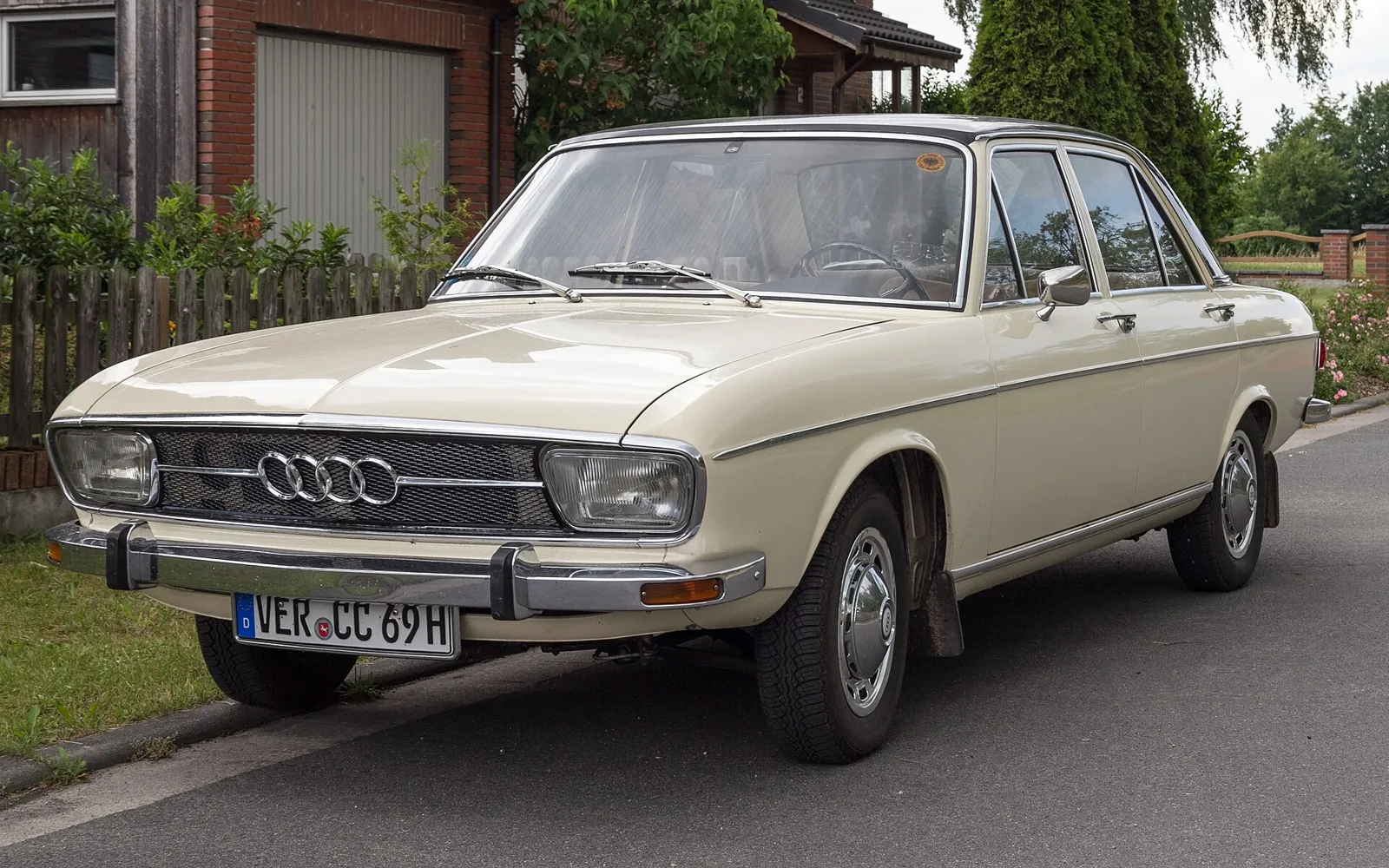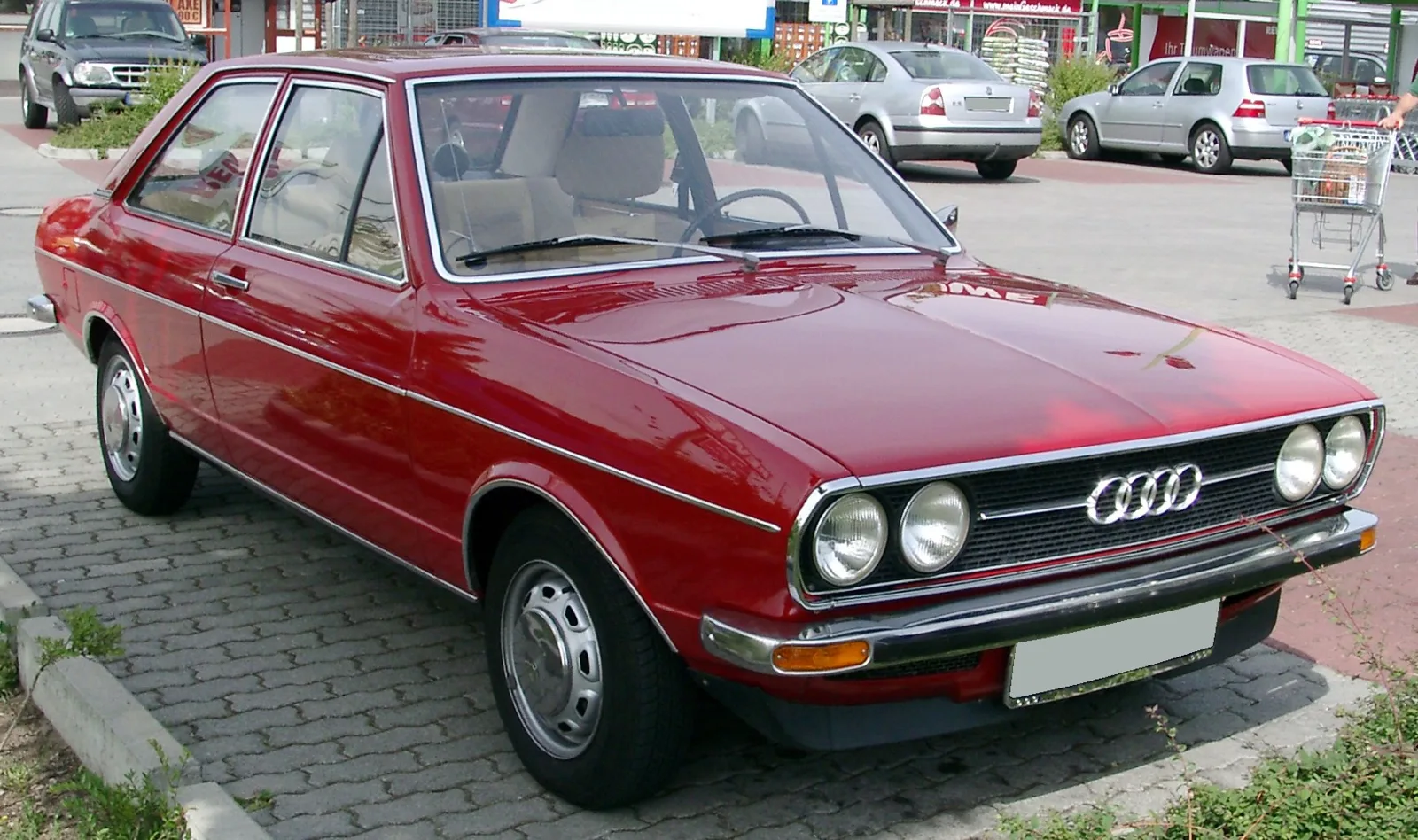
Audi's 1972 mid-size saloon shared its platform with the first Passat and started an engine family that was built until 2013.
Built by Audi from 1972 to 1978, the Audi 80 B1 was a three-box saloon with front-wheel drive. Its 1.3 and 1.5 litre single overhead camshaft engines began the EA827 family, which remained in production until 2013. The car won the Car of the Year award early in 1973.
The Audi 80 B1 was the first generation of the Audi 80, a mid-size saloon built by Audi from 1972 to 1978. It was a front-wheel-drive three-box car whose engines and platform were shared with the first Volkswagen Passat. Its single overhead camshaft engines, between 1.3 and 1.6 litres, started a family that stayed in production for more than forty years.
Why did Audi need a new mid-size car?
Audi's post-war F103 range still carried the image of the earlier DKW cars, which relied on two-stroke engines with roots going back before the Second World War. The Volkswagen group wanted the Audi line-up modernised, so a new mid-size project began in January 1968, coded EA838. It was run alongside a successor to the ageing Beetle and a higher model that became the Passat.
The Audi 100 was already in development and would sit one step above the F103, and so above the future mid-size car. Engineer Ludwig Kraus supervised the EA838 programme. To keep costs down, the three projects were to share as many components as possible, starting with a single overhead camshaft engine that would be offered in sizes from 1.3 to 1.6 litres.
For the chassis, the team reused the solutions already chosen for the first Audi 100. There had been a period of indecision over the rear axle, with MacPherson, rigid axle and torsion beam all considered, but the outcome gave the new saloon more modern suspension, especially at the front.
A saloon that was 20.5 cm shorter than its predecessor yet offered more room inside.
How was the Audi 80's body style chosen?
Designers were divided between a two-box body with a steeply raked tailgate and a classic three-box saloon. Both were modelled at 1:1 scale from 1969, and the three-box saloon was chosen in the end. The two-box idea returned when the lines of the first Volkswagen Passat were fixed, since the Passat amounted to a two-box Audi 80 B1 with a rear hatch.
It was decided early that the new saloon should be more compact than the F103. The aim was not to get in the way of the Audi 100, which was about to go on sale. By 1970 the EA838 project had a clear character and was moving quickly, with other styling proposals for the planned trims. In September 1971 a prototype appeared with a front fitted with twin round headlamps, a feature that would be carried into the definitive range alongside simpler versions with single lamps.
When and where was the Audi 80 launched?
The first generation was presented to the press in July 1972, at the Austrian circuit of the Salzburgring, shortly before the Munich Olympics. Production also began in July. In September the car was shown in Ingolstadt to the representatives of Audi dealerships across Germany, and the first official public presentation followed at the Paris Motor Show.
Many dealer representatives travelled to the Audi headquarters by train or by bus, hoping to drive home in one of the first examples. By the time the dealer network saw the car, 1,500 had already been built. That number delighted the dealers, who would be able to drive to work each day in a car that represented the brand they sold.
What did the Audi 80 look like?
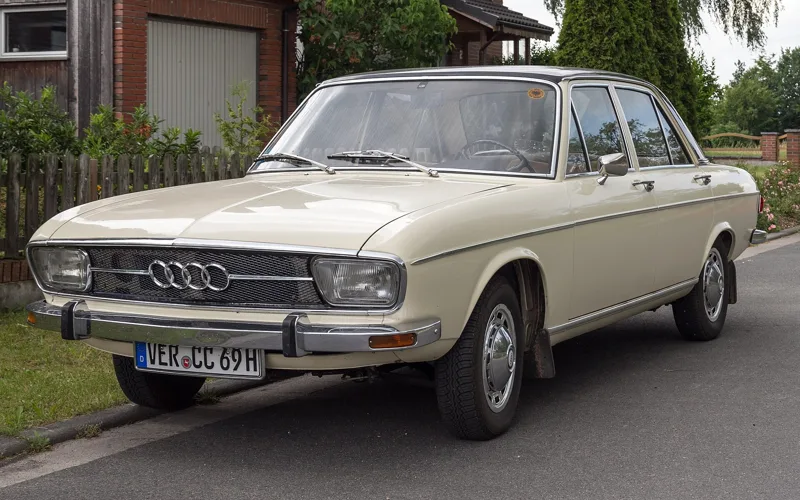
The Audi 80 had a classic three-box body, initially with only two doors, and angular lines in plain 1970s style. Its styling was deliberately simple, and it set the direction for much of Volkswagen's styling in that decade. The front carried round single headlamps set in a black full-width grille, with double headlamps reserved for the top version. That same headlamp arrangement would soon appear on the Golf, Scirocco, Polo and Derby, and on the small Audi 50.
The Audi front differed from the Volkswagen fronts in a few details. It had a chrome surround around the grille, a curved rather than vertical profile on the grille's side edges, and a chrome bar running through the four-ring badge, which the Volkswagens lacked. From the side the only decoration was a chrome moulding at mid-height on the doors. The belt line was fairly low, which gave the car a sense of forward movement, and the relatively large glass areas, helped by thin pillars, brought light into the cabin.
The rear was almost plain, with a large rear window and two nearly square light clusters, whose outer edges alone were curved.
How roomy was the Audi 80's interior?
The new saloon was 20.5 cm shorter than the F103 it replaced, yet it offered a roomier cabin and a bigger boot. The four-ring company quoted a boot capacity of 450 litres. Seats with backrests that reclined to the horizontal were fitted as standard across the range, creating two sleeping berths.
The driver faced a dashboard made almost entirely of plastic, with few controls in the centre and a centre console that was practically absent. The instruments sat behind a two-spoke steering wheel and consisted of two round dials, one for the speedometer and one grouping several indicators and warning lights. A clock sat in the centre of the dashboard.
For its market segment the interior was well finished. It was still a long way, however, from the premium image that Audi would project many years later.
What engines and chassis did the Audi 80 B1 use?
The Audi 80 B1 had a longitudinal front engine driving the front wheels. Its platform was new and became the mechanical basis of the first Passat, which debuted a few months later. Its front suspension was MacPherson type, while the rear kept a rigid axle with a Panhard rod. Coil springs and telescopic hydraulic dampers were used on both axles, and the steering was rack and pinion.
The engine range was the biggest innovation. The units were single overhead camshaft engines, unlike the pushrod and rocker engines still used under the bonnet of the Audi 100 C1. There were two displacements, sized for the mid-size segment: a 1.3 litre (79.1 cu in) with 55 PS (54 hp), and a 1.5 litre (89.8 cu in) offered with 75 PS (74 hp) or 85 PS (84 hp).
These engines were the first members of the EA827 family of VW-Audi engines. They were built for more than forty years, until 2013, in many variants, adapted as standards grew stricter. The manual gearbox had four speeds across the range, and a three-speed automatic could be had on request, paired only with the 1.5.
Audi 80 B1 engines and trims at a glance
| Trim | Engine | Output |
|---|---|---|
| Base and L | 1.3, 1,297 cc (79.1 cu in) | 55 PS (54 hp) |
| S and LS | 1.5, 1,471 cc (89.8 cu in) | 75 PS (74 hp) |
| GL | 1.5, 1,471 cc (89.8 cu in) | 85 PS (84 hp) |
Which trim levels could buyers choose?
Five trim levels were planned at debut, matched to the three engines. The base version was very spartan and had a sparse options list. The others were considerably better equipped as standard, with the GL the richest and offering a fuller list of extras. By the end of 1972 buyers could order a radio, a sunroof, alloy wheels, air conditioning, a vinyl roof, or leather trim.
What did the first changes fix after launch?
The first changes after launch dealt with what might be called teething problems. The braking system wore its components quickly in the early months, the clutch was judged too spongy, and some engine parts had airtightness issues. Improvements were made to each.
Public showings followed in Turin, at the end of 1972, and in Geneva in March 1973. Geneva was also where a four-door body was first shown. The Audi 80 took the Car of the Year title in early 1973.
How did the Audi 80 reach the United States?
At the end of 1973 the Audi 80 went on sale in the USA and South Africa under the name Audi Fox. The Fox needed safety and emissions equipment to pass US homologation. It was also offered as a station wagon, a body never sold in European markets except as the Volkswagen Passat Variant. The first Foxes used only the 1.5 also sold in Europe, but it was tuned down to 56 PS (55 hp).
Also at the end of 1973 Europe gained a sporty top version, the GT. It introduced a new EA827 engine, the 1.6 with 100 PS (99 hp). The GT could be told apart by its two-door body, its single colour, a distinctive yellow-orange, and its dedicated alloy wheels, which were perhaps the only external features separating it from a two-door GL. Inside it had a sports steering wheel and seats, a grained dashboard trim, a rev counter, a water temperature gauge and a radio as standard.
How did the 1974 and 1975 changes respond to the market?
In 1974 Audi began measures against the oil crisis. The 1.5 engine of 75 PS (74 hp) was revised to run on regular petrol, which was cheaper than super, and the gearbox ratios were adjusted. Accessories such as an electric windscreen washer and an external mirror adjustable from inside the car were added to fill out the equipment.
In September 1975 the GTE replaced the GT. It had a new 1.6 engine derived from the earlier unit but fitted with mechanical fuel injection, lifting the maximum output to 110 PS (108 hp). It was essentially the engine that was then fitted to the much more famous first-generation Golf GTI. The GTE was two-door only at first, but from January 1976 it could also be ordered as a four-door. The 1.5 engines were updated to 1.6 at the same time, matching the GTE in capacity while keeping their two previous power levels.
What did the 1976 restyle change?
In 1976 the second-generation Audi 100 arrived with more modern styling, and the Audi 80 B1 received a mid-life restyle. The front was redesigned with square headlamps and integrated indicators in the style of the new Audi 100, and the rear light clusters became more elongated. The bumpers at both ends wrapped more around the body.
The trim list changed too. The LS was also offered with 85 PS (84 hp), the 75 PS GL was dropped, and the 85 PS GL was replaced by the GLS. Equipment was slightly fuller: the GLS had tinted side glass, chrome wheel-arch trim and its own exhaust tailpipe. Its engine was the 1.6 in either 75 or 85 PS (74 or 84 hp), and its seats were velvet-covered, with a voltmeter like the sporty GTE. The GTE received decals on its bonnet and sills.
The update cost the Ingolstadt company five million Deutsche Mark (DM). The saloon updated in the second half of 1976 also received a new internal code, changing from Typ 80 to Typ 82.
How did the Audi 80 B1 end its production?
In May 1978 the millionth Audi 80 was built, a clear sign of commercial success. To mark the occasion a limited edition called the Milionenausgabe, German for Million Edition, was added to the range in every engine version except the one reserved for the GTE.
At the end of that same May, once the celebration series was complete, production of the Audi 80 B1 stopped. Sales ran on until late summer, clearing cars that were still in storage. The second generation of the Ingolstadt mid-size saloon arrived in September 1978.
Across the versions in the summary table, 932,401 examples were built. The overall total of Audi 80 B1 units was 1,010,201, the difference being 77,800 Audi Fox cars sold outside Europe.