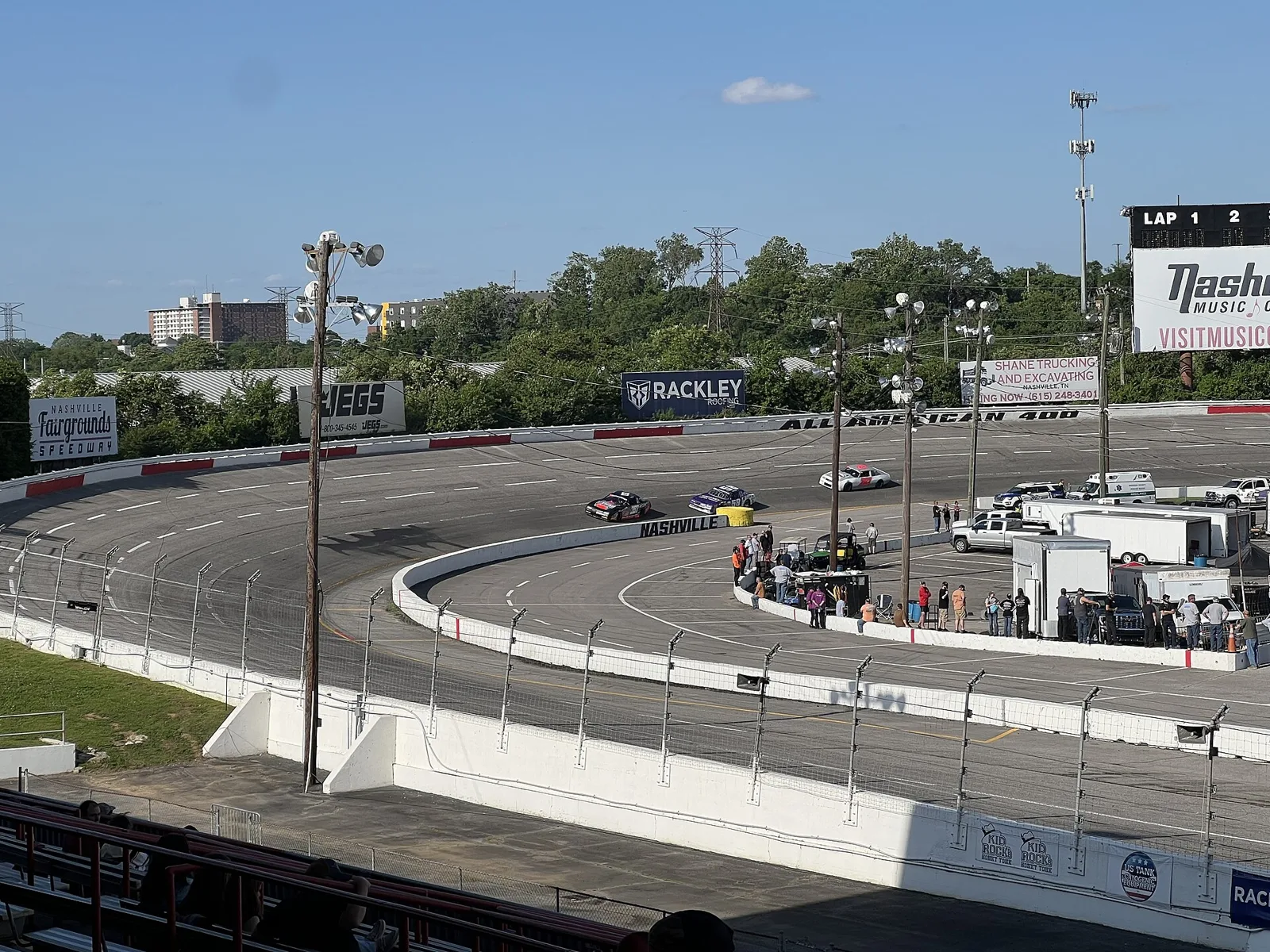
A banked paved oval on the Tennessee State Fairgrounds, the second-oldest continuously operating track in the United States, and home to NASCAR's top series until 1984.
Nashville Fairgrounds Speedway is a 0.959 km (0.596 mi) banked paved oval at the Nashville Fairgrounds, close to downtown Nashville. It is the second-oldest continuously operating track in the United States, and it hosted NASCAR Cup races from 1958 to 1984.
Nashville Fairgrounds Speedway is an 18 degree banked paved oval on the Tennessee State Fairgrounds, close to downtown Nashville. It has been used for motor racing since 1904, and its NASCAR Cup races ran from 1958 to 1984.
What is Nashville Fairgrounds Speedway?
Nashville Fairgrounds Speedway is a 0.959 km (0.596 mi) paved oval that sits at the Nashville Fairgrounds. It is the second-oldest track in the United States to have operated continuously, and it has hosted racing in several forms over more than a century.
The current configuration is a paved oval banked at 18 degrees. Inside the larger oval is a smaller 0.402 km (0.250 mi) paved oval, which was created in 1957 when the track began to run NASCAR events.
The speedway has been reshaped several times. It was made longer in 1969 and 1970, its corners were cut back from 35 degrees to 18 degrees in 1972, and it was resurfaced in 1995 and 1996.
A paved oval on the state fairgrounds that carried NASCAR's top division for a quarter of a century and still races today.
How did racing begin at the Fairgrounds?
The first events at the site took place on 11 June 1904, when horseless carriages and motorcycles ran on a 1.8 km (1 1/8 mi) dirt oval. A race was halted after a motorcycle hit the back of a car lining up, and harness horse racing was also held there.
In September 1904 a second series of races attracted entrants who had come straight from the World's Fair in St. Louis, among them the pioneer Barney Oldfield. Spectators were amazed to see cars exceed 60 mph (97 km/h).
From September 1915 the track held annual events to coincide with the state fair, and drivers who had raced at the Indianapolis 500 brought their cars south for the meetings. Local tracks also ran weekly Saturday shows, and local racers competed at the fair from 1954 to 1957.
When did the paved track open?
In 1958 the racers decided to build a paved track. They secured a ten-year lease from the state fair board and, after objections from horse racers, laid out a horse track alongside it. The new paved oval shared its front straight with a quarter-mile track.
The first race on the new speedway was held on 19 July 1958. The original cars were 1930s Modified Specials, but parts became hard to find, and by 1964 the track switched to 1950s Late Model Modifieds.
Which NASCAR races were held there?
Every year from 1958 through 1984 the speedway staged at least one Cup race. Joe Weatherly won the first NASCAR race there on 10 August 1958, in front of a capacity crowd of 13,998.
In 1959 a 200-lap race was unusual because all 12 starters finished, one of only four occasions in Cup Series history. The entire field finished again in 1995, 36 years later, at the Tyson Holly Farms 400.
Richard Petty won nine of the 42 Cup races held at the track, and Darrell Waltrip won eight. Waltrip also took five of the last seven Cup races between 1981 and 1984. Counting every sanctioned and local event, he has the most wins at the track, 67 in all.
The 1980s brought a new headline division of Late Model Stock Cars, built on smaller Camaro-type bodies. Only 13 drivers entered the first race, but the division caught on in 1987, when stars including Bobby Allison, Sterling Marlin and Darrell Waltrip raced there.
How did NASCAR's time at the track end?
Geoff Bodine won the last Cup race at the track in 1984, beating Waltrip in an event that also marked a win for All Star Racing. NASCAR left before the 1985 season amid a row over management of the track.
National-level racing came back in 1995 with a yearly Busch Series event, followed by a Craftsman Truck Series race. Those events moved to the new Nashville Superspeedway in 2001.
| Series | Years at the track | Events | Notes |
|---|---|---|---|
| NASCAR Cup Series | 1958 to 1984 | 42 | Joe Weatherly won the first race; Geoff Bodine won the last |
| NASCAR Busch Series | 1984, 1988, 1989 and 1995 to 2000 | 9 | Waltrip won the 1988 event |
| NASCAR Craftsman Truck Series | 1996 to 2000 | 5 | Federated Auto Parts 250 |
The 1960s brought drivers from further afield. The Alabama Gang, from Hueytown in Alabama, included Bobby Allison and Donnie Allison, and Nashville native Red Farmer also raced at the track. Marty Robbins was another regular, racing purple and yellow cars.
Who were the leading weekly drivers?
The weekly division produced a long list of local champions. Coo Coo Marlin became the first driver to win consecutive titles in 1965 and 1966, and he later took four in all. His son Sterling Marlin was also a track champion, and Joe Buford won the title in 1998 and 1999.
Andy Kirby won the championship in 1994, 1996 and 1997, Bobby Hamilton took the title in 1987 and 1988, and Casey Atwood, the 1996 Rookie of the Year, was a former weekly competitor. Steve Spencer earned a title, the Rookie of the Year award and the track record, and Darrell Waltrip won two track championships as a weekly driver.
One of the most notable names in the weekly ranks was Deborah Renshaw, who became the first woman to lead a NASCAR-sanctioned series when she reached the top of the points table at the Fairgrounds.
Who has owned and run the speedway?
In 2003 the track was renamed Music City Motorplex by its new promoter, Joe Mattioli III, whose family also owns Pocono Raceway and South Boston Speedway.
In 2009 the All American 400 was cancelled and not rescheduled after severe rain and a clash with Mayor Karl Dean, who wanted the site closed for redevelopment. A ballot measure protecting the track passed, and it kept operating.
In December 2018 the operator at the time agreed to share running of the facility with Speedway Motorsports, whose Tennessee track is Bristol Motor Speedway, and to fund upgrades so NASCAR's Cup, Xfinity and Truck series could return. In December 2021 Speedway Motorsports struck an in-principle deal with Mayor John Cooper to revitalise the speedway and bring Cup racing back.
In June 2026 the grandstands caught fire, according to a report in The Tennessean.
What kind of race was the All American?
The All American 400 is a super late model race of 400 laps, or 240 miles. It has been held at the Fairgrounds since 1981, although some editions were shortened to 300 or 200 laps, and the remainder of the card was split for pro late model classes.
Early editions were run under the All Pro Super Series and the American Speed Association. The NASCAR Southeast Series ran it from 1991 to 2000, and it came back in 2003 within the ARCA CRA Super Series.
It was cancelled in 2009 and revived for 2012. It was cancelled again in 2018 and returned in 2019.
How has the track appeared in games?
Sierra's NASCAR Racing 2 included the track in its Grand National Expansion Pack. Later releases in the series adapted it, among them the 1999 edition of NASCAR Racing and NASCAR 2003.
iRacing scanned the venue in October 2019 and added it in September 2020. The track also features in SRX: The Game, which was released in 2021.