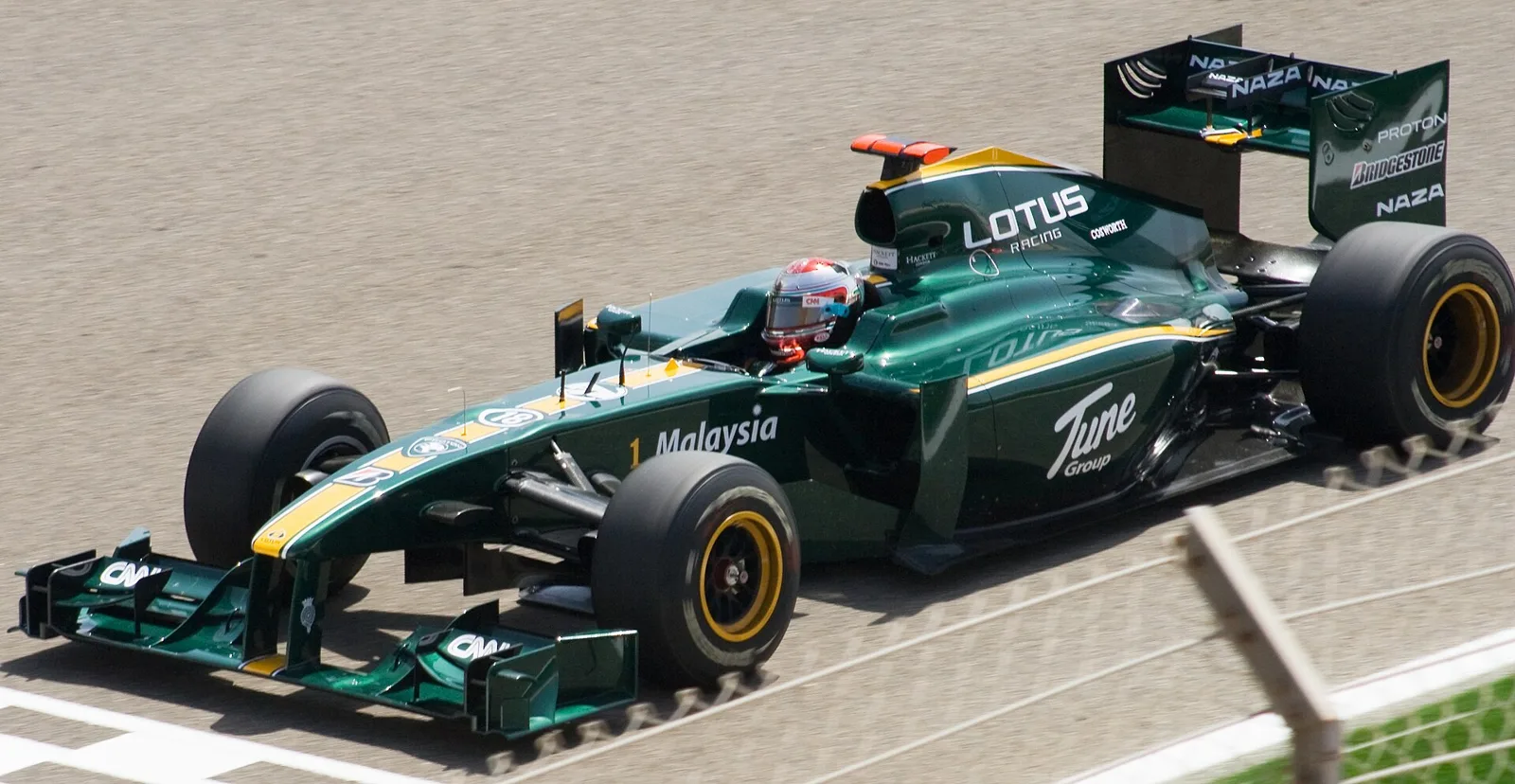
A Malaysian-backed debut car, built fast in a bare factory, that gave the Team Lotus name its return to Formula One grids.
The Lotus T127 was the Formula One car designed and raced by Lotus Racing in the 2010 season. Jarno Trulli and Heikki Kovalainen drove it, with Fairuz Fauzy as test and reserve driver. It was launched in London on 12 February 2010 and finished ahead of the other new teams in most races.
Lotus Racing used the T127 for its first Formula One season in 2010, under a name with a long history in the sport. Its story is as much about a fight over a famous name as about the racing, and on track it was consistently the fastest of the three new teams.
How did the Lotus name return to Formula One?
The original Team Lotus collapsed in 1994, but before that season ended the rights to its name were bought by David Hunt, brother of former champion James Hunt. In 2009 the FIA announced plans for a budget-limited championship for 2010, and Litespeed obtained the right to apply under the historic name. Lotus Cars, which was tied to the original squad, kept its distance from the project and said it would take steps to defend its good name should that prove necessary.
When the 2010 entry list appeared on 12 June 2009, the Litespeed entry was not among those selected. The Litespeed F3 team then turned to Tony Fernandes, a Malaysian businessman who already backed Williams through his AirAsia airline. Reports in September 2009 said the Malaysian government would back a Lotus-named entry to promote Proton, the carmaker behind Lotus Cars.
The FIA granted the Malaysian-backed Lotus Racing a place for 2010 on 15 September 2009. Running the operation was 1Malaysia Racing Team Sdn Bhd, a venture that was privately financed and owned by Tune Group and Naza Group. Proton allowed the Lotus brand to be used, while the government said it would invest only through Proton. Group Lotus later ended the licence for future seasons, citing what it called serious and repeated breaches.
The name came fully back on 24 September 2010, when Fernandes bought the name rights from David Hunt. That step formally restored the Team Lotus name to the grid.
A Malaysian-backed debut car that gave the Team Lotus name its return to the Formula One grid.
Who designed and built the T127?
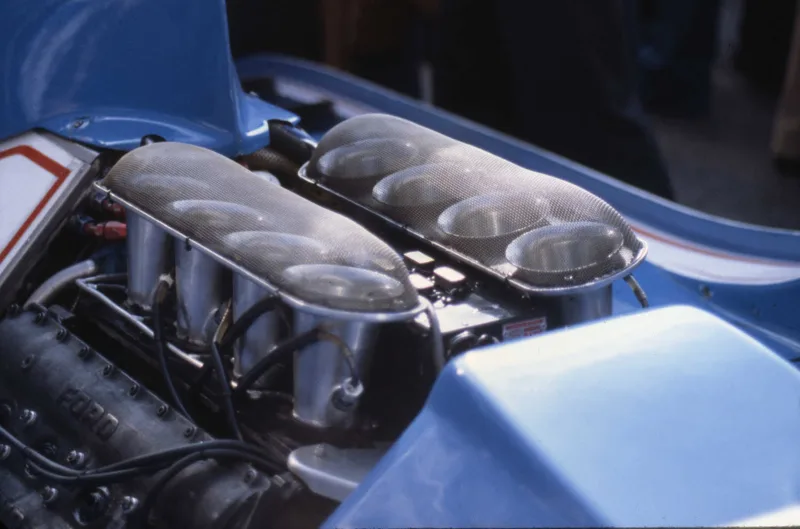
The T127 was built by Lotus Racing from a factory that was largely empty when work began on 14 September 2009. Its engines came from Cosworth and its gearboxes from Xtrac, and its shape was first shown in October 2009, as wind tunnel testing got under way.
Development started late because the team's entry was accepted late. The first four people began work in a factory that was bare and old. When Heikki Kovalainen first visited, workers were still building walls and floors. Mike Gascoyne phoned contacts he knew to help, and by November the team had a mock engine design.
Gascoyne spoke often about the heritage the team had to live up to. He hoped to rival the impact of Brawn GP, but accepted that Brawn already had a car ready and needed only money, which made the challenge harder. The first goal was simply getting a car onto the Bahrain grid in 2010.
Aerodynamic work was carried out with Fondtechon. In November the two men spoke together about how heavy the famous name felt.
The line-up was confirmed on 14 December 2009: Jarno Trulli, who had raced for Toyota, and Heikki Kovalainen, who came from McLaren. Fairuz Fauzy, a Malaysian, was named as test and reserve driver. Trulli said goals for the first year had to be realistic, and that the team had to earn respect among the new teams.
How did the T127 perform in its first season?
The T127 was the fastest of the three new teams for most of 2010, with Heikki Kovalainen finishing ahead of the Virgin and Hispania cars at most races. Kovalainen finished 15th in Bahrain and 14th in China, and the team ended the season tenth in the constructors' standings.
The car made its track debut at Circuito de Jerez on 17 February 2010, driven by Fauzy. In Bahrain Kovalainen finished 15th, two laps behind the race winner, and was the only one of the three new teams to cross the line. Trulli retired on lap 46 with hydraulic problems but was classified, having covered more than 90% of the race distance.
In China Kovalainen ran as high as sixth behind the safety car, the first time a new team had been running in the points all season, and he finished 14th. Trulli retired on lap 36 with another hydraulic failure. Australia was less fruitful: Trulli did not start after a hydraulic failure on the grid, while Kovalainen finished 13th.
By Spain it was becoming clear that Lotus Racing had the edge over Virgin and Hispania. Kovalainen's gearbox software tried to select two gears at once before the race, which broke the gearbox, and he pitted before the start. Trulli finished 17th, ahead of both Virgin cars. Monaco brought Kovalainen the fastest qualifying time of the three new teams, and it was the first time Trulli had been out-qualified at Monaco by his own teammate. Kovalainen's race ended on lap 58 when his steering failed.
Monaco also prompted a rule change. After complaints that slower new teams could hold up faster cars, the FIA set a maximum lap time for qualifying, and any car needing more than one minute and twenty-two seconds from the first corner to the last drew a penalty. Trulli said nobody had any cause to complain, because the teams had time to find a solution.
At Rascasse Trulli tried to pass Karun Chandhok, and his Lotus mounted Chandhok's car. Chandhok raised his hands to protect his helmet as the car came across him, and he was fortunate to escape injury. Both drivers walked away, and Trulli later apologised.
In Australia the two Lotus cars lined up 19th and 20th, and Trulli's seat bounced around in his car. Monaco had been a concern for the new teams, which were three to six seconds off the established teams' lap times, making the narrow layout a worry.
The Malaysian Grand Prix was the team's home race, and qualifying was thrown into chaos by a storm. McLaren and Ferrari drivers kept to their garages while others set banker laps, and the rain arrived before they could get a representative time. Kovalainen had set a good Q1 time, got ahead of Trulli into Q2 and was quicker than Glock there. In the race he pitted on lap 20 with hydraulic issues and finished ten laps down without being classified, while Trulli collided with Glock on lap three and later struggled with hydraulics. Glock, the Virgin driver, retired after that contact.
Turkey brought a new rear wing that improved the balance of the chassis, but both cars suffered hydraulic failures. Even so, Lotus again out-qualified the other two new teams. Canada ended with Trulli stopping in the pit entry with brake problems. In Germany Trulli could not select second gear and retired, and Kovalainen also retired.
By the end of the season the T127 was clearly the faster of the three new teams, despite persistent hydraulic trouble. At Japan Kovalainen came 12th, the first new team across the line, which helped consolidate Lotus in tenth place, while Trulli was 13th. Kovalainen finished 12th again in Korea.
Which incidents defined the season?
The most serious incident came at Valencia, where Webber's Red Bull collided with Kovalainen on lap nine and both drivers were taken to the medical centre. Kovalainen retired from the race after the contact. At Singapore Kovalainen's car caught fire, and he put out the flames himself. Trulli's Monaco clash with Chandhok was another low point of the year.
At the European Grand Prix in Valencia, Webber tried to pass Kovalainen for 17th place by running in his slipstream at about 190 mph (310 km/h) along the main straight. Kovalainen braked earlier than Webber expected and the cars made contact. The Lotus struck an advertising hoarding and somersaulted, and Webber's car landed on its nose before hitting a tyre barrier. Webber later admitted he had misjudged how early Kovalainen would brake, while Kovalainen blamed Webber.
At Singapore Kovalainen and Sebastien Buemi tangled in the closing sector of the lap. A cracked valve in the fuel tank pressure system left Kovalainen's car burning at the rear. He pulled up on the main straight, climbed out and put the fire out himself, using an extinguisher handed to him by members of the Williams team.
Livery and the 500th race
The T127 used the historic green and gold Lotus colours, with a 1Malaysia logo on the bodywork. The Malaysian flag also featured on the engine cover in Malaysia and China. Drivers wore white overalls for the first four races, and green from the Spanish round onwards.
The Branson wager was a lighter side of the season. In December 2009 Tony Fernandes accepted a challenge from Richard Branson: the loser's boss would work on the winner's airline for a day, dressed as a stewardess. The team produced a poster of Branson in an AirAsia uniform. The date slipped several times, first because Branson broke a leg, then because of a royal wedding and a fire on Necker Island, and Branson finally honoured the bet years later.
At the European Grand Prix the squad celebrated the 500th Grand Prix for the Lotus brand. The car carried the number 500 between laurels on its rear, and relatives of Colin Chapman, who founded the original Team Lotus, came along to the celebration.
Specification and results overview
| Item | Detail |
|---|---|
| Team | Lotus Racing, renamed Team Lotus at the British Grand Prix |
| Season | 2010 Formula One World Championship |
| Drivers | Jarno Trulli and Heikki Kovalainen |
| Test and reserve driver | Fairuz Fauzy |
| Engine | Cosworth CA2010 |
| Gearbox | Xtrac |
| Unveiled | London, 12 February 2010 |
| First track run | Circuito de Jerez, 17 February 2010 |
| Best Kovalainen finish | 12th at Japan and at Korea |
| Team position | Tenth in the constructors' standings |
The team was renamed Team Lotus during the British Grand Prix, and it brought a final update to the T127 as attention shifted to 2011. It was also reported that Lotus was nearing a deal for Renault engines for 2011, because of a number of transmission problems with the car and the Cosworth CA2010 engine.