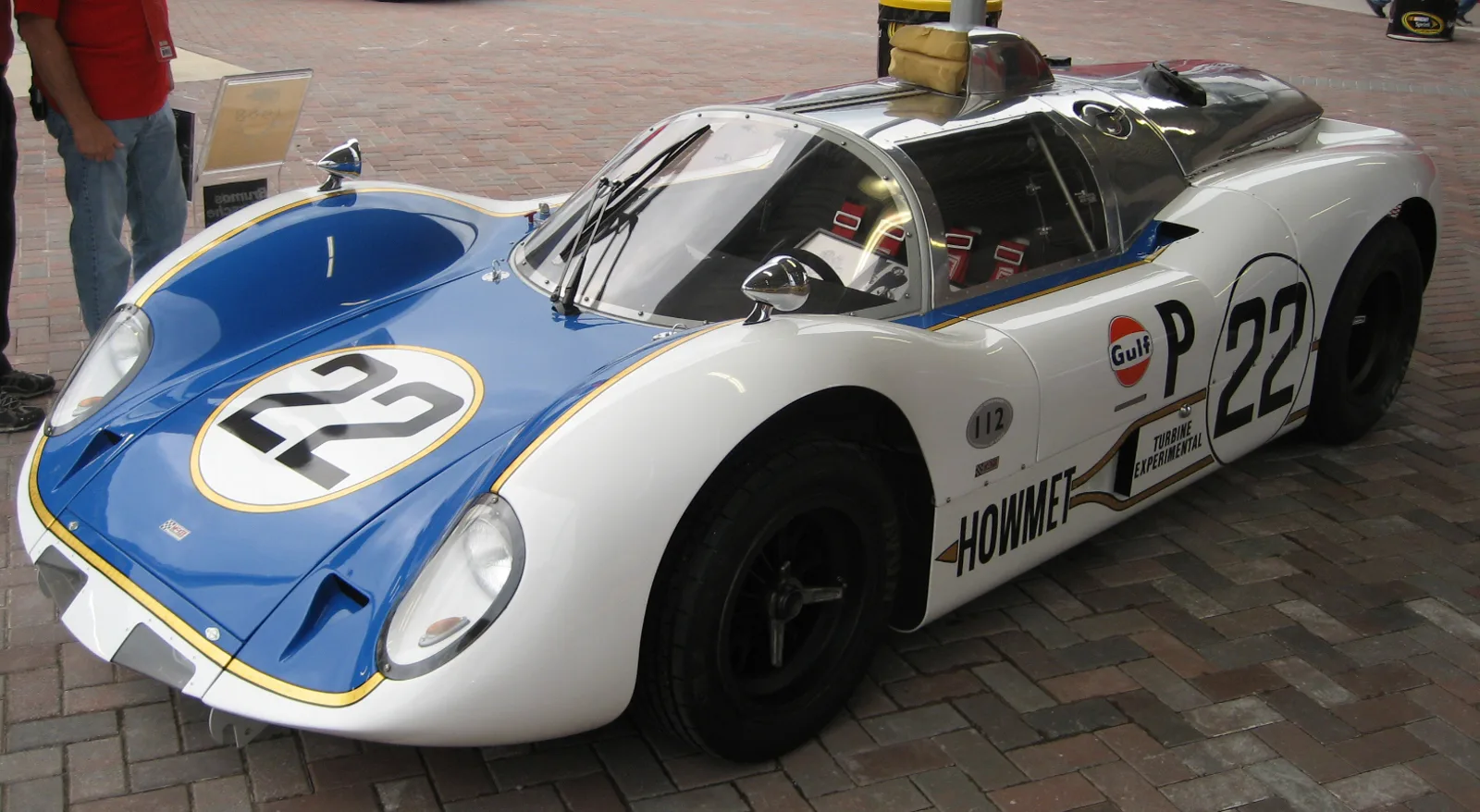
Built in 1968 to test a gas turbine in sports car racing, the Howmet TX won SCCA races, was disqualified at Le Mans and later set six FIA land speed records.
The Howmet TX was a 1968 American sports prototype built to test a gas turbine in sports car racing. Its Continental turbine gave it two SCCA main race wins, and the car later set six FIA turbine land speed records.
The Howmet TX, short for Turbine eXperimental, was an American sports prototype built in 1968 to see whether a gas turbine could compete in sports car racing. Racer Ray Heppenstall planned it, and the Howmet Corporation funded it and lent its name to the car.
Although it was not the first turbine in racing, the TX was the first turbine to win a race. It took two SCCA main race victories and two sprint wins in its only year of competition, and the car later set six FIA land speed records for turbines.
Why did a sports car team build a turbine racer?
Interest in gas turbines as an alternative to the piston engine was growing during the 1960s. Heppenstall saw the TX as a way to show that a simpler chassis could make a turbine car competitive against piston rivals.
Chrysler had leased its Turbine Car to the public from 1963, and the British firm Rover combined with BRM to build a turbine racer for Le Mans in 1963 and 1965. Both programmes showed reliability, but neither won over the public or the race itself.
In 1967 Andy Granatelli's STP-Paxton Turbocar nearly won the Indianapolis 500 with Parnelli Jones before a mechanical failure ended its run. A Lotus 56 with a turbine also showed winning potential at Indianapolis in 1968, but it retired as well.
Heppenstall began to conceive his own turbine sports car at the same time as Granatelli's Indianapolis debut. He first offered the design to the Allison Engine Company, then to Williams Research, before turning to fellow racer Tom Fleming for help.
A turbine sports car that won two SCCA main races in its only season and then set six FIA land speed records for turbines.
How was the Howmet TX built?
Fleming was a vice-president at Howmet Corporation, which made castings for turbines in the aerospace industry. He and Heppenstall convinced the company that backing a unique sports car could raise public awareness of the firm, and Howmet agreed to fund the project.
Heppenstall first bought a Cooper Monaco sports car, but he judged it unsuitable for a turbine and sold it on. He then contracted Bob McKee of McKee Engineering to build two cars, both of which were known to McKee as the Mk.9.
The first chassis came from an older McKee car that had been built for the Can-Am series in 1966 and was adapted to house the turbine. The second car, GTP2, was built from scratch and was designed around the turbine, with a chassis 57 mm (2.25 inches) longer.
The Mk.9 was designed around the FIA Group 6 regulations for sports prototypes, which allowed a custom mid-engine layout limited only by the engine sizes on offer. McKee gave the car a closed cockpit with gullwing doors, which shrouded the mid-engine layout.
The suspension used double wishbones with coil springs, and each wheel had a disc brake. A 32-US-gallon (120 L; 27 imp gal) fuel tank for Jet A sat between the cockpit and the turbine.
What turbine powered the Howmet TX?
The turbines were leased from Continental Aviation and Engineering. They were TS325-1 units, prototypes left over from an aborted bid for a military helicopter contract, and Continental had no other use for them at the time.
Each turbine weighed 170 pounds (77 kg) and produced 350 bhp (260 kW) and 650 lbf ft (880 N m) of torque. It could reach a maximum of 57,000 rpm, which made the output a wide and very strong range.
The drivetrain had two stages: an internal power turbine drove the rear wheels via reduction gears. The torque was so high that a conventional gearbox was unnecessary, so the TX ran with a single gear. Its ratios could be changed in the differential to suit different circuits.
The single-speed design had no reverse gear, which the FIA required. Heppenstall had wanted to do without reverse, but a small electric motor driven by the turbine was installed to give the car reverse.
The turbine had two large exhaust pipes and a third, off-centre pipe for a wastegate. The wastegate reduced the lag between the driver's throttle input and the turbine's response, because it regulated the hot gas flow to the power turbine.
The FIA used an equivalence formula to give the Continental TS325-1 a displacement of 2,960 cubic centimetres, which placed the car in the Prototype Under 3000 cc class. Heppenstall later admitted that the engine was actually above the three-litre limit.
How did the TX race in 1968?
The TX made its debut at the 1968 24 Hours of Daytona, where it qualified seventh. A wastegate failure on lap 34 caused the car to spin and hit a barrier, which forced the team to retire.
The car was quicker at Sebring, where it qualified third, trailing the front-running Porsche 907 and Ford GT40 by about one second. Debris damaged the turbine as the race went on, and it shook loose from its mounts, so the TX retired after six hours.
The International Championship then returned to Europe, and the team followed. At Brands Hatch the wastegate problems caused another crash, this time after seven laps, and a starter motor failure at Oulton Park ended the hour-long sprint for Hugh Dibley.
The team then took the TX home to America for the SCCA National Championship instead of continuing through Europe. The problems that had plagued the car in Europe were eased, and it finished its first American race.
Why did the SCCA wins matter?
The TX's first US race was the Vandergraft Trophy in New Cumberland, West Virginia, where Heppenstall finished second and set a new lap record for the circuit. The car then retired in Michigan before reaching the Heart of Dixie event in Huntsville, Alabama.
At Heart of Dixie the TX won the sprint held the day before the main race, which gave it pole position. It then dominated the main event for its first main race victory. Those two wins were the first ever by a turbine-powered car in a racing event.
Heppenstall was joined by Dick Thompson for the Marlboro 300, where the car again won the qualifying sprint to take pole. It led every lap of the main event and won by an eleven-lap margin, which made it the car's second main race win.
Feeling that the TX could now take on European entries, the team sent both cars to the 6 Hours of Watkins Glen, another round of the International Championship. They qualified eighth and ninth, and one entry finished on the podium and was the highest finisher in its class, earning four points.
What happened at Le Mans in 1968?
The TX team's Le Mans bid had Pechiney as its sponsor, and the race was postponed until September. The cars qualified twentieth at best, and mechanical problems struck early in the race.
Thompson's car was short of fuel because the system could not supply enough Jet A to the turbine, so it limped down the long straights. Two hours later the other car suffered a wheel bearing failure, which needed a lengthy repair.
One car was disqualified after covering only 60 laps, and Thompson's car later crashed at the Indianapolis corner, which ended the Le Mans attempt.
With the 1968 season over, Heppenstall had planned to develop a multi-gear transmission to replace the single-speed unit. Howmet felt the programme was not giving the company enough promotion, so it decided to discontinue it.
How did the TX become a land speed record car?
Howmet decided in 1969 that the two cars could still serve a promotional purpose. Heppenstall rebuilt the second chassis, GTP2, with open-cockpit bodywork and renamed it the Howmet TX Mk.II.
The TX Mk.II weighed about 1,000 kilograms (2,200 lb), and ballast could be added or removed to allow attempts at two classes of records. In August 1970 Heppenstall drove the car on a road beside Talladega Superspeedway and set six FIA records for turbine-powered cars.
IMSA, the International Motor Sports Association, handled the timing of those runs. The six records were the car's main achievement after its racing programme ended.
What happened to the two Howmet TX cars?
Howmet ended its promotional use of the cars in 1971 and sold both chassis to Heppenstall for one US dollar. The two Continental turbines had been leased to Howmet, so they had to be returned once the cars were out of the company's hands.
Chassis GTP1 was bought by Jim Brucker, who kept it in his collection in California with a mock-up turbine in the engine bay. In 2006 Bruce Linsmeyer of Avon Aero bought the car and restored it with an original Continental turbine. After restoration GTP1 won the Sebring Trophy at the 2007 Amelia Island Concours d'Elegance.
GTP2 was converted back into its original closed-cockpit design by McKee Engineering for its new owner, Chuck Haines. That work finished in July 1996. Because the original Continental units were unavailable, the restorers fitted an Allison 250C18.
Bob McKee built a spare frame, GTP3, to original specification for Haines. Haines has entered the spare, GTP3, in historic events, including the 2007 Goodwood Festival of Speed.
What were the Howmet TX specifications?
| Specification | Detail |
|---|---|
| Name | Howmet TX, Turbine eXperimental |
| Designer | Ray Heppenstall |
| Chassis | McKee Engineering, Mk.9 design, two cars |
| Turbine | Continental TS325-1, leased from Continental Aviation and Engineering |
| Turbine output | 350 bhp (260 kW), 650 lbf ft (880 N m) of torque |
| Turbine weight | 170 pounds (77 kg) |
| Maximum turbine speed | 57,000 rpm |
| Fuel | 32-US-gallon (120 L; 27 imp gal) tank for Jet A |
| Displacement (FIA) | 2,960 cubic centimetres, Prototype Under 3000 cc class |
| Race wins | Two SCCA main races, plus two sprint wins |
| Land speed records | Six FIA turbine records, August 1970 |
| Mk.II weight | About 1,000 kilograms (2,200 lb) |
The figures show a car built around a turbine rather than a piston engine. Its single gear, electric reverse and wastegate were all responses to the turbine's character, as the sections above explain.