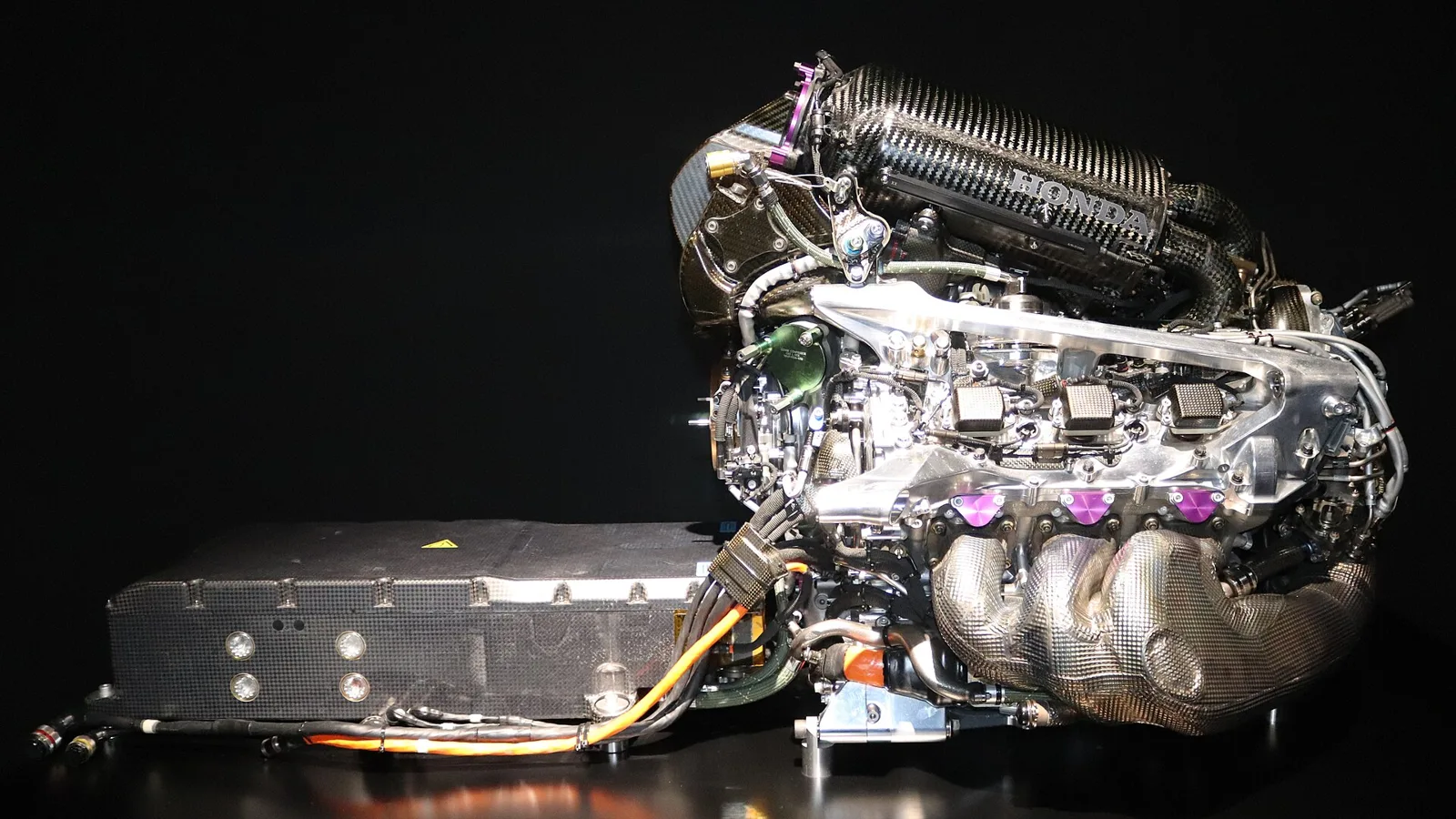
Honda's V6 hybrid came back to Formula One in 2015 with an undersized design, grew into a title-winning unit and entered the 2026 rules with Aston Martin.
The Honda V6 hybrid was a 1.6-litre turbocharged Formula One engine that Honda supplied from 2015 to 2025, then again under the 2026 rules. It powered McLaren, Toro Rosso, Red Bull Racing and AlphaTauri, and its 2021 unit helped Max Verstappen win his first world title.
The Honda V6 hybrid Formula One power unit was a 1.6-litre turbocharged engine that Honda built for the sport from 2015 to 2025, and then for the new rules of 2026. It combined an internal combustion engine with two electric motors, and it powered cars for McLaren, Toro Rosso, Red Bull Racing, AlphaTauri, Racing Bulls and, from 2026, Aston Martin.
Why did Honda return to Formula One in 2015?
Honda was drawn back by the hybrid regulations introduced in 2014, which offered a demanding technical challenge and an environmental direction. It had planned to enter in 2016 in a works partnership with McLaren, but McLaren's chief executive, Ron Dennis, pushed for an earlier start, and Honda accepted entry for 2015 because its contract with Mercedes was expiring.
Honda had been out of Formula One for more than seven years, and the early entry meant it arrived a year sooner than planned. The company later admitted that it had underestimated the technical challenge and entered the championship too early.
An undersized 2015 engine that became a championship unit through rapid combustion, a rushed 2021 redesign and a new fuel era.
What was the RA615H and why did it struggle?
The RA615H debuted in the McLaren MP4-30 in the 2015 season. Rivals Renault, Mercedes and Ferrari had already introduced their units a season earlier, so Honda chose an aggressive and radical concept to make up for lost time. At McLaren's request it focused on compact dimensions and high operating temperature, so that the cooling needed for the bodywork could be reduced.
The result was so small that McLaren nicknamed it "The Size-Zero". However, the turbocharger was undersized, its compression was poor, and the intake system was too complex. The hybrid side suffered as well, and the MGU-H regularly overheated. Honda blamed teething problems that appeared only once the engine ran under racing loads in a moving chassis. Development was further slowed by the development token system, which limited upgrades during the season.
| Season | Engine | Car and team | Main change |
|---|---|---|---|
| 2015 | RA615H | McLaren MP4-30 | Compact Size-Zero concept, reliability problems |
| 2016 | RA616H | McLaren MP4-31 | Bigger package, reworked intake and exhaust |
| 2017 | RA617H | McLaren MCL32 | Split turbo and compressor, pre-chamber ignition |
| 2018 | RA618H | Toro Rosso STR13 | Redesigned MGU-H, Spec 2 in Canada |
| 2019 | RA619H | Red Bull RB15, Toro Rosso STR14 | Two-team supply, rapid combustion fully integrated |
| 2020 | RA620H | Red Bull RB16, AlphaTauri AT01 | K-Plating and 3D printed parts |
| 2021 | RA621H | Red Bull RB16B, AlphaTauri AT02 | Entirely new architecture |
| 2022 | RBPTH001 | Red Bull RB18, AlphaTauri AT03 | E10 fuel, freeze begins |
| 2026 | RA626H | Aston Martin AMR26 | MGU-H removed, new regulations |
How did the RA616H and RA617H change the engine?
The RA616H, raced in the McLaren MP4-31 in 2016, kept the Size-Zero idea but grew considerably after McLaren agreed to give it more room. The induction system was raised, the exhaust was reworked with equal-length runners, and the MGU-K and MGU-H received improved magnets. The engine was more reliable and McLaren had a better year, but Honda concluded the architecture had reached its limit.
The RA617H, which raced in the McLaren MCL32 in 2017, was a completely new design after the development token system was scrapped. The compressor and turbine were split and placed at either end of the block, and a shaft linked them across the engine. That lowered the centre of gravity and allowed larger components, but it also introduced a lot of risk.
Honda's new combustion system, Turbulent Jet Ignition or pre-chamber ignition, was among the most experimental parts of the unit, and Honda described the whole package as high risk. Pre-season testing at Catalunya exposed oil tank problems, and a catastrophic turbo and MGU-H shaft failure appeared at the second test week. McLaren Honda changed complete power units repeatedly, and the season was run on a lower tune than the year before.
What did the RA618H achieve at Toro Rosso?
The RA618H was the first Honda engine for Scuderia Toro Rosso, in the STR13, and it was far more mature than the RA617H. Toro Rosso gave Honda more freedom over packaging, and the engine suffered only three engine-related retirements across the whole season.
The MGU-H was redesigned with input from HondaJet, Honda's aerospace division, because its shaft spins up to the regulation speed limit. The shaft was resized, its bearings were improved, and the rotor was housed in a pressurised chamber, which largely removed the vibration problems of the earlier unit.
The Spec 2 version arrived at the Canadian Grand Prix, and it delivered a clear jump in power. Honda believed that gain pushed it ahead of Renault in performance and reliability, and it convinced Red Bull Racing to sign Honda from 2019 to replace Renault.
What was rapid combustion?
During research in 2018 at the HRD headquarters in Sakura, Honda engineers running a prototype 2019 engine on the dynamometer noticed that cylinder pressure and power jumped for a moment before disappearing. The cause was a mismatch of certain specification parts on the test engines, but the phenomenon led to a deeper study of combustion.
Honda called the result rapid combustion. In a conventional engine the flame spreads outward from the spark plug, so ignition has to be timed early and the energy release is not all at the optimal point. Rapid combustion uses pre-chamber jet flames to ignite the charge from many points, which burns faster and allows a much leaner air and fuel mixture. The price was a large rise in pressure that stressed the engine.
The Spec 3 engine first ran in a race weekend at the 2018 Russian Grand Prix, with a gain of approximately 40-50hp that exceeded estimates. It also pushed the engine past its structural limits, and the gearbox needed further work before shifts were smooth.
How did the RA619H and RA620H refine the design?
The RA619H was the first Honda unit supplied to Red Bull Racing, debuting in the RB15 in 2019. It was also the first time Honda supplied two teams simultaneously in the hybrid era, with Toro Rosso running the STR14. Fuel partner ExxonMobil developed a fuel that stabilised the rapid combustion process in time for the race debut.
Honda then worked on calibration and energy management. At the French Grand Prix it introduced a new compressor, and for the Austrian Grand Prix, held at high altitude, it used calibration that kept power high in heat and altitude, where rivals ran into cooling problems. Max Verstappen won that race. By that point the RA619H's output was closely matched with the Mercedes engine.
The RA620H followed in 2020 for Red Bull and AlphaTauri. Honda applied a patented surface coating called Kumamoto Plating, or K-Plating, to the cylinder bores to cut wear. It also introduced an "Extra Harvest" mode for faster energy recovery, used 3D printing for the turbine housing in Inconel and for the pistons, and added the Charge Air Cooler 2, which routed air into non-firing cylinders to give a turbo boost effect and extra knock resistance.
Why did Honda rush the RA621H into 2021?
The RA621H was planned for 2022, but Mercedes' M11 EQ Performance unit made a substantial step in 2020, and Honda accelerated its project. That left just six months to finish the engine for the 2021 season. Honda admitted the risk was considerable, but it believed this was the only route to overtaking Mercedes. Red Bull Racing gave its blessing, and the RA621H went into the RB16B and AT02.
The engine redesigned the whole internal combustion architecture for the first time. The camshaft layout was more compact, the cylinder block was machined from a single billet instead of cast, and the exhaust manifolds became asymmetric. The energy store was also new. It was an in-house Honda design using carbon nanotubes, with a volumetric density 1.3 times the 2020 unit, and it was 26% smaller and 15% lighter than the 2015 store.
The RA621H became the front runner of the field, with superior power, energy recovery and reliability. It was a key factor in Max Verstappen's first World Drivers' Championship in 2021.
How did the 2022 and 2024 engines cope with the new fuel?
The RBPTH001 was a development of the RA621H for the 2022 and 2023 seasons, powering the RB18, RB19, and their AlphaTauri partners. It was the last permitted design change before the engine freeze began on 1 March 2022. The biggest change was the move to E10 fuel, which contains ethanol. Ethanol has a lower energy content, and because fuel flow was limited to 100kg per hour, Honda had to make the engine more thermally efficient instead of simply burning more fuel.
The ethanol blend resists detonation and cools the charge through its higher latent heat, which allowed Honda to raise the engine's nominal running temperature. The bottom end was strengthened, the ignition map was rewritten, and the crankshaft and bores were adjusted for the new combustion. Honda reported a thermal efficiency well over 50%, against 20 to 35% for road car engines.
The RBPTH002 followed for 2024 and powered the RB20, RB VCARB 01, RB21 and VCARB 02 in 2025. With the freeze in place, development was limited to reliability, and the changes were enough to justify a new designation. The engine could run in a higher power mode for longer without degrading.
What happened with the RA626H in 2026?
The RA626H was designed for the 2026 regulations, which removed the MGU-H, raised the MGU-K output to about 470 bhp (350 kW) from 160 bhp (120 kW), cut internal combustion output to 540 bhp (400 kW) from 850 bhp (630 kW), and lowered the compression ratio limit from 18:1 to 16:1. Fuel was limited to roughly 70kg per race, and the engine had to run on 100% sustainable fuel. Honda revealed it in Tokyo on 20 January 2026 and ran it first on 27 January at Barcelona.
Testing at Bahrain exposed severe problems. Vibrations damaged the battery system and meant neither driver could manage more than 15 laps before losing feeling in their hands. Aston Martin recorded the lowest mileage of all teams, with three breakdowns across the tests and a lap time four seconds slower than Charles Leclerc's Ferrari. Honda used many spare parts in Bahrain alone.
At the 2026 Australian Grand Prix both cars were run as a test, with the team pitting to collect data, and both drivers withdrew after finishing last among the cars still running. A second double retirement followed at the next round. Honda and Aston Martin worked to isolate the vibrations, and by the Japanese Grand Prix the team finished 18th, with a countermeasure that nearly removed the vibrations in one session. At Miami the cars finished 15th and 17th.
After the Monaco Grand Prix the FIA's Additional Development and Upgrade Opportunities process gave Honda extra budget and development time, because its internal combustion engine was 6-8% (36-48hp) behind the RBPT Ford unit. Honda was allowed two additional engine specifications during 2026. The Spec 2 engine arrived at the Dutch Grand Prix, improving lap times by roughly a fifth of a second, although drivers complained about downshifts and engine braking while the software was being integrated.
| Round or event | Result | Note |
|---|---|---|
| Bahrain tests | Three breakdowns across the tests | No driver managed more than 15 laps |
| Australian GP | Both cars finished last among the running cars | Race run as a test session |
| Japanese GP | 18th | First full race distance |
| Miami GP | 15th and 17th | Vibrations reduced to normal levels |
| Dutch GP | Spec 2 introduced | A gain of roughly a fifth of a second per lap |
What is the legacy of the Honda V6 hybrid?
The Honda programme is one of the most dramatic recoveries in modern Formula One. It began as an unreliable and underpowered design in 2015, then became a championship-winning engine. Honda became the first manufacturer to win a Formula One race with two different teams in the V6 hybrid era, and its engines were part of Verstappen's record-breaking seasons.
The programme also shows the cost of rushing. Honda admitted that its early entry and lack of experience with the new rules shaped its problems, and its later engines benefited from that lesson. The 2026 season began another difficult chapter, but the unit has a long record of developing technology that later influenced the sport.