Riley and Scott chassis, a turbocharged Northstar V8 and a Le Mans return that General Motors ended after three seasons.
The Cadillac Northstar LMP was a family of Le Mans prototypes that Cadillac raced in the American Le Mans Series from 2000 to 2002. They took their name from the Northstar V8 that powered them, and the first generation used Riley and Scott chassis before a custom Cadillac design replaced them.
Cadillac built the Northstar LMP to race in the American Le Mans Series and to mount a return to the 24 Hours of Le Mans. Over three seasons from 2000 to 2002 it ran two generations of prototype, both powered by a twin-turbocharged version of the Northstar V8. General Motors then ended the programme so that it could concentrate on the Chevrolet Corvette.
Where did the Northstar LMP come from?
The programme grew out of General Motors' plan to bring Cadillac back to the 24 Hours of Le Mans, a race the brand had first entered in 1950. The prototypes were named after the Northstar V8 engines that drove them. Riley and Scott, builders of the successful Mk III chassis, produced the first design.
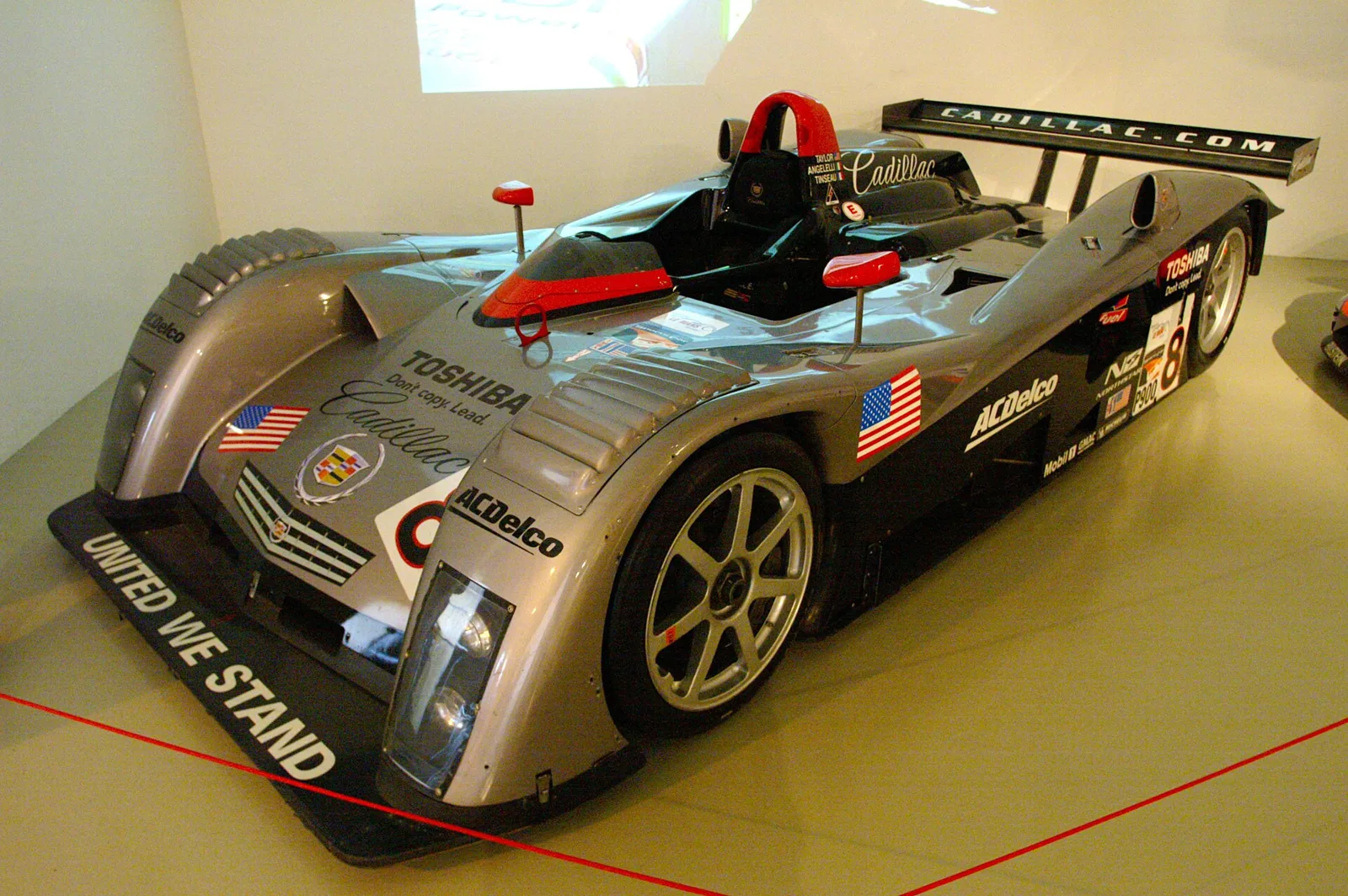
Riley and Scott developed a from-scratch prototype around a bespoke carbon fibre monocoque. The bodywork carried Cadillac's Art and Science design theme, with a functional egg-crate grille on the nose and large side scoops that fed air to the turbochargers.
Two generations of turbocharged Northstar prototypes, one Le Mans push and a programme that lasted three seasons.
How many chassis were built?
Ten Northstar LMP chassis were built in total, seven from the first generation and three all-new LMP02s. Just two teams raced them: Team Cadillac and the French squad DAMS. Two of the first-generation monocoques went to Team Cadillac and three to DAMS, while one became the crash test and show car and one spare tub went back to GM.
The first generation shared a Riley and Scott origin, while the LMP02 was a Cadillac design from the ground up. The programme therefore produced ten cars across two distinct designs. That change is the clearest way to follow the programme, because each generation brought a different body, chassis and turbocharger arrangement.
How was the Northstar engine used in the prototypes?
The prototypes used a 4.0 L Northstar derived from the L47, a unit from the Oldsmobile Aurora sedan. That engine had been adapted for Indy Racing League use in 1995, and the programme's version was twin-turbocharged for endurance racing. The 4.0 L capacity stayed unchanged.
McLaren Engines helped develop the prototype engine, while Ishikawajima-Harima Heavy Industries (IHI) produced the twin turbochargers. The aim was more power as well as more durability, because a prototype had to survive the long distances of Le Mans and the American endurance races.
Engine changes did not stop with the first cars. For 2002 the Northstar V8 was modified again after two years of development, and Garrett turbochargers replaced the IHI units. The turbo change came with a new pneumatic shift system for the X-Trac gearbox.
The LMP01 update of 2001
For 2001 the car became the Northstar LMP01 and kept its Riley and Scott chassis. Nigel Stroud redesigned the bodywork, with the aim of making the car more competitive against the Audi R8. Little else changed, but the new shape was a clear step away from the original.
The sidepods no longer ran flat and horizontal. Instead they dived down toward the front wheel arches. The cooling ducts moved out of the sides and into the wheel wells, with air exits added there, and the grille lost its open functional design. Two of the 2000 cars were upgraded to the new bodywork, and a third was built fresh.
Because only the bodywork changed in 2001, the season is the cleanest comparison with the 2000 cars.
The LMP02 and the move to a custom chassis
For 2002 Cadillac stopped relying on Riley and Scott and used a new custom-built chassis, the Northstar LMP02, designed by Nigel Stroud. The car kept some aerodynamic ideas from the LMP01 but had a more angular shape, with a raised footbox in the nose and a large central air intake.
The stylised grille was dropped, and the side air exits were closed down to a minimum width, which gave the car a cleaner look than its predecessors. Three all-new LMP02 chassis were built, so the team no longer depended on a bought-in platform.
With DAMS gone, all development of the LMP02 fell to the American team. Cadillac again chose to concentrate on private testing before Le Mans,.
How did Team Cadillac and DAMS race in 2000?
In 2000 Riley and Scott ran the factory entry under the name Team Cadillac in the American Le Mans Series, while DAMS ran a customer effort in the Sports Racing World Cup. The cars were far off the pace in the long races, and the Le Mans effort ended with three finishers in 19th, 21st and 22nd.
At Daytona the factory cars qualified second and third, yet both finished 13th and 14th after problems. They ended nearly 100 laps behind the leading grand tourer cars. Team Cadillac also chose private testing ahead of Le Mans in 2000, which kept the team away from the early ALMS races. At Sebring one Team Cadillac car finished sixth, 29 laps behind the winning Audi R8, while another car was involved in an accident.
DAMS made a better start in Europe. Its debut in the Sports Racing World Cup brought seventh and eighth places, three laps behind the winning Ferrari 333 SP, and a fifth place at Silverstone followed in the ALMS. At Le Mans the DAMS car qualified ninth.
By the end of the year DAMS had finished seventh in the ALMS championship, one place ahead of Team Cadillac in eighth. In the Sports Racing World Cup, DAMS earned eighth in the championship. Team Cadillac had preferred private testing to early ALMS races.
At the Petit Le Mans all four Cadillac cars finished, placed sixth, seventh, eighth and 13th. Finishing all four cars was a useful result after a season of breakdowns.
What did the 2001 season bring?
In 2001 Cadillac focused on private testing for Le Mans, leaving DAMS to run a two-car effort at the race. Team Cadillac joined the American Le Mans Series only after Le Mans. Its best result came at Mosport, where it finished third and fourth, and the team ended the season tied for fourth in the teams championship.
Le Mans was a mixed weekend. DAMS qualified eighth, ahead of a new Bentley EXP Speed 8 and two Chrysler LMPs, but one Northstar LMP01 was taken out in an early accident. The surviving car improved on the previous year by taking 15th place.
The ALMS return at Sears Point was troubled, because both cars suffered problems. Results improved at Mid-Ohio, where the cars took seventh and eighth, and at Laguna Seca, where they took fourth and fifth. The season finished with another fourth and fifth at Petit Le Mans, which gave the team its best run of the year.
Le Mans and the 2002 season
The 2002 programme began at the 12 Hours of Sebring, where one car failed with an electronics fault late in the race and the other finished 31st. Team DAMS was no longer part of the project, so Team Cadillac carried the whole effort, and it again chose private testing ahead of Le Mans.
At Le Mans the LMP02s qualified eighth and tenth, ahead of an Audi and a Bentley. Both cars ran in the top ten for most of the race and finished ninth and 12th. That was the best Le Mans result of the programme since its start, and it came from the new custom chassis rather than the older Riley and Scott cars. In 2000 mechanical woes had left only three Northstar LMPs at the finish, so the progress was clear.
One DAMS car had been damaged in a fire at Le Mans in 2000 and replaced with another monocoque.
The team's strongest weekend came at Miami. JJ Lehto and Max Angelelli took second place in an LMP02, just fourteen seconds behind the winning Audi. Earlier in the year the team had taken fourth at Washington, a single lap behind the winners, and third and sixth at Mosport, with a third at Laguna Seca.
Petit Le Mans brought third and fourth places for the cars. Cadillac finished fifth in the championship with only half a season run,.
How did each season compare?
| Season | Best Le Mans finish | Best ALMS finish | Championship standing |
|---|---|---|---|
| 2000 | 19th (DAMS) | 6th at Sebring (Team Cadillac) | DAMS 7th and Team Cadillac 8th in the ALMS |
| 2001 | 15th (DAMS) | 3rd at Mosport (Team Cadillac) | Tied for 4th in the teams championship |
| 2002 | 9th (Team Cadillac) | 2nd at Miami (Team Cadillac) | 5th in the championship |
The 2000 numbers reflect cars that struggled for consistent finishes. By 2002 the LMP02 had produced several podium finishes in the ALMS, including second at Miami. The table is a useful guide to how the programme developed year by year.
At Le Mans the pattern was familiar. Qualifying eighth in 2001 and eighth and tenth in 2002 showed good pace, but early accidents and mechanical trouble limited what the cars could do in the race.
Why did the project end and what happened next?
General Motors ended the Cadillac project after the 2002 season. It judged that the programme had done what it was meant to do, and it chose to concentrate on the Chevrolet Corvette, which it considered the more successful programme. The company also kept the Northstar LMPs rather than offering them to privateers.
Customers never got the chance to race the cars during the programme. Every Northstar LMP stayed in GM's hands once the programme ended. In 2009 GM sold some specialty cars from the GM Museum, and the car carrying number 8, chassis 02-002, was sold to a privateer for the first time.
Cadillac returned to prototype racing in 2017 with the DPi-V.R, which competed in the WeatherTech SportsCar Championship. It was the brand's first prototype programme since the Northstar cars. That car was a separate project, and it did not carry the Northstar name into the new era.