A Tilke-designed track near Delhi that hosted three Indian Grands Prix before a legal and tax fight left it without Formula One.
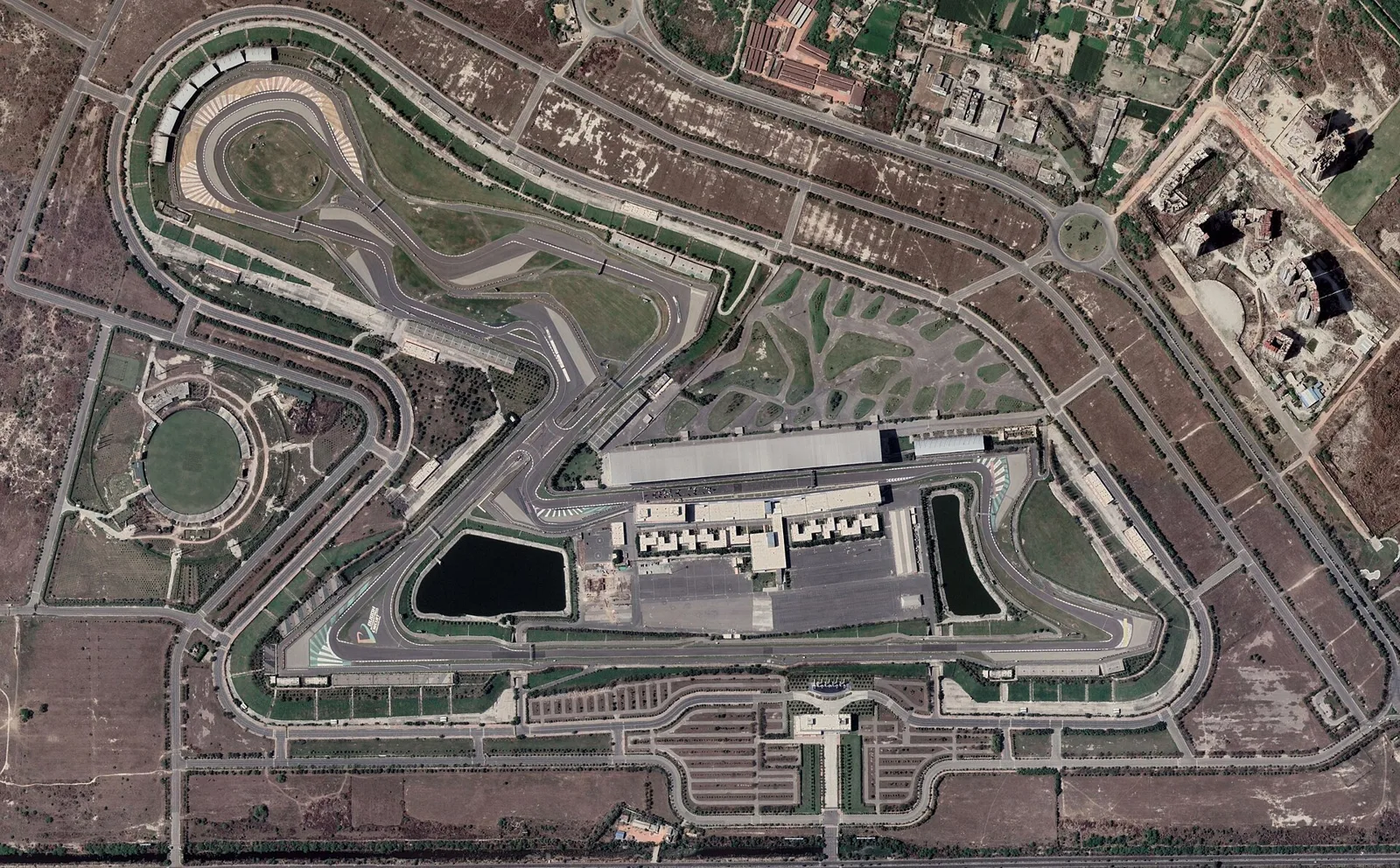
The Buddh International Circuit is a 5.125 km (3.185 mi) motor racing track in Jaypee Sports City, Greater Noida, India, designed by Hermann Tilke. It hosted the Indian Grand Prix from 2011 to 2013. A tax dispute then led to the race being suspended and cancelled, and the circuit now runs local series and track days.
The Buddh International Circuit sits in Jaypee Sports City in Greater Noida, Uttar Pradesh, India. Designed by Hermann Tilke and inaugurated in October 2011, it was built to stage the Indian Grand Prix. Formula One raced there for three seasons before a tax dispute led to the race being suspended and then cancelled.
Where is the Buddh International Circuit and where does its name come from?
The circuit lies in Jaypee Sports City and takes its name from Gautam Buddh Nagar, the district that contains it. It was first called the Jaypee Group Circuit, then the Jaypee International Circuit, before the April 2011 renaming. The name links the track to the same region that gave its title to the Buddha.
Sameer Gaur, the managing director and chief executive of Jaypee Sports International Limited, explained that the location made the name a logical choice for the company. The logo's stylised B is shaped like a heart and stands for Buddh and Bharat, the native name of India. Its saffron, green and white colours echo the national flag, while the curves in the letter suggest the lines of a racetrack.
Inaugurated two weeks before its first race, the circuit's Formula One era ended over tax rather than on the track.
How did the Indian Grand Prix come to Greater Noida?
The project began with a tentative 2007 deal involving the Indian Olympic Association and Bernie Ecclestone, who headed the Formula One Group at the time. Land in Greater Noida, in Uttar Pradesh, was selected as the venue, but procurement and construction ran late in early 2009 because of the financial crisis. The track design was not revealed until November 2009.
The venue was first slated to debut in the 2010 Formula One season, but the date slipped. The circuit opened officially on 18 October 2011, about two weeks before the first race. The Grand Prix was held on 30 October 2011, after an earlier plan for December 2011 was moved because of scheduling conflicts with the Bahrain Grand Prix.
What caused the tax dispute at Buddh?
The dispute began in 2009, when the national youth and sports ministry denied the promoter JPSK Sports approval to send $36.5 million in licence fees to Formula One's London office. The Chief Minister of Uttar Pradesh at the time, Akhilesh Yadav, argued that Formula One was entertainment rather than sport. Customs duty on imported engines and tyres was not waived either.
Fees worth $51.3 million owed to Formula One World Championship Limited remained unpaid when Liberty Media acquired the Formula One Group in 2016. In April 2017 India's top court held that the circuit was a permanent establishment, which made the company liable for tax on income earned locally, put at 40% of business income. Royalty payments were also treated as taxable business income, which contradicted the original agreement that the fees would be paid free of tax.
Liberty Media was ready to settle the debt in July 2017, earmarking $14.8 million. The owners had already written off losses of at least $25 million across the three seasons, and in 2016 they said they did not want to sell the circuit despite high maintenance costs.
Who won the Indian Grand Prix at Buddh?
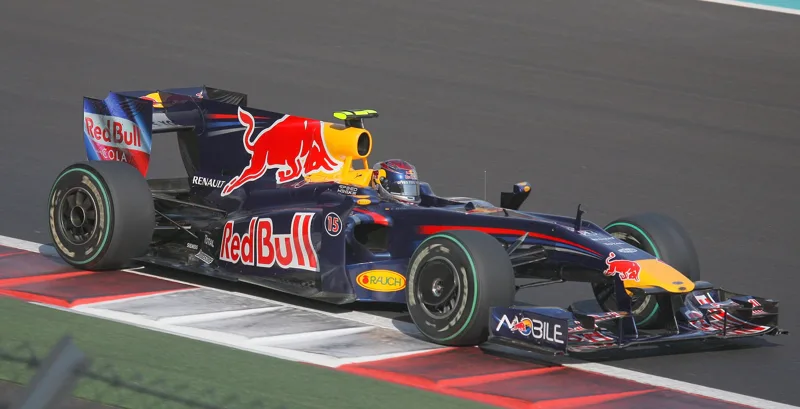
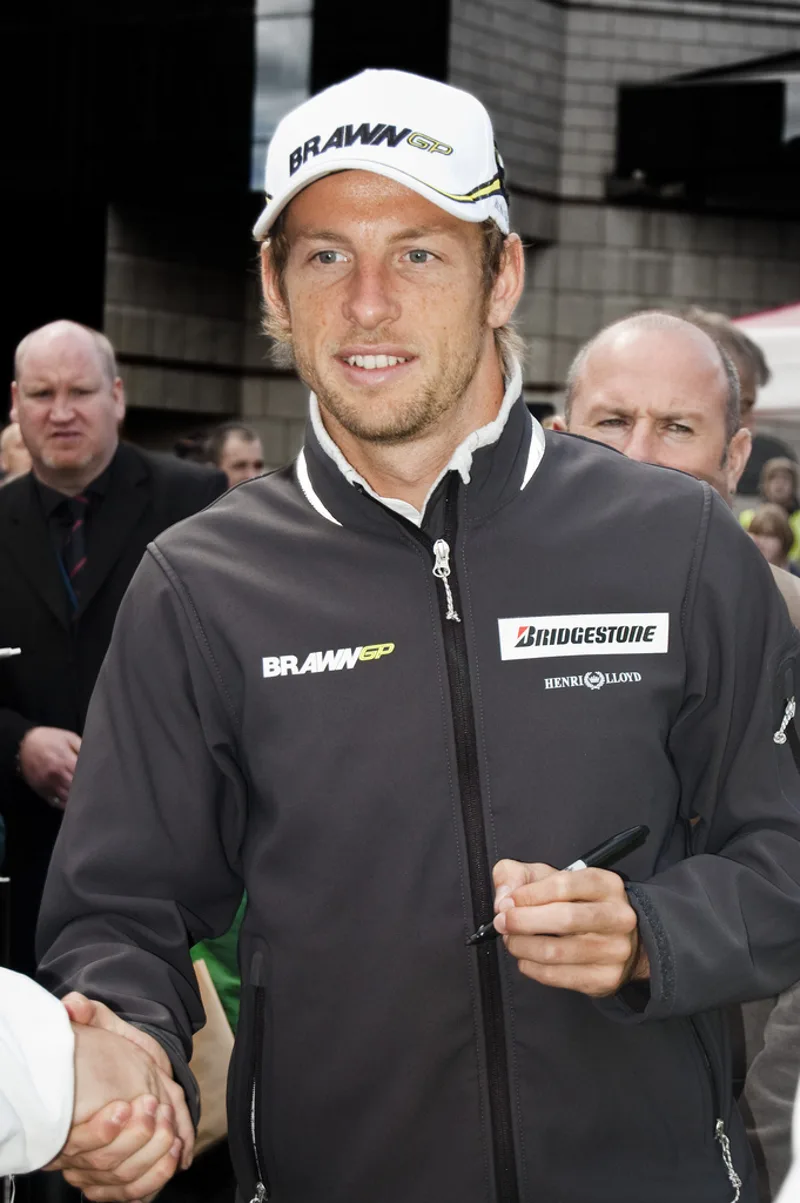
Sebastian Vettel won all three Indian Grands Prix held at the circuit, in 2011, 2012 and 2013. He started from pole position in the inaugural race and set the fastest lap, a race lap record that stood for the next two Grands Prix. In 2012 he took pole again, led every lap and won, while the fastest lap went to Jenson Button of McLaren.
The 2013 race was the sixteenth of a nineteen-race season. Vettel started from pole and won, securing his fourth consecutive World Drivers' Championship while Ferrari's Fernando Alonso finished 11th. Red Bull added a fourth straight Constructors' title. Kimi Raikkonen set the fastest lap for Lotus, and the race was the last Formula One event held at the circuit.
What are the core facts about Buddh International Circuit?
| Feature | Detail |
|---|---|
| Location | Jaypee Sports City, Greater Noida, Uttar Pradesh, India |
| Designer | Hermann Tilke |
| Inaugurated | 18 October 2011 |
| Length | 5.125 km (3.185 mi) |
| Main straight | 1.06 km (0.66 mi) |
| Pit lane | More than 600 metres |
| Indian Grand Prix | 2011, 2012 and 2013 |
| Last Formula One race | 2013 |
| Qualifying lap, 2011 | 1:24.178 by Sebastian Vettel |
What is the Buddh International Circuit layout like?
The full circuit is 5.125 km (3.185 mi) long. Its main straight measures 1.06 km (0.66 mi) and is among the longest in Formula One, and it ends at a key overtaking spot. The pit lane runs for more than 600 metres, one of the longest in the sport, so time spent there matters a great deal to race strategy.
Turns 10, 11 and 12 form a banked multi-apex sequence that generates high tyre loadings. Commentators likened it to the long, fast Turn 8 at Istanbul Park, but unlike that corner it tightens on exit. It is a clockwise right-hander, and it shows Formula One cars at their full cornering potential even though it is not a main overtaking point.
The design went through changes before 2010. A planned hairpin at turn 7 was removed, and turn 3 was widened so drivers could take different lines. The 2010 plans also described a rise of fourteen metres within the first three corners and a banked double-apex bend nicknamed the Currybolica, a nod to the Parabolica at Monza.
Predictions made before the opening weekend put a lap at 1 min 27.02 sec, averaging 210.03 km/h (130.51 mph). Cars were expected to reach about 318 km/h (198 mph) between corners 3 and 4, and Jaime Alguersuari recorded 324.2 km/h (201.4 mph) through the speed trap in qualifying.
How did drivers rate the track?
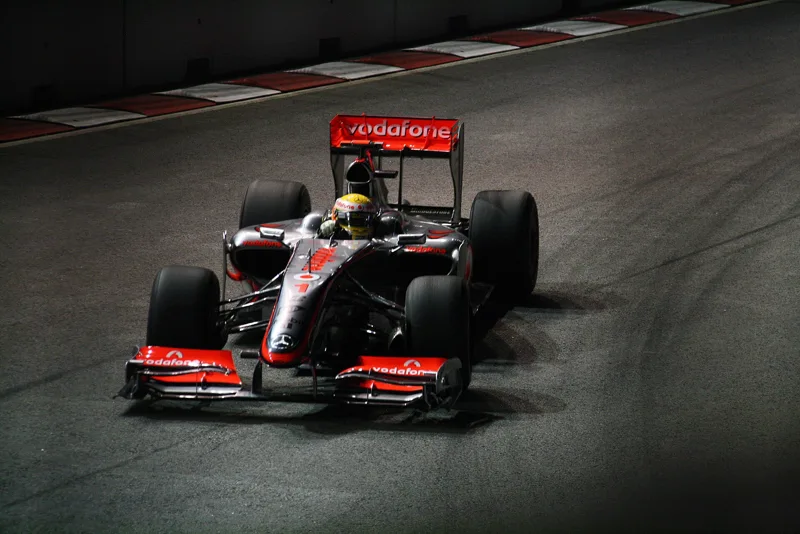
The reaction from drivers was broadly positive. Jenson Button praised the high-speed layout and its challenging corner combinations, which he said were difficult to drive consistently quickly. Lewis Hamilton compared the track to Spa-Francorchamps, a comparison that signals respect for its flow and natural terrain.
Vettel highlighted the elevation changes, which run from as much as 8% downhill to 10% uphill. He described the lap as a roller coaster and said the circuit had quickly become one of the most challenging on the calendar for drivers.
Why did Formula One stop racing at Buddh?
Formula One left the circuit after the 2013 race because the 2014 event was suspended and later cancelled over the tax dispute. Moving the 2014 race to March made little sense after the October 2013 event, and a return in 2015 was ruled out in mid-2014 for contractual and taxation reasons.
Other fixtures fell through as well. A GT1 World Championship round planned for December 2012 was cancelled, and a Superbike World Championship round planned for four seasons from 2013 was abandoned after the 2013 race was cancelled over operational charges. The owners were unable to recover their investment through the three seasons of Formula One.
Has MotoGP raced at Buddh International Circuit?
MotoGP visited the circuit once, for the Indian motorcycle Grand Prix in 2023. Several participants received their travel visas only days before the event. A second MotoGP running planned for 2024 was cancelled, and although the round was placed in a reserve role for 2025, it was dropped from the 2026 calendar.
Between 2014 and 2026 the circuit hosted no international championship apart from an Asia Road Racing Championship race in 2016. Its regular business became local series such as the JK Tyre National Racing Championship, covering both open-wheel and motorcycle racing, along with open track days.
What plans exist for the circuit in 2026?
In February 2026 the managing director of Adani Cement said the Adani Group was drafting a plan to bring Formula One back to the circuit. The plan depends on the group's acquisition of the debt-laden Jaiprakash Associates, which it had secured a majority lender vote to pursue for 14,535 crore rupees.
The State Transformation Commission of Uttar Pradesh has also entered a memorandum of understanding with AVW Global, a motorsport consultancy founded by former MotoGP rider Karel Abraham. Its stated aim is a world-class motorcycle racing ecosystem in the state and the return of MotoGP and the Asia Road Racing Championship to the circuit.
How big is the site and what did it cost?
The circuit was estimated to cost about 20 billion rupees ($400 million) to build. Its seating capacity was first expected to be 110,000, with provisions to raise it to 200,000 later. The site covers 874 acres (354 ha), part of the wider Jaypee Greens Sports City, which spans 2,500 acres (1,000 ha).
The wider development was meant to include a 100,000-seat international cricket stadium, an 18-hole golf course, a 25,000-seat field hockey stadium and a sports academy. Those projects were repeatedly delayed, and the motorsport venue remained the centrepiece of the site.
Did Buddh International Circuit win any awards?
Yes. The circuit was named 2011 Motorsport Facility of the Year at the Professional Motorsport World Expo 2011. It also received the Best Promoter Trophy at the FIA prize-giving gala for the successful running of the 2011 and 2012 Formula One races.