Three rounds were lost to arguments over fees and taxes, one to a war, and each left a purpose-built circuit behind.
Formula One dropped Malaysia in 2017 over rising fees and falling crowds, India after 2013 amid a tax dispute, Turkey in 2011 over cost, and Russia in 2022 when its contract was terminated after the invasion of Ukraine. Turkey is due back from 2027.
Three of the four rounds were lost to arguments about money; the fourth was lost to a war. Malaysia, India, Turkey and Russia each built a circuit for Formula One and then watched the sport leave.
The exits were all different. Malaysia's came through rising fees and thinning crowds, India's through a state tax, Turkey's through an argument over the annual cost, and Russia's through the invasion of Ukraine in 2022. One of the four is already scheduled to come back, and another is hosting a rescheduled race on behalf of somebody else.
The Malaysian Grand Prix before Sepang
The name is older than the circuit. From 1962 to 1965 a weekend for motorcycles and Formula Libre cars ran at Thomson Road in Singapore under the Malaysia banner. When Singapore left the federation in 1965 the event became the Singapore Grand Prix and carried on until 1973.
Back on the mainland, Shah Alam's circuit hosted the national Grand Prix between 1968 and 1995, with the formula changing every few years.
The world championship version needed something grander. Sepang International Circuit was built between 1997 and 1999 near Putrajaya, the freshly founded administrative capital, as one of the headline infrastructure projects of Mahathir Mohamad's government. Its weather is its signature: humid, unpredictable, and capable of swinging from furnace-hot afternoons to tropical downpours.
Three of the four rounds were lost to arguments about money, and the fourth to a war.
Sepang's Formula One years, 1999 to 2017
The first race, in 1999, opened with a comeback. Michael Schumacher was back after breaking a leg at that season's British round, and Ferrari dominated. He let his title-chasing teammate Eddie Irvine take the win, and then both cars were disqualified over a technical irregularity. They were reinstated later.
From 2001 the race shifted to the start of the calendar instead of the finish. New cars and new line-ups produced topsy-turvy results, many decided by the scramble into the tight double hairpin at turn one. That year a heavy storm arrived mid-race. Schumacher and Rubens Barrichello spun off almost together at the same corner, yet both recovered to give Ferrari a one-two, because for long stretches they were nearly 5 seconds a lap quicker than anyone else. Jos Verstappen briefly led after starting 18th and running sixth at the end of lap 1, before the drying track dropped him to seventh.
In February 2008 the management said it wanted to be Formula One's second night race after Singapore, from 2009, and discussed buying floodlights. The organisers settled for a late-afternoon start instead. The 2009 race began at 17:00 local time (09:00 UTC), around sunset, and it went badly: heavy rain brought a red flag, fading light ruled out a restart, and the race ended on lap 33. Full points needed 42 laps, so the results were halved. Jamiroquai played a concert that night.
Why did Formula One leave Malaysia?
On 7 April 2017 organisers confirmed that the 2017 race would be the last. The contract ran to 2018, but its future was threatened by climbing hosting fees and falling ticket sales.
The youth and sports minister of the day, Khairy Jamaluddin, posted that Malaysia should step back from hosting for a while: "Cost too high, returns limited. Not a novelty." The country had been the first in Asia outside Japan to stage a race, he pointed out, and that novelty had gone because so many venues now offered the same thing.
The BBC reported that Malaysia had struggled to draw big crowds, its appeal dented by the flashier night race on the streets of Singapore. The exit also had a knock-on effect: when the Russian Grand Prix moved from April to 30 September for 2018, it took the slot Malaysia had vacated.
The Indian Grand Prix and its long road to the grid
India's Formula One story is short on races and long on planning. The race ran three times, from 2011 to 2013, at the Buddh International Circuit near Greater Noida in Uttar Pradesh. The first edition, on 30 October 2011, was the 17th round of the season, and Sebastian Vettel won it. Jaypee Sports International was the organiser, on a five-year deal with Formula One Management.
Plans for an Indian race go back to at least 1997, when Calcutta was floated. By 2003 the country had only two permanent raceways, at Chennai and Coimbatore, and land near Bangalore and Hyderabad was being studied. In December 2003 a seven-year pre-agreement was signed for a Hyderabad race in 2007, but in 2004 Mumbai appeared as a rival bid. Both projects were written off before the end of that year, when Mumbai's government decided it would rather not spend money on car fumes while more serious issues needed attention, and the Hyderabad land became an IT park. Anti-tobacco legislation and a shift in government policy have been suggested as factors.
By 2007 five locations were still in contention, among them Bangalore, Gurgaon, a New Delhi street circuit proposed by Vijay Mallya and Lucknow. In June 2007 the Indian Olympic Association and Ecclestone announced a provisional agreement for a 2009 debut at Gurgaon, working with architect Hermann Tilke. By September 2007 the plan had moved to a 2010 debut at Buddh, and a year later Ecclestone pushed it back again, to 2011.
Why did F1 leave India?
The race lasted only three editions because of a tax fight with the Uttar Pradesh government. In August 2013 the FIA said India would sit out 2014 and come back early in 2015; the 2015 race was then cancelled over the tax dispute, with a return pencilled in for 2016. Nothing was resolved, and the race has never been restored to the calendar.
The economics had looked good. The race had the potential to bring in around $170 million and employ as many as 10,000 people, and it fell over the Diwali holiday, when spending and travel peak. It was also one of the few races of its day without a government subsidy, and the venue paid $40 million per year to Formula One Holdings.
The sums did not settle the matter. Ecclestone confirmed the slide to 2016 in August 2014, in Belgium. The state government, led by Chief Minister Akhilesh Yadav, argued that Formula One was entertainment rather than sport and taxed it accordingly. The circuit's placards said New Delhi, but it sits in Uttar Pradesh, outside the Delhi territory.
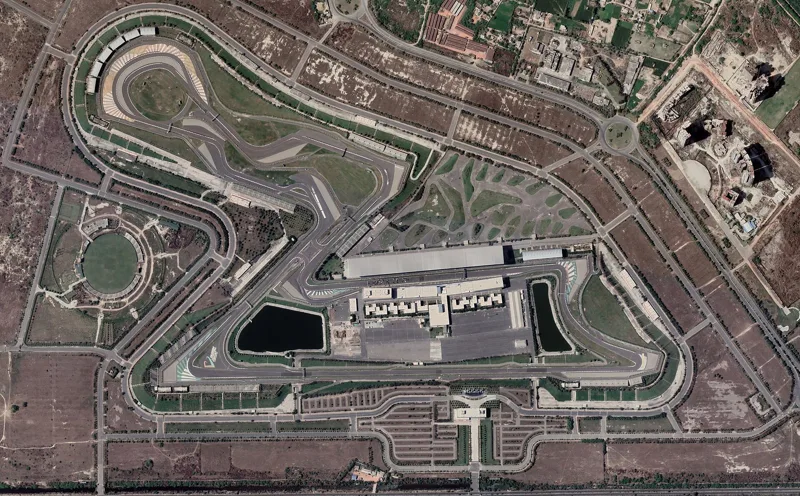
The legacy is the circuit itself. The 5.125 km layout was designed by Tilke, and the builders shifted four million cubic tons of soil to give the lap its rise and fall. It spreads over 875 acres as part of Jaypee Green Sports City.
The Turkish Grand Prix at Istanbul Park
Turkey's race had two lives. Istanbul Park, another Tilke design, hosted the world championship from 2005 to 2011, and then the pandemic brought it back in 2020 and 2021. Massa is the race's most successful driver and Ferrari its most successful constructor, three wins apiece. Teams drove their equipment from European factories to every meeting but the 2020 one, a trek that included a boat crossing.
The 2005 original was frantic, with drivers spinning off all weekend as they pushed too hard. At Turn 8 Juan Pablo Montoya went wide with two laps left after tangling with Tiago Monteiro's Jordan, which let Fernando Alonso into second behind Kimi Raikkonen, a swing that mattered in their championship fight. Montoya set the fastest lap, 1'24.770, and nobody has bettered it at the circuit.
A year later Massa took his first pole position and his first win, after Vitantonio Liuzzi's spin brought out a safety car and the leading Ferraris pitted together. He won again in 2007 ahead of his new teammate Raikkonen, and in 2008, when the race moved to May, he beat Lewis Hamilton, who had passed him on track but made three stops against Massa's two.
Jenson Button won for Brawn GP in 2009, and Hamilton won for McLaren in 2010 after pole-sitter Mark Webber collided with his Red Bull teammate Vettel. Vettel won in 2011, in a dry race that logged the greatest number of pit stops and overtaking moves in Formula One history.
The circuit also had a diplomatic scare. At the 2006 podium the trophy was handed over by Mehmet Ali Talat, introduced on screen as head of the Turkish Republic of Northern Cyprus, an entity only Turkey recognises. The FIA investigated a possible breach of its political neutrality, and some commentators feared for the race's future. It ended in a 5 million dollar fine, later halved.
Why did F1 leave Turkey?
The 2011 race was already in doubt because Ecclestone wanted to double the hosting fee. On 30 July 2011 it was announced that Turkey would drop off the calendar from 2012 because the two sides could not agree on the annual cost. The organisers called the fee too high, while Ecclestone blamed weak promotion for the race failing to turn a profit.
A last attempt failed on 9 January 2013, when the government declined to sign off on a deal for a 2013 race. The scheme was to cost Turkey around 20 million dollars and needed 13 million dollars of public money. The approval never came.
The pandemic then reversed everything. The race joined the revised 2020 calendar in August and ran from 13 to 15 November. The track had been resurfaced without Pirelli's knowledge, so the tyre supplier could neither test nor bring suitable rubber, and heavy rain made the surface greasier still. Lance Stroll took pole in the wet. Hamilton, starting sixth, led through the middle stages and won, which secured his seventh world title and equalled Schumacher's record.
In 2021 the race was first lined up to replace the Canadian Grand Prix, but British travel restrictions on Turkey forced a postponement and the Styrian Grand Prix took the slot. It was later re-added to replace the cancelled Singapore round, and Valtteri Bottas won it for Mercedes from pole.
The Russian Grand Prix, from Saint Petersburg to Sochi
Russia staged a Grand Prix twice before the revolution, in 1913 and 1914, on a Saint Petersburg circuit. Georgy Suvorin won the first in a Benz and Willy Scholl took the second in another. Two wars ended it, and it did not resume under the Soviet Union.
The sport kept trying. A Grand Prix of the Soviet Union was pencilled in for Moscow on 21 August 1983, but bureaucracy under the Andropov regime killed it, and Hungary got there first among communist states, in 1986. Moscow Raceway at Fedyukovo, a Tilke design 77 km (48 mi) from the capital, was finished but never held a Grand Prix, though in 2012 it staged the first internationally accredited motorsport events in Russia.
When Vitaly Petrov joined Renault in 2010 he became Russia's first Formula One driver, and on 14 October 2010 the new Russian Grand Prix was announced for a 2014 debut. It would run on the Sochi Autodrom, a 5.9 km street circuit threading around the Olympic Park venues of the 2014 Winter Games host city.
The inaugural race on 12 October 2014 was won by Hamilton from Nico Rosberg and Bottas, and the Mercedes one-two secured the team's first constructors' title. The 2016 race, moved to 1 May, began with a crash at turn 2 that eliminated Nico Hulkenberg, Esteban Gutierrez and Rio Haryanto, and on the Thursday afterwards Red Bull swapped Daniil Kvyat for 18-year-old Max Verstappen. Bottas scored his first Formula One win in 2017, 0.7 seconds ahead of Vettel. The 2018 race moved to 30 September to fill Malaysia's old slot, and in 2019 Vettel led until lap 26, when his MGU-K failed. In its time as a championship round the race was won only by Mercedes.
How the Russian Grand Prix ended
In 2021 a contract was signed to relocate the race to Igora Drive, roughly 54 km (34 mi) from Saint Petersburg, from 2023. That circuit had opened in 2019, and its layout, 4.086 km (2.539 mi) with 15 turns, was to be stretched to 5.182 km (3.220 mi) with 19.
It never happened. On 24 February 2022, after Russia invaded Ukraine, Formula One suspended the contract, calling a race impossible in the circumstances. Vettel and Verstappen had already called for cancellation. The race was cancelled on 1 March, and on 3 March 2022 Formula One announced it had terminated the contract outright.
Four exits compared
| Race | Circuit | Time in Formula One | How it ended |
|---|---|---|---|
| Malaysian | Sepang International Circuit | 1999 to 2017 | Fees up, crowds down; 2017 announced as the last |
| Indian | Buddh International Circuit | 2011 to 2013 | Tax dispute with the Uttar Pradesh government; 2014 skipped, 2015 cancelled |
| Turkish | Istanbul Park | 2005 to 2011, then 2020 and 2021 | No agreement on the annual cost in 2011; revived for pandemic calendars |
| Russian | Sochi Autodrom | 2014 to 2021 | Contract suspended and then terminated in 2022 after the invasion of Ukraine |
What each race left behind
The clearest legacy is hardware. Sepang still stands, built in the late 1990s for a Malaysian Grand Prix, and Buddh and Istanbul Park carry the same Tilke signature. Moscow Raceway exists although no Grand Prix ran on it, and Igora Drive opened in 2019.
Some of the legacy is statistical. Montoya's 2005 lap at Istanbul Park has yet to be beaten, Massa and Ferrari lead the win count there, and Mercedes took every win at Sochi. The 2011 Turkish race logged the most pit stops and overtakes ever recorded in a dry Formula One race.
The rest is a lesson in how a Grand Prix gets paid for. India could not make peace with a state that saw the race as entertainment to be taxed. Turkey and Malaysia both collided with the fee Formula One charged, with Ecclestone blaming promotion in one case and a minister blaming cost in the other.
Which of the four may return
Turkey has the firmest date. In April 2026 Formula One Group struck a deal with the Turkish government for the race to return to Istanbul Park for a minimum of five seasons, from 2027 to 2031.
Malaysia has a stranger story. In August 2025 the youth and sports minister, Hannah Yeoh, said revival was not on the immediate agenda, pointing to the fees demanded by Liberty Media and the heavy spending needed to keep Sepang at the required standard. She argued the money was better used on athlete development and local sport, and that a crowded calendar and regional competition from Singapore made a permanent slot highly improbable unless private sponsors paid for it in full.
Within a year circumstances had shifted. In July 2026 The Athletic reported that Sepang was a candidate to host the Bahrain Grand Prix, whose April date had been called off because of the 2026 Iran war. The new minister, Mohammed Taufiq Johari, said the government was weighing the proposal, Prime Minister Anwar Ibrahim signalled that a decision was close, and the BBC's Andrew Benson reported a provisional deal for October. On 26 July 2026 Formula One and the FIA confirmed that Sepang would run the rescheduled race from 2 to 4 October 2026, in the gap between the Azerbaijan and Singapore Grands Prix.
Bahrain's government stayed on as the main financial promoter and underwrote the replacement costs, so the event kept its original commercial identity instead of becoming a standalone Malaysian Grand Prix. It is officially titled as a Bahrain Grand Prix held in Malaysia, and Bahrain kept the ticket pricing rights and the proceeds.
For India and Russia there is no plan to report. The Indian race is absent from the calendar since the tax dispute, and the Russian contract was ended for every future edition in March 2022.