A rain shower, two Williams cars that beat the Mercedes off the line and a wrong-footed Hamilton made Silverstone 2015 the race fans talked about.
The 2015 British Grand Prix was a Formula One race held at Silverstone on 5 July 2015, the ninth round of the season. Hamilton won from pole for Mercedes, with Rosberg second and Vettel third after rain arrived late in the race.
Lewis Hamilton won the 2015 British Grand Prix at Silverstone on 5 July, his third Silverstone victory and the second in a row. Rain arrived in the closing laps, Sebastian Vettel took the last podium place, and Nico Rosberg finished 11 seconds behind his teammate in second. Two Williams cars had led the early laps after a poor getaway from the Mercedes pair.
What was the championship picture before Silverstone?
Hamilton arrived with a ten-point lead over Rosberg in the drivers' standings. Mercedes led Ferrari by 136 points in the Constructors' Championship, while Williams was a further 63 points adrift of the Italian team. Rosberg had won the Austrian Grand Prix the race before, and Silverstone was the ninth round of the season.
Two Williams cars led early, rain arrived late, and Hamilton kept his nerve on the tyres that mattered.
What changed on the cars for Silverstone?
Force India brought a new B-spec version of its VJM08, with a shorter nose. Ferrari revised its wheelnut system after a wheel problem had caused trouble for Vettel in Austria, and Manor Marussia changed its livery after securing new sponsorship.
The race also marked the 900th Grand Prix in which at least one car used a Ferrari engine. Pirelli took its two hardest dry compounds, the white-banded medium as the option and the orange-banded hard as the prime, and it brought its two wet tyres as it did for every event.
Silverstone had been returned to its revised 2011 Arena layout. It has 18 turns, and the Stowe and Vale corners offered the best chances to overtake. Race stewards included Nigel Mansell, the 1992 world champion, which added a little weight to a weekend that already had plenty of history.
How did practice and qualifying go?
Hamilton won pole, beating Rosberg by 0.113 seconds, and Massa and Bottas filled the second row for Williams. Qualifying was run in parts of 18, 15 and 12 minutes, and race directors had warned drivers to respect the track limits, particularly at Copse corner.
In the first practice session Rosberg was fastest after his team had to change his gearbox to fix an early hydraulic problem. He finished 0.07 seconds clear of Hamilton. Verstappen was 1.2 seconds off Rosberg in third, which suggested Toro Rosso's chassis was well suited to the track. Jolyon Palmer took Grosjean's place at Lotus, Susie Wolff drove Bottas's Williams FW37 in that session, and Raffaele Marciello took Marcus Ericsson's seat at Sauber for the weekend's practice.
Practice had its share of trouble. Grosjean got stuck in the gravel at Luffield in the second session, which was red-flagged early, and Merhi beached his Manor at the same spot later on. Hamilton was fastest on the Saturday, half a second ahead of Rosberg, but Alonso was confined to six laps.
Track limits decided a lot of qualifying. Eleven drivers had lap times struck out for going off line at corners, with all four wheels over the limit. Maldonado had two laps deleted, among them his best Q1 time, and only just got through, while Grosjean's top Q2 lap was also removed for track limits.
Both McLaren drivers, both Manor cars and Sauber's Felipe Nasr failed to reach Q2, and both Lotus drivers and Verstappen went out in the second part. Sergio Perez qualified eleventh. In Q3 Hamilton set the pole time and then aborted his final run, while Rosberg could not improve on his best.
Pole was Mercedes' twentieth consecutive one, four races short of the record Williams set across 1992 and 1993. That run of poles was the backdrop to a race that Mercedes did not dominate from the start.
How did the race start and develop?
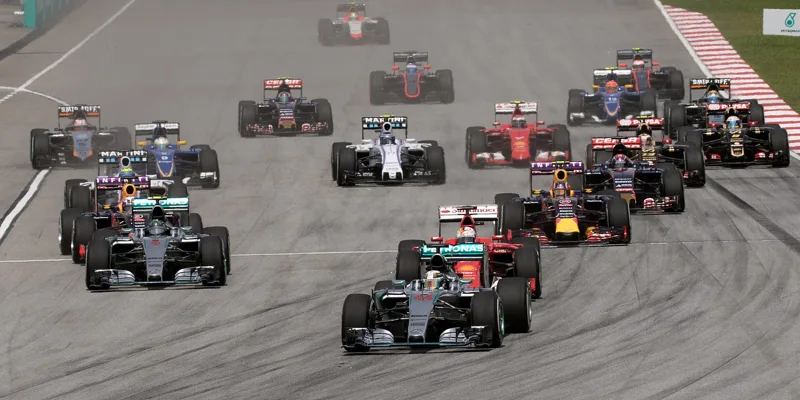
Felipe Nasr had gearbox trouble on the way to the grid and could not start, so his place was left empty. Both Mercedes cars were slow away from the line, and Massa and Bottas moved into first and third. Hulkenberg, who had been ninth, jumped to fifth at the start, while Ricciardo's contact with Grosjean at Turn 3 sent Grosjean into Maldonado and created a wider incident.
Alonso had to avoid that accident and collided with his teammate Button. Button and both Lotus drivers were forced to retire, while Alonso pitted for a new nose. That crash meant a safety car, which kept the order frozen until lap four.
Hamilton immediately attacked Massa, but ran wide on Vale and let Bottas take second on the inside of Club. Williams then used team orders to hold its drivers apart and stop them racing each other. Bottas claimed he had more pace and requested a chance to go for the lead; Williams agreed, yet his speed failed to materialise.
By lap 13 the leaders had stretched away from the rest, with Hulkenberg fifth, seven seconds back. Ferrari pitted early on laps 14 and 15, apparently for a two-stop race. Hamilton pitted for new tyres on lap 20 and used the undercut, and Massa and Rosberg came in a lap later.
How did the rain change the race?
Rain began in the closing stages of a race that had seemed settled. The drivers were told in the middle of the race that rain was expected before the finish, and a brief Virtual Safety Car period followed on laps 33 and 34. Then the first drops arrived, landing first near the pit wall.
By lap 38 drivers were losing traction. Raikkonen made a poor choice, pitting for intermediates at the end of lap 39 when the track was not wet enough, and he dropped to ninth. Rosberg, on slicks, pushed hard and reduced Hamilton's lead to 3.7 seconds by lap 43.
Hamilton then switched to intermediates, and Vettel followed him in. The gamble paid off, as rain arrived just then and Rosberg and both Williams cars dashed into the pit lane in the laps that followed, but those stops came too late for Massa and Bottas, who fell behind Vettel. Hamilton pulled his lead out to nine seconds over Rosberg.
Will Stevens went wide into the barriers on lap 49 and lost his front wing. He kept going, although the nose change sent him to the back. Hamilton held his lead over the final laps and took the chequered flag.
| Driver | Outcome | Detail |
|---|---|---|
| Lewis Hamilton | Winner | Pole by 0.113 seconds; third Silverstone win |
| Nico Rosberg | Second | 11 seconds behind Hamilton |
| Sebastian Vettel | Third | Took the last podium place in the rain |
| Nico Hulkenberg | Seventh | B-spec Force India, double-point finish with Perez |
| Sergio Perez | Ninth | B-spec Force India, double-point finish with Hulkenberg |
| Fernando Alonso | Tenth | First point since his return to McLaren |
| Daniel Ricciardo | Retired, lap 23 | Electrical failure |
What did the drivers and stewards say?
Media reception was good. Hamilton's performance was described as brilliant, and he said losing places at the start had made the race for the fans. He admitted he had been tearing up on the last lap, a sign of how much the victory had meant to him.
Bottas believed he could have pulled clear of the Mercedes, but he was also firm that drivers should never simply let others past. He said it was not racing, though it would have been nice to race when he had the best chances. Christian Horner said a spin on the damp track had cost Daniil Kvyat a podium chance.
The stewards took no action over the first-lap incident between a Lotus and a McLaren. A day after the race, a small row surfaced about a Mercedes stop on lap 14 that never happened. Toto Wolff said it had been a bit of a game, and Charlie Whiting warned all teams against the practice before the Hungarian Grand Prix.
The win pushed Hamilton's lead over Rosberg to 17 points, and he had now led at least one lap in 18 straight races. It was the ninth time in a row that Mercedes had put two drivers on the podium, matching a Ferrari record from 1952 and 1953.