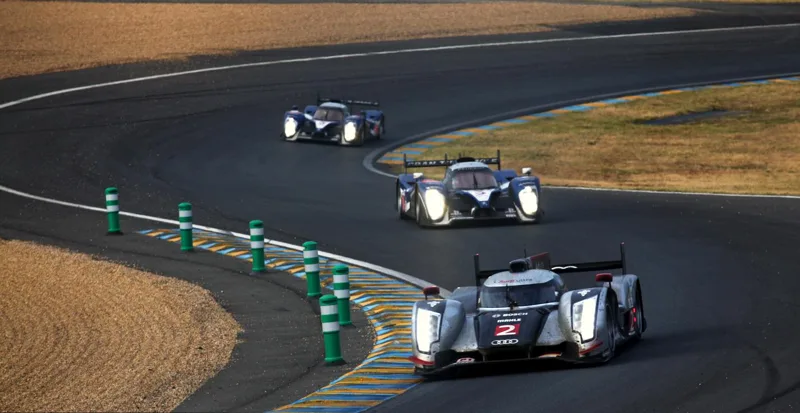
Audi's No. 2 car won the 60th running of the race, four laps ahead of its sister car, in the first round shared by the WEC and the ALMS.
The 2012 round at Sebring International Raceway in Florida was the 60th running of the 12-hour race, held on 17 March 2012. It was the first event of both the WEC and ALMS seasons, and more than 90,000 spectators came to watch.
Audi's No. 2 car won the 60th Annual Mobil 1 Twelve Hours of Sebring on 17 March 2012, four laps ahead of its sister car. The race was the opening round of both the FIA World Endurance Championship and the American Le Mans Series, the first and only event to involve both series.
Who won the 2012 Twelve Hours of Sebring?
The No. 2 Audi R18 TDI of Rinaldo Capello, Tom Kristensen and Allan McNish won, four laps ahead of the No. 3 Audi of Timo Bernhard, Romain Dumas and Loic Duval. Starworks Motorsport's HPD of Dalziel, Potolicchio and Sarrazin was third overall.
For Kristensen it was a sixth Sebring win, while Capello took his fifth, McNish his fourth, and Audi its tenth victory at the track. The trio led all but 66 laps of the race.
The pole car, the No. 1 Audi of Fassler, Lotterer and Treluyer, lost the lead on the opening lap to the sister Audi. The No. 2 car then stayed at the front for the rest of the twelve hours.
Two championships shared one grid for the first time, and the Audi R18 TDI finished its last race at the top.
How did the race start?
The race began at 10:30 a.m. local time in front of more than 90,000 spectators, and FIA president Jean Todt told the drivers to start their engines. Heavy traffic and traffic management were a factor from the first lap.
During the second formation lap, Bergmeister's Flying Lizard Porsche and Farnbacher's Luxury Ferrari collided entering turn 17. Farnbacher's car had frontal damage, and Bergmeister's needed 26 laps of garage work to repair the suspension and undertray.
McNish passed Lotterer for the lead at the end of the first lap, in the fast turn 17. Vilander's AF Corse Ferrari then spent 45 minutes in the garage on lap five with an alternator failure, and it rejoined 20 laps down.
What caused the first full course caution?
The first full course caution lasted 15 minutes after an incident on lap eight. Aguas had to pull the AF Corse-Waltrip Ferrari over with alternator trouble, and he stopped it twice before it could continue.
Melo's No. 59 Luxury Ferrari took the GT lead while Vilander was out. Beretta's No. 71 Ferrari slipped inside Gavin's No. 04 Corvette to claim second in the GT class.
McNish lost the overall lead to his teammate Fassler during the pit stop cycle, because his crew wanted to be out of sequence to avoid traffic in the pit lane.
What happened in the afternoon?
Fassler's No. 1 Audi lost control after a clash with a Luxury Ferrari midway through the second hour, yet he kept going with little time lost. Eleven full course cautions were shown in all, and the last was a Sebring record.
Keen's AJR car suffered a puncture and wheel damage after going off at turn 10, which handed the GTC lead to Estre's JDX entry. The second caution came when Hansson's Conquest Morgan stopped at the hairpin braking point with no fuel.
Racing resumed after 23 minutes of caution. Treluyer then slowed on the Ullmann Straight with an electronic downshift fault, and the No. 1 Audi went into the garage briefly to have the problem fixed.
What did the sunset period bring?
When racing restarted as the sun fell, Cisneros's NGT Porsche lost the GTC lead to Townsend Bell's AJR car. Cisneros later hit the turn 13 tyre wall head on, and the ninth caution came out while crews spent 20 minutes rebuilding the six-deep wall.
The engine in Moreau's OAK Pescarolo failed, which brought out the tenth caution. The eleventh and final caution came when Nicolosi stopped in the grass and was recovered to the pit lane.
Thiim's NGT Porsche tangled with von Moltke's AJR machine at turn 17 once the safety car went in. Both cars spun, but both drivers went on.
How did the leaders hold on through the night?
Sarrazin's Starworks HPD climbed to third overall, as he and Barbosa ran nose to tail through the last two hours. Sarrazin got past Barbosa after the final stops.
Bernhard's No. 3 Audi, a lap down on its sister car, hit a GTC Porsche and needed a rear-end change in the pits.
Lamy's No. 50 Larbre Corvette lost its driveshaft with 16 minutes remaining, which promoted Ruberti's No. 88 Felbermayr-Proton Porsche to the lead of LMGTE Am.
In the final hour, Bruni's sister No. 51 Ferrari bumped Hand at turn three and spun him off the track. Beretta's No. 71 Ferrari and Hand's No. 56 BMW had traded the GT lead in the closing laps. Hand regained control and later passed Beretta, who had been delayed by a puncture.
How did qualifying set the grid?
A 65-minute session in four 15-minute parts set the grid. Lotterer took pole with a lap of 1:45.820 in the closing minutes, despite serving a penalty for speeding in the pit lane. It was Audi's tenth Sebring pole.
Kristensen was second, nearly four-tenths of a second behind. Dumas placed the rebuilt No. 3 Audi third, which gave Audi all three of the top three spots.
Graf's Muscle Milk HPD was the leading ALMS qualifier in fourth, and Moreau's OAK Pescarolo the best WEC petrol car in fifth. Pla put OAK on the LMP2 pole at 1:50.467.
Bruni's lap of 1:58.427 secured the GT pole, breaking the 2011 category track lap record by more than two seconds. Farnbacher's Luxury Ferrari took the LMGTE Am pole at 2:00.184.
What did practice show?
The first practice session lasted an hour on 15 March, and Dumas was fastest at 1:48.626. In the second session Lotterer's No. 1 Audi was fastest at 1:47.761, and Kristensen set the quickest time of the evening session at 1:47.049.
Testing had been held over two days, with Audi leading both days. McNish set 1:47.187 on the first day, and Kristensen's lap of 1:48.138 led the second day.
On the morning of 16 March, the final practice session saw Dumas go fastest overall at 1:48.200.
Who was in the field?
Audi Sport Team Joest entered three R18 TDIs that were a year old, Rebellion ran two 2011 Lola B11/60s, and OAK and Pescarolo Team each brought a 2011 Pescarolo 01. Toyota kept its TS030 Hybrid at home for time reasons.
The FIA track homologation set a 64-car entry limit, and only full-season ALMS and WEC entries were permitted. Five car types ran, and nine categories raced at Sebring.
LMP2 had 13 teams from five manufacturers, and the one-make PC class had nine Oreca FLM09 cars. The GTC class had nine Porsche 997 GT3 Cup cars.
What did the balance of performance changes do?
Audi's R18 TDI received a 7% smaller air restrictor, reduced turbo boost and 5 litres less fuel capacity. The Corvette C6.R's air restrictor grew by 0.4 mm (0.016 in).
A Porsche 997 GTE-RSR in WEC LMGTE Am shed 25 kg (55 lb) of ballast, while the Black Swan Lola B11/80 took on 20 kg (44 lb).
Why did the Muscle Milk car retire?
Simon Pagenaud's No. 6 Muscle Milk car was forced out in the final hour. A refuelling valve failed during a pit stop because of a loose buckeye, and a switch to another valve led to a fuel leak.
The car had started as the top ALMS qualifier in fourth, so its retirement ended a race that had begun well for the team. Most LMP1 privateer entrants had trouble that afternoon and evening.
How did the LMP1 privateers fare?
JRM's Peter Dumbreck was battling Luhr for third overall when his rear-right tyre punctured. The right-rear suspension then collapsed after the pit stop that replaced the tyre, and the No. 22 car lost 15 laps in the garage.
Pescarolo's No. 16, crewed by Boullion, Collard and Jousse, ran untroubled to sixth overall and completed the LMP1 class podium.
How did Alex Job Racing and the GTC class finish?
Alex Job Racing's Porsche 997 GT3 Cup of Townsend Bell, Dion von Moltke and Bill Sweedler won the GTC class by one lap over its teammates, which gave the team its eighth Sebring category win.
Edwards's No. 30 NGT car had taken GTC pole at 2:06.674, 0.023 seconds faster than Faulkner's Green Hornet. When Cisneros's NGT car lost the GTC lead at sunset, Bell's AJR car took over.
What happened to Krohn's Ferrari and the Gulf Lola?
Krohn's Ferrari was caught out by a slowing car ahead of it in the concertina effect, and it collided with the outside wall at the start of the Ullman straight. The car entered the garage for 71 minutes to replace the rear suspension and splitter.
The No. 29 Gulf Lola had been excluded from the race, after failing to meet the minimum qualifying time because of engine installation issues that limited it to two qualifying laps.
Why did the caution periods pile up?
Several cars stopped on track in the afternoon, and each stoppage brought out another full course caution. Heylen's No. 37 Conquest Morgan stopped past the bridge at the first corner with a lack of drive, which brought out the fifth caution of the race.
Roger Wills's No. 5 Muscle Milk PC car then crashed backwards into the turn seven tyre barrier and returned to the pit lane with bodywork and car damage. That brought out the sixth caution for barrier repairs.
Olivier Lombard's Signatech Oreca, Melo's Luxury Ferrari, Hunter-Reay's Level 5 car and the No. 22 AJR Porsche collided on fluids at turn 13, which caused the third caution.
Class results
| Class | Winning crew and car | Second place |
|---|---|---|
| Overall (LMP1) | Capello, Kristensen and McNish, No. 2 Audi R18 TDI | Bernhard, Dumas and Duval, No. 3 Audi, four laps back |
| LMP2 (WEC) | Dalziel, Potolicchio and Sarrazin, Starworks HPD | Level 5 HPD No. 055, 32 seconds back |
| ALMS P1 | Dyson, Kane and Smith, Lola B12/60 | Only classified finisher |
| GT | Hand, Muller and Summerton, BMW M3 GT2 | Magnussen's Corvette No. 03, 1.740 seconds back |
| LMGTE Am | Ried, Roda and Ruberti, Felbermayr-Proton Porsche | Larbre Competition Corvette No. 70, one lap back |
| PC | Frisselle, Popow and Viso, CORE Autosport Oreca FLM09 | PR1 Mathiasen car, one lap back |
| GTC | Bell, von Moltke and Sweedler, Alex Job Racing Porsche | Dumoulin, Keen and MacNeil, one lap back |
The No. 16 Pescarolo finished sixth overall, untroubled, and completed the LMP1 class podium. Dyson Racing's car was the only classified ALMS P1 finisher, and it placed eighth overall.
What did the result mean for the championship?
The race opened both the 2012 WEC, which had eight races, and the 2012 American Le Mans Series, which had ten. It was also the only North American round of the WEC season.
The R18 TDI made its final appearance with this win, and most LMP1 privateer entrants had trouble along the way. Starworks won its third Sebring class title, and CORE Autosport took its first PC win at the event.