A ninth-place start, a penalty that removed the crew chief from the event and a record 32 lead changes marked the 48th Daytona 500.
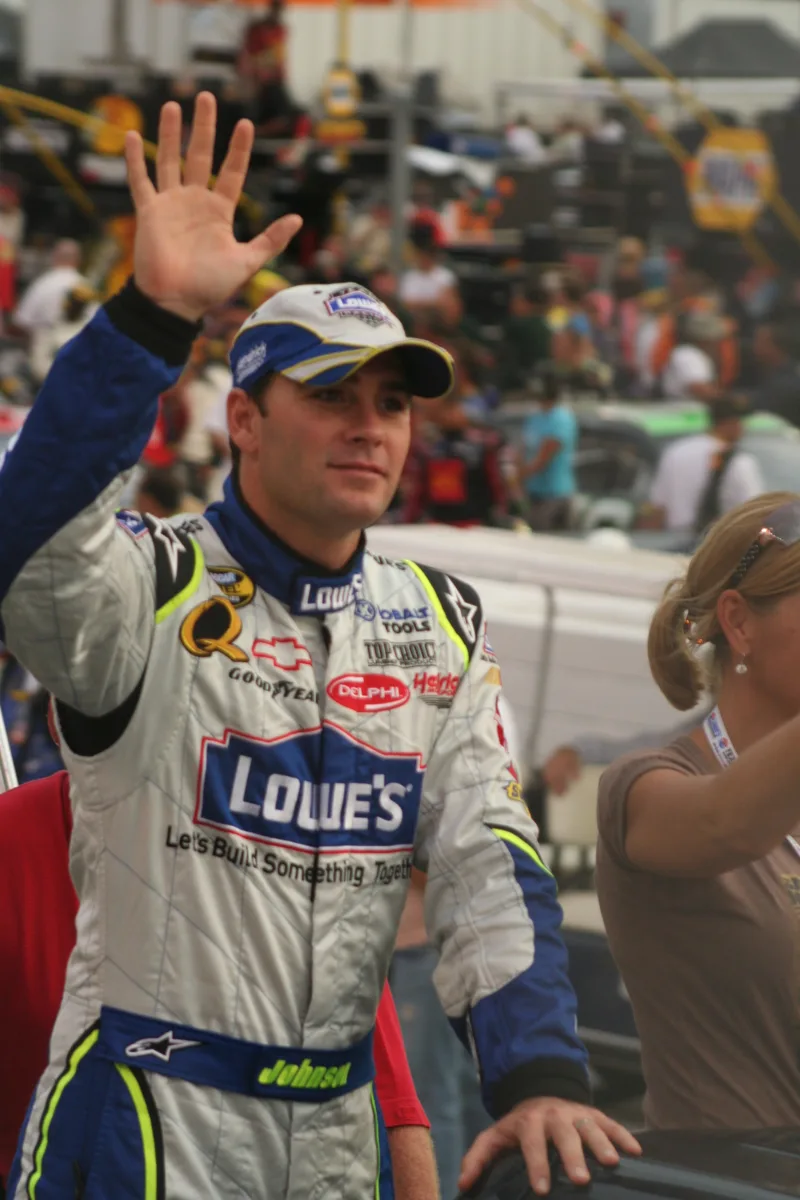
Jimmie Johnson won the 2006 Daytona 500 from ninth on the grid after NASCAR ejected his crew chief, Chad Knaus. Casey Mears was second and Ryan Newman third, and the 203-lap race set a record with 32 lead changes among 18 drivers.
Johnson, who started ninth, took the 2006 Daytona 500 in a race with a record 32 lead changes among 18 drivers. NASCAR had ejected his crew chief from the event earlier that week.
The result was not only about speed. Penalties, a late-week ejection and a series of rule changes on bump drafting all shaped the week, and the finish under the caution flag left some questions open for days afterwards.
What was the 2006 Daytona 500?
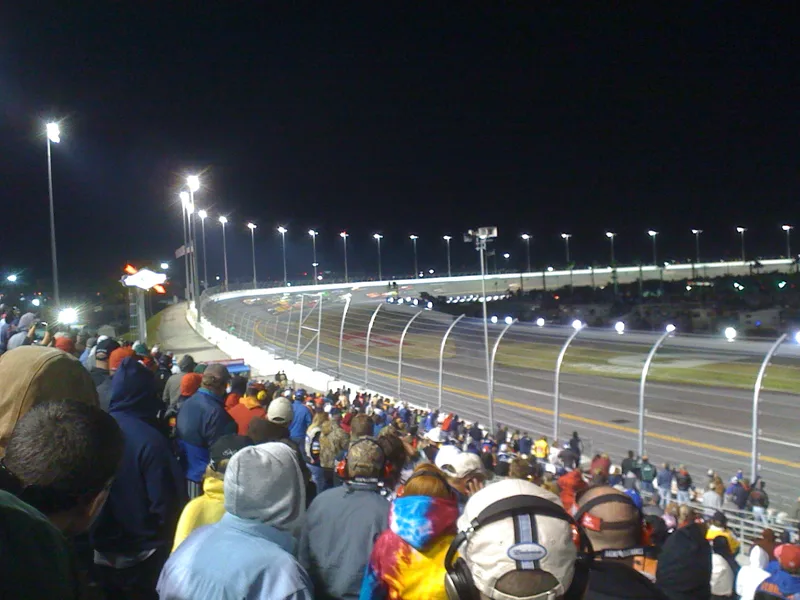
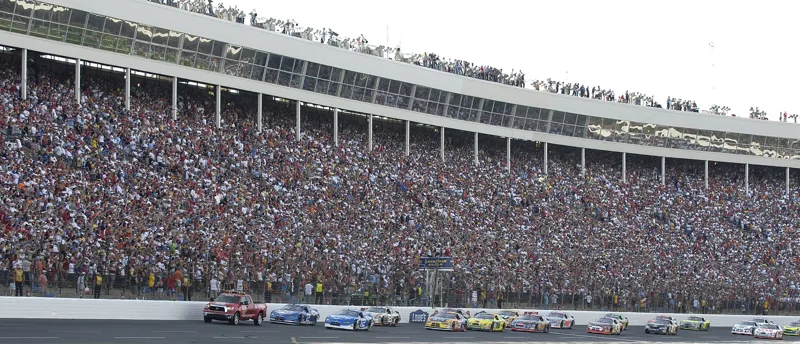
The 48th Daytona 500 was held on 19 February 2006 at Daytona International Speedway in Florida, and it was the first stock car race of the 2006 NASCAR Nextel Cup Series. It was the first of 36 scheduled races that season. Johnson won the 203-lap event after starting ninth, and the race drew a crowd of 200,000 spectators.
Johnson's victory was his first in the Daytona 500, his first at either Daytona or Talladega, and the 19th win of his career. It was also the first of five wins he would record that year on the way to his first of seven NASCAR Cup Series championships.
A crew chief ejection, a lap 107 collision and a record 32 lead changes marked the 2006 Daytona 500.
What is the history of the race and the track?
The race was first held in 1959, and it followed a series of races on the beaches around Daytona Beach. NASCAR founder Bill France Sr. built the speedway and conceived the 500. It has opened the NASCAR season since 1982, and from 1988 it required cars to run restrictor plates.
The track is a four-turn superspeedway of 4.0 km (2.5 miles). Its turns are banked at 31 degrees, and the front stretch, where the finish line sits, is banked at 18 degrees. The race is often seen as the top event in the sport because its purse is the largest of any American auto race. A win is treated as comparable to taking the World Series, the Super Bowl or The Masters, and it carries nicknames that compare it with the biggest events in American sport.
How did the week's testing and bump drafting rules shape the race?
NASCAR held test sessions before the race on 9-11 January, for teams that finished in an odd-numbered position in the 2005 car owner points standings, and on 16-18 January for those in even positions. Jeff Gordon was fastest in the first session, and Jimmie Johnson led the third. Kyle Busch led the final session, the fastest of the test week.
The race had 58 entrants from 34 teams. After a large amount of bump drafting in the Budweiser Shootout, NASCAR introduced two no zones at the exit of corners. Officials and multiple digital cameras watched those zones, and a driver who rammed another car to gain an advantage faced a drive-through penalty or disqualification depending on the severity of the bump.
NASCAR's vice president of competition, Robin Pemberton, said bump drafting in turns would no longer be tolerated.
What happened in practice and qualifying?
Six practice sessions were held before the race, the first two on 11 February. Kevin Harvick was fastest in the opening session at 47.771 seconds. Qualifying took place on 12 February, when 58 cars ran two laps for 43 places in the race. Unlike most weekends that season, qualifying set the first two positions and the rest of the field went through the Gatorade Duels.
Jeff Burton took his third career pole with a time of 47.581 seconds. It was his first pole at Daytona since the 2000 Chevrolet Monte Carlo 400, and it was set in cool conditions with a tailwind. Gordon qualified second, 0.169 seconds slower, and Matt Kenseth did not set a time after a flat left-rear tyre at the start of his lap.
Johnson's lap times were deleted after inspection because his car had an illegal rear window template, which had been lowered by a track bar adjuster and gave an aerodynamic advantage. Terry Labonte's times were also invalidated for non-sanctioned carburetor modifications. Both drivers were moved to the rear for the Duels.
Sadler and Gordon won the two Gatorade Duels. Burton and Gordon were on the front row, and Sadler, Kyle Busch, Carl Edwards, McMurray, Earnhardt, Bobby Labonte, Johnson and Mark Martin completed the top ten starters. Travis Kvapil, Hermie Sadler and Kirk Shelmerdine qualified on speed for the final places. Labonte started on a champions' provisional, and 15 drivers did not make the race.
Why was the crew chief removed?
NASCAR ejected Chad Knaus, Johnson's crew chief, from the Daytona 500, and the decision could not be appealed. Darian Grubb, a Hendrick Motorsports lead engineer, took over as crew chief for the race and continued in the role until the Golden Corral 500. The team's car was not confiscated, and the crew corrected the infraction so the car could compete again.
Two days after the race NASCAR announced penalties for Hendrick Motorsports for actions detrimental to stock car racing and for an unapproved template modification to Johnson's rear window. Knaus received a $25,000 fine and was suspended until 22 March 2006, then placed on probation until 31 December 2006. Johnson did not incur a points penalty, and the team did not appeal.
How did the race unfold?
Jeff Gordon took the lead early, and Kenseth took it from him soon after. Later, Kyle Busch led for a short time before Johnson passed him. None of these changes lasted long, which is why the race recorded so many lead changes.
A caution for spring rubber on the track, followed by pit stops, gave Martin and Johnson their chances at the front. Martin used Stewart's drafting to pass Earnhardt for the lead, which set up the late battle for the win.
At the start, the weather was overcast and cool, with a forecast air temperature of 18 C (65 F). Ronald Durham gave the invocation, Fergie sang the national anthem, and actor James Caan commanded the drivers to start their engines. The race began at 2:45 pm after live television coverage began on NBC at 1:30 pm.
Jeff Burton led the first 18 laps before the first round of pit stops. Tony Stewart then led 20 laps, and Matt Kenseth led laps 58 to 80. Dale Earnhardt Jr. took over on lap 86 and went on to lead seven times for 32 laps, more than any other driver. Gordon lost control and collided with Stewart's car, sending both into the right-hand wall.
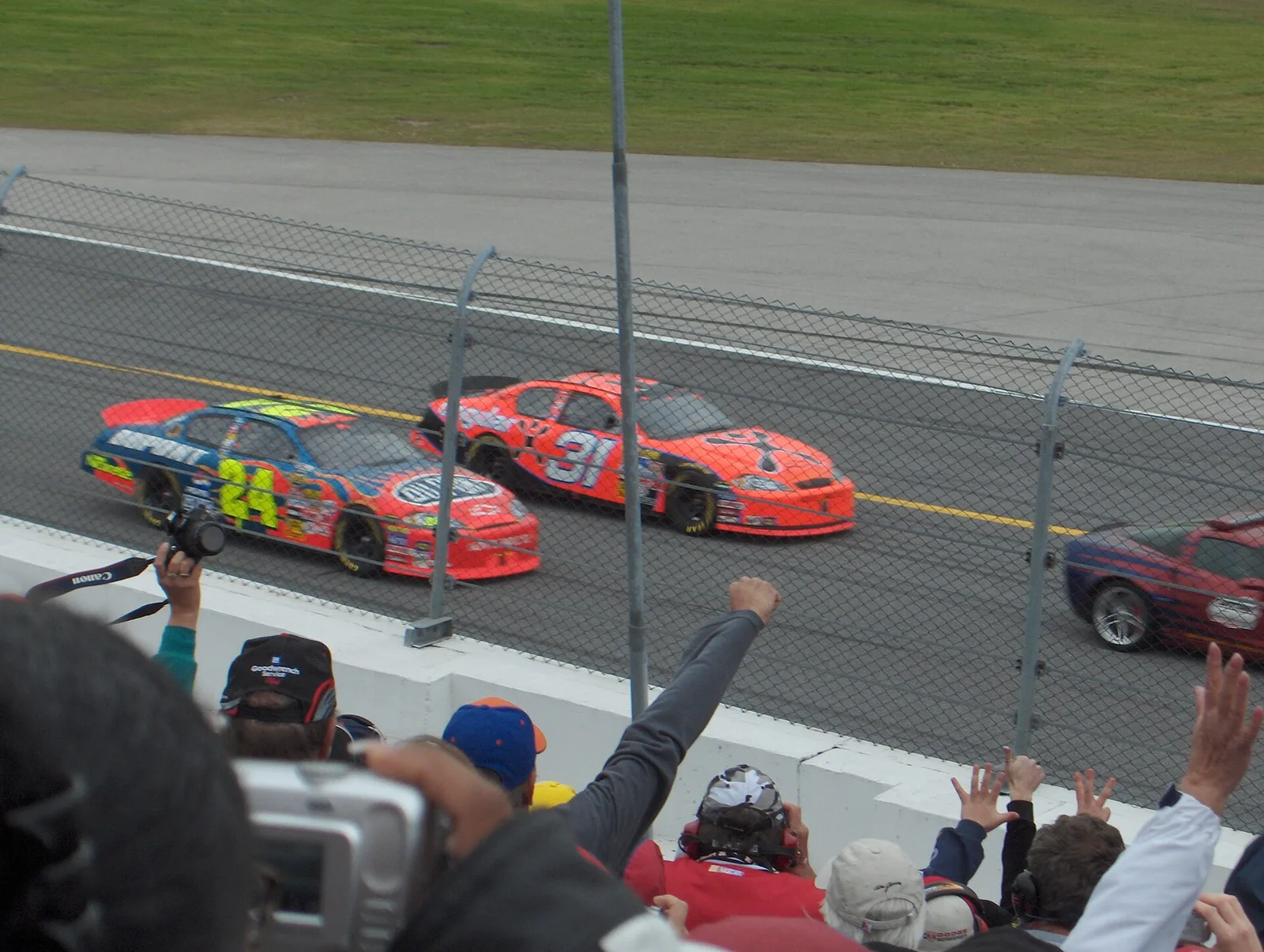
Stewart hit Kenseth's car on lap 107, and was sent to the back of the longest line for aggressive driving. Kenseth later took a drive-through penalty after contact on pit road, and he said Stewart had deliberately eliminated him. Robby Gordon's right-front tyre failed on lap 124 in turn three, bringing the sixth caution.
Johnson took the lead from teammate Brian Vickers on lap 187. The ninth caution came on the same lap, when Jamie McMurray collided with Kurt Busch and sent him into a barrier. After a late restart, the race finished on a green-white-checkered finish that extended it to 203 laps. Greg Biffle lost control on the final lap, and the finish was decided under caution.
How many cautions and lead changes were there?
There were 11 cautions during the race. A race-record 32 lead changes were made among 18 different drivers, and Earnhardt led the most laps of any racer with 32. Johnson led four times for a total of 24 laps.
Kvapil's right-front tyre burst a few laps later and sent him into the turn three wall, prompting another caution.
Who finished where?
Johnson, Casey Mears and Ryan Newman were the first three across the line. Mears finished second, his fifth top-five result of his career, and Newman followed in third. The top ten also included Elliott Sadler, Tony Stewart, Clint Bowyer, Brian Vickers, Earnhardt, Schrader and Jarrett.
| Specification | Detail |
|---|---|
| Race date | 19 February 2006 |
| Race length | 203 laps |
| Winner | Jimmie Johnson, started ninth |
| Second | Casey Mears |
| Third | Ryan Newman |
| Cautions | 11 |
| Lead changes | 32 among 18 drivers |
| Most laps led | Dale Earnhardt Jr., 32 |
| Johnson's laps led | 24 in four spells |
| Race time | 3 hours, 33 minutes and 26 seconds |
| Winner's prize | $1,505,124 |
| Average TV audience | 19.355 million viewers |
What did the championship look like after the race?
Mears and Newman each had 170 points after the opening race, and the manufacturers' standings favoured Chevrolet, which had nine points. Dodge had six points and Ford four. Sadler and Stewart were fourth and fifth in the drivers' table, while Johnson's win put him at the head of the points.
Johnson went on to win five races in 2006 and his first of seven championships at the end of the season.
How did the drivers react to the finish?
Johnson celebrated in victory lane in front of a crowd of 200,000. Newman told Mears after the race that his finish had cost Newman a million dollars, while Mears said he was happy to finish second.
Kenseth and Stewart remained at odds over the lap 107 incident. Earnhardt was pleased with ninth place despite leading the most laps.
What penalties followed the race?
Hall of Fame Racing was also penalised over a non-compliant carburetor. Crew chief Philippe Lopez was fined $25,000, and Labonte and owner Bill Saunders each lost 25 points in the driver and owner standings. Hall of Fame Racing appealed, and the appeal was heard on 7 March before a three-member National Stock Car Racing Commission at NASCAR's Research and Development Center in Concord, North Carolina. The penalties were upheld.
Johnson was declared the winner several hours after the race, once his car passed post-race inspection.
How big was the television audience?
The race attracted an average of 19.355 million viewers, a figure that put it at the top of NASCAR's broadcasts by average audience. It took 3 hours, 33 minutes and 26 seconds to complete, and because it ended under caution, no margin of victory was recorded.