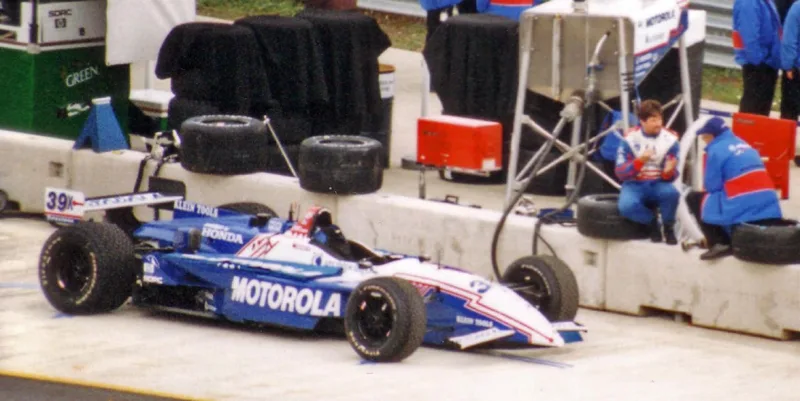
Helio Castroneves led all 72 laps to win the CART race at Belle Isle, while a dispute over an engine spacer and an uncertain future for the event played out around it.
The 2001 Tenneco Automotive Grand Prix of Detroit was a CART race held at Belle Isle on 17 June 2001. Helio Castroneves led all 72 laps for Team Penske, with Dario Franchitti second and Roberto Moreno third. The race was overshadowed by an engine spacer dispute and doubts about the event's future.
Helio Castroneves won the 2001 Tenneco Automotive Grand Prix of Detroit on 17 June 2001, leading all 72 laps for Team Penske. Dario Franchitti finished second for Team Green and Roberto Moreno third for Patrick Racing. The race was held at Belle Isle in a season where a dispute over an engine part had already overshadowed practice, and where the future of the event itself was in doubt.
When and where was the 2001 Detroit race held?
The race was held on Sunday 17 June 2001 at the Raceway at Belle Isle in Belle Isle Park, Michigan. It was the seventh round of the 2001 CART FedEx Championship Series, the seventh of 21 scheduled open-wheel races that season, and the 20th running of the event. It was the 13th under CART sanctioning.
The circuit was a 14-turn street course measuring 3.776 km (2.346 miles). It was the tenth successive year that the Detroit event had used Belle Isle, and the race had previously been part of the Formula One World Championship from 1982 to 1988.
The race was run under the sun with the air temperature between 28 and 30 degrees Celsius (82 and 86 degrees Fahrenheit), which the race report called perfect at the start.
Castroneves led every lap at Belle Isle, but the race was also a warning about the engine rules and the cost of keeping a street event alive.
What was the championship picture before Detroit?
Kenny Brack led the Drivers Championship with 70 points, 23 more than second-place Castroneves. Cristiano da Matta, Paul Tracy and Jimmy Vasser were tied for third with 40 points each, and the Constructors Cup was led by Lola with 98 points, six ahead of Reynard.
In the manufacturers' table Honda led with 86 points, while Toyota was two points behind in second and Ford-Cosworth was 13 points in arrears. Castroneves had already won at Long Beach and the Indianapolis 500 that year, but his momentum had been broken by a first-lap crash at the Milwaukee Mile.
Brack had won at Motegi and Milwaukee in consecutive races, which widened his gap over Castroneves at the top of the standings. Castroneves said he hoped to climb the fence again at Detroit, where his first CART win had come the year before, and that Team Penske was looking forward to repeating the result.
Why was the future of the Detroit race in doubt?
The 2001 race was the last year of CART's contract with International Management Group, which promoted the Detroit Grand Prix. Attendance had set a record of 62,000 in 1994, but it had fallen steadily since then, and the race drew about 44,000 spectators on the day, down from 50,500 in 2000.
Fans considered Belle Isle the worst track on CART's schedule because there was very little passing, and the drivers and teams disliked the cramped paddock and the narrow circuit. IMG president Bud Stanner said his company was struggling to afford the event and to pay CART.
A possible move to the Michigan State Fairgrounds Speedway was being considered as a way to keep CART in Detroit.
What was the spacer dispute about?
Toyota complained to CART that Honda and Ford-Cosworth were exploiting a loophole in the rules that let them lower the pressure of the pop-off valve and gain more turbocharger boost. To cancel that advantage, CART added a 3/4 in (19 mm) spacer to the base of the manifold pressure relief valve.
The spacer had first been used in a test at Michigan International Speedway on 12 June. CART said all three engine manufacturers had been told that the spacer would be introduced at Detroit, but Honda and Ford-Cosworth said they had only been informed when CART issued a bulletin on Friday morning, before the first practice.
Honda and Ford-Cosworth told the teams that used their engines to boycott the first session while their representatives met CART officials. Toyota did not join the boycott, because its teams had already tested the spacer at Mid-Ohio on 13 June, which led to rumours that Toyota had created the part, rumours that Toyota denied.
Ford-Cosworth eventually relented and let its teams practise with 15 minutes left in the session. Honda drivers never took to the track in that session, and the first session was led by Vasser at 1 minute 16.305 seconds.
How did the protest and the practice sessions unfold?
On Friday evening Honda and three of its teams filed a protest asking CART to cancel the Detroit Grand Prix because of the sudden spacer. A three-man judicial panel heard the protest and denied it, finding no basis under the rules for granting it. Honda was allowed to appeal within three business days.
Franchitti was quickest in the second Friday session at 1 minute 14.838 seconds, and Honda advised its teams to sit out the session but allowed them to practise if they wanted to. Every team eventually did practise, and the humid conditions made it hard to find a good setup.
The final practice on Saturday ran without a boycott, and de Ferran was fastest at 1 minute 14.043 seconds. Fittipaldi, Franchitti, Castroneves and Moreno were among the leading drivers, and three stoppages during the session showed how difficult the bumpy surface was.
Who took pole and who missed the race?
Castroneves took pole with a time of 1 minute 13.499 seconds. It was his third pole of the season and his seventh of his career, and Junqueira qualified second, 0.082 seconds behind him, to give Team Penske the front row.
De Ferran was third, Vasser fifth, Carpentier sixth and Moreno seventh, and Brack started tenth. Fittipaldi did not record a lap in the final 76 seconds of qualifying because of a car problem but still started eighth.
Tony Kanaan made contact with Papis and hit a wall at the tenth turn, and he was later diagnosed with a mild concussion after a CAT scan at hospital. Doctors advised him not to race, and Mo Nunn Racing withdrew his No. 55 car from the event.
How did the race start and open up?
The green flag was waved at 2:05 pm local time by starter Jim Swintal. Carpentier moved from sixth to fourth in turn one, and after one circuit Castroneves was 0.4 seconds clear of Junqueira.
Three laps later Jourdain and Zanardi collided in the third turn, and their tyres touched before both spun into a tyre barrier. For Bettenhausen Racing, Jourdain's team, it ended a 200th CART event, and the first caution followed.
Castroneves brought the field back to green-flag racing on the seventh lap, and he continued to hold his lead under pressure from Junqueira. On the tenth lap Franchitti's engine cut out momentarily, letting Vasser overtake him, but Franchitti got by Vasser for fifth on lap 20.
Dixon spun and stalled in the 12th turn on the 27th lap, prompting a local caution, and on lap 29 Junqueira's gearbox lost power and dropped him to fifth. That left Castroneves with a 7.8 second lead.
How did the cautions shape the middle of the race?
Castroneves made his first stop for tyres and fuel on lap 32 and kept the lead, because the other leaders had pitted the lap before. Tracy inherited second until he stopped on lap 36, hoping that later cautions would save his fuel.
The second caution came five laps later, after Minassian skidded into a tyre barrier in turn seven and Tagliani suffered brake failure at the 12th corner. Takagi also left the track in the third turn and retired. The top 17 drivers, except Tracy, made their final stops under that caution.
Junqueira spun against the turn eight barrier on the 42nd lap, and Vasser hit a wall while warming his tyres and retired from seventh. Four laps later the race went green again, with the top five made up of Castroneves, Carpentier, de Ferran, Franchitti and Moreno.
De Ferran's engine malfunctioned on lap 55, and he dropped from third to eighth before it refired. Servia crashed into the left-side wall at turn 12 two laps later, bringing out the third caution.
Green-flag racing resumed on the 61st lap, and Herta drove into the marbles and hit the turn 12 wall, causing the fourth and final caution. Castroneves pulled away from the field on the lap 66 restart.
Did anyone challenge Castroneves for the win?
Franchitti took second from Carpentier in the third turn, briefly losing the rear of his car, and Moreno then made wheel-to-wheel contact with Carpentier for third. Castroneves held the lead for the remaining six laps and took his fifth CART victory, his second of the season and his sixth in American open-wheel racing.
Castroneves became the first driver to take the Detroit Grand Prix as a CART event in two straight seasons. He led every one of the 72 laps, and there were no lead changes in the entire race.
Andretti set the fastest lap of 1 minute 16.010 seconds on the penultimate lap and finished fourth. Tracy ran out of fuel on the final lap and retired, which allowed Fittipaldi to take fifth.
| Finish | Driver | Note |
|---|---|---|
| First | Helio Castroneves | Team Penske, led all 72 laps |
| Second | Dario Franchitti | Team Green, 0.702 seconds behind the winner |
| Third | Roberto Moreno | Patrick Racing, first podium since the 2000 Marlboro 500 |
| Fourth | Michael Andretti | Fastest lap of the race |
| Fifth | Christian Fittipaldi | Took the place of Tracy after his fuel ran out |
| Retired | Paul Tracy | Ran out of fuel on the final lap |
De Ferran, da Matta, Carpentier, Brack and Gugelmin completed the top ten, while Papis and Fernandez were the final two classified finishers.
What did the result do to the championship?
Brack kept the Drivers Championship lead with 74 points after the race, but his gap over Castroneves shrank to five points. Andretti rose from seventh to third in the standings, and da Matta dropped to fourth while de Ferran improved to fifth.
Reynard reached 114 points and overtook Lola by six points in the Constructors Cup. Honda, on 108 points, extended its lead over Toyota to ten points in the manufacturers' standings, while Ford-Cosworth stayed third on 78 points with 14 races left.
Castroneves said the win was a dream come true, that his pit crew and the Firestone tyres had helped, and that he had climbed the catch fence in his traditional celebration. He said he had known the pole would give the team a good chance if they stayed calm.
What happened to the spacer dispute after Detroit?
Honda's Robert Clarke said the win by a Honda-powered car vindicated the team, but he was still pursuing legal action over the spacer after learning of disturbing information about why CART had mandated it. Honda redesigned its engine plenum to fit the spacer.
A second hearing of the protest was held in Cleveland, where a panel of three judges ruled that the spacer would not be enforced until 8 August, ahead of the Miller Lite 200 at Mid-Ohio. Toyota criticised the ruling as a disappointment.
On 16 July CART announced that all three engine manufacturers would use the spacer for the rest of the season, beginning with the Michigan 500.
What happened to the Detroit event afterwards?
Hours after the race Stanner and CART chief executive Joe Heitzler issued a joint statement after a private hour-long meeting about the future of the Detroit race. They hoped to explore ways to continue the event, including a return to the original street circuit in downtown Detroit.
The event was dropped from the 2002 schedule and was put on hiatus until 2007, when it returned as an IndyCar Series race.