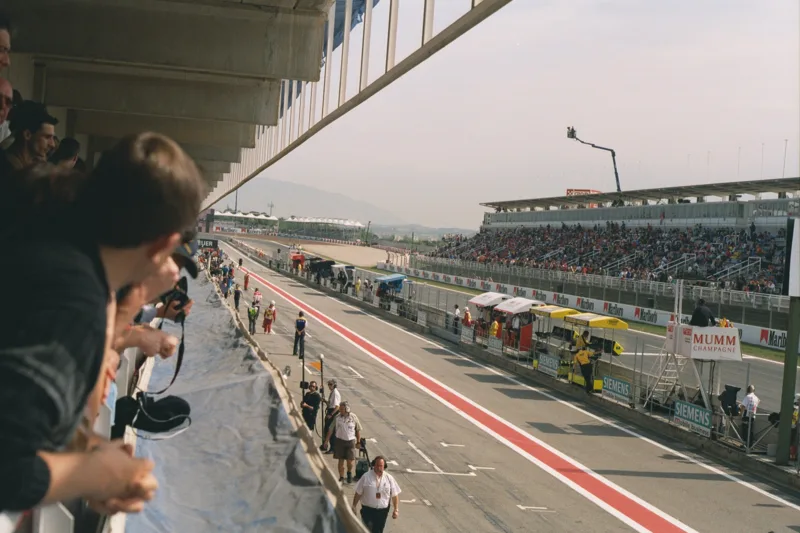
Michael Schumacher took pole and won at the Hungaroring, clinching his fourth world title, while Barrichello's second place gave Ferrari the constructors' championship.
The 2001 Hungarian Grand Prix was won by Michael Schumacher for Ferrari from pole position, with Barrichello second and Coulthard third. The 77-lap race at the Hungaroring gave Schumacher his fourth world drivers' title and Ferrari its third constructors' title in a row.
The 2001 Hungarian Grand Prix was a Formula One race held on 19 August 2001 at the Hungaroring in Mogyorod before 110,000 spectators. Michael Schumacher took pole and won the 77-lap race for Ferrari, which clinched his fourth world drivers' title, while his team-mate Rubens Barrichello finished second and gave Ferrari the constructors' championship.
Who won the 2001 Hungarian Grand Prix?
Michael Schumacher won the race from pole position, his seventh victory of the 2001 season and his 51st in Formula One. Barrichello finished second, 3.363 seconds behind, and David Coulthard took third for McLaren. Ralf Schumacher was fourth, Mika Hakkinen fifth and Heidfeld sixth.
The result matched the record of Alain Prost for career wins, and it made Schumacher the 2001 drivers' champion. Coulthard could not catch his points total with four races remaining, so the title was settled in Hungary.
A dry, hot Hungaroring gave Michael Schumacher his fourth world title, and Barrichello's second place gave Ferrari the constructors' crown.
What was at stake before the race?
Only Schumacher and Coulthard were still in contention for the drivers' title. Schumacher led the table with 84 points, while Coulthard was on 47 and Ralf Schumacher on 41. Barrichello was fourth on 40, and Hakkinen fifth on 19.
In the constructors' championship Ferrari led with 124 points, 58 ahead of McLaren. Williams were third with 56 points, while Sauber and BAR contended for fourth. A maximum of 40 points remained in the final four races, so Coulthard and Ralf Schumacher could still win the title, but Schumacher only needed to win the race.
Ferrari could also secure the constructors' title with a one-two finish. Schumacher said he was excited by the prospect of a fourth title but was not counting on it until it was in his pocket.
What changes did the teams make for Hungary?
Several teams modified their cars to maximise slow-speed grip and traction for the high-speed chicanes at the Hungaroring. Minardi revised its chassis for both race and test cars, with a titanium gearbox and changed rear geometry, and Andrea Piccini tested the update at Fiorano.
McLaren added a secondary wing behind the engine cover of its MP4/16, and Williams fitted cooling bodywork to the engine for the first time since the Malaysian Grand Prix. Jordan brought a new engine cover, undertray and diffuser, and Frentzen and Alesi had different brake and pedal set-ups in their cars.
Jean Alesi moved from Prost to Jordan for the rest of the season, while Heinz-Harald Frentzen, whom Jordan had sacked before the German Grand Prix, took the Prost seat. Both drivers completed separate 50 km (31 mi) shakedown tests in the week before the race.
How did practice go on the hot track?
The Friday sessions were hot and clear. Michael Schumacher was fastest in the morning at 1 minute 16.995 seconds, 0.288 seconds faster than Barrichello, while in the afternoon he was quickest again at 1 minute 16.651 seconds, with Barrichello 0.083 seconds behind.
Kerb height at turn 12 had been a concern for Ferrari and Coulthard, who complained to the FIA technical race director Charlie Whiting. Race officials agreed to lower the kerb by 2.5 cm (0.98 in) on Saturday morning, so that cars could be propelled more smoothly over the turn.
On Saturday, Michael Schumacher led the third session at 1 minute 15.466 seconds, but in the final session Coulthard was quickest with 1 minute 15.266 seconds. Michael Schumacher could not improve after going wide onto the grass at turn six and later spinning at turn 12.
Who was on the grid for Hungary?
Michael Schumacher took pole with a new qualifying track record of 1 minute 14.059 seconds, his ninth pole of the year and his 41st career pole. He overtook Hakkinen as the fastest driver on his first attempt, and set his best lap with 20 minutes remaining.
Coulthard qualified second, 0.801 seconds slower, after an oversteer put him wide at turn 13 and Frentzen had earlier slowed him. Barrichello was third after being delayed by Montoya early on, and Ralf Schumacher was the highest-placed Michelin-shod car in fourth.
| Grid | Driver | Team | Note |
|---|---|---|---|
| 1 | Michael Schumacher | Ferrari | 1 minute 14.059 seconds, track record |
| 2 | David Coulthard | McLaren | 0.801 seconds slower |
| 3 | Rubens Barrichello | Ferrari | Delayed by Montoya early on |
| 4 | Ralf Schumacher | Williams | Highest-placed Michelin runner |
| 5 | Jarno Trulli | Jordan | Aborted one timed lap |
Panis was the fastest driver outside the top ten, after an electrical fault and a traction control failure. Verstappen drove Arrows' spare car after damaging his race car in practice, and Tarso Marques qualified 22nd on a set-up that could not be changed after a sensor was replaced.
How did the race start?
The race took place in the afternoon before a crowd of 110,000 and was run over 77 laps. The air temperature was between 27 and 33 degrees C (81 and 91 degrees F), and the track was 40 to 41 degrees C (104 to 106 degrees F). A 20 per cent chance of rain had been forecast, but the race was run in dry, hot conditions.
On a reconnaissance lap, Schumacher's rear brakes locked and he ended up in the gravel at turn 12. The mechanics removed most of the stones and replaced a turning vane as a precaution. Coulthard's gearbox gave trouble, so he took the spare McLaren to the grid.
Michael Schumacher made a brisk start and kept his advantage. Barrichello overtook Coulthard on his left into turn one and then moved across to protect his team-mate. Verstappen made the best start in the field, moving from 21st to 16th by the end of the first lap, while Frentzen fell four places in the same distance.
At the end of the first lap, Michael Schumacher led Barrichello by 1.3 seconds, with Coulthard half a second further back in third. Ralf Schumacher was fourth, Trulli fifth and Hakkinen sixth. Button was given a ten-second stop-and-go penalty for jumping the start.
What were the key moments of the race?
Michael Schumacher was conserving his tyres, because he felt that speed would matter more as the race went on. Trulli held up Hakkinen, Heidfeld and Montoya for several laps, and Burti retired on lap 9 after spinning into the gravel at turn 14 on blistered tyres.
Barrichello began to slow Coulthard by about a second per lap on lap 12, which let his team-mate lead comfortably while lapping slower traffic.8 seconds and breaking Nigel Mansell's official lap record from 1992 along the way.
His stop lasted 8.4 seconds and handed the lead to Barrichello, and Michael Schumacher rejoined in third ahead of his brother Ralf. Barrichello stayed out until lap 31 to delay Coulthard in second, but his 9.1-second stop was slower than Coulthard's, and Coulthard passed him.
Coulthard closed the gap to Michael Schumacher to 11 seconds but could not get closer. Michael Schumacher made a second pit stop on lap 52, and Barrichello followed on the next lap, rejoining third. Coulthard's second stop was held up for two seconds when the refuelling rig jammed.
Hakkinen set the race's fastest lap of 1 minute 16.723 seconds on lap 51 and was two seconds a lap faster than Ralf Schumacher. Hakkinen made his final stop for fuel on lap 71.
Which drivers retired from the race?
Twelve of the 22 starters failed to finish, and the attrition rate was high. Button stalled on the start-finish line after his traction control failed to operate, and he was extricated under yellow flag conditions. Alonso spun into the gravel at turn one when his rear brakes failed.
Bernoldi locked his rear brakes and retired by spinning into the gravel at turn four. Trulli pulled off with a hydraulic failure, and Panis parked his car after an electrical fault and one exploratory lap. Marques was told to switch off his engine at turn 12 because of low fuel pressure.
How did the title race end?
Michael Schumacher slowed in the closing laps, and Barrichello held off Coulthard to let his team-mate take the win. The winning time was 1 hour, 41 minutes, 49.675 seconds, an average of 180.344 km/h (112.061 mph), which equalled Prost's record of wins.
Schumacher became the first Ferrari driver since Alberto Ascari in 1953 to win back-to-back world drivers' titles. Ferrari's third consecutive constructors' title was its 11th overall, and Barrichello's second place was the decisive result for the team.
Coulthard was third, with Ralf Schumacher fourth, Hakkinen fifth and Heidfeld sixth. Raikkonen, Montoya, Villeneuve, Alesi, De la Rosa and Verstappen were the final classified finishers.
What did the result mean for the championships?
Michael Schumacher finished the season as drivers' champion with 94 points, and Coulthard stayed second on 51. Barrichello was five points behind Coulthard, and Ralf Schumacher was two points further back in fourth. Hakkinen finished fifth with 21 points.
Ferrari won the constructors' title with 140 points, and McLaren were second on 72, 13 points ahead of Williams in third. Sauber were fourth with 20 points, and BAR were four points behind them. Four races remained in the season when the title was decided.
What did people say about the title?
Michael Schumacher called his fourth title and his 51st win a great achievement, and he said that each victory and each championship feels different. Barrichello was proud of his role in securing the constructors' title, and admitted he had mixed feelings about falling behind Coulthard after the first round of pit stops.
Coulthard said it made no difference to him whether he finished second, third or fourth, and that his goal was to give full effort in each race. Hakkinen said Trulli had held him up for 29 laps before his first stop, and he said his lap record was of little consolation.
Chancellor Gerhard Schroeder wrote to Michael Schumacher to congratulate him, and about 2,000 people watched the race on a large screen in his hometown of Kerpen. Church bells rang in Maranello, where Ferrari's headquarters are based.