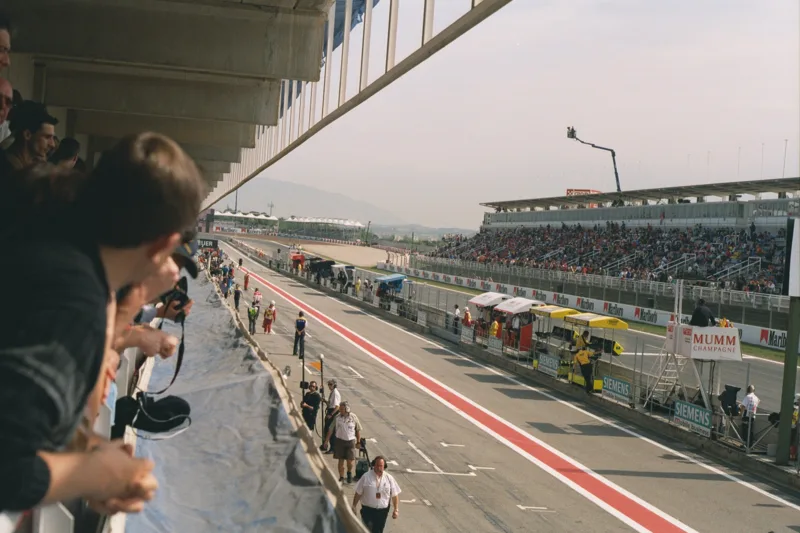
Starting second behind Michael Schumacher, Ralf took the lead after the pit stop cycle and held it for the final 18 laps in Montreal.
On 10 June 2001 Ralf Schumacher took the flag for Williams at Montreal's Circuit Gilles Villeneuve. Starting second, he led from lap 51 to the finish, and his brother Michael came home second for Ferrari. It was the first time siblings had finished first and second in a Formula One race.
Ralf Schumacher won the 2001 Canadian Grand Prix for Williams after starting second behind his brother Michael on the Montreal grid. Ralf led from lap 51 to the flag at Circuit Gilles Villeneuve, a circuit where Michael had already won four times before the race.
How did Ralf Schumacher come from second to win?
Michael took the early lead, but Ralf reduced the gap as his Williams tyres came into their optimum operating range. Michael had opened up a lead of 1.1 seconds at one point, but Ralf had cut it to four-tenths of a second before the safety car was needed on lap 20.
That safety car followed separate accidents involving Rubens Barrichello and Juan Pablo Montoya. It stayed out for three more laps before the restart, and the two Schumachers were still first and second when the green flag returned. Ralf kept searching for a way past on the track, and the gap moved with every lap.
Ralf got past his brother after the pit stop cycle on lap 51, and he held the lead for the last 18 laps. It was his second win of the 2001 season, and the first time that brothers had finished first and second in a Formula One race.
Montreal gave Williams a win and gave the Schumacher family a result that had never happened in a Formula One race before.
Where did the championship stand before Montreal?
Michael Schumacher led the drivers' championship going into the race, ahead of David Coulthard of McLaren. Michael had 52 points, Coulthard 40 and Rubens Barrichello of Ferrari 24. Ralf was fourth on 12 points, while Nick Heidfeld of Sauber was fifth on eight.
Ferrari led the constructors' championship with 76 points, ahead of McLaren on 44 and Williams on 18. Jordan on 13 and Sauber on 12 were contesting fourth place.
Montreal was the eighth of seventeen scheduled rounds, and the 33rd Canadian Grand Prix as part of the world championship. The race was run over 69 laps around a 4.421 km (2.747 mi) course with 13 turns, and the programme also included support races: the Ferrari Challenge, Formula Ford 1600 and the Toyota Atlantic Championship.
What did the teams do before the weekend?
Ten of the eleven teams spent three days at Magny-Cours, the French circuit. Ralf Schumacher set the fastest times on the opening two days, and Williams test driver Marc Gene set the pace on the final day. Those three days were the main preparation for the weekend.
Monza also hosted testing. Sauber's Kimi Raikkonen led on the first day, and Juan Pablo Montoya was quickest on the last two. Ferrari's test driver Luca Badoer spent three days at the Fiorano circuit, shaking down three F2001 chassis and practising starts before they were sent to Canada.
Most teams focused their work on braking, because the Circuit Gilles Villeneuve has several sharp braking sections. Sauber, Jordan and Arrows brought brake air intake fairings like the ones Ferrari had used, although Sauber did not run its new fairings in the race itself.
Michael Schumacher, who had won here four times, said his Montreal record counted for little now that 2001 offered a new challenge. He expected a tight contest with McLaren and Williams.
Ralf had his own view of the track. He said it suited a powerful engine, and he hoped to score points after a poor result at Monaco. Race director Charlie Whiting had also asked Canadian Grand Prix president Normand Legault to fit two-inch ribs behind the kerbs at turns 12 and 13, to encourage drivers to take a different line through the chicane and reduce the risk of damage.
What makes the Circuit Gilles Villeneuve demanding?
The circuit is a 4.421 km (2.747 mi) temporary road course with 13 turns, and its character is set by sharp braking zones and stop-and-go sections rather than long high-speed corners. That suits some cars and drivers better than others, and it was the reason the teams worked so hard on their brakes before the weekend.
Ralf described the track as a stop-and-go circuit that was not especially demanding on the drivers. Michael had won here four times, but he had a preference for high-speed corners and did not regard the slow sections as his strength.
The ribs behind the kerbs at turns 12 and 13 were the other talking point. Whiting wanted drivers to alter their line through the chicane, so that they kept clear of the kerb and reduced the risk of damage to their cars.
What did the practice sessions reveal?
Four practice sessions came before the race, two of one hour and two of 45 minutes. Coulthard was fastest in the first at 1:18.763, but the second session belonged to Hakkinen, whose 1:17.692 was the only time under 1:18 and broke the circuit record Michael Schumacher had set in 1997.
In the opening session Coulthard was almost four-tenths of a second clear of Barrichello, who was second. Michael Schumacher was third before the late laps, and Hakkinen, Panis, Heidfeld, Trulli, Raikkonen, Ralf Schumacher and Montoya completed the top ten.
Villeneuve had the most dramatic moment of the early running. His BAR lost its rear at almost 240 km/h (150 mph) after a suspension failure, struck the barriers at the next corner and was destroyed. Because the rules did not allow spare cars in free practice, he missed the rest of the session.
The drivers' briefing that followed produced friction. Montoya and Villeneuve clashed, and Whiting stepped in to stop it. Both drivers were warned that they would face a two-race ban if there was another altercation.
Frentzen's weekend was cut short. He had a heavy accident at turn three, and his Jordan was driven for the rest of the weekend by test and reserve driver Ricardo Zonta. Frentzen had also been hit by an 18 g crash at Monaco earlier in the season.
On Saturday morning Hakkinen was fastest at 1:16.628, with Coulthard 0.047 seconds slower. In the final session, which took place in clear conditions, drivers made their last set-up changes, and Schumacher was quickest at 1:16.200.
Who took pole, and how did the grid settle?
Michael Schumacher took his 38th career pole position at 1:15.782 in the one-hour session. It was the only lap under 1:16 in qualifying, and the 107 per cent rule meant every driver had to be within that margin of the quickest time to take part.
Ralf was 0.515 seconds slower in second. Coulthard ran wide at the final chicane on his first timed lap, but he improved in the final sector on his last try to take third, which dropped Trulli to fourth. Barrichello was fifth after losing control of his Ferrari at the final chicane, which brought out the first red flag.
Barrichello's crash meant he had to return to the pit lane and drive the spare Ferrari, which had been set up for his team-mate Michael. Marshals spent five minutes clearing debris and removing his stricken car, and Barrichello set his fastest time on his last run.
Panis took sixth, ahead of his BAR team-mate Villeneuve. Trulli had been ordered to park at the pit lane entry during the session, and he felt the wait had stopped him from bettering his time. Hakkinen switched to a spare McLaren after damaging his main car at the final corner, and a misfiring engine restricted him to eighth.
Montoya and Villeneuve completed the top ten. Heidfeld was the fastest driver outside it, but he was 1.383 seconds slower than the pole time. He later crashed heavily at the final chicane, and his car's monocoque had to be rebuilt for the race.
Further down the order, Zonta qualified 12th and Verstappen 13th. The two Jaguars of De la Rosa and Irvine were 14th and 15th, and Alesi was 16th after brake instability and a lack of traction. Bernoldi made his first appearance at the circuit and qualified 17th, Fisichella took 18th in the faster Benetton, and Burti was 19th.
Button had excessive understeer and took 20th. The two Minardis of Fernando Alonso and Tarso Marques were on the final row in 21st and 22nd. Alonso's times were later disallowed after scrutineers found his front wing less than 100 mm (3.9 in) above the regulation reference plate.
Fifteen drivers beat Schumacher's 1997 pole lap time. Improvements in engines, chassis and tyre technology across the whole grid were the reason.
How did warm-up and the start look?
The half-hour warm-up was sunny and dry. Panis set the fastest lap at 1:18.512, running quicker than he had all weekend, while Coulthard was the faster McLaren in second. Hakkinen came fifth after his team rebuilt his car overnight.
Schumacher was sixth-fastest and spent the session assessing two versions of front wing for his Ferrari, and the top six were separated by only 0.15 seconds. Hakkinen braked too late for turn one and ran across the gravel, but he avoided the tyre barrier.
The race started at 13:00 in sunny and dry weather. The air was between 25 and 26 C (77 and 79 F) and the track between 27 and 32 C (81 and 90 F). Forecasts had predicted no rain, and engine stress and fuel use made a single pit stop the best strategy.
A record crowd of 111,000 watched the race, beating the previous year's figure of 106,000.
How did the race itself unfold?
The race turned on two things: the lap 20 safety car and the pit stop cycle that followed it. Ralf used the time on track to reduce his brother's advantage, and he took the lead on lap 51 when the stops were complete.
The safety car came out on lap 20 for the accidents that involved Barrichello and Montoya, and it stayed out for three more laps. Michael had built a lead of 1.1 seconds before Ralf's tyres came into their optimum range, and by then the margin between the two had shrunk to four-tenths of a second.
After the stops Ralf got past his brother and built a lead he would hold to the flag. Coulthard retired with an engine failure in the final 15 laps.
Final result
| Position | Driver | Note |
|---|---|---|
| Winner | Ralf Schumacher (Williams) | Started second, led the last 18 laps |
| Second | Michael Schumacher (Ferrari) | Pole position and fastest lap in qualifying |
| Third | Mika Hakkinen (McLaren) | Completed the podium |
| Retired | David Coulthard (McLaren) | Engine failure in the final 15 laps |
What did the result do to the championships?
Michael Schumacher increased his lead at the top of the drivers' championship to 18 points over Coulthard, who had retired. His second place was enough to extend that lead, even though the race went to his brother. Barrichello kept third in the standings despite his crash, Ralf stayed fourth, and Hakkinen completed the top five.
Ferrari extended its advantage over McLaren in the constructors' championship to 38 points. Williams kept third place with nine rounds still to run.