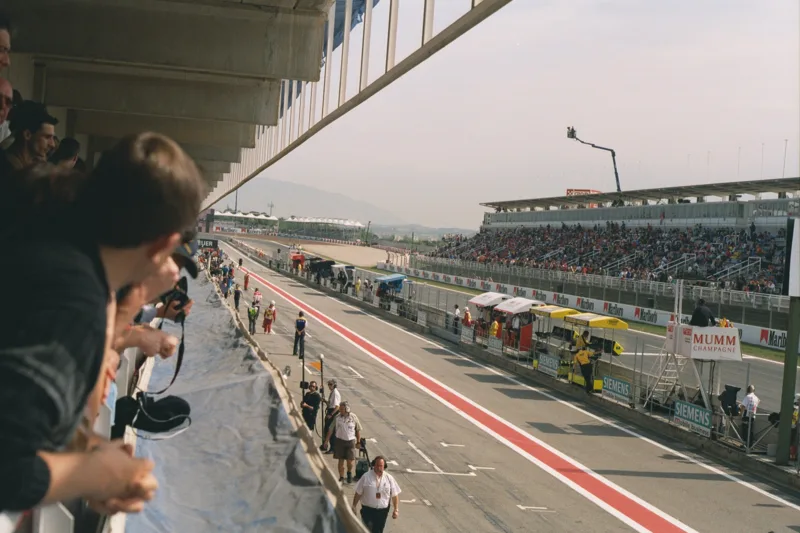
A first-lap crash stopped the race at Spa, a shorter restart followed and Michael Schumacher passed Alain Prost's career win total.
The 2001 Belgian Grand Prix was the 14th round of the 2001 Formula One World Championship, held at Spa-Francorchamps on 2 September 2001 before 85,000 spectators. Michael Schumacher won the restarted race from third on the grid, David Coulthard was second and Giancarlo Fisichella third, after a first start was abandoned following Luciano Burti's crash.
The 2001 Belgian Grand Prix at Spa-Francorchamps is remembered for a serious first-lap-five accident, a race that was stopped and restarted over a shorter distance, and Michael Schumacher passing Alain Prost's long-standing career win total. The result gave Schumacher his eighth win of the season and a place in the record books.
Where did Spa stand in the 2001 title fight?
Both world championships were already settled before the race. Schumacher had won the drivers' title and Ferrari the constructors' title at the Hungarian Grand Prix, leaving McLaren too far behind to catch them. Coulthard led Barrichello by five points for second in the drivers' table and had a further two points over Ralf Schumacher in fourth.
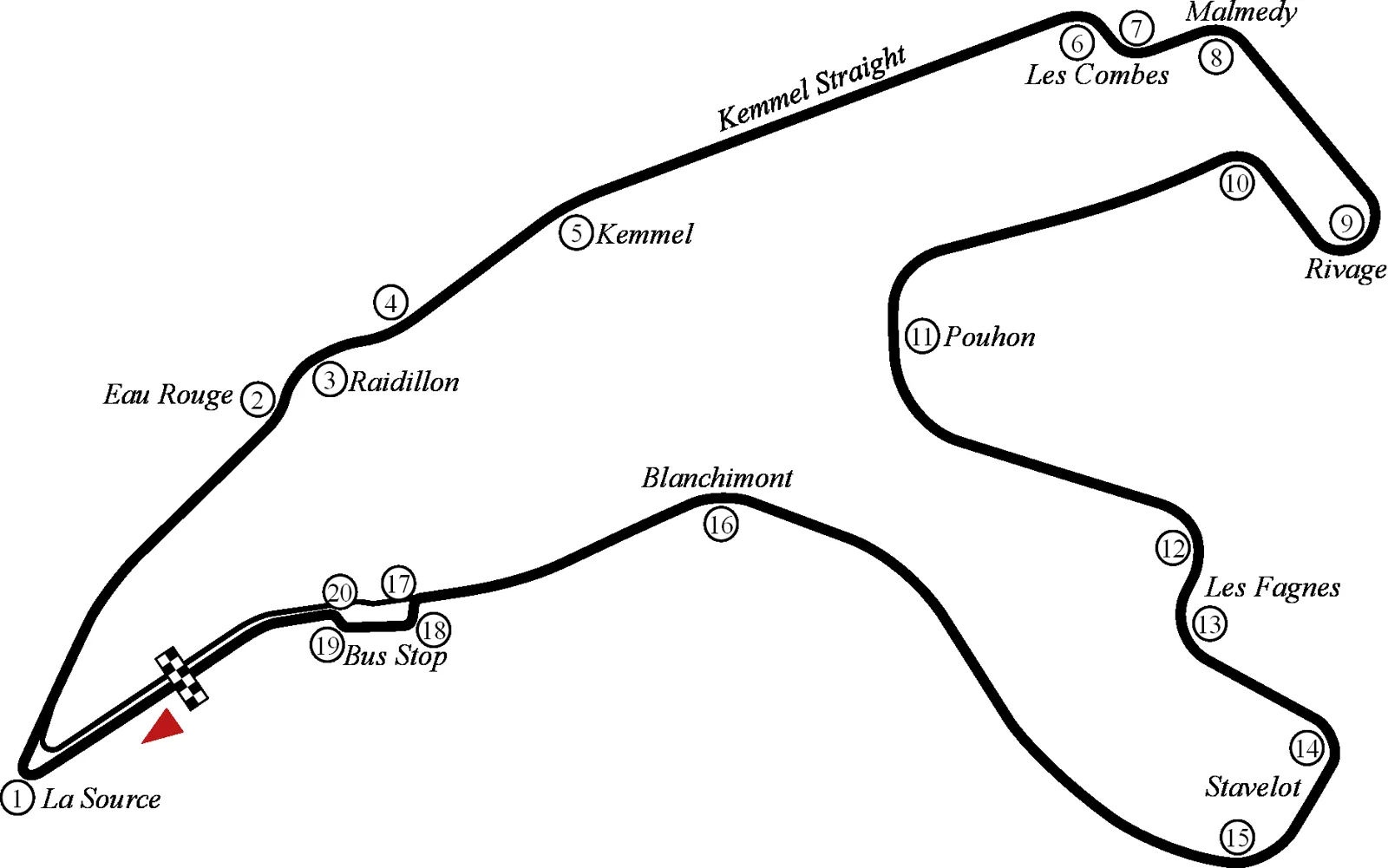
Spa-Francorchamps is a long track by any measure. At 6.968 km (4.330 mi) with 21 turns it was reduced from 14 km (8.7 mi) for safety reasons, yet it remained the longest circuit in Formula One. Its fast, sweeping corners and heavy changes in gradient put a lot of load on the drivers, and teams set their cars up for medium downforce.
Several teams changed their cars for the weekend. Williams gave Ralf Schumacher a chassis that was 3 kg (6.6 lb) lighter and stiffer, along with revised aerodynamics for the FW23. Ferrari fitted a new front wing to the F2001, built on solutions tested in the previous race. Prost adopted a new rear suspension layout, and Minardi brought in its new PS01B chassis with a revised rear crash structure.
A first-lap crash, a restart over a shorter distance and Schumacher's record-breaking win at Spa.
How did the wet practice sessions unfold?
Friday practice began cool and overcast before a downpour in the afternoon, and several drivers aquaplaned on the standing water. Michael Schumacher was fastest in the first session at 1:48.655, but the day was marked by several accidents.
David Coulthard lost control on sodden dirt at the exit of Les Fagnes, hit the kerb and then struck the metal barrier head-on at the corner, which is taken at 160 km/h (99 mph). The impact tore the right-front wheel from its mountings and the car skidded backwards along the wall. He climbed out unhurt but missed the second session while his car was repaired.
Michael Schumacher was trying to pass Pedro de la Rosa's Jaguar on the way down to Eau Rouge when the spray hid the car ahead, and he ran into the back of it, breaking his front wing. Montoya lost his car on a wet kerb after Les Combes, and Button hit an armco barrier in the pit lane as he left the Bus Stop chicane.
The third session on Saturday morning was delayed by two hours because of fog, rain and low cloud. Organisers then cancelled it for safety, since the emergency medical helicopters were grounded in Liege. When the sky cleared, a single 45-minute session was agreed, without practice starts, to protect the television timetable for qualifying.
How did qualifying decide the grid?
Heavy rain kept the cars in the garages for 26 minutes before anyone ventured out on intermediate tyres. Juan Pablo Montoya traded fastest laps with his team-mate and took pole with 1:52.072, the second pole of his career, with Ralf Schumacher alongside him on the grid.
Qualifying ran under the 107% rule, with each driver limited to twelve laps. Frentzen was reluctant to switch to dry tyres until Prost, his team owner, persuaded him, and he qualified fourth. Michael Schumacher began in the spare Ferrari and moved to his race car once the track had dried, and Barrichello used intermediates throughout to start fifth. Coulthard, who had been third, dropped to ninth in the last seconds because there was not enough time to fit dry tyres.
Verstappen, Alonso, Bernoldi and Marques all set times outside the 107% limit. The stewards allowed them to start because of exceptional circumstances caused by the changing conditions. McLaren's team principal Ron Dennis protested the decision, but the stewards rejected the protest after reviewing the data and hearing arguments eight hours later, and McLaren chose not to appeal.
What went wrong at the start?
The first start was abandoned before the race had properly begun. Frentzen and Marques stalled with gearbox problems before the formation lap and were sent to the back of the grid, which cut the race from 44 laps to 43. On the next formation lap Montoya stopped while engaging first gear and forfeited pole, leaving his team-mate Ralf Schumacher to lead into Les Combes.
Michael Schumacher had been third but slipped past his brother Ralf around the left at Les Combes to lead the race. He was 2.1 seconds clear of Ralf at the end of the first lap, and the gap grew to 6.3 seconds over the next three laps. The field appeared to be settling in behind him when the race was thrown into chaos on lap five.
On that lap Luciano Burti was attempting to pass Eddie Irvine on the inside at Blanchimont. Irvine stayed on the racing line, which put Burti's left-hand wheels onto the grass, and Burti's right-front wheel touched the Jaguar. That contact removed Burti's front wing and most of his downforce. His car was sent across the gravel and into a four-deep tyre barrier at 150 mph (240 km/h). The front of his full-face helmet broke, but a head and neck restraint absorbed much of the force and prevented further injury.
Irvine stopped and helped the marshals remove the tyres pinned against Burti's car. The safety car was called out, and the race was stopped and declared null and void. Sid Watkins, the FIA medical delegate, directed the extraction of Burti from the car, which was then taken to the circuit medical centre. He was flown by helicopter to a hospital in Liege with a serious concussion.
How was the restarted race decided?
The restarted race covered 36 laps, with the first four laps not counting, and the field was reduced to 18 cars. The restart came at 14:45 local time. Michael Schumacher led every lap, opening a 24.8 second gap over Fisichella by lap 15, and his advantage stretched further after the stops.
Fisichella made a strong start from sixth and passed both McLaren cars and Barrichello, though not Michael Schumacher. Ralf Schumacher's car had to start from the back because his mechanics were replacing a rear wing beam after Montoya's wing broke. Heidfeld tried a move on De la Rosa at La Source, the two cars touched, and Heidfeld retired at once. Montoya's engine failed after he had passed four cars.
The first round of stops began early. Barrichello made his stop on lap nine and Michael Schumacher came in on the next lap, rejoining in second. Panis took a ten-second stop-and-go penalty for crossing the white line at the pit exit.
Button struck a plastic bollard at the Bus Stop chicane while under pressure from Ralf Schumacher. The bollard folded his front wing under the front-left wheel, the car lost its downforce and he went into the outside barrier. Coulthard, meanwhile, was tackling Fisichella, and after several attempts he passed him on the outside into Eau Rouge to claim second.
Michael Schumacher's fifth win at Spa equalled the record of Ayrton Senna for victories at the circuit. It was also his eighth win of 2001 and his 52nd in Formula One, overtaking the 51 wins of four-time champion Alain Prost. Coulthard finished 10.098 seconds behind, Fisichella was third, and Hakkinen, Barrichello and Alesi completed the points.
Top ten classification
| Position | Driver | Team | Notes |
|---|---|---|---|
| 1 | Michael Schumacher | Ferrari | Started third, 52nd career win |
| 2 | David Coulthard | McLaren | 10.098 seconds behind |
| 3 | Giancarlo Fisichella | Benetton | Same front tyres for the whole race |
| 4 | Mika Hakkinen | McLaren | Fourth at the flag |
| 5 | Rubens Barrichello | Ferrari | Early stop on lap nine |
| 6 | Jean Alesi | Prost | Last of the points scorers |
| 7 | Ralf Schumacher | Williams | Started from the back of the restart |
| 8 | Jacques Villeneuve | BAR | Finished the race |
| 9 | Heinz-Harald Frentzen | Prost | Finished the race |
| Tenth | Jos Verstappen | Arrows | Finished the race |
What did Burti's accident mean afterwards?
Burti was kept in hospital with facial bruising and a concussion. He had a brain scan that showed a head injury without any swelling of the brain. He was placed in an induced coma until he left intensive care on 4 September, then discharged six days later and returned to Monaco to recover. Tomas Enge replaced him for the rest of the season.
The FIA reviewed the accident and banned the practice of cutting holes in helmets to pass drinking tubes and radio wires through them. The case later became an example in the development of the halo. Burti went on to suffer seizures and memory loss for the following four months, and in a 2019 interview with Autosport he credited the safety improvements made after Ayrton Senna's death in 1994 with saving his life.
The stewards looked at television footage and heard Irvine's account before concluding that the collision was a racing incident and that neither driver was to blame. Jaguar's team principal Niki Lauda was critical of the trackside marshals, saying Irvine had been forced to take over the rescue.
What did the win change in the championships?
The win took Schumacher past Prost's career record of 51 victories, and his fifth success at Spa matched Ayrton Senna's record for the circuit. Alain Prost said Schumacher had the talent and motivation to become a five- or six-time champion. Schumacher himself said the milestone had no priority for him, and he was happy to look back on it later.
In the drivers' table Coulthard moved nine points clear of Barrichello in the battle for second. In the constructors' table McLaren extended their lead over Williams by nine points, and Jordan passed BAR for fifth with three races left in the season.