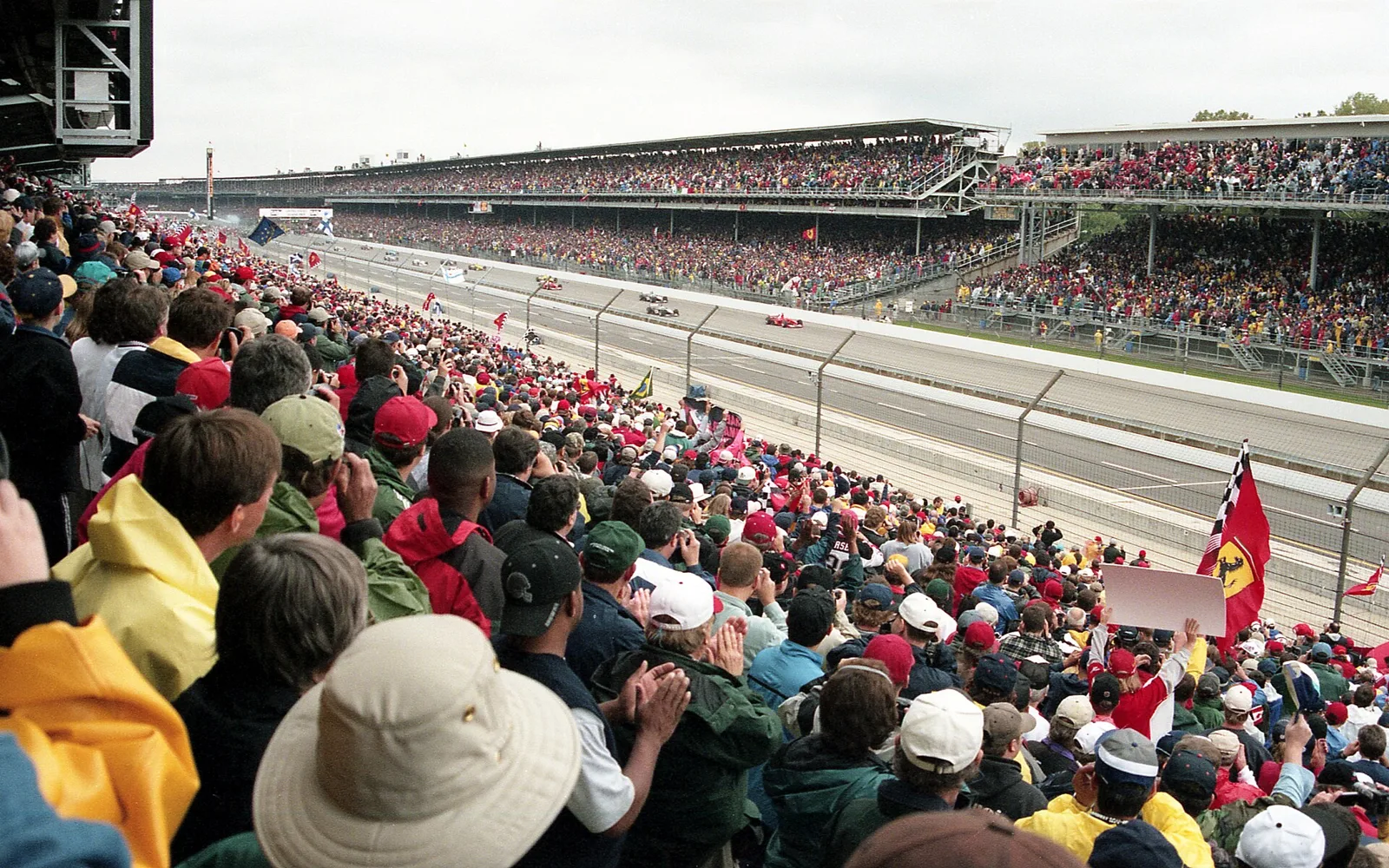

A road course built inside the Indianapolis Motor Speedway hosted its first Formula One race, and Michael Schumacher won it from pole after a jump start and a late Hakkinen failure.
The 2000 United States Grand Prix was won by Michael Schumacher for Ferrari from pole position at Indianapolis. Barrichello finished second and Frentzen third. It was the first world championship Formula One race held at the Indianapolis Motor Speedway and Schumacher's seventh win of the season.
The 2000 United States Grand Prix was a Formula One race held on 24 September 2000 at the Indianapolis Motor Speedway, before a crowd of about 250,000. It was the first Formula One world championship event held at Indianapolis, and it was won by Michael Schumacher from pole position for Ferrari, after McLaren's title hopes were affected by a jump start and a late engine failure.
Who won the 2000 United States Grand Prix?
Michael Schumacher won the 73-lap race for Ferrari from pole position. Rubens Barrichello finished second, 12.1 seconds behind, and Heinz-Harald Frentzen took third for Jordan. It was Schumacher's seventh win of the season and his 42nd in Formula One.
Schumacher passed David Coulthard on lap seven, after the McLaren driver had taken the lead at the start. Once in front, Schumacher was not seriously challenged, and despite losing control of his Ferrari in the final five circuits he held on to the win.
A road course inside Indianapolis hosted its first world championship race, and Schumacher came through from pole to win.
Why was Indianapolis chosen for a Grand Prix?
The race marked the return of the United States to the championship after a gap since 1991. The road circuit was built between 2 December 1998 and 10 September 2000, and it was finished only two weeks before the Grand Prix.
The Phoenix street race had ended because of low attendance, and it was replaced in the 1992 season by the South African Grand Prix. The Indianapolis project was revived in December 1998 after a seven-year campaign by Tony George, the president of the Indianapolis Motor Speedway. The event was held under the auspices of the United States Auto Club, the FIA's member for the United States.
To celebrate the return, Eddie Irvine and Johnny Herbert drove a Jaguar R1 and a taxicab along Broadway in New York City on the Tuesday before the race.
What was the championship situation before the race?
Hakkinen led the drivers' championship with 80 points, ahead of Schumacher on 78, Coulthard on 61, Barrichello on 49 and Ralf Schumacher on 24. McLaren led the constructors' table with 131 points, four ahead of Ferrari.
With three races left, the championship was still open. Hakkinen said the remaining rounds were equally vital and that the title might not be settled until the Malaysian Grand Prix. Ron Dennis told Coulthard to help Hakkinen win the title, and Barrichello said his job was to support Schumacher.
How did the teams prepare for a new circuit?
Teams tested on European circuits between 11 and 15 September. Ferrari, McLaren and Sauber tested at Mugello, and Olivier Panis set the pace for McLaren. Williams and Benetton worked at Estoril, and BAR and Jaguar tested for two days at Silverstone.
Bridgestone brought the Hard and Extra Hard dry compounds to the event. The Extra Hard tyre was developed for the extra loads of the Indianapolis road course, and the company advised teams to raise their air pressures for the high loads through the final two corners.
Drivers were generally impressed by the circuit. Hakkinen called it great, really enjoyable and difficult in some parts, while Villeneuve found the infield very slow and the banked turn 13 lacking a real challenge. Mario Andretti tested a car on the track and said it kept the driver's attention.
What happened in practice?
The first session on Friday was warm and dry, and every driver used it to learn the layout. Schumacher set the early pace with a time of 1:14.927 before Barrichello, and Hakkinen was third after his gearbox was changed. Coulthard was barred from running after an electrical fault stopped him at the pit lane entry.
The second session was sunny. Coulthard set the day's fastest lap of 1:14.561, one tenth of a second faster than Hakkinen. Michael Schumacher and Barrichello fell back after failing to improve, and Herbert crashed into the tyre barrier at the first turn.
On Saturday the track was damp in the morning and warmed as the day went on. Hakkinen was quickest in the third session, while Schumacher set the fastest time of the final session with a lap of 1:14.804. Both McLaren drivers were fast throughout, but the drying track caused several drivers to lose the car's balance.
How was the pole position decided?
Michael Schumacher took pole with a time of 1:14.266, set seven minutes into the one-hour qualifying session. It was his seventh pole of the season and his 30th in Formula One. Coulthard was second, one tenth behind, after using Hakkinen's slipstream through turn 13 and the start of the main straight.
Hakkinen qualified third, having completed nearly all of his allowed laps without a final run. Barrichello was fourth, three tenths of a second behind Schumacher, after missing the slipstream that had helped his team-mate. Trulli replaced his engine late in the session.
| Grid | Driver | Team | Note |
|---|---|---|---|
| 1 | Michael Schumacher | Ferrari | 1:14.266, 30th career pole |
| 2 | David Coulthard | McLaren | One tenth behind pole |
| 3 | Mika Hakkinen | McLaren | No final run |
| 4 | Rubens Barrichello | Ferrari | Missed the slipstream |
| 7 | Heinz-Harald Frentzen | Jordan | Grip trouble in the infield |
| 8 | Jacques Villeneuve | BAR | Spun at turn nine |
| 9 | Pedro Diniz | Sauber | Season-best grid position |
| 10 | Ralf Schumacher | Williams | Setup problems |
Yoong did not set a time within the 107 per cent limit, which left him outside the race. The front row was moved back 8 ft (2.4 m) on the night before the race, after drivers raised concerns about wheelspin over the Yard of Bricks.
How did the race start and unfold?
The grid was damp, and the track was drying in places. Almost every driver began on intermediate tyres, and Coulthard jumped the start by releasing the clutch too soon. He took the lead into turn one, and the stewards later investigated the start.
Hakkinen held off Barrichello's attempts to pass him for third going into turn one. Schumacher attacked Coulthard on lap five, and then passed him on the outside into turn one on lap seven. Contact was minor, but Schumacher went ahead, and nobody could catch him after that.
Coulthard was given a ten-second stop-and-go penalty on lap eight, and he dropped to sixth after serving it. Barrichello was the first of the front runners to pit, and many drivers switched to dry tyres as the track dried quickly on the oval section, although the infield stayed slippery.
Schumacher made his pit stop on lap 16, when he took seven seconds to refuel and change tyres. He came back out ahead, and Hakkinen began reducing the gap by a steady margin. Hakkinen's engine failed on lap 26 when the pneumatic valve system broke, which left Ralf Schumacher in second.
Herbert had a difficult pit stop on lap 28 when a wheel gun was dropped on his front wing. Verstappen crashed on lap 35 after a brake balance failure, and Coulthard passed Diniz for sixth on lap 39 before setting the race's fastest lap on lap 40.
Ralf Schumacher later had a long pit stop to deal with a leak in his pneumatic valve system. He retired later in the race with a fault in the same system. Villeneuve spun on lap 40 and was passed by Barrichello, who then climbed into second.
Which drivers retired from the race?
Salo spun into the gravel on lap 19, and the race had several retirements in the second half. De la Rosa retired on lap 46 when his gearbox failed, and Fisichella followed one lap later with smoke from his engine. Alesi retired on the following lap after an engine failure, and Mazzacane stopped on the grass on lap 62.
Coulthard had moved up to fifth by the end, but he could not push as hard as he wanted on his second set of tyres. Zonta finished sixth for the second consecutive race, and Irvine seventh was the last driver on the lead lap.
| Position | Driver | Team | Result |
|---|---|---|---|
| 1 | Michael Schumacher | Ferrari | Winner from pole |
| 2 | Rubens Barrichello | Ferrari | 12.1 seconds behind |
| 3 | Heinz-Harald Frentzen | Jordan | Held off Villeneuve late on |
| 4 | Jacques Villeneuve | BAR | Half a second behind Frentzen |
| 5 | David Coulthard | McLaren | Penalised for the jump start |
| 6 | Ricardo Zonta | BAR | Sixth for a second race |
| 7 | Eddie Irvine | Jaguar | Last on the lead lap |
What did the drivers say after the race?
Schumacher said his late spin was caused by a lack of concentration when the team had asked him to slow down. He was happy with the win and said the team would now focus on the drivers' and constructors' titles. Barrichello said wet tyres had let him lap two seconds faster than the dry tyres, but he struggled with oversteer on a heavy fuel load.
Frentzen described his race as hard, because of the amount of time he spent passing other drivers. Villeneuve said he was disappointed to miss a podium that would have been the first for BAR, and he admitted making a couple of mistakes that would probably not have changed the result.
Coulthard apologised for his jump start. Hakkinen was disappointed to retire, saying the race could have been interesting by the end, and Mercedes-Benz motorsport vice-president Norbert Haug apologised to him for the engine failure.
Schumacher later accused Coulthard of unsporting behaviour after a minor collision in the battle for the lead. Coulthard denied any wrongdoing and said he could easily have pushed Schumacher off the circuit, but he had chosen not to do so.
How did the race affect the championship?
Schumacher reclaimed the lead in the drivers' championship with 88 points, the second time he had led the table in the 2000 season. Hakkinen was eight points behind after failing to finish. Coulthard finished fifth and stayed third, 25 points behind Schumacher, which ended his chance of the title.
In the constructors' championship, Ferrari retook the lead, and they were ten points ahead of McLaren with two races left. The race itself gained praise from many of those who had raced at Indianapolis. Fifteen of the 20 Indianapolis 500 winners supported the race, and Danny Sullivan said the event had been integrated into the schedule without losing the integrity of the Indianapolis track.