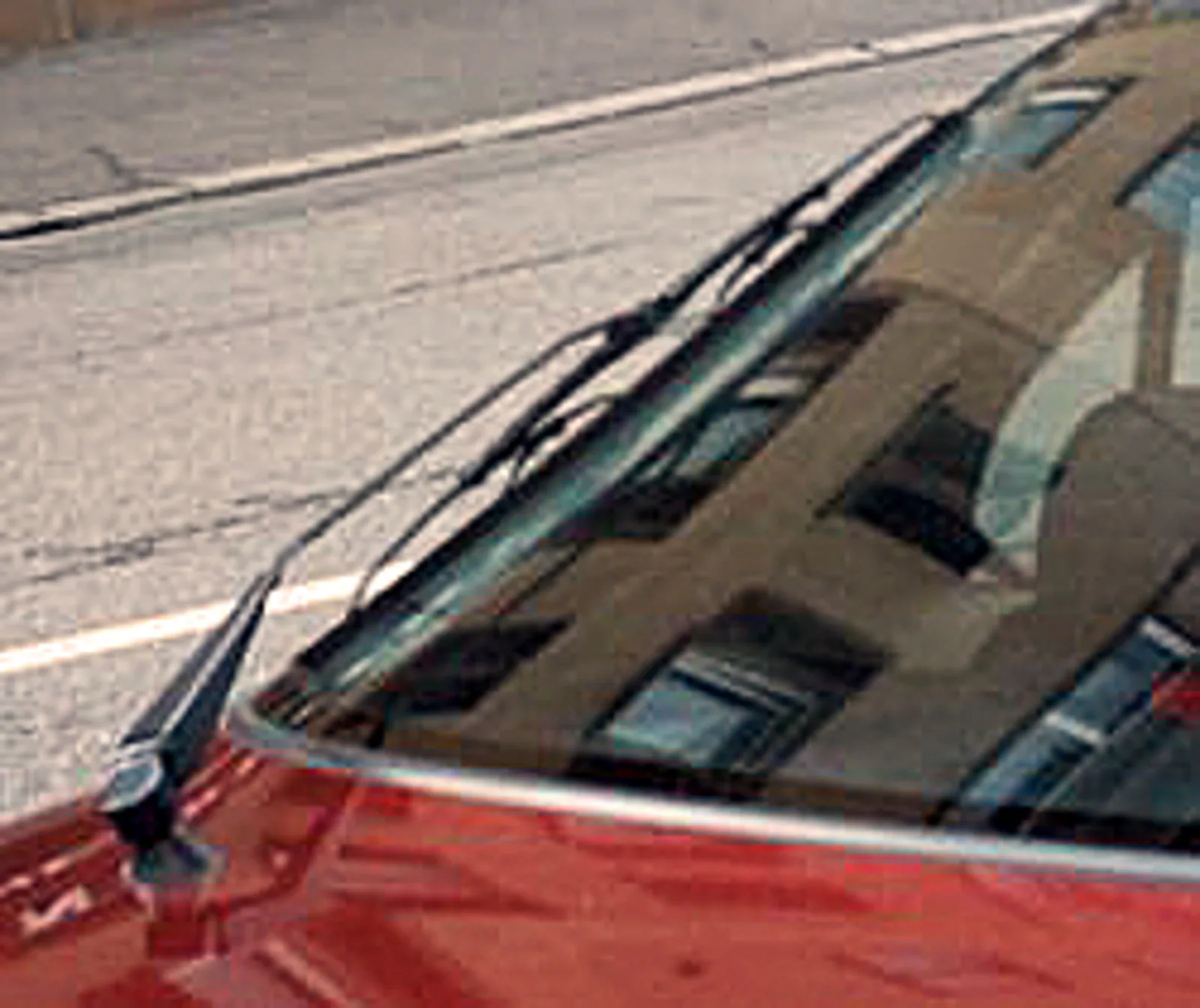
How a wiper works, who really patented it first, why Anderson's lever never sold and how intermittent and rain-sensing wipers arrived.
Mary Anderson patented the first operational windscreen wiper in the United States on 10 November 1903, a hand-operated lever device. It did not sell, and her patent expired in 1920, but Cadillac was fitting wipers as standard by 1922 and the principle became universal.
At least three people patented a windscreen cleaning device in 1903, and the one whose lever-operated design looked most like the wipers that followed made nothing from it. Mary Anderson's patent was issued on 10 November 1903. Her 17 years of protection ran out in 1920 with the device never mass-produced, and within two years Cadillac was fitting wipers as standard.
How do windscreen wipers work?
A wiper is a metal arm that pivots at one end and carries a long rubber blade at the other. A motor, usually electric but sometimes pneumatic, swings the arm back and forth so the blade pushes water, snow or other debris off the glass. In North America the same device is called a windshield wiper.
Almost every motor vehicle has one, along with trains, cabin boats and some aircraft, and it is usually a legal requirement. Since 1969 the speed has generally been adjustable on new vehicles, with a few steady rates and frequently an intermittent mode or two. Most cars use two synchronised radial arms, while many commercial vehicles use pantograph arms.
Many vehicles add a washer system, which sprays water or antifreeze fluid through nozzles to shift dirt and help the wipers deal with snow or ice. Some have heaters aimed at the glass, or heating wires embedded in the screen or the blade, and a few cars fit miniature wipers on the headlights.
Anderson's patent was ignored for 17 years, then every car used its principle.
Who invented the windscreen wiper?
There is no single answer. One of the earliest recorded patents is George J. Capewell's, filed in Hartford, Connecticut, on 6 August 1896, for fast locomotives and cars, usually with two wipers placed out of sight. Other early designs are credited to the Polish concert pianist Jozef Hofmann and to Mills Munitions of Birmingham.
Around 1903 at least three inventors patented cleaning devices: Mary Anderson, Robert Douglass and John Apjohn. Apjohn, who was born in Ireland, patented an apparatus for brushes or wipers that could be driven by a motor or by hand, with a UK priority date of 9 October 1903. In April 1911 patent agents in Liverpool registered one for Gladstone Adams of Whitley Bay.
What was Mary Anderson's wiper patent?
Most people credit Anderson with the first working windscreen wiper. Her US patent No. 743,801 was filed on 18 June 1903 and issued on 10 November that year, and it was written up as a window cleaning device aimed at electric cars and other vehicles. A lever inside the vehicle moved a spring-loaded arm carrying a rubber blade across the outside of the glass, with a counterweight keeping the blade in contact. It could be taken off once winter was over.
She was born on 19 February 1866 in Greene County, Alabama, at a place called Burton Hill Plantation, and lost her father in 1870 and moved to Birmingham with her mother and sister in 1889. The family built the Fairmont Apartments, which she managed, and in 1893 she went to Fresno, California, to run a cattle ranch and vineyard before returning to Birmingham around 1898.
How did she come up with it?
The story goes that on a snowy day in New York she sat in a streetcar and watched the driver keep opening the window, or stopping, to wipe the glass by hand. The date of that trip varies between telling: it is placed in the winter of 1902 in one version and 1903 in another. Anderson was not an engineer. She saw a problem and a business, and sketched a blade that the driver could work from inside.
Back in Alabama she drew up the sketch and wrote the description. Her first idea was a squeegee blade on a spindle that passed through a hole in the corner of the windscreen frame, attached to a handle inside. She hired a designer, and a local company made a working model. Similar devices had been made earlier, but hers was the first that actually worked.
Why did it not sell?
In 1905 she tried to sell the rights through a Canadian firm, Dinning and Eckenstein, which turned the idea down as lacking commercial value. Cars were still rich people's toys, and some feared the moving blade would distract the driver. Her patent expired in 1920 with no mass production. By the early 1920s mechanical wipers were standard on many passenger cars, and in 1922 Cadillac installed them as standard, using designs that followed the principles of her device.
Anderson died at age 87 at her summer home in Monteagle, Tennessee. In 2011 she entered the National Inventors Hall of Fame, which describes the invention as simply ahead of its time. Her great-great niece Sara-Scott Wingo has suggested that it went nowhere partly because Anderson was an independent woman with no father and no husband in a world run by men.
What happened after Anderson?
In 1917 John R. Oishei set up the Tri-Continental Corporation, whose Rain Rubber wiper was made for the two-piece, slotted windscreens of the day. Trico Products is now one of the world's largest wiper makers, while Bosch has the world's biggest wiper factory in Tienen, Belgium, which turns out 350,000 blades daily.
Charlotte Bridgwood patented the first automatic electric wiper arms in 1917, and her "electric storm windshield cleaner" used rollers rather than blades. She, too, made no money from it. Brothers William M. and Fred Folberth applied in 1919 for an automatic wiper mechanism, granted in 1921, the first developed by an American, though others attribute the original idea to Ormand Wall of Hawaii. Trico settled a patent dispute with Folberth and bought his Cleveland company.
The vacuum-powered system quickly became standard equipment, and vacuum drive stayed around until roughly 1960. Late in the 1950s another familiar feature appeared: pressing the washer button made the wipers run for two or three passes automatically. The delay originally came from a small vacuum cylinder linked to a switch.
How are wipers powered?
Most today use an electric motor driving two 4-bar linkages in series or in parallel. Vehicles with air brakes sometimes use pneumatic wipers fed by a small tapping from the brake system.
Early wipers ran off manifold vacuum, which falls away when the throttle is wide open, so they slowed or even stopped just when the driver was working the engine hardest. A combined fuel and vacuum booster pump eased this. Some cars of the 1960s and 1970s had variable-speed hydraulic wipers driven by the power steering pump, including the Lincoln Continental of the 1960s, the Continental Mark III and the Ford Thunderbird from 1963.
The Citroen 2CV used a purely mechanical system: a cable from the transmission, which also drove the speedometer to cut costs. The wipers therefore varied with road speed and stopped when the car did, so a handle under the speedometer let the driver turn them by hand.
Who invented intermittent wipers?
The first may have been Raymond Anderson, whose electro-mechanical proposal dates from 1923. In 1958 Oishei and colleagues filed a patent describing electro-mechanical, thermal and hydraulic versions, and in 1961 John Amos of Lucas Industries filed the first UK application for a solid-state electronic design.
The best-known inventor is Robert Kearns, who taught engineering at Wayne State University in Detroit. In 1963 he built a system modelled on the human eye, which blinks just once every few seconds. A capacitor charged until it reached a certain voltage, then discharged to trigger one wipe, and the cycle repeated.
Kearns showed the design to Ford, which rejected the proposal then, yet from 1969 sold a similar design as an option on Mercurys. He sued, won after a multi-year patent dispute, and the fight inspired the 2008 film Flash of Genius, which drew on a magazine article of 1993. In March 1970 Citroen's SM introduced a more advanced rain-sensitive system: a dry screen made the motor draw high current, setting a long delay, while a wet one drew little current and shortened it.
What are wiper blades made of?
Early wipers had a rubber blade on a flat metal base, which stopped working well once styling and aerodynamics brought curved windscreens. In 1945 John W. Anderson, who founded Trico's rival Anco, patented a wiper with branched arms that pressed the blade evenly on curved or flat glass. These became standard as curved screens spread after the 1947 Studebaker Starlight Coupe. Beam-type wipers with flexible bodies have since come along, but the branched type is still the most popular.
Blades are made from natural rubber, EPDM rubber or a mix. Natural rubber performs better in cold weather, while EPDM does not "set" and resists heat ageing, UV, ozone and tearing. Some makers coat blades with graphite.
How do wiper layouts differ?
Most wipers are the pivot, or radial, type, with a single arm attached to the motor. Modern ones usually sweep in parallel, but several Mercedes-Benz models and cars such as the Volkswagen Sharan sweep in opposite directions. That is more complex mechanically but avoids a big unwiped corner in front of the passenger, and it needs no repositioning for right-hand-drive export markets such as the UK and Japan.
Pantograph wipers, common on buses and other commercial vehicles with large windscreens, give each blade two arms, one driven by the motor and one on an idle pivot. They cover more glass per sweep but usually park in the middle of the screen, where they can partly block the driver's view. The Triumph Stag, Lexus and several American makes used a pantograph arm on the driver's side with a normal arm on the passenger side, to cover wide, shallow screens.
A single centre-pivot blade is common on rear windscreens. Mercedes-Benz pioneered the "Monoblade", a cantilever arm that stretches out to the top corners, then draws in at the ends and the middle of each stroke, tracing an M-shaped path. Asymmetric layouts clear more on the driver's side, so they are usually mirrored for left and right-hand drive, with exceptions such as the second-generation Renault Clio, Twingo and Scenic, the BMW 5 Series E39 and E60, the Peugeot 206 and the Nissan Almera Tino, whose wipers always sweep to the left. On right-hand-drive versions a linkage lets the right-hand wiper reach out towards the corner.
Wiper milestones
| Year | Person or company | Contribution |
|---|---|---|
| 1896 | George J. Capewell | Early patent for vehicle window wipers |
| 1903 | Mary Anderson | Lever-operated wiper, US patent 743,801 |
| 1917 | Charlotte Bridgwood | First automatic electric wiper arms |
| 1921 | William M. Folberth | Automatic wiper patent granted |
| 1945 | John W. Anderson | Branched arms for curved glass |
| 1963 | Robert Kearns | Eye-inspired intermittent wiper |
| 1970 | Citroen | Rain-sensitive wipers on the SM |
Where this goes next
Mary Anderson's legacy was recognised in 2011, when she joined the National Inventors Hall of Fame. Today wipers are usually a legal requirement, and in the wiper business Trico remains one of the world's largest makers while Bosch produces 350,000 blades a day in Belgium.