The 1989 Audi 100 started it, a pump-and-nozzle in one part shaped many of the engines, and a diesel won Le Mans in 2006. An emissions defeat device came later.
TDI is the Volkswagen Group's name for turbocharged direct-injection diesels, first used in the 1989 Audi 100. SDI is its naturally aspirated version. The unit injector, which Volkswagen calls Pumpe Duse, combined pump and nozzle and was used from 2000, before common rail took over.
In 2006 a diesel car won the 24 Hours of Le Mans for the first time, and it was an Audi using the same TDI name that Volkswagen would later put on millions of road cars. That name belongs to a family of Volkswagen Group diesels, and it sits beside a cousin called SDI and a piece of hardware called the unit injector that shaped many of them. Between them they took diesel cars from the Audi 100 of 1989 to Le Mans, and, later, into an emissions scandal.
What a VW TDI engine actually is
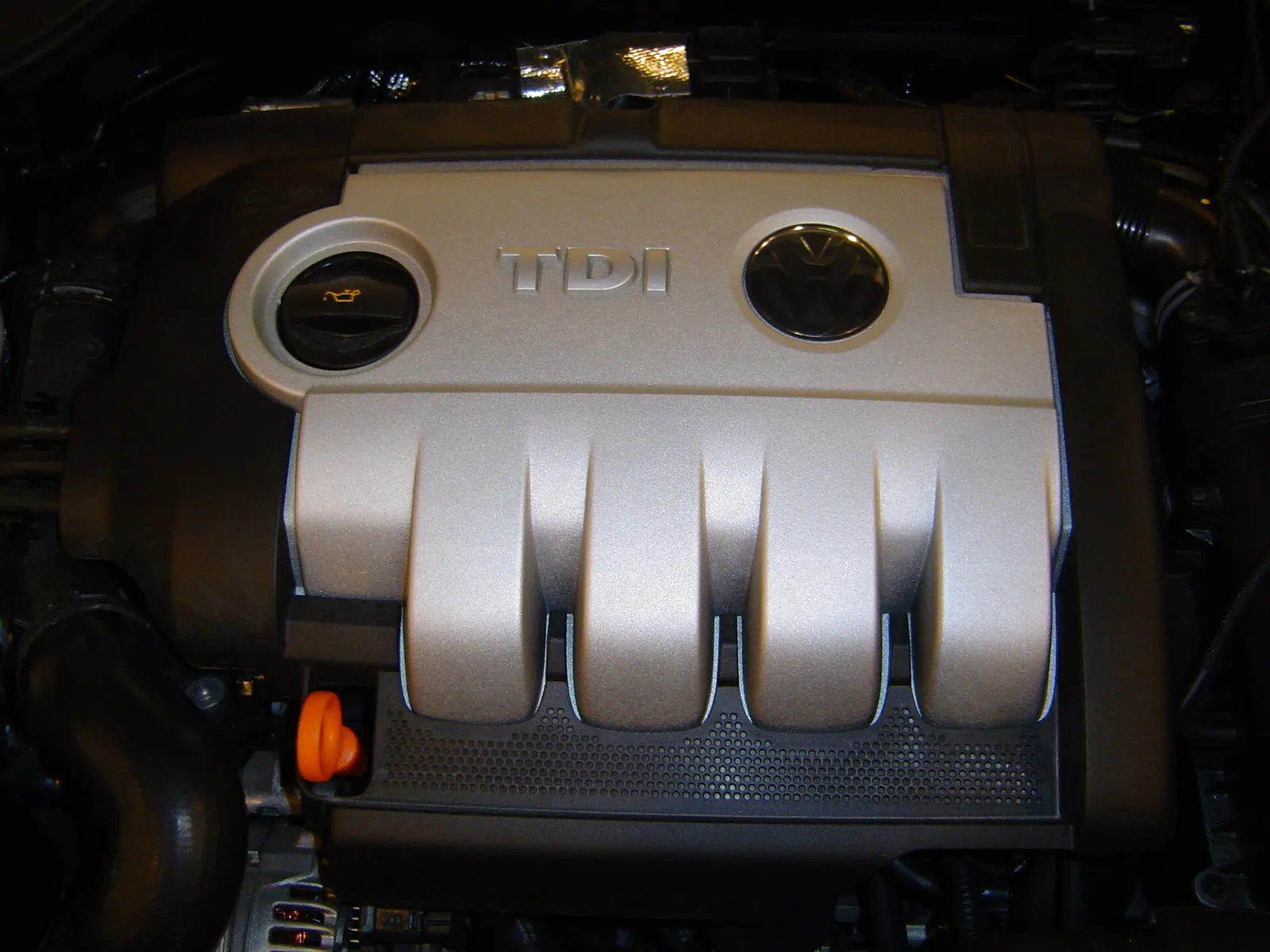
TDI stands for Turbocharged Direct Injection. It is the Volkswagen Group's name for its modern turbodiesel range, which uses common rail direct injection and an intercooler as well as a turbo compressor. TDI engines go into Audi, Volkswagen, SEAT and Skoda cars, into boat engines sold by Volkswagen Marine and into industrial engines from Volkswagen Industrial Motor.
The name joins two older ideas. In a direct injection engine, the injector sprays diesel straight into the main combustion chamber, rather than into a small pre-chamber off to one side, which is indirect injection. Direct injection burns the fuel more completely, so torque goes up and exhaust emissions come down. Turbocharging then uses a turbine spun by exhaust gas to squeeze the intake air, which lets a small engine make the power and torque of a bigger one. Most TDIs add an intercooler, a radiator for the compressed air, because squeezing air heats it and cooler air is denser, which means more oxygen in each cylinder.
Other makers use similar technology, but the TDI label itself is used only by the Volkswagen Group and Land Rover. For naturally aspirated direct-injection diesels without a turbo, Volkswagen uses the name SDI.
The unit injector puts the pump and the nozzle in one part, so no high-pressure fuel pipe is needed.
The first TDI: the 1989 Audi 100
Volkswagen was not first with either half of the recipe. Mercedes-Benz got there first in 1978: its 300SD carried an indirect-injection five-cylinder turbodiesel, the earliest in a passenger car. Fiat followed in 1986 with the Croma 2.0 TD i.d., the first direct-injection turbodiesel. Three years after the Fiat, the first Volkswagen Group TDI appeared in the 1989 Audi 100 TDI.
That car used the Volkswagen 2.5 R5 TDI, a straight-five with an electronic distributor injection pump, which Volkswagen calls 'VerteilerPumpe', and two-stage direct injection. Output of the first version was 88 kW (118 hp) at 3,250 rpm and 275 Nm (203 lb ft) at 2,500 rpm.
From pump injection to common rail
TDIs with common rail injection and piezoelectric injectors came with the Volkswagen Group 32v V8 TDI used in the 1999 Audi A8 3.3 TDI Quattro. Alfa Romeo had beaten them to common rail in a passenger car, with the 2.4 JTD in the 1997 156. In 1999 the 1.2-litre Volkswagen TDI also won two International Engine of the Year categories, for engines from 1.0 to 1.4 litres and for best fuel economy. It was a three-cylinder, rated at 61 to 75 PS in the Audi A2, SEAT Arosa and Ibiza, Skoda Fabia, Volkswagen Lupo and Polo.
The injection hardware kept moving. From 2000 a fuel system built around unit injectors, which Volkswagen calls Pumpe Duse, started to replace the distributor pump, with the V8 staying on common rail. In 2003 upgraded injectors with piezoelectric operation began to replace the earlier solenoid-operated ones. Since 2009 most Volkswagen Group TDIs have moved from unit injectors to common rail.
| Year | Milestone |
|---|---|
| 1978 | Mercedes-Benz 300SD: first turbodiesel in a passenger car, with indirect injection |
| 1986 | Fiat Croma 2.0 TD i.d.: first direct-injection turbodiesel |
| 1989 | Audi 100 TDI: first Volkswagen Group TDI |
| 1997 | Alfa Romeo 156 2.4 JTD: first passenger car with common rail |
| 1999 | Audi A8 3.3 TDI Quattro: V8 TDI with common rail and piezoelectric injectors |
| 2000 | Unit injectors begin to replace distributor pumps |
| 2003 | Piezoelectric unit injectors start replacing solenoid ones |
| 2009 | Most TDIs begin the move back to common rail |
The unit injector, explained
A unit injector is a high-pressure direct injection system for diesels that puts the injector nozzle and the injection pump into a single component. A plunger pump, usually driven by a camshaft shared with the engine's valves, builds the pressure, and the unit is normally lubricated and cooled by the fuel running through it.
Why does pressure matter? Forcing fuel through the nozzle at high pressure breaks it into many tiny droplets rather than a few large ones. Think of a spoonful of sugar compared with a spoonful of icing sugar: the finer powder has far more surface for its volume, and so dissolves faster. Fine droplets of fuel likewise vaporise from their surface more readily and mix better with the oxygen in the air, which makes combustion more complete and cleaner.
A century of the unit injector
A British patent for a unit injector very like today's went to Frederick Lamplough in 1911. In the early 1930s Winton engines in the United States put the idea to commercial use, in locomotives, boats and US Navy submarines among them. In 1934 Arthur Fielden received a US patent for the design that General Motors later used in its two-stroke diesels. Most mid-sized diesels used one pump with separate injectors, though Detroit Diesel and Electro-Motive Diesel earned a name for preferring the unit injector, with the pump built into the injector body. The Cummins PT system is a related form: its injectors sit on a common rail supplied by a low-pressure pump and are worked by a third lobe on the camshaft, with pressure setting how much fuel they get and cam timing setting when.
In 1994 Bosch delivered the earliest electronic unit injector for commercial vehicles, with rivals following quickly. A year later Electromotive Diesel converted its 710 engines to electronic fuel injection. In 1993 Caterpillar and International had introduced a different approach, hydraulically actuated electronic unit injection, or HEUI, which uses engine oil pressure rather than the camshaft to drive the injectors and so can build fuel pressure independently of engine speed. It first appeared on Navistar's 7.3 litre V8, and many manufacturers have since replaced it with common rail to meet economy and emissions standards.
How a unit injector works
Because the pump is part of the injector, the design needs no high-pressure fuel pipes, which removes a source of failures and allows much higher injection pressure. Timing and quantity can be controlled as precisely as with common rail. The injector is fitted into the cylinder head, with fuel supplied through ducts machined into the head itself, and each one has its own pumping element and, with electronic control, a solenoid valve. Pressure on the low-pressure supply side stays under 500 kPa, and injection pressure reaches up to 2000 bar.
Each injection passes through four phases. In the filling phase the pump element rises and draws fuel in while the solenoid is switched off and the line stays open. In the spill phase the element descends, and with the valve still open the fuel just flows out to the return duct. In the injection phase the solenoid is energised and slams the line shut. The descending plunger compresses the trapped fuel until it passes the opening pressure, lifts the needle in the nozzle and sprays fuel into the chamber. In the pressure reduction phase the engine computer switches the solenoid off once enough fuel has gone in. The line opens, pressure falls and the needle closes.
The solenoid does the work of control. The point at which it closes starts the injection, and how long it stays closed fixes the quantity. Electronic control also allows special functions: timing adjusted to temperature, balancing between cylinders for a smooth idle, cutting out individual cylinders under light load to reduce fuel use and emissions, and multi-pulse injection, with more than one injection in a single engine cycle.
Where Volkswagen used Pumpe Duse
Volkswagen Group's mainstream marques used the unit injector, branded Pumpe Duse and shortened to PD, in both their SDI and TDI engines, until common rail, in engines like the 1.6 TDI, took over. North American Jetta, Golf and New Beetle TDI models of 2004 to 2006 used Pumpe Duse, in the fourth and fifth generations (engine codes BEW and BRM respectively), while earlier cars had a belt-driven injection pump.
PD TDIs also went into some cars sold where diesel was priced attractively, including the Chrysler and Dodge models of the DaimlerChrysler years: the Dodge Caliber, Dodge Journey, Jeep Compass and Jeep Patriot. Scania, a Volkswagen Group truck and engine maker, uses the unit injector too, as Pumpe-Duse-Einspritzung, or PDE. Elsewhere, unit injectors are found on commercial vehicles from Volvo, Cummins, Detroit Diesel, Caterpillar and Navistar International, on cars from Land Rover, and on Electro-Motive Diesel locomotives.
The Volkswagen SDI engine
The SDI is a naturally aspirated direct-injection diesel, made by the Volkswagen Group for cars and vans and for marine and industrial use. SDI comes from 'Suction Diesel Injection', a literal rendering of the German Saugdiesel-Direkteinspritzung. The label was adopted to separate the new engines from the earlier, less efficient indirect-injection ones, which Volkswagen called SD. The 'suction' refers to the lack of forced induction: the engine breathes in air at atmospheric pressure.
SDI engines are always inline, as an R4 or R5 (the R is from the German word Reihenmotor). They come in sizes from 1.7 to 2.5 litres and in various states of tune. They suit uses where reliability and fuel economy matter most, and give up power to a turbo engine of the same size. The 2.0 SDI in the Volkswagen Golf Mk5 makes 55 kW (75 PS; 74 bhp), where the same engine as a TDI is rated at 103 kW (140 PS; 138 bhp) or 125 kW (170 PS; 168 bhp), depending on specification.
Which oil to use
Volkswagen AG requires oil for SDI engines, like its TDI engines, to meet one of its own approved standards: VW505.00, 505.01, 506.00, 506.01 or 507.00. Generic standards from the American Petroleum Institute or the European Automobile Manufacturers Association are not in themselves recognised by Volkswagen, although an oil might also meet one of its specific standards. Plenty of brands now carry Volkswagen approval, but some unapproved makes print the VW number on the label while burying the word 'recommended' in small type. Only Volkswagen AG can grant approval, after its own testing, and Volkswagen Germany and Volkswagen of America publish lists of approved oils on their websites.
Models on LongLife or extended service intervals need an official LongLife oil: VW506.00 for engines without PD, VW506.01 for those with it, or VW507.00. Generic LongLife oils, or ones certified by other manufacturers, should not be used.
The TDI emissions scandal
TDI engines fitted to Volkswagen Group cars of the 2009 to 2015 model years, sold through 18 September 2015, carried an emissions defeat device. On that date the US Environmental Protection Agency and the California Air Resources Board served notice that around 480,000 VW and Audi cars with 2.0 TDI engines sold in the United States between 2009 and 2015 had one fitted.
The device was specially written firmware in the engine management unit. It detected testing conditions and, in those, made the car comply with the rules by switching on all its emissions controls. In ordinary driving the controls were suppressed, which let the engine make more torque and use less fuel, at the cost of emitting up to 40 times the legal limit of nitrogen oxides. Volkswagen has since admitted to the allegations, and said the software had been fitted to its diesels around the world, some 11 million vehicles in all.
TDI in racing: Le Mans, Sebring and touring cars
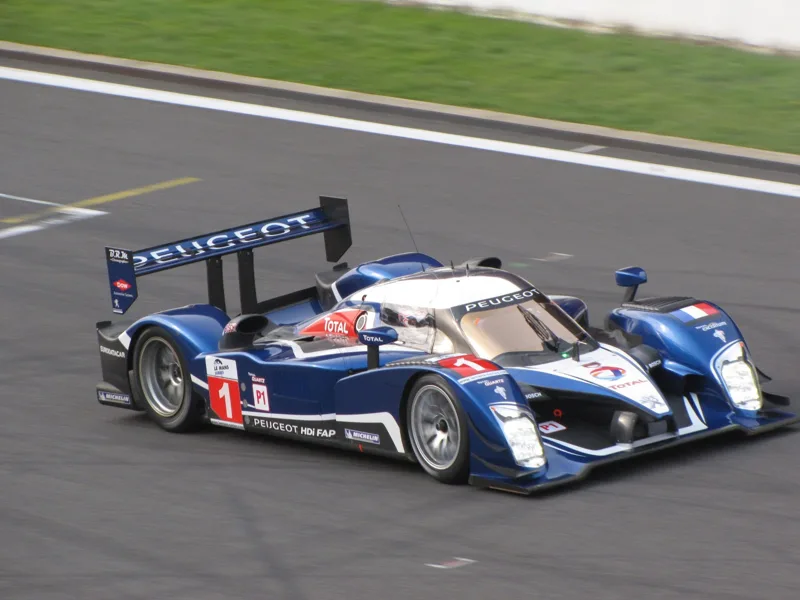
The first TDI engine the Volkswagen Group used in racing was in the Audi R10 TDI, a Le Mans Prototype. It won first time out, at the 2006 12 Hours of Sebring, then took the 2006 24 Hours of Le Mans, and both were the first victories by a diesel-powered car in each race. Across 2006 to 2014 the R10 and the R15 and R18 that followed it won Le Mans eight times. The one exception was 2009, when another diesel, the Peugeot 908 HDi FAP, took the race.
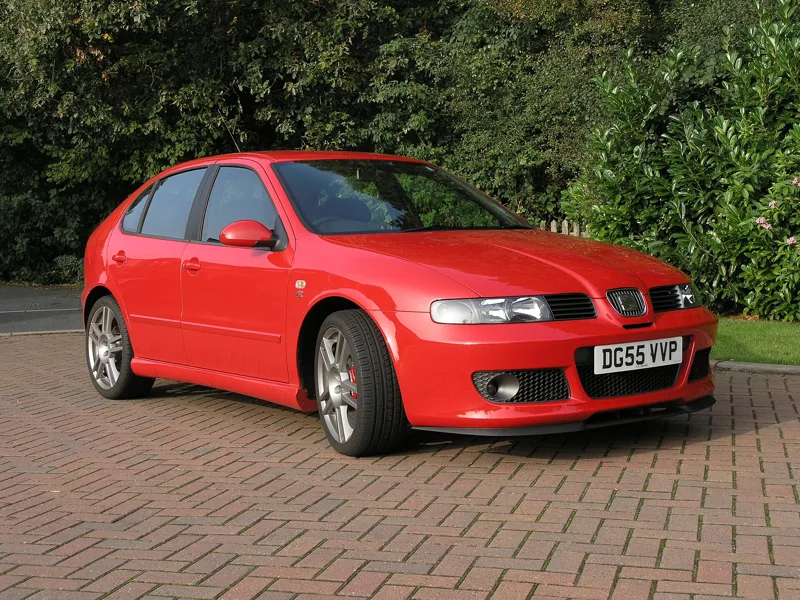
In touring cars the SEAT Leon TDI won the World Touring Car Championship for drivers and manufacturers in both 2008 and 2009. In 2008 it also entered the British Touring Car Championship, where it won at Donington Park, the first time a diesel car had taken a round.