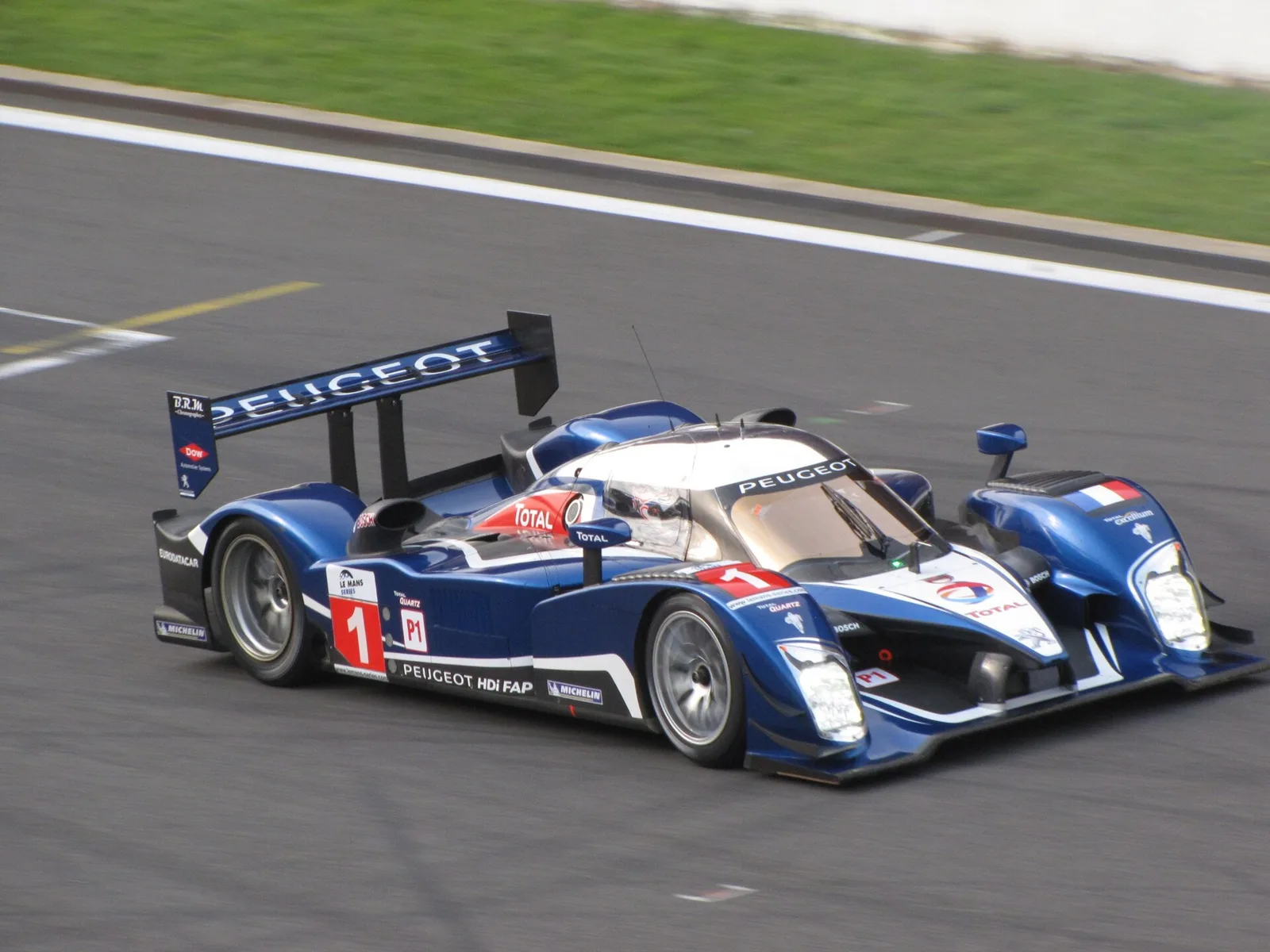
Peugeot's closed-cockpit diesel prototype, its 5.5-litre V12 and the 2009 Le Mans win that came after a long rivalry with Audi.
Built by Peugeot for the 24 Hours of Le Mans, this diesel prototype was unveiled in June 2006 and raced from 2007. It won 19 of its 28 races and gave the French marque its Le Mans win in 2009, before a new 908 replaced it for 2011.
The Peugeot 908 HDi FAP was a diesel sports prototype that Peugeot built to race at the 24 Hours of Le Mans. It was publicly unveiled on 15 June 2006, raced from 2007 and won Le Mans in 2009. Across its racing life the car won 19 of the 28 races it took part in.
The car gave Peugeot Sport its first Le Mans programme since the 905 project ended in 1993. Its name carries three codes that are easy to misread, so the sections below explain the parts of the name first and then follow the car through its design, engines and racing record.
What was the Peugeot 908 HDi FAP built to do?
The 908 was built for the sports prototype rules that Le Mans was using in the mid 2000s. The Automobile Club de l'Ouest announced new rules on 16 June 2006 that encouraged closed-cockpit Le Mans Prototypes, and Peugeot answered with a car that had a fully enclosed cockpit. The programme had been in development since 2005, and the team planned to race it against the Audi R10 TDI from the start.
The name itself is a code. The 908 number belongs to Peugeot's 90X family of racing cars, HDi stands for High Pressure Direct Injection, and FAP stands for particulate filter, which is the Filtre a particules in French. Diesel was the point of the project: the car became the second diesel-engined sports car from a major manufacturer, after the Audi R10 TDI.
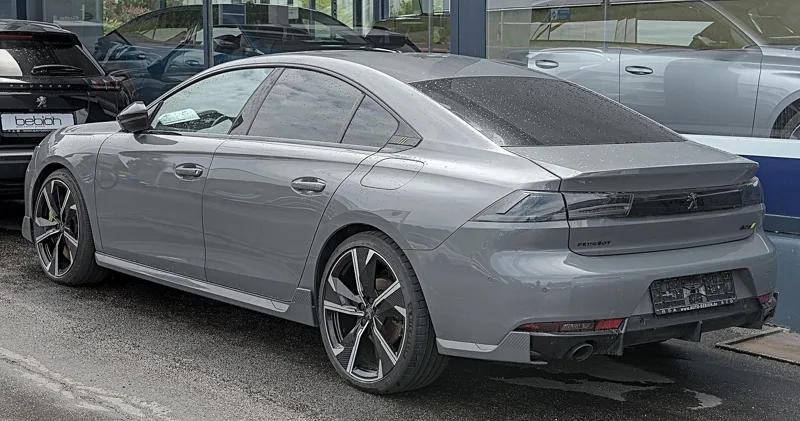
The same name was later shared with a concept saloon. The 908RC was a luxury four-door concept that used the race car's diesel V12. Enthusiasts should also keep the Porsche 908 separate, because that car was a different sports car that raced from 1968 to 1981.
A diesel prototype that won Le Mans in 2009 and left Peugeot with a race-proven platform for its successor.
How was the 908 chassis built?
The 908 used a carbon fibre monocoque rather than an open structure, which Peugeot said would give better rigidity and lower weight. Its closed cockpit used a two-part door. The upper window swung forward and out, while a hinged plate that formed part of the sidepod made up the lower section, and that lower plate could be swung out or removed entirely.
Front and rear suspension were linked, the steering was electrically powered and the magnesium wheels came from BBS. The car measured 4.65 m (183 in) long and 2 m (79 in) wide, and the minimum weight was 925 kg (2,039 lb). Peugeot also chose to build the chassis itself instead of relying on another manufacturer to do it.
The closed cockpit carried trade-offs. A closed design brought weight, centre of gravity and operational drawbacks, and the rules required air conditioning in that layout. Peugeot believed better chassis rigidity and aerodynamics could offset those problems, and it may also have chosen the layout because it allowed a larger air restrictor.
What engine and gearbox did the 908 use?
The 908 was powered by a 5.5 L HDi diesel V12, the largest engine size that Le Mans Prototype rules allowed. The engine was a 100-degree V12, an angle chosen to lower the centre of gravity. Output was later revealed as more than 730 hp (540 kW), with 1,200 N m (890 lbf ft) of torque, nearly 10 percent more than the Audi R10 TDI.
The gearbox was designed and built by Ricardo. It was longitudinal, offered a maximum of six gear ratios and was electro-pneumatically controlled, and the differential was self-locking. TotalEnergies, the technical partner, developed the oil systems. The table below summarises the main figures for the first-generation car.
| Item | Figure |
|---|---|
| Engine | 5.5 L HDi diesel V12, over 730 hp (540 kW) |
| Torque | 1,200 N m (890 lbf ft) |
| Length and width | 4.65 m (183 in) by 2 m (79 in) |
| Minimum weight | 925 kg (2,039 lb) |
| Gearbox | Ricardo, longitudinal, maximum of 6 ratios |
| Differential | Self-locking |
| Public unveiling | 15 June 2006 |
How did the 908 HY hybrid work?
Peugeot showed a hybrid version, the 908 HY, at the 2008 1000 km of Silverstone. It added an 80 hp (60 kW) electric motor in place of the standard starter motor. The motor drew power from 600 lithium ion batteries, housed in the cockpit and on the left side of the car, and regenerative braking charged them. A recharge needed approximately 20 to 30 seconds.
The electric motor could add about 20 seconds of extra power, either automatically or when the driver chose. It could also run alone as the car entered the pit lane, switching off the diesel to save fuel. The electrical systems added about 45 kg (99 lb), and Peugeot expected to cut that figure further.
The hybrid was planned for the 2009 Le Mans Series, even though it could not score championship points. Peugeot dropped the idea so that it could concentrate on preparing for the 2009 24 Hours of Le Mans, and the hybrid never raced in a championship round.
How did the 908 perform in 2007?
The 908 made its race debut at the opening round of the 2007 Le Mans Series, the 1000km of Monza. Both cars were quick in qualifying and took the top two places by more than a second. In the race the Peugeot led almost the entire distance, but the number 8 car suffered repeated door problems and finished third. The number 7 car, driven by Gene and Minassian, took the victory.
The number 8 car won at Valencia, while the number 7 car retired with clutch trouble. At the Le Mans test day Peugeot set a lap of 3:26.707 and beat the Audi, and Sarrazin then took pole position at 3:26.344. The Audi R10s were quicker on the straights and more stable in the corners during the race, and the number 8 car finished second after 359 laps.
The number 7 car had to retire in the final hour with engine failure. After Le Mans the number 8 car won at the Nurburgring and at Spa, and the number 7 car took Silverstone and Interlagos. The number 8 car won the LMP1 teams championship, while the number 7 car had reliability problems and finished third behind Pescarolo Sport.
Why did Audi beat the 908 in 2008?
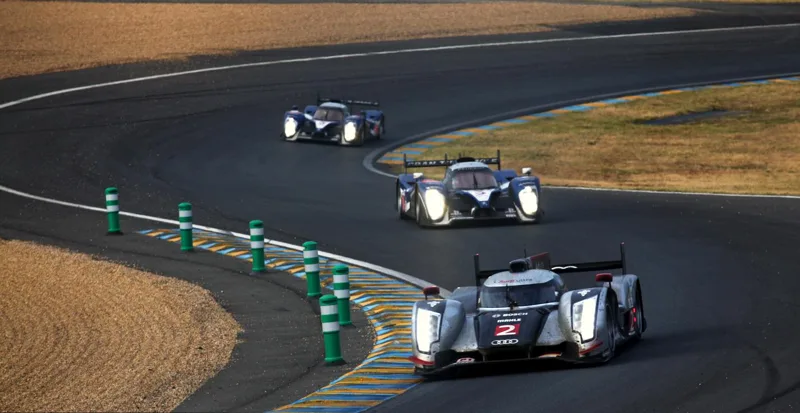
The 908 won the first round of 2008 at Catalunya, the first time a 908 had beaten an R10. Later that year, three 908s started Le Mans from pole position. The 908 was capable of running in the 3:18 range, about 7 seconds faster than the Audi, which struggled to get below 3:25. In the race the 908s could lap up to 5 seconds faster, but lengthy pitstops and instability in the rain handed the win to the R10.
Peugeot had also gone to the 12 Hours of Sebring, where a single 908 led early before mechanical problems dropped it from contention. The car still finished, which the team saw as useful preparation. At the 1000 km of Silverstone, two accidents involving both 908s let Audi take the drivers, teams and constructors championships.
Peugeot then took one 908 to the Petit Le Mans at Road Atlanta. That car took pole and led several times, but it finished 4.5 seconds behind the North American Audi team.
Did a 908 win the 2009 Le Mans?
Yes. In 2009 the 908 won the 24 Hours of Le Mans, with the number 9 and number 8 cars taking the first two places. It was Peugeot's first win at the race for 16 years, and the number 7 car finished sixth, so the three Peugeots crossed the line in a formation finish.
Four 908s were entered that year, three by Peugeot and one older 2008 model run by Pescarolo, which crashed at night. Earlier that year two 908s had met the new Audi R15s at Sebring, where the lead changed hands repeatedly until the R15 pulled 22 seconds clear. The R15s still could not run double stints,. At the Petit Le Mans later in 2009, Team Peugeot Total won the rain-soaked race while leading only 10% of the laps.
What happened to the 908 at Le Mans in 2010?
All four Peugeot-run cars retired from the 2010 24 Hours of Le Mans, the first year that none of the 908s finished the race. The Peugeots had taken the top four places in qualifying, but the pole-sitting number 3 suffered suspension damage and the other three cars suffered engine failures.
A post-race analysis found that the number 3 car's suspension mounting point had separated from the carbon fibre tub. The other three cars had failures of the new titanium connecting rods. The Audi R15 TDI plus finished on the podium and set a new distance record, even though the 908s had been faster over a single lap, and Loic Duval set a race lap of 3:19.000.
The 908 recovered elsewhere in 2010. Two cars took a 1-2 finish at Sebring, the first Sebring win for Peugeot, and the same team won at Silverstone. At Spa the number 3 car finished first, the number 2 car second and the number 1 car fourth, while the Oreca crashed out four laps into the race. Two cars also qualified and finished 1-2 at the Petit Le Mans. At Zhuhai a controversial team-work win went to the number 2 car, and Peugeot finished the year by winning the Le Mans Series LMP1 teams championship through Oreca.
What replaced the 908 HDi FAP?
New Le Mans Prototype regulations for 2011 made the first-generation 908 obsolete, so Peugeot began work on a new prototype known as the 90X in late 2009. It was unveiled on 3 February 2011 at the company's store on the Champs-Elysees. The new car was similar in design to the HDi FAP, but it had larger front wheels like the Audi R18 and a new rear fin required by the ACO.
The new 908 used a 3.7 litre V8 that also ran on diesel. Oreca continued to race the old car in 2011 with new restrictors, and it won the Sebring 12 Hours ahead of the factory Peugeot, Audi and HPD cars. At Le Mans the Oreca finished fifth behind the three new factory cars and the winning Audi R18. At the Petit Le Mans, Oreca finished second behind the one surviving factory 908, which kept the older car on the podium.
What was the 908 RC?
The 908RC was a four-door luxury limousine concept that carried the 5.5 L V12 from the race car. The engine was installed centrally and transversely in the concept, so the car showed how the racing engine could be packaged in a much larger vehicle.
The family ended in 2011. Peugeot's motorsport programme closed in 2012, and 2011 was the last year in which any 908 competed. Across Le Mans Series and Intercontinental Le Mans Cup racing, the first-generation car proved that a diesel prototype could win races and bring the team to Le Mans victory.