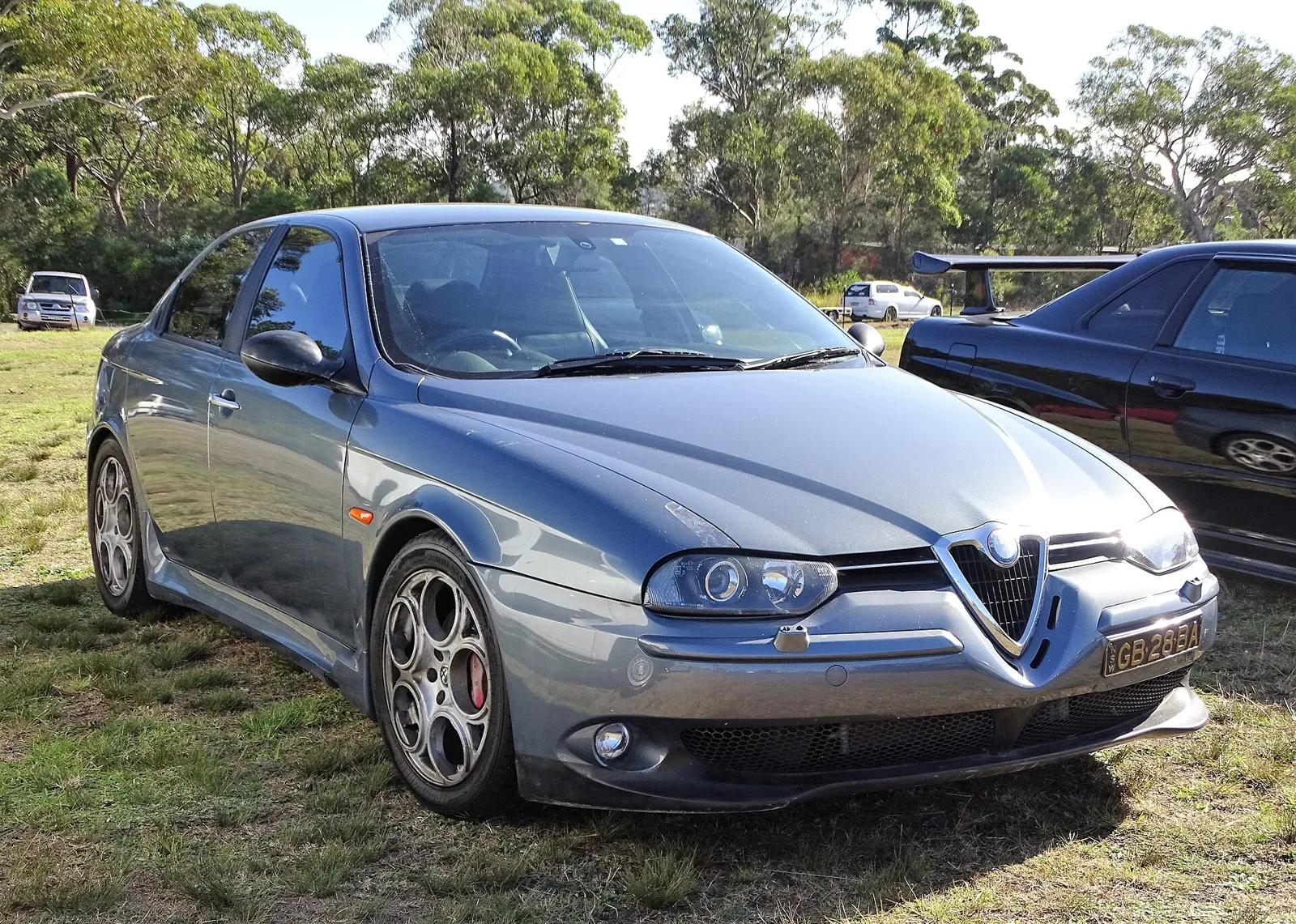
Launched at the 1997 Frankfurt Motor Show, the 156 won European Car of the Year in 1998 and offered saloon, Sportwagon and Crosswagon bodies with a Q4 four-wheel-drive option.
Alfa built the 156 from 1996 to 2007 as the successor to the 155, offering saloon, Sportwagon and Crosswagon bodies. Its styling came from Alfa Centro Stile under Walter de'Silva, and the car earned European Car of the Year honours in 1998.
The Alfa Romeo 156 was a compact executive car that replaced the 155 and was introduced at the 1997 Frankfurt Motor Show. It was named 1998 European Car of the Year, and 673,435 examples were built between 1996 and 2007. Buyers could pick it as a saloon, a Sportwagon estate or a Crosswagon crossover.
When was the Alfa Romeo 156 launched?
The 156 was introduced at the 1997 Frankfurt Motor Show as the replacement for the 155. Assembly took place at the Fiat Group factory in Pomigliano d'Arco, Italy, and production in Thailand began in March 2002 at a General Motors facility in Rayong.
Production ran from 1996 to 2007, and 673,435 units were built. The saloon was discontinued in Europe late in 2005, and the Q4 Crosswagon continued until the end of 2007.
The Thai-built cars were aimed at Asia-Pacific markets, and that production lasted only a couple of years from March 2002.
The 159 replaced the 156 in 2005, although the Crosswagon remained in production for two more years.
A refined front-drive executive car that won European Car of the Year, then carried the Busso V6 into the GTA.
What did the 156 look like?
Alfa Centro Stile designed the 156 under head designer Walter de'Silva, giving it high curved flanks, retro front door handles and a deep grille. Its drag coefficient was 0.31, and the shape was influenced by the Alfa Romeo 1900, Giulietta and Giulia.
The styling deliberately recalled earlier Alfas. The rear door handles were recessed and visually de-emphasised, while the front handles were accentuated, which gave the car the look of a coupe from the side.
The deep grille meant the licence plate holder sat off centre, and the front end became one of the most recognisable parts of the car.
Inside, the original dashboard used a scalloped upper section and a simple centre console, with the main controls and displays angled towards the driver. The original interior had no cup holders.
What engines did the 156 offer?
The 156 used four and six-cylinder petrol engines and four and five-cylinder diesels. The Twin Spark petrols ran from 1.6 to 2.0 litres, the diesel line-up included a five-cylinder 2.4-litre JTD, and the 2.5-litre V6 was the top petrol choice until January 2002.
The 1.6-litre Twin Spark produced 120 PS (88 kW), the 1.8-litre 144 PS (106 kW) and the 2.0-litre 155 PS (114 kW). These 16-valve models used variable valve timing, and a 1.9-litre 8-valve four-cylinder with 105 PS (77 kW) also served the range.
The 2.4 JTD was a straight-five 10-valve common rail turbodiesel with 136 PS (100 kW), and it was the first common rail diesel in a passenger car. The 2.5-litre 24-valve Busso V6 produced 190 PS (140 kW) until January 2002.
In 2001 the engines were upgraded to Euro III standards, with ratings of 120 PS for the 1.6, 140 PS for the 1.8, 150 PS for the 2.0 and 192 PS for the 2.5-litre V6.
The 2003 diesels were substantially reworked, with four-valve heads, a second-stage common rail system with 1400 bar maximum pressure and up to five injections per cycle. They were rated at 140 or 150 PS for the 1.9 and 175 PS for the 2.4.
Gearboxes included a five-speed Selespeed automated manual from 1999 on the 2.0 Twin Spark. The V6 used a four-speed Q-System automatic that could also be shifted manually in an H-pattern, with city, sport and ice modes.
What body styles did the 156 come in?
The 156 came in three bodies, with seven engine configurations spread across the range. The Sportwagon arrived in 2000, and the Crosswagon followed in 2004 with a raised ride height.
The Sportwagon was shown at the 2000 Geneva Motor Show, and its development began in 1998 at Stola under project code 932 AF. Early planning used the name Powerwagon before the Sportwagon name was chosen.
Alfa had used the Sportwagon name before on the 33 and Alfasud estates, and the 75 Sportwagon shown at Geneva became an early victim of the Fiat takeover.
The Sportwagon was marketed as a lifestyle estate rather than a load carrier, and it could be fitted with Boge-Nivomat self-levelling hydropneumatic rear suspension. Its advertising campaign featured the actress Catherine Zeta-Jones.
The Sportwagon Q4 arrived in 2004 with all-wheel drive, a raised ride height and 17-inch five-spoke wheels, and it was sold only in left-hand drive markets. It carried three differentials, with a Torsen C limited-slip unit in the centre, and weighed about 150 kg (331 lb) more than the front-drive car.
The Crosswagon Q4 followed in 2004 with a crossover look, tougher bumpers and door sills with steel inserts. Its ride height was raised further, to 1,497 mm (58.9 in), which was 6.5 cm (2.6 in) taller than a standard 156.
Both Q4 models relied on a 1.9-litre M-Jet diesel rated at 150 PS (110 kW; 148 hp), the only engine offered. The Crosswagon remained in production after the 159 arrived and was the last 156 to be discontinued, in 2007.
What changed in the 2002 and 2003 facelifts?
The 2002 facelift brought matte-finish interior surfaces, a dual-zone climate controller from the 147 and optional xenon lighting. The 2003 update gave the car new front and rear fascias designed by Giorgetto Giugiaro and added the TI trim.
Electronic stability control (VDC) and traction control (ASR) became standard in 2002, and window airbags were fitted to every version. The MSR control, which restores engine torque when a driver shifts down abruptly on a slippery surface, also arrived.
The 2.0 JTS replaced the 2.0 Twin Spark in 2002, with gasoline direct injection rated at 165 PS (121 kW) and more low-end torque. The bumper strips and mirrors changed from black to body colour.
The TI, short for Turismo Internazionale, carried a sporty kit, modified suspension, 215/45 17-inch wheels and a leather-trimmed interior. The GTA never received the Giugiaro facelift.
Why did the 156 win European Car of the Year?
The 156 won the 1998 European Car of the Year award, which was decided by an international jury of 56 journalists from 21 countries. Forty of the jurors voted for the 156, and the jury praised its refined suspension layout and impeccable roadholding.
The 156 collected more than 35 awards in total. Among them were the Technical Innovation Award for Common Rail from Autocar and the Best Compact Executive honours from What Car? and Auto Express in Britain.
It was named Car of the Year in 1998 in Denmark, Spain, the Netherlands, Luxembourg, Germany, Portugal, France and Croatia, and in South Africa in 1999.
Its 2.5-litre V6 won the International Engine of the Year award in 2000. In Italy the car was named the most beautiful car in the world in 1997.
The Common Rail diesel was honoured in several places, including a French innovation prize and a German innovation award.
How was the 156 engineered?
The 156 used a platform derived from the 155, shared with the Fiat Bravo, Brava and Marea, and built on the Tipo C1 architecture. It was a front-wheel drive car with a double high wishbone front suspension and an updated MacPherson-type rear with transverse links.
Aluminium was used in several front and rear suspension parts to save weight, and the rear arrangement gave a small amount of passive steering. Four-wheel drive was offered only on the Q4 models in left-hand drive markets.
Engines were produced at Pratola Serra, except the V6, which came from Alfa's Arese plant. The GTA engines were built at the Maserati Research Centre, and the 2.4 JTD was the first common rail diesel for a passenger car.
What was the 156 GTA?
The 156 GTA and Sportwagon GTA were launched at the 2001 Frankfurt Motor Show, named after the 1960s Alfa Romeo GTA, meaning Gran Turismo Alleggerita, or lightened grand tourer. It was developed alongside the 147 GTA and hand assembled on a separate line.
Stola developed the GTA's styling and engineering from early 2000, completing six prototypes that Alfa Romeo mechanically assembled. Two of those prototypes were presented at Frankfurt.
Production totalled 2,973 saloons and 1,678 Sportwagons until October 2005, when the V6 could no longer meet emissions rules and the 156 gave way to the 159.
The first GTA was sold by online auction from 13 to 23 September, during the Frankfurt show. The winning bid of EUR 48,691.26 went to the Telethon charity fund.
The GTA's 3.2-litre Busso V6 displaced 3,179 cc with a 93 mm bore and 78 mm stroke, and it was rated at 250 PS (184 kW; 247 hp) and 300 Nm of torque. It was the largest version of the engine Alfa built, and it was named after the engineer Giuseppe Busso.
The GTA was 55 kg (121 lb) heavier than the standard V6 car and used a faster steering rack, at 1.7 turns lock to lock compared with 2.1 in normal models. Its brakes were Brembo units, with 305 mm front discs later upgraded to 330 mm.
The GTA kept the de Silva design to the end of production, and it shared its interior, doors, bonnet and boot lid with the post-facelift 156. Magnesium-framed front seats and a magnesium dashboard frame saved weight.
Which 156 GTA specials were built?
Several tuners developed the GTA further. The GTAm shown at the 2002 Bologna show raised the V6 to 3,548 cc and 300 PS (221 kW), but it never reached production. Autodelta also built versions with up to 400 PS (294 kW).
Autodelta's Sportwagon GTA 3.5 prototype was shown at the 2004 Geneva Motor Show, with a 3,548 cc V6 producing 300 PS (221 kW) at 6,800 rpm. It used Bilstein adjustable shock absorbers, Eibach springs and 330 mm Brembo front brakes.
The London-based Autodelta bored the GTA's V6 to 3,750 cc, making 328 PS (241 kW) at 7,300 rpm. That car reached 282 km/h (175.2 mph) and ran 0-100 km/h in 5.2 seconds.
The GTA AM Super added a Rotrex supercharger and was rated at 400 PS (294 kW).
How did the 156 race?
The 156 competed in the World Touring Car Championship, the European Touring Car Championship and the British series. Its racing programme was run by N.Technology, which began as Nordauto Squadra Corse, and it won the FIA European championship in 2001, 2002 and 2003.
Fabrizio Giovanardi was the 156's leading driver, winning the 1998 and 1999 Italian Super Touring championships and the 2000 European Super Touring Car Cup. He also took the FIA European title in 2001 and 2002.
Oscar Larrauri won the 2000 South American Super Touring Championship, and Gabriele Tarquini won the FIA European title in 2003 in a GTA Super 2000.
In 1998 the 156 Group N version was offered to the public with no carpets, seats or upholstery, but with extra track safety equipment.
The Coloni S1 Alfa Romeo 156 was a one-off prototype built for FIA Group E Formula Libre. Its carbon-fibre body sat on a tubular frame, and a 3.0-litre Alfa V6 rated between 380 and 500 hp drove a six-speed Hewland-Coloni sequential gearbox. It weighed around 900 kg (2,000 lb) and could exceed 310 km/h (190 mph).
What are the Alfa Romeo 156 specifications?
The table summarises the core figures for the 156 range, with GTA and Q4 values marked where they apply to those versions only. Production figures cover 1996 to 2007, the years the car was built. Power is given in kilowatts first, with the PS or hp figure in brackets.
| Specification | Detail |
|---|---|
| Type | 932, compact executive car |
| Introduced | 1997 Frankfurt Motor Show |
| Production | 673,435 units, 1996 to 2007 |
| Drag coefficient | 0.31 |
| Twin Spark engines | 1.6 L 120 PS; 1.8 L 144 PS; 2.0 L 155 PS |
| Diesel engines | 1.9 L 105 PS (8-valve); 2.4 L 136 PS JTD |
| V6 | 2.5 L 190 PS until January 2002, then 192 PS under Euro III |
| Q4 | 1.9 M-Jet, 150 PS (110 kW; 148 hp), four-wheel drive |
| GTA | 3,179 cc Busso V6, 250 PS (184 kW; 247 hp), 300 Nm |
| Gearboxes | Selespeed five-speed from 1999; Q-System four-speed |
| Successor | 159, from 2005 |
Frequently asked questions
How fast was the Autodelta GTA 3.7?
Autodelta's 3.7-litre development of the GTA made 328 PS (241 kW) at 7,300 rpm and ran 0 to 100 km/h in 5.2 seconds, according to the figures published for the car. The tuned car was a 3.7-litre version of the GTA's V6, and the work was done by a London-based firm rather than by Alfa Romeo itself. Its top speed was 282 km/h.
Was the 156 platform a simple Fiat clone?
No. The 156 used a platform derived from the 155, which shared its underpinnings with the Fiat Bravo, Brava and Marea. Alfa's version was modified enough that it is not a simple clone of those Fiats, with significant changes to suspension, chassis and rigidity.
Were right-hand drive GTA cars worth more?
The GTA was sold in limited numbers, and right-hand drive vehicles held a premium over left-hand drive cars because of their rarity. The GTA had been developed as a separate high-performance model, hand assembled on its own line.
Did the Crosswagon have four-wheel drive?
Yes, the Crosswagon Q4 used the same four-wheel drive system as the Sportwagon Q4, and it too was limited to left-hand drive countries. Its tall-sidewall all-season tyres on 17-inch wheels suited its all-terrain styling.
.jpg)