Britain has said it intends to end new petrol and diesel sales in 2035, hybrids included.
Britain's government announced in 2020 an intention to ban new petrol and diesel car sales, hybrids included, from 2035. Until then the push has relied on purchase grants, charge-point funding and low-emission zones, with roughly a quarter of overall sales battery electric by early 2025.
Britain's government has said it intends to stop the sale of new petrol and diesel cars in 2035, and that the ban is meant to catch hybrids too. It is a long way from the 2008 vision of a green car revolution, and the route between the two says a lot about how far policy can run ahead of what buyers actually do.
What counts as a zero-emission vehicle?
A zero-emission vehicle is one that releases no exhaust gas or other pollutants from its own onboard power source. California's definition is the strictest, because it applies in every operating mode and condition, including a cold start, which is exactly when a combustion engine tends to produce the most pollutants.
Battery electric cars and hydrogen fuel cell vehicles meet that test. A hydrogen-burning combustion engine does not, because it still emits a little, however close to clean it runs. Nor does a car running on 100% biofuel, which releases exhaust gases even though the fuel is carbon neutral overall.
The label is narrower than it sounds. It describes what comes out of the car, not what went into making the electricity or the hydrogen. If a battery is charged from fossil fuel power stations, the pollution has simply moved to the chimney. Analysts have estimated that on the 2018 American energy mix, an electric vehicle would cut carbon dioxide per mile driven by 58% on average, and they put the equivalent cut at 40% for the UK and 19% for China.
Building the car is a second argument. One view holds that manufacturing emissions are of a similar order to those from running a car for its whole life. Another holds that over a full lifetime they are relatively small. A 2020 study from the Eindhoven University of Technology sided with the more optimistic reading on batteries, finding that their manufacturing emissions are far lower than a 2017 estimate of around 75 kg of CO2 per kWh and that lithium batteries last at least 12 years at 15,000 km a year.
Words carry weight here. In March 2010 the Advertising Standards Authority banned a Renault UK advertisement that described its electric vehicles as zero-emission, ruling that it was misleading on environmental claims.
A date on a government announcement is a promise about intent; a grant at the dealership is a promise about money.
What has Britain promised, and when?
In 2020 the British government declared that it intended to end sales of new petrol and diesel cars, hybrids included, from 2035. It is a statement of intent, and it sits at the end of a long run of targets that have moved around since the late 2000s.
The story starts with Gordon Brown, who told the G8 summit in 2008 that Britain should lead a green car revolution. He floated the idea that by 2020 every new car sold in Britain might be an electric or a hybrid emitting under 100 grams of CO2 per kilometre. Trials of electric cars followed from 2009, including a Scottish consortium that won more than 1.8 million pounds to run a pilot scheme in Glasgow.
In 2014 the Deputy Prime Minister, Nicholas Clegg, set a clear objective of moving the national car fleet to ultra low-emission vehicles by 2040. The government's own yardstick for that phrase is a car emitting less than 75 g/km of CO2. In October 2019 Labour said it would aim to outlaw sales of new cars with no electrification by 2030, a more demanding date than the one the government then chose.
Internationally, the UK is among the countries listed as having proposed bans or 100% zero-emission sales. At the 2021 climate summit in Glasgow, governments and companies signed a non-binding declaration to make all new cars and vans emit nothing from the tailpipe by 2035 in leading markets and by 2040 globally. The United States, China and Germany did not sign, and neither did Volkswagen, Toyota, Renault-Nissan or Hyundai-Kia.
How does a ban on petrol and diesel cars work in practice?
Governments have three main levers: forbidding the sale or registration of new vehicles from a set date, forbidding imports, or forbidding use in a defined area. A sales ban leaves cars already on the road legal to drive. Zones, subsidies and heavier taxes on fossil-fuelled vehicles do the nudging in the meantime.
Think of a sales ban as closing the shop rather than emptying the garages. Nothing is confiscated; the supply simply dries up from a given day. Denmark and Israel have planned the import route instead. Use bans are the preserve of cities, which restrict fossil-fuelled cars through low-emission or zero-emission zones, sometimes with a windscreen sticker such as the Crit'air system in France.
Governments like the approach for a practical reason. A ban is a simpler compliance target than a carbon tax or a wholesale phase-out of fossil fuels, and it addresses health risks from diesel particulates and nitrogen oxides as well as national carbon targets under the Kyoto Protocol and the Paris Agreement. Energy independence is a third motive.
The legal form matters. Ireland made announcements without legislation, and so ended up with no binding phase-out at all. Norway shows the other path: it set a target in 2017 to end new combustion-engine sales by 2025 but delivered it through tax incentives, bus lane access and reduced tolls rather than an outright ban. Electric cars reached 50% of its new sales by September 2018 and 98% in December 2025. In January 2026 Norway sold only seven new petrol cars, against 29 hybrids, 98 diesels and more than 2000 battery electric cars.
UK ban dates against the rest of the world
| Who | Date | What was said |
|---|---|---|
| UK government (announced 2020) | 2035 | Intention to ban new petrol and diesel cars, hybrids included |
| Labour Party (October 2019) | 2030 | Aim to ban sale of new non-electrified cars |
| UK Deputy Prime Minister (2014) | 2040 | Objective to move the car fleet to ultra low-emission vehicles |
| European Union | 2035 | 100% CO2 reduction target for new cars and vans |
| Glasgow Declaration (2021) | 2035 leading markets, 2040 globally | Non-binding pledge for all new cars and vans to be zero emission |
| Norway (set 2017) | 2025 | Target to end new combustion-engine sales, delivered through incentives |
| California (August 2022) | 2035 | 35% zero-emission share by 2026, 68% by 2030, 100% by 2035 |
| Denmark (proposal, October 2019) | 2030 | Phase-out by member states, backed by 10 other EU countries |
How has Britain tried to get drivers into electric cars?
The main tool was the Plug-in Car Grant, which ran from 2011 to 2022 and took money off the price at the point of purchase. It began as 25% of the cost, capped at 5,000 pounds, and was trimmed in steps as plug-in sales grew.
In 2015 the rule changed to cover up to 35% of the recommended retail price, still capped at 5,000 pounds. That meant an electric car priced under 20,000 pounds, such as the Renault Zoe, could take most or all of the maximum. The scheme was then extended to March 2018 with the top rate cut to 4,500 pounds, and models with a list price above 60,000 pounds lost eligibility. It fell to 3,500 pounds in 2018 and 3,000 pounds in March 2020. By September 2018, 176,962 eligible cars had benefited.
The rules rewarded range. From April 2015 a car emitting under 50 g/km with a zero-emission range of at least 70 miles (110 km) qualified for the full 4,500 pounds, while plug-in hybrids in the lower categories received 2,500 pounds if they cost under 60,000 pounds. Hydrogen fuel cell cars were eligible too. Vans had their own scheme from February 2012, worth 20% of the price up to 8,000 pounds, and trucks above 3.5 tonnes could claim up to 20,000 pounds from October 2016.
Charging and campaigns
Money also went to the plug itself. Home charge-point grants cover up to two points at a residential address or up to 20 at a workplace, paying 75% of the cost. The residential cap began at 1,000 pounds, dropped to 500 and fell to 350 pounds in March 2020. The earlier Plugged-in Places scheme, announced in November 2009, made 30 million pounds available to city-led consortia, and eight places took part.
When sales disappointed, the government went to market. In January 2014 it launched the Go Ultra Low campaign with BMW, Nissan, Renault, Toyota and Vauxhall, at a cost of 2.5 million pounds, and committed 9 million pounds to more rapid charge-points so motorway journeys by electric car were feasible.
The tax side
Since 2017, new cars costing over 40,000 pounds pay an extra supplement on vehicle excise duty at each of their first five annual renewals. Zero-emission cars were exempted from April 2020. That exemption ended in April 2025, so an expensive new electric car now carries the same supplement as a petrol one.
How many plug-in cars are on British roads?
About 745,000 light-duty plug-in vehicles had been registered in the UK up to December 2021, of which 395,000 were all-electric and 350,000 were plug-in hybrids. As of early 2025, roughly a quarter of overall sales were battery electric.
The surge began in 2014. Registrations went from 3,586 in 2013 to 37,092 in 2016 and 59,911 in 2018, lifting market share from 0.16% in 2013 to 0.59% in 2014 and 2.6% in 2018. Until 2019 the UK had the second largest stock of plug-in vehicles in Europe, behind Norway.
The early favourites tell their own story. By September 2018 the Mitsubishi Outlander P-HEV was the all-time best seller with almost 37,000 registered, followed by the Nissan Leaf with nearly 24,000, the BMW 330e with more than 13,000 and the BMW i3 with 11,000. Plug-in hybrids and pure electric cars shared the top of the list.
Chargers lagged. In November 2013 Britain had around 5,000 public charging points, of which only 200 were quick chargers. By 18 January 2018 there were 19,108 points at 6,703 locations, including 4,391 rapid points at 1,332 locations. In April 2014 the UK led Europe in quick-charging deployment, with 211 CHAdeMO stations.
What stood in the way of earlier targets?
Earlier targets ran ahead of the market. Money pledged was not always spent, cars sold more slowly than forecast, and charging networks took time to build. The gap between ambition and delivery is the best guide to how hard the 2035 date may prove.
London offers the clearest case. In April 2009 the mayor, Boris Johnson, announced plans for 25,000 charging places by 2015 and a goal of 100,000 electric vehicles on the capital's streets. By June 2014 there were about 3,000 plug-in vehicles in London, 3% of the goal, and 1,408 charging points, only 57% of which were used in the first quarter of that year. By October 2015 the DVLA counted 8,000 electric vehicles in Greater London postcodes.
National funding followed the same pattern. The government pledged 400 million pounds to support plug-in vehicles in the five years from March 2010 to March 2015, but by 30 September 2013 only 92 million pounds had been spent, with a further 44 million committed. Lower than expected sales are what prompted the Go Ultra Low campaign.
What does it mean for the cars on offer and their price?
Support so far has been about bringing the upfront price down, and it has been thinning. The grant that once took up to 5,000 pounds off a small electric car is gone, and the supplement on expensive new cars now applies to electric models as well.
Britain is best known for premium and sports marques: Aston Martin, McLaren, Bentley, Rolls-Royce, Jaguar, Land Rover, Mini and Lotus, with Nissan, Toyota and MINI as the volume makers. In 2024 the UK made around 779,584 passenger vehicles and 125,649 commercial vehicles, and the industry turned over 92 billion pounds. About 183,000 people worked directly in manufacturing, with a further 796,000 in supply, retail and servicing.
Yet the great bulk of the new cars bought in Britain are built elsewhere, mostly in Europe, with a rapidly growing share from China and smaller shares from Japan and South Korea. The engine business is also substantial: around 1.58 million engines were produced in the country in 2024, though that sector has been shrinking for decades.
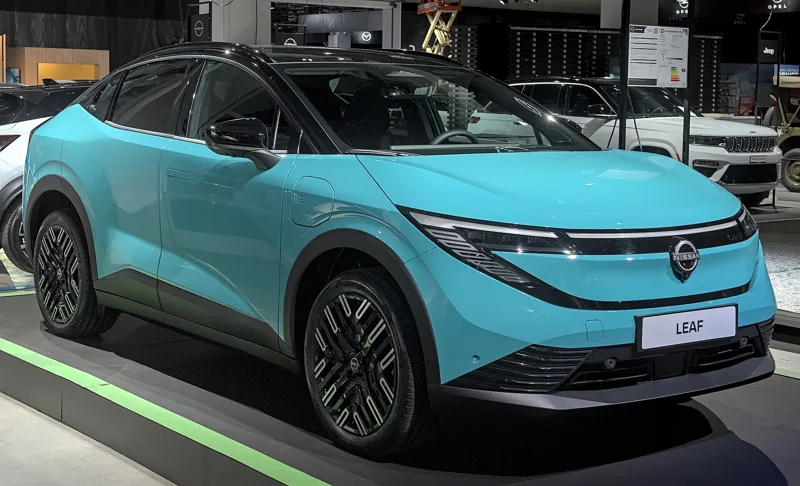
Electric production has local roots. The Nissan factory at Sunderland, Britain's biggest, began building the Leaf in March 2013 with up to 220 million pounds from the European Investment Bank and 20.7 million pounds from the British government. It was set up to make 60,000 lithium-ion batteries and 50,000 Leafs a year, and the British-built car was sold only in Europe.
Zones that already charge for petrol and diesel
Cities have not waited for 2035. London's Ultra Low Emission Zone launched in 2019, with an expansion planned for 2023, and sets daily charges for vehicles that fail its emission standards. Oxford became the first British city to introduce a zero emission zone in February 2022: electric vehicles enter free, while others can pay up to 10 pounds to drive in between 07:00 and 19:00.
Transport for London also said every new taxi had to be capable of running with zero emissions by 2018, and the government has put money into its own fleets, with a 5 million pound readiness project aiming to bring more than 150 plug-in cars and vans into central government use.
Where this goes next
The government's announced intention is a 2035 end to new petrol and diesel sales, hybrids included. Everything else depends on how that intention is turned into rules, and how other markets move. The European Union has already written a comparable date into law: its Parliament approved zero CO2 emissions for new cars and vans in 2035 on 14 February 2023.
That was not smooth. After 16 hours of talks on 29 June 2022, climate ministers of all 27 member states backed the Commission's proposal. Germany asked whether hybrids or CO2-neutral fuels could still comply, and Frans Timmermans said the Commission kept an open mind, on the grounds that, at that point, hybrids cut too little and alternative fuels cost far too much. France opposed a ban on hybrids in July 2021, and Italy's industry minister asked the EU in September 2024 to look again at the 2035 date.
Elsewhere, California's plan targets a 35% zero-emission share by 2026, 68% by 2030 and 100% by 2035, backed by 10 billion dollars of supporting funding. Norway's example shows what a market can do when the incentives are strong enough. Whether Britain's own intention holds at 2035, shifts, or is written into law more firmly is the open question.