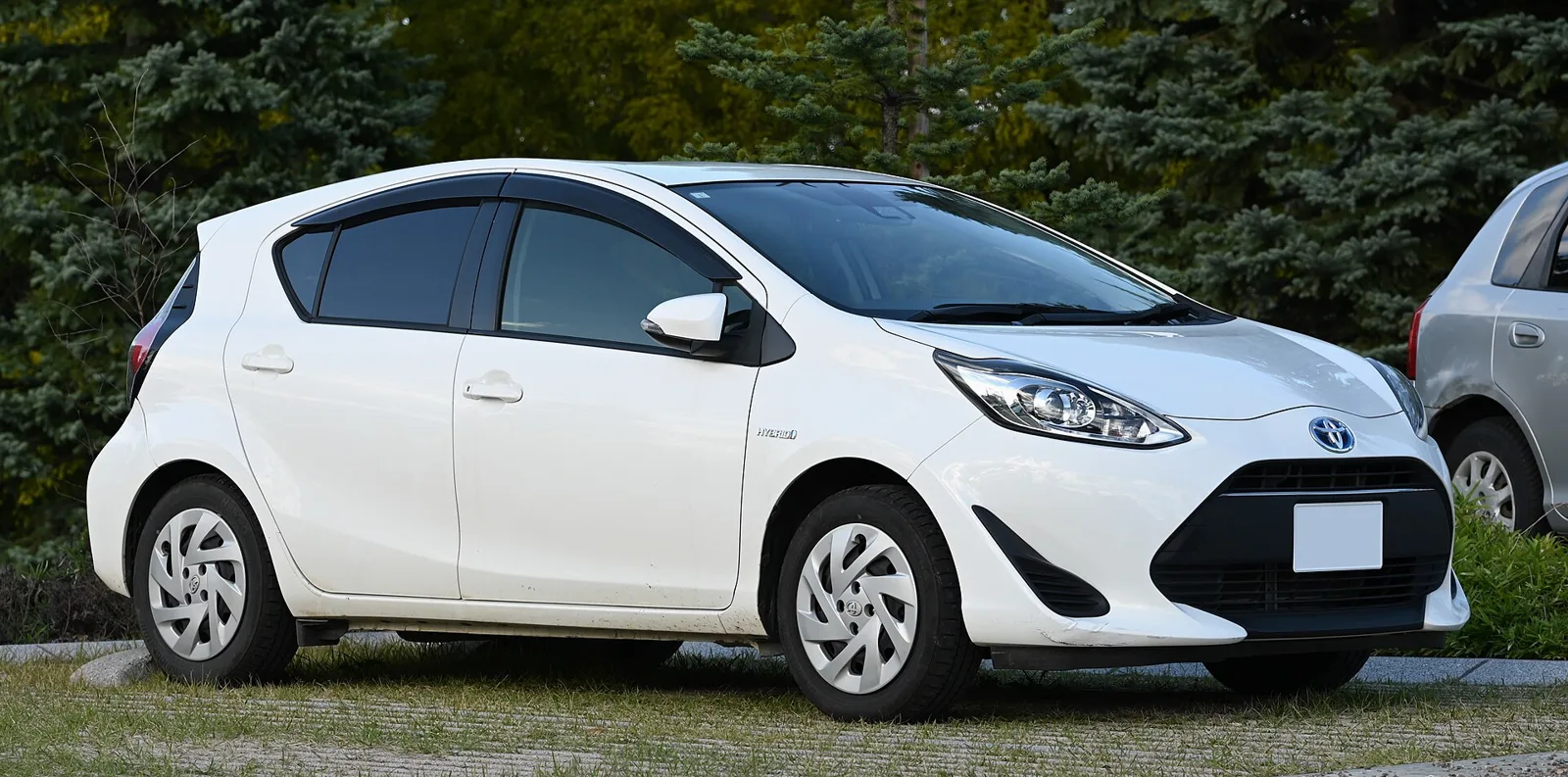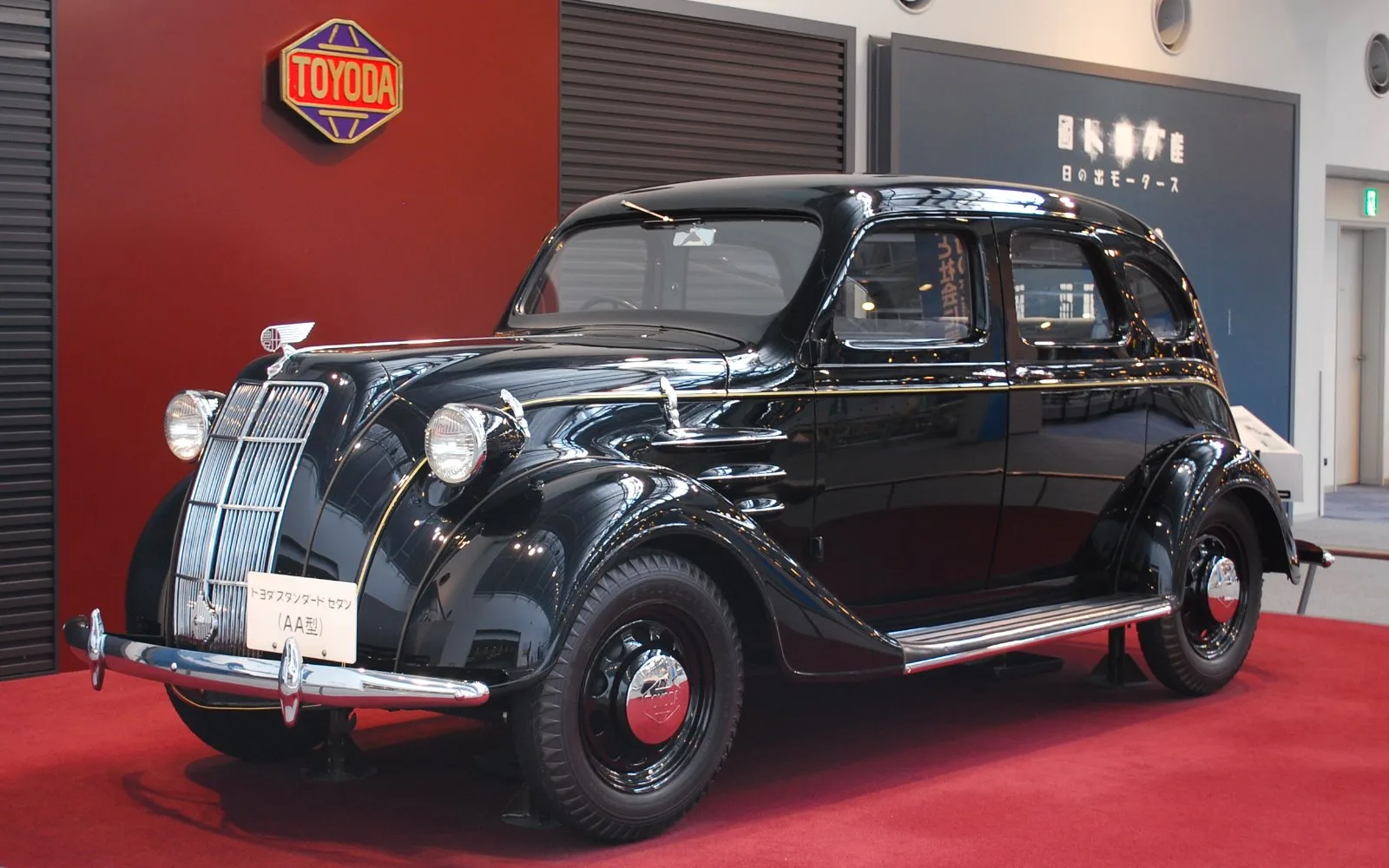
A pre-war sedan with a reverse-engineered Chevrolet six, and a wagon with a transfer case and a very low crawler gear, built by the same maker.
The Toyota AA was the company's first production sedan, built from 1936 with a copied Chevrolet-based six and a body inspired by the DeSoto Airflow. The Sprinter Carib was a four-wheel-drive station wagon sold in three generations from 1982 to 2002, based on the Tercel and then the Corolla.
When Toyota turned 50 in 1987, it wanted a 1936 AA sedan to celebrate with and could not find a single surviving car. The company had to build a replica from drawings that were incomplete and inconsistent, and that one car now sits in the Toyota Automobile Museum. The story of how the Toyota AA came about, and of how the same maker later built the four-wheel-drive Sprinter Carib wagon, runs through copied Chevrolet engines, an Art Deco Chrysler and a transfer case bolted into a Tercel.
Toyota's first car started as the A1
Three A1 prototypes were finished in May 1935, and none of them has survived. They were blessed in a Buddhist ceremony. Kiichiro Toyoda then drove one of them to the grave of his father, Sakichi Toyoda, the man who had supplied the seed money for a car factory.
The A1 did not go straight into production. Toyota turned first to the G1 truck, which looked likelier to make money in the short run. Only once the G1 was being built did the company free up resources to develop the AA sedan and the AB cabriolet from the prototype.
Underneath, this first Toyota car was a borrower. Its 3,389 cc (206.8 cu in) Type A engine was an overhead-valve six-cylinder rated at 62 horsepower (46 kW), and it was copied from a 1933 Chevrolet Master that Toyota bought and took apart to reverse engineer. Think of dismantling a clock, drawing every wheel and spring, then having your own workshop make them. The chassis and electrics were copied from Ford. A three-speed gearbox with a column-mounted shift lever sent the power on.
The rest was period-correct and simple. Solid axles sat at both ends, braking was by drums, and all four wheels were pressed metal discs, which counted as very modern at the time. These same mechanicals served the production AA, the AB and the G1 truck.
When Toyota wanted an AA for its 50th birthday in 1987, it could not find a single surviving car.
The Toyota AA sedan of 1936
The A1 body leaned heavily on the DeSoto Airflow, a Chrysler product whose streamlined shape reflected Art Deco taste. Toyoda had bought an Airflow and disassembled it the year before he built the A1. The result was a fully enclosed four-door sedan with conventional front doors and rear doors hinged at the back, the so-called suicide arrangement. The windscreen was one flat piece of glass with a single wiper mounted at the top on the driver's side. Each side had three windows: one in the front door, which had no quarter light, one in the rear door and one behind it. The spare tyre rode on a boot lid that was almost vertical. The A1 was built only with right-hand drive.
The production AA stayed close to that prototype, with only minor changes. Its metal body sat on a metal ladder chassis, and that was modern for a design of the mid-1930s, because many cars drawn up in the 1920s still used fabric stretched over a wooden frame. The rear doors still opened backwards and the single-pane windscreen still spanned the full width of the body.
The AB was the same car as a convertible. It had a folding cloth roof, its rear doors opened forwards like ordinary doors, and its windscreen could be folded down onto the engine compartment.
Output was small by any measure. A total of 1,404 AA sedans were built between 1936 and 1943, when the more austere AC took over. Toyota made 353 ABs, including the military ABR version, from 1936 to 1942, and the AB had no direct replacement.
The AC, AE, BA and the cars that never reached the showroom
The AC looked like the AA with small body changes. The most visible was the windscreen, now split into left and right halves with a thick strip of bodywork between them. Design work started in 1938, but production came later and in fits. Forty-three were built in 1943, 19 in 1944 (until February), and a final three in 1948. In between, 50 were assembled from spares in 1947 for a military order. That makes 115 AC sedans in all. No Toyota passenger car was built at all in 1945 or 1946, although the SA, the first post-war car, was being developed in those years. The SA was a quite different and much more advanced car, and it ended the line.
The AE was a smaller sedan. It was developed during 1939, with a prototype finished that September, and it was introduced at the start of 1940 but built only from 1941 to 1943. Just 76 were made. Its engine, the Type C, was a Type A with two cylinders removed, a quick way to get a smaller engine out of an existing design.
The BA was an austerity sedan whose framing used wood to save metal. It was introduced and first built in 1940, and no more than 17 were made. It is said to have been based on the Volvo PV60, but the dates make that doubtful: the PV60 was not introduced until 1944 and did not enter production until 1946.
The one-off BB phaeton followed in 1941, and it resembled a contemporary Chevrolet. Two or three examples of a luxury sedan, known as the Model B, were built as well, as prototypes in 1944. It was the last passenger car development before the war ended.
Two more designs from 1938 never got off the drawing board. Kiichiro Toyoda drew the EA as a copy of the DKW F7 sedan, with a small two-cylinder, two-stroke Type E engine at the front driving the front wheels. The EB was a rear-wheel-drive minicar derived from it, using the same front-mounted two-stroke engine. Wartime restrictions stopped both.
Looking for a surviving Toyota AA
The 1987 hunt for an AA ended with no car to display. Toyota decided to build a replica, but even that was hard, because the plans that could be found came from various points in the development process and were often incomplete by today's standards. The company still built a single replica that it believes represents the AA. It runs a 2.3-litre Toyota 2M straight-six, not the original engine.
An original did turn up in 2008, in Vladivostok, Russia. It was derelict and heavily modified, with the undercarriage and drivetrain of a GAZ-51 truck. A local family had used it on their farm until the 1990s without knowing what it was worth. When engine trouble finished its working life, it went into an old barn, where a 25-year-old student found it and phoned the Louwman Museum in the Netherlands. The museum now shows the car in the condition it was found. How it reached Russia is unknown.
The AA's styling had one more outing. During the retro craze of the 1990s and 2000s, Toyota took the look of the AA, AB and AC series and put it on a Hilux chassis with modern comforts, calling the result the Toyota Classic. No more than 100 were built, so it is very rare.
Toyota Sprinter Carib, the wagon named after a caribou
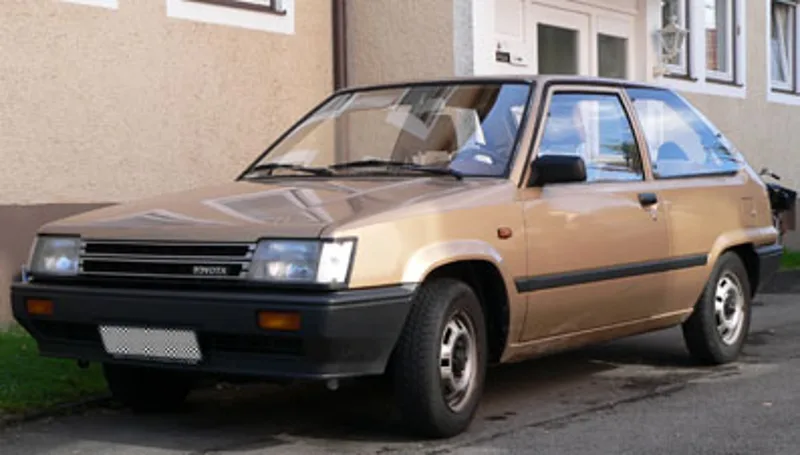
Fast-forward to 1982 and Toyota was selling a very different sort of car. The Sprinter Carib was a front-engined, all-wheel-drive station wagon built under the Sprinter name until 2002. The name comes from the caribou, chosen to suggest a strong animal that gallops gracefully over mountains and snow-covered plains.
The first generation, coded AL25G, was shown as a concept called the RV-5 at the Tokyo Motor Show in October 1981 and reached Japanese buyers in August 1982. It was Toyota's answer to rising demand for four-wheel-drive wagons in the RV style, a segment where Subaru had taken an early lead in 1972 with its Leone wagon. Outside Japan it was sold as the Tercel 4WD wagon, because it was based on the second-generation Tercel.
Styling depended on the market. A vertical grille and long bumpers went to Japan, where the lower AV-I model had short bumpers, and to North America. Europe and Australasia received the Corolla II grille and front bumper instead.
Only a 1.5-litre engine was fitted. The manual gearbox had five ratios plus an extra-low gear, called EL, and a three-speed automatic was added in October 1983. The driver could switch from two- to four-wheel drive without stopping.
How the Sprinter Carib's four-wheel drive worked
Toyota built this car largely from parts it already had. The engine, transaxle and front-drive system came from the Tercel, and because the engine sat lengthwise, adding drive to the rear was a simple job. The coil-sprung live rear axle and the driveshaft were borrowed from the rear-wheel-drive E70 Corolla and Sprinter. The only major new part was the transfer case, built into the transmission.
That case gave the driver three choices. Normally the car ran as a front-wheel-drive wagon. Pull the lever back, or press a button on automatics, and the front and rear differentials were tied together to turn at the same speed by a direct mechanical coupling. There was no conventional centre differential. Picture two people walking round a bend with their wrists tied together: the one on the outside has further to go, so something has to give. On loose or slippery ground, such as snow, gravel or sand, the tyres give. On a dry road the drivetrain takes the strain, with severe wear and compromised handling, so this system was meant for slippery surfaces only.
The third choice existed only on manual cars. With the lever in four-wheel-drive mode, the driver could shift from first down to EL. This was not the low range of a truck or a conventional SUV, since the Tercel had no separate high-and-low transfer case. EL was simply a very low gear, at 4.71:1, which produced a 17.5:1 final drive ratio and gave the torque needed to pull the car out of places that could otherwise trap it. It worked only in four-wheel-drive mode and was suitable only for very low speeds. Better-equipped cars also carried an inclinometer above the radio and air conditioner that showed the tilt of the car, shared with the J70 Land Cruiser.
Updates followed steadily. In August 1984 the top manual model gained a dual Venturi carburettor engine, the 3A-SU, plus a refreshed interior, and the manual cars swapped their 4WD lever for a button like the automatic's. For the 1985 model year the manual gearbox changed from the Z52F to the Z54F. EL (now 4.871), first and reverse gears were revised for better crawling, and the final drive moved from 3.727 to 4.100 for stronger acceleration. Europe and Australasia also got engine and exterior revisions. In May 1987 Japan received Toyota's TEMS suspension, and Japan and North America a new grille.
Second generation, with full-time four-wheel drive
The AE95G arrived in February 1988 and was exported as the Corolla 4WD wagon in most of the world, the Corolla Tercel 4WD in parts of Europe such as Germany and Switzerland, and the Corolla All-Trac in North America. It used the E90 Corolla and Sprinter wagon shell, with a rear end styled to echo the older Carib.
The drivetrain was new. Four-wheel drive changed from part-time to full-time, operated by a centre diff lock button. With the lock engaged, power split 50/50 between front and rear wheels, and unlocked, most of it went to the front. The engine now sat across the car like any front-drive-based four-wheel-drive design, and it grew to a 1.6-litre DOHC 16-valve unit with a carburettor or fuel injection depending on the market. Gearboxes were a five-speed manual or four-speed automatic. In Japan, some models had a height control switch that raised the body by 30 mm (1 in) and dropped it back automatically above 80 km/h (50 mph) for stability.
A new bumper, grille, wheels and the revised 4A-FHE engine came for Japan in August 1990. In September 1991 Toyota launched the E100 Corolla wagon, but the Carib was not replaced. It was improved instead, with standard three-point rear seat belts and stronger side door beams, and it sold alongside the E100 through different dealers in Japan, because the E100 had no four-wheel-drive version until May 1995. Australia and Germany saw the same situation. The last update, in August 1993, added a driver's airbag, larger 14-inch wheels and bigger brakes.
Third generation and the end of the Sprinter Carib
The E110 was launched in August 1995 and sent to Europe as a Corolla wagon with a different front end in 1997. It used 1.6 to 1.8-litre A series engines. Export Corollas also offered a smaller 1.3-litre 4E-FE petrol and a 2.0-litre 2C-III diesel. In Japan both engines came with standard four-wheel drive, while in Europe the system went only with the 1.8. The older E100 wagons stayed on sale in Japan with four-wheel drive available too.
May 1996 brought dual front airbags and ABS as standard, a front-wheel-drive option for 1.6-litre cars, and a hot BZ Touring trim with the 1.6-litre 20-valve 4A-GE black top engine. A facelift in April 1997 added Toyota's GOA body structure and a six-speed manual for the BZ Touring. A year later came the Sprinter Carib Rosso, which wore the European Corolla wagon front end and was offered only with the 1.6-litre 4A-FE.
European Corollas moved on faster. In January 2000 they took Euro 3 compliant 1.3 to 1.6-litre ZZ series VVT-i petrol engines, though the 1.8 stayed for the four-wheel-drive model. The diesel was replaced by a rebadged 1.9-litre PSA unit and, in 2001, by Toyota's 2.0-litre 1CD-FTV D-4D turbodiesel. Apart from the 1.8, the newer engines never reached the Sprinter Carib, which was discontinued in August 2002.
Sprinter Carib generations at a glance
| Generation | Launched | Base | Engine | Four-wheel drive |
|---|---|---|---|---|
| First (AL25G) | August 1982 | Second-generation Tercel | 1.5 L, mounted lengthwise | Part-time, no centre differential |
| Second (AE95G) | February 1988 | E90 Corolla and Sprinter wagon | 1.6 L DOHC 16-valve, transverse | Full-time, centre diff lock button |
| Third (E110) | August 1995 | Corolla and Sprinter wagon | 1.6 to 1.8 L A series | Standard in Japan, front-drive option on 1.6 L from May 1996 |