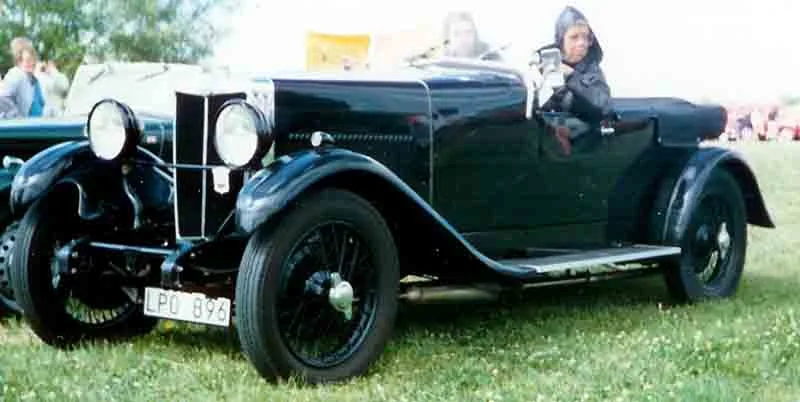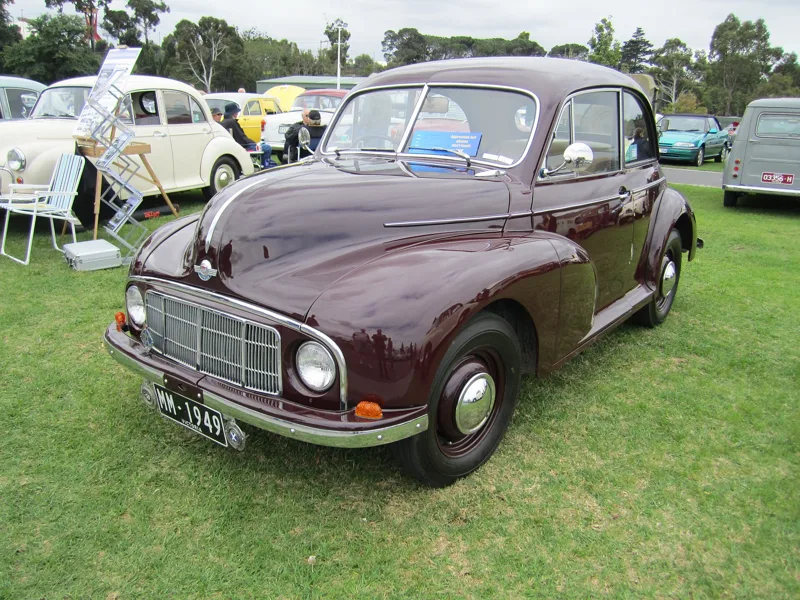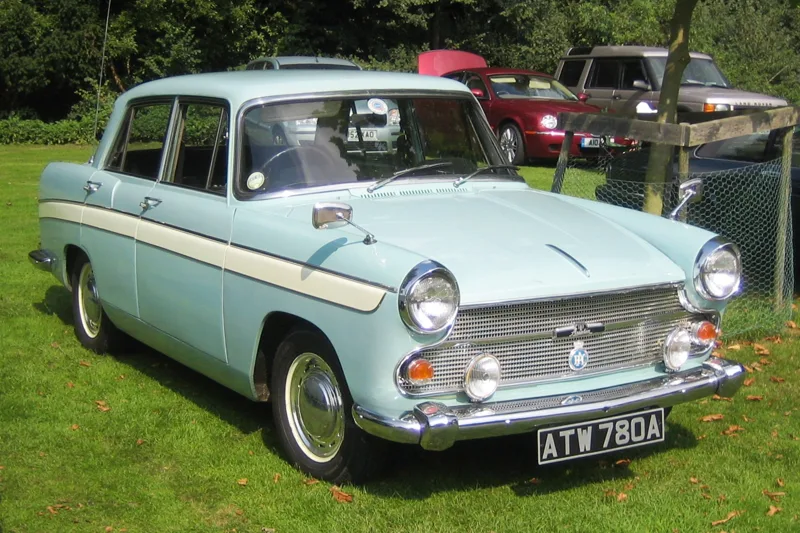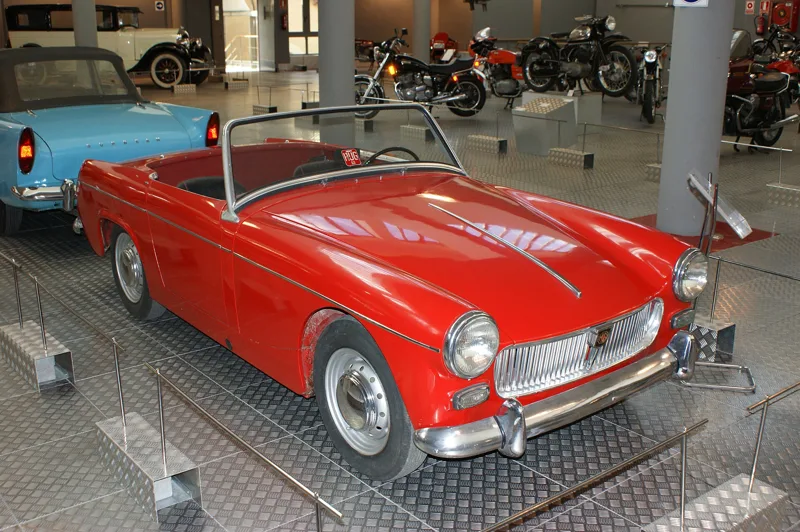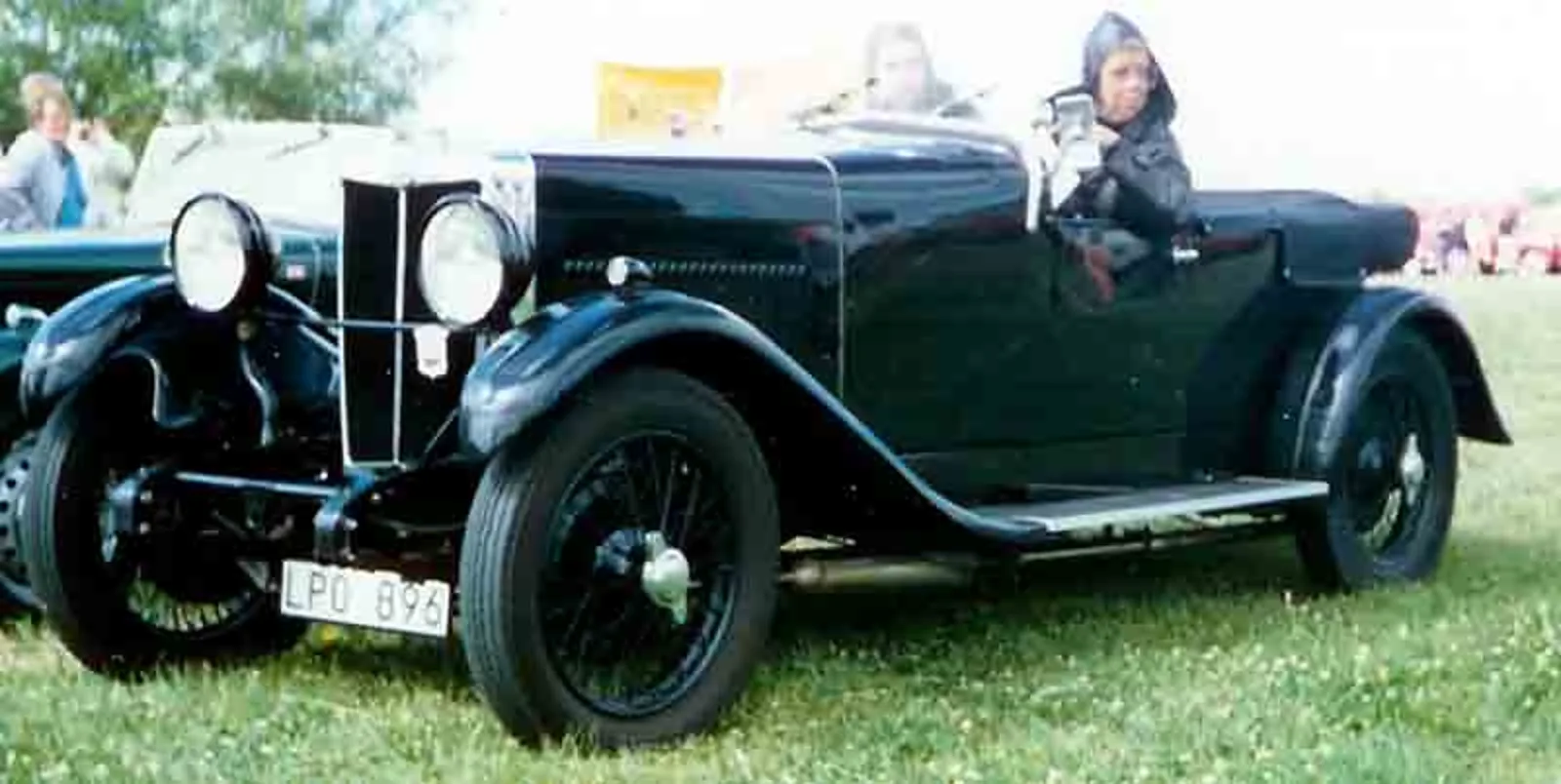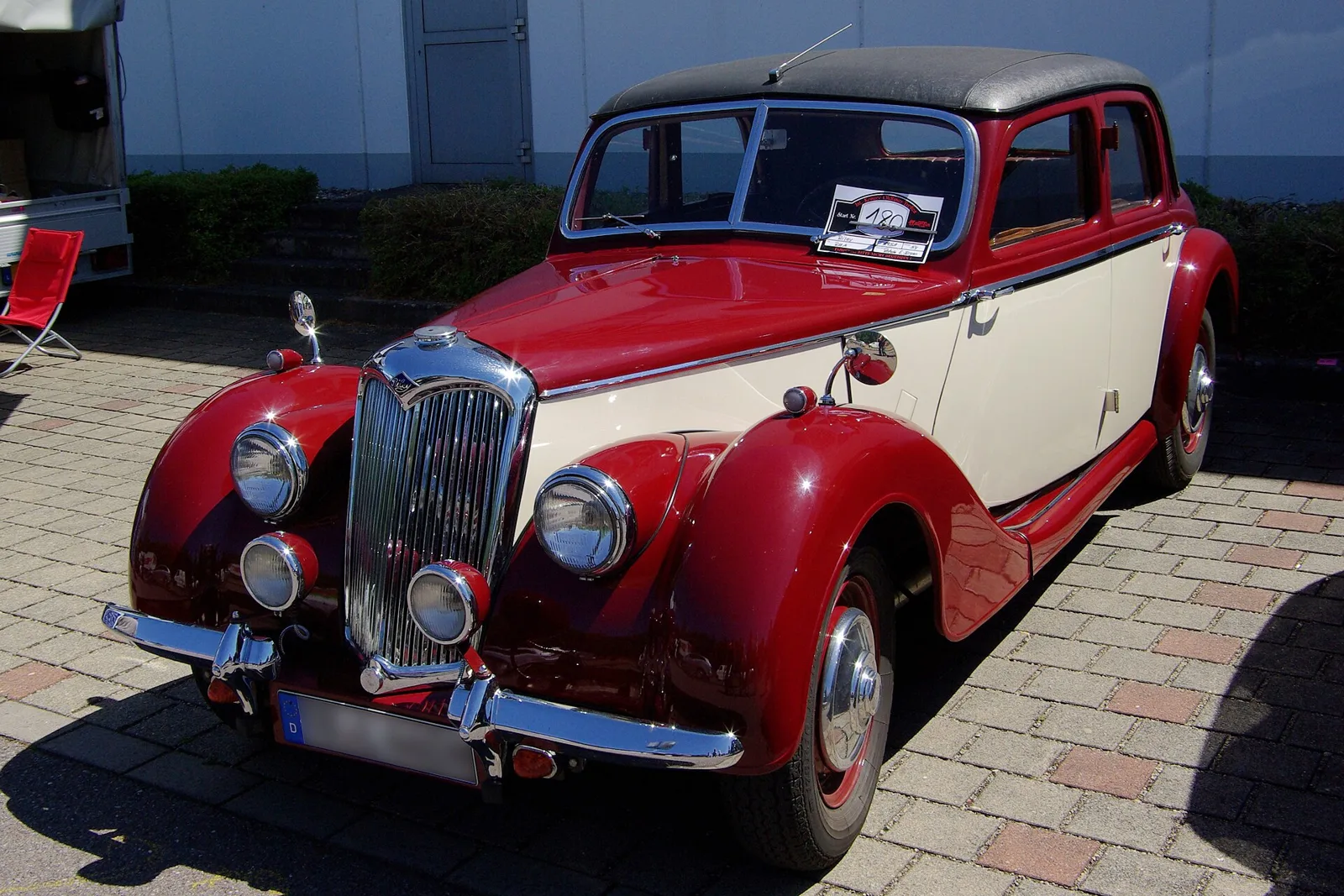
Four British cars from 1927 to 1960: the Riley rebuilt after air raids destroyed its dies, the Sapphire with a sphinx on its nose, the small Rover and the roadster that reached a few maharajas.
The Riley RM was a post-war executive car built from 1945 to 1955. Armstrong Siddeley's Sapphire ran from 1952 to 1960 with four- and six-cylinder engines, the Rover 10 was a small family car built from 1927 to 1947, and the Singer Roadster a nine-horsepower sports-tourer built from 1939 to 1955.
The sphinx on an Armstrong Siddeley Sapphire's grille sometimes wore aircraft wings, with tiny Sapphire jet engines. That small touch sat on the nose of one of four very different British cars, with the Riley RM, the Rover 10 and the Singer Roadster, that were built between 1927 and 1960.
What was the Riley RM?
The Riley RM was a series of executive and compact executive cars made by Riley Motors from 1945 to 1955. They were the last models Riley developed independently before its parent, Nuffield, merged with Austin to form BMC. Coventry built them until 1949, and after that the MG factory at Abingdon took over.
Until 1952 the cars were sold as the Riley 1.5 Litre and 2.5 Litre, and RM was a name applied later to the whole run. All used Riley four-cylinder in-line engines with hemispherical combustion chambers and two camshafts carried high in the block sides. The RMA saloon, later the RME, had the 1.5-litre (1,496 cc) engine developed before the war. The longer RMB, later the RMF, used the 2.5-litre (2,443 cc) Big Four, new in 1937. The RMC roadster and RMD drophead were limited-production cars, and the Pathfinder, the RMH, was the last saloon with the Big Four engine.
The RM drew on the pre-war Kestrel saloons, but it needed a new chassis, which brought Riley's torsionic independent front suspension and the lessons of the war years. It was a new design anyway, because air raids on Coventry had destroyed the die patterns of the earlier cars.
A Rover freewheel let drivers change gear without the clutch, and it stayed on some Rovers until 1959.
How did the Riley RM range develop?
The RMA, announced in August 1945 as the first post-war Riley, had hydro-mechanical brakes and torsion-bar front suspension. Its body frame was wood, in the English tradition, under traditional styling, and the car could reach 75 mph (121 km/h). It ran until 1952, when the RME replaced it.
The RMB, launched a year after the RMA, was a lengthened car with a wheelbase 6.5 in (165 mm) longer and overall length 7 in (178 mm) more. Twin SU carburettors gave its 2.5-litre engine 90 hp (67 kW) at first and 100 hp (75 kW) for 1948, with a top speed of 95 mph (153 km/h). Light blue badges on the bonnet and bootlid told a 2.5 Litre from a dark-blue 1.5 Litre. The Motor tested one in 1949: 90 mph (140 km/h), 0-60 mph (97 km/h) in 16.8 seconds, 19.6 mpg imperial (14.4 L/100 km; 16.3 mpg-US) and a price of 1,224 pounds including taxes.
The RMC roadster, announced in March 1948, reached Geneva just too late for the motor show. It was designed mainly for North America, normally with left-hand drive and a column gear change, a lowered bonnet, a fold-flat windscreen and a 20 imp gal (91 L; 24 US gal) fuel tank. Celluloid side curtains replaced windows. With the 100 hp engine it could reach 100 mph (160 km/h), and its front and rear resembled the 1934 Ford V8. Just over 500 were built from 1948 to 1951. In September 1949 Riley said a small quota would have right-hand drive, because steel supplies had eased slightly.
The RMD drophead, first shown in October 1948 at London's Earls Court, was a traditional two-door cabriolet and the last Riley cabriolet. It used the same 100 hp engine, and just over 500 were produced between 1949 and 1951.
How did the Riley RM end?
The RME of 1952 was an improved RMA, with fully hydraulic brakes, a larger curved rear window and a rear axle ratio changed from 4.89:1 to 5.125:1 for better acceleration. When the RMF ended in October 1953, the RME lost its running boards and gained new front wings. In 1952 The Motor measured 75 mph (121 km/h) and 29.5 seconds to 60 mph; fuel use was 24.2 mpg imperial (11.7 L/100 km; 20.2 mpg-US) and the car cost 1,339 pounds.
The RME went out in 1955. The Riley One-Point-Five of 1957 followed it, but that was a BMC car with no link to the RM family, far shorter, and sold under other badges too: Wolseley 1500, and in Australia Morris Major and Austin Lancer. The RMF replaced the RMB in 1952, and the RMH Pathfinder replaced the RMF in 1953. Because the Pathfinder was the last car with the Big Four engine, purists consider it the last real Riley. It continued until 1957.
That engine was a 16.07 hp (RAC) four, designed in a matter of months in difficult financial conditions and announced in summer 1937. It followed Riley practice, but each cylinder had its own water jacket and the counterbalanced crankshaft ran in three main bearings. Output began at 80 bhp (60 kW), rose to 85 bhp (63 kW) and reached 110 bhp (82 kW) in the Pathfinder, which kept it in production until February 1957.
What was the Armstrong Siddeley Sapphire?
The Armstrong Siddeley Sapphire was a large car built by the British company between 1952 and 1960. Its signature was the traditional V-shaped radiator grille with the Sphinx mascot, and the range split into a six-cylinder series and a smaller 2.3-litre pair.
The 346 was the first Sapphire, introduced late in 1952 for sale in 1953 and made until 1958. Its 3,435 cc six had hemispherical combustion chambers, and twin Stromberg carburettors, a 25 pound option, lifted output from 125 to 150 bhp (93 to 112 kW) and the top speed beyond 100 mph (161 km/h). It had independent coil-spring front suspension and a rigid rear axle on leaf springs, with Girling hydraulic brakes on 11 in (279 mm) drums. Buyers chose four-light or six-light bodywork at the same price and either a bench or individual front seats, trimmed in leather with walnut veneer, and a heater came as standard.
The gearbox options were a Wilson electrically controlled four-speed preselector for 30 pounds extra or a four-speed synchromesh box. In 1954 the 346 Mark II could be had with Rolls-Royce-made Hydramatic automatic, and a limousine on a 21-inch (535 mm) longer chassis followed in 1955. Export cars for the United States all had twin carburettors. A twin-carburettor saloon tested by The Motor in 1953 managed 100.1 mph (161.1 km/h) and reached 60 mph (97 km/h) in 13.0 seconds. Consumption came out at 18.7 mpg imperial (15.1 L/100 km; 15.6 mpg-US), and it sold for 1,757 pounds. Armstrong Siddeley built 7,697.
What were the Sapphire 234 and 236?
The 234 and 236 looked identical but used different engines with near-identical displacements, so they drove quite differently. The sporting 234, made from 1955 to 1958, had a four-cylinder 2,290 cc engine and a four-speed manual gearbox with optional overdrive. It was pitched at drivers wanting performance, as a car good for 100 mph, and 803 were made.
The 236, made from 1955 to 1957, used the six-cylinder 2,310 cc engine already fitted to the Armstrong Siddeley Whitley 18. It could be had with a conventional gearbox, but many were fitted with the Lockheed Manumatic clutchless transmission, and overdrive was an option on either. With an 85 mph top speed, it was meant as a quiet, flexible, easy saloon. Only 603 were made.
What changed on the Star Sapphire?
The Star Sapphire was announced on 17 October 1958 and built until summer 1960. Its six grew by over 16 percent to 3,990 cc, with twin Strombergs as standard, and it produced 165 bhp SAE (167 hp, 123 kW) or 145 bhp DIN (147 hp, 108 kW). Torque at 50 mph was up by nearly 30 percent. Lead-indium bearings and a crankshaft vibration damper were fitted, the compression ratio rose to 7.5-to-1, and the car could circle the Lindley high-speed track at 104 mph.
At the front, Girling 12 in (305 mm) discs with servo assistance took over from drums, and Burman recirculating-ball power steering cut the turning circle by 4 ft 6 in. A Borg-Warner type DG automatic had a fascia lever to hold an intermediate gear at 35, 45, 55 or 65 m.p.h. Door hinges were hidden, the front doors hinged at the leading edge, and rear passengers had an independent heater. All features were standard because the maker believed alternatives led to compromise.
Armstrong Siddeley made 980 Star Sapphires, among them 902 saloons and 77 long-wheelbase cars, 73 of which were limousines including two prototypes. Twelve of the limousines had automatic gearboxes, and the remaining four chassis became three hearses and an ambulance. The car won the four-door coachwork class for cars costing 4,000 pounds at the 1958 Earls Court show, beating a Jaguar Mark IX as well as an Austin Princess limousine. A Mk II of 1960 never got beyond one prototype.
Fuel consumption of an automatic Star Sapphire tested by The Motor in 1959 was 15.4 mpg imperial (18.3 L/100 km; 12.8 mpg-US), with 0-60 mph in 14.8 seconds and a top speed of 99.6 mph (160.3 km/h). It cost 2,498 pounds, including 735 pounds of taxes, after purchase tax was cut by one-sixth on 8 April 1959.
How did the Star Sapphire's price compare in 1958?
| Car | Price including tax, October 1958 (pounds) |
|---|---|
| Humber Super Snipe with automatic | 1,666 |
| Jaguar XK150 | 1,939 |
| Jaguar Mark IX with automatic | 2,163 |
| Daimler Majestic | 2,492 |
| Armstrong Siddeley Star Sapphire | 2,646 |
The Sapphire has literary credentials. In Ian Fleming's Diamonds Are Forever, published in 1956, James Bond is collected from the Ritz in London by a black Sapphire with a chauffeur, though the novel does not name the year or mark. A black Armstrong Siddeley limousine also carries a character in the 1956 British film Wicked as They Come, and a Sapphire is driven in the 1955 film The Flaw.
What was the Rover 10?
Between 1927 and 1947 Rover built the 10, a small family car. The 10/25 began in mid 1927, when Rover enlarged the bore of its 9/20 by 3 mm and renamed it for a 10 per cent capacity rise and a claimed 25 per cent output rise. Capacity went to 1185 cc.
Underneath it was conventional: rigid axles on leaf springs, half-elliptic ones in front and quarter-elliptic behind, a three-speed gearbox and brakes on all four wheels. Coil ignition replaced the magneto in 1929. Rover built open tourers and semi-sports tourers, and four-seat saloons with fabric Weymann bodies built under licence at its Parkside works. The Paris body had leather upholstery, two electric horns, an eight-day clock and a rear blind controlled from the driver's seat, and the Riviera version added a roof that folded back over two-thirds of its length. A Regal version from 1928 carried a 12 per cent premium for a sliding roof, bumpers and vacuum servo braking.
In August 1930 Pressed Steel all-steel bodies arrived, supplied painted and trimmed for far less than Rover's own Weymann bodies, yet Rover kept the price identical across all three models. The steel saloon was named the Family Ten. A Times correspondent reported that it was smooth and quiet and would reach 46 mph on the straight. In February 1932 Rover announced a stronger chassis after lengthy testing on the roughest roads in New Zealand and Australia.
What was the Rover freewheel?
In July 1932 Rover announced the 10 Special, with an all-new chassis, a four-speed gearbox with a freewheel, bigger brakes and an optional automatic clutch. Rover priced it 17 per cent above the Family Ten, which stayed on sale. The freewheel let the driver change gear once the throttle eased slightly, with no clutch needed and no noise, and a knob on the instrument panel switched it off. It remained a Rover feature for more than 20 years.
The engine sat on just three rubber-insulated points, a Startix device restarted it automatically if it stalled, and Lockheed hydraulic brakes with large drums took the strain of coasting. Rover offered chassis to coachbuilders including Carbodies, Charlesworth, Swallow and Weymann.
The 1933 10, known as the P1, was really a new car with an underslung chassis and a 1389 cc engine. It was the first Rover developed after the Wilks brothers, Spencer and Maurice, joined the company. At GBP238 against GBP168 for the Austin 10 it was relatively expensive, reflecting a new policy of heading upmarket instead of chasing sales, and Rover claimed a 15 per cent saving in fuel from the freewheel.
The last version, the P2, was launched in 1939 alongside the Rover 12, 14, 16 and 20. Its wheelbase gained half an inch (12 mm) and a new cylinder head raised power from 44 to 48 bhp, with synchromesh on the top two gears. The saloon cost GBP275, but few were built before production stopped in 1940. Bombing damaged the Coventry factory in November 1940, and when production resumed it was at the new Solihull works. A left-hand-drive version for export and an optional heater arrived in 1947, the year the last cars were made.
What was the Singer Roadster?
The Singer Roadster was a nine tax horsepower open two or four-seat sports-tourer built from 1939 until 1955. Singer launched it in March 1939 as an open version of its Bantam saloon, using many Bantam parts. Production stopped after less than six months for the war, then restarted with the engine moved forward and more interior space.
The original used Singer's 1074 cc overhead-cam four, tuned to 36 hp (27 kW) at 5000 rpm with a hot-spot manifold and a downdraught SU carburettor. The Bantam's three-speed gearbox held the top speed to about 65 mph (105 km/h), though the makers claimed 70 mph (110 km/h). The body was aluminium panels on a wooden framework, the axles were rigid and the brakes mechanical. Advertising copy mentioned the Le Mans model, but Singer kept its sporting links muted after eight spectators died at the September 1936 RAC Tourist Trophy at Ards in Ireland.
The car returned in 1946 with the engine further forward for better seating and a flat luggage platform, and almost every post-war car went abroad. The model found favour with India's elite and joined the collections of some maharajas. In September 1949 the 4A gained a four-speed gearbox from the Singer Hunter and a Solex carburettor, and the 4AB of October 1950 added independent front suspension by coil springs and Girling hydro-mechanical brakes.
The final version, the 4AD or SM Roadster, made its debut at the Paris Motor Show in October 1951. It took the 1497 cc engine of the SM1500 saloon, rated at 48 hp (36 kW), and a 58 hp (43 kW) twin-carburettor option arrived in 1953, when the 1.5-litre cars also reached the home market. The Motor recorded 73 mph (117 km/h) and 0-60 mph in 23.6 seconds in 1951. Singer showed a glass-fibre SMX Roadster at Earls Court in October 1953, and probably about 10 were made. The last Roadsters were built in 1955.