A 6.213 km public road with a 174 m climb, grades of 1:6.13 and walls close to the edge, and the crashes that shaped how Bathurst is made safer.
Mount Panorama is a 6.213 km public road at Bathurst that becomes a racing circuit, with a 174 m climb and grades of 1:6.13. It opened in 1938 after earlier road circuits, and its walls, blind crests and fast descent have prompted repeated safety changes.
You can drive Mount Panorama for nothing. On days without racing it is a public road, open in both directions, with a 60 km/h (37 mph) speed limit that Bathurst Police strictly enforce. Yet on race day V8 Supercars reach up to 290 km/h (180 mph) on the same tarmac.
What is Mount Panorama?
Mount Panorama is a 6.213 km (3.861 mi) street circuit at Bathurst in New South Wales, home to the Bathurst 1000 each October and the Bathurst 12 Hour each February. It is a public road outside race meetings, and some residences can only be reached from the circuit itself.
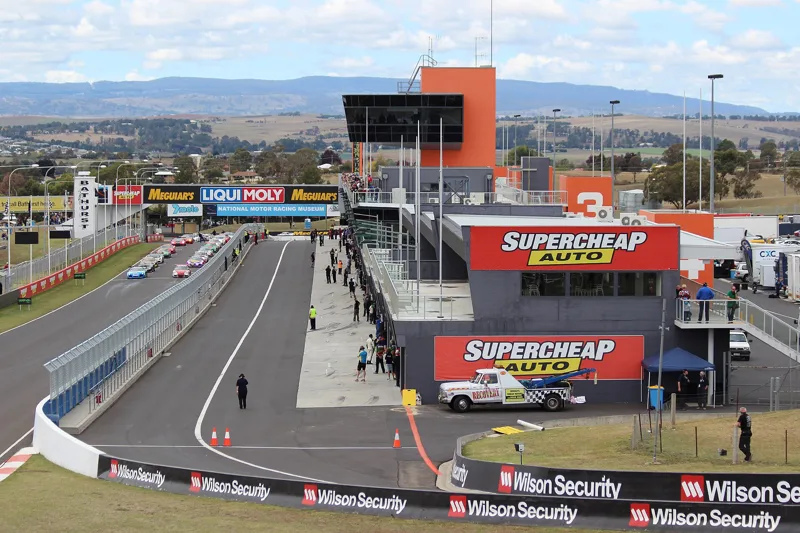
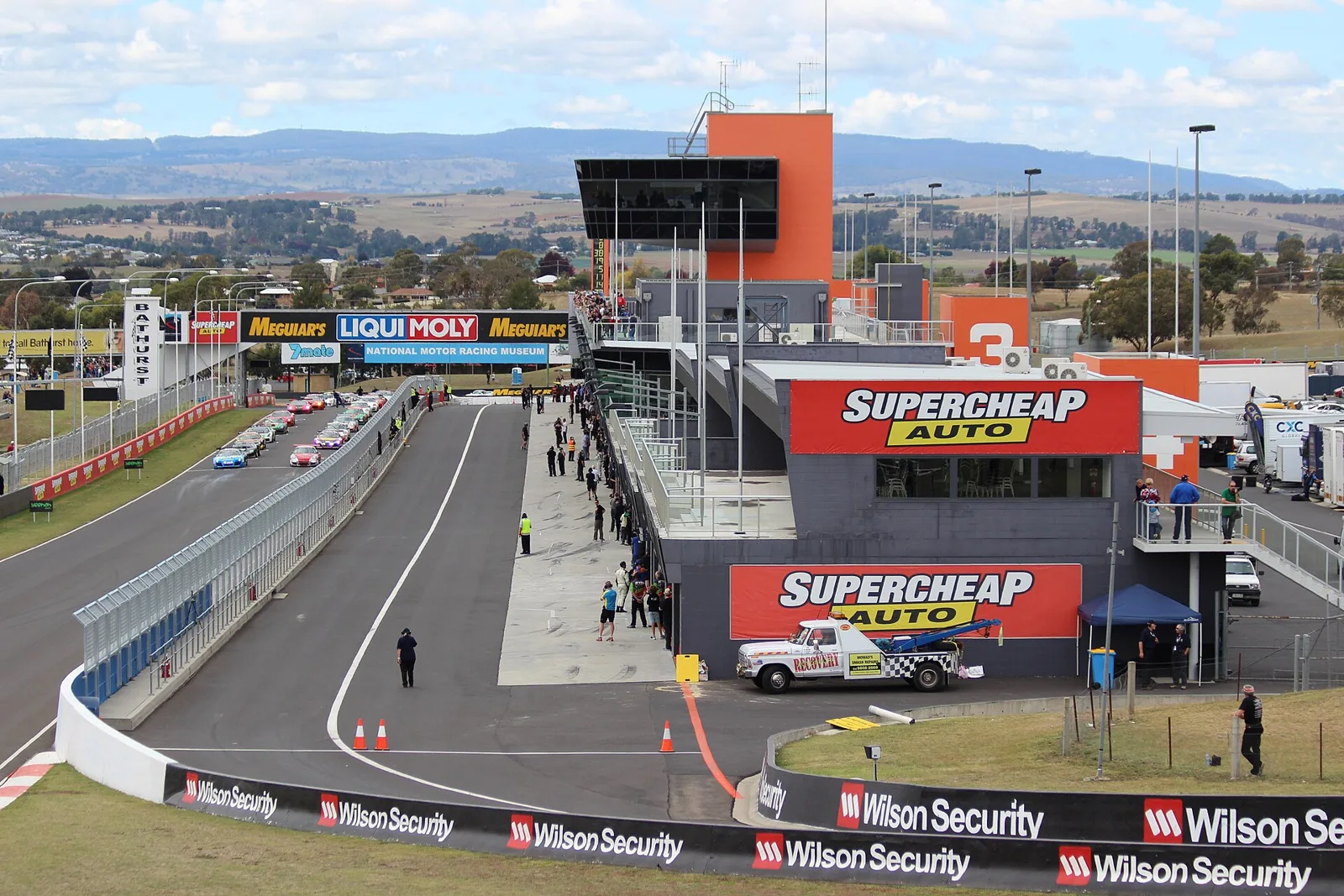
By modern standards the layout is unusual. The track climbs 174 m (571 ft) from its lowest point to its highest, and the steepest grades reach 1:6.13. From the start line the lap falls into three parts. First comes a short pit straight and a tight left into the long, steep Mountain Straight. Next is the tight, narrow stretch across the top. Last is the long downhill of Conrod Straight, the very fast Chase, and a final turn on to the pit straight.
Drivers have tried to describe it by comparison. Alexandre Premat called it a mix of the Nurburgring Nordschleife, Petit Le Mans and Laguna Seca, while Nurburgring 24 Hours winner Kevin Estre said half the track is the Nordschleife and half is Macau. Touring car racing has no faster corner than the kink where the Chase begins.
The circuit holds FIA Grade 3 registration, which allows FIA-sanctioned events for cars with a weight-to-power ratio of 2 to 3 kg/hp. That covers every current Australian domestic category except S5000, whose cars had their power reduced for the event held there. Next door stands the National Motor Racing Museum.
On race day V8 Supercars reach up to 290 km/h on a road you can drive for free.
How did a public hill road become a racing circuit?
Racing around Bathurst predates the track by decades. In the 1900s a local doctor, Dr Machattie, talked two builders into driving 793 km (493 mi) from Melbourne to Bathurst in his steam-powered Thomson. From 1906 races were run on circuits of public roads, dirt and tarmac, and each new venue was bigger or smaller than the last.
| Circuit | Years used | Length |
|---|---|---|
| Peel-Limekilns | Until 1913 | 33.0 km (20.5 mi) |
| Yetholme | 1914 to 1925 | 24.9 km (15.5 mi) |
| Sunny Corner (Mount Horrible) | 1926 to 1930 | 100.6 km (62.5 mi) |
| Vale | 1931 to 1937 | 11 km (7 mi) |
| Mount Panorama | From 1938 | 6.213 km (3.861 mi) |
Building the Mount Panorama circuit began in mid-1936. The first meeting, for motorcycles, took place on 16 April 1938, and the opening race, the Junior Tourist Trophy, went to 20-year-old Queenslander Les Sherrin on a Norton. Two days later the 1938 Australian Grand Prix gave the venue its first car race, won by Peter Whitehead in an ERA.
The mountain had a name long before. The Wiradjuri name for the mountain, Wahluu, means to watch over, and young men were initiated there. The turns of the modern lap carry the names of local people: Griffins Bend honours Martin Griffin, the mayor whose vision created the circuit, Reid Park honours city engineer Hughie Reid, who redesigned sections for racing, and McPhillamy Park honours Walter McPhillamy, a former mayor who gave the land to the people of Bathurst.
What makes the climb so demanding?
Hell Corner opens the climb, and a common belief that its name comes from the accidents there is wrong. It was named after a tree stump on the apex of the turn. The pit straight has separate start and finish lines; for a standing start the line sits 143 m (156 yd) closer to Hell Corner so the grid does not spill around Murray's Corner.
Then the Mountain Straight starts the climb towards Griffins Bend, with V8 Supercars reaching 290 km/h (180 mph) at most before they brake. In the days before modern aerodynamics, drivers lifted off at a crest halfway up to stop the car becoming airborne. The same crest caught out riders in the old Easter motorbike races, and several had serious crashes after failing to lift.
Griffins Bend is a right-hander with a negative camber, so a car that drifts wide on exit meets the wall. David Besnard hit the wall there in 2011 in a Ford Falcon FG; he had left the pit lane on new brakes and reached the corner without enough front brake pressure.
Why are the Cutting and Quarry Corner so unforgiving?
The Cutting is a pair of left-handers leading to a steep 1 in 6 exit. There is little room, overtaking is hard and a spin is very difficult to recover from. It was the scene of the race-rage collision between Marcos Ambrose and Greg Murphy late in the 2005 Supercheap Auto 1000, when neither would give way and the wreckage partly blocked the track.
Quarry Corner, a right-hander straight after the Cutting, is named after the quarry beyond its outside wall. The circuit briefly flattens at the apex, so drivers sometimes short-shift to avoid wheelspin. It is also the site of one of the best-known incidents in the history of the race. On lap 18 of the 1980 Hardie-Ferodo 1000, Dick Johnson was leading in his Ford Falcon XD when he passed a quick-lift tow truck and met a large rock pushed out of the spectator area.
Johnson had nowhere to go. His car hit the rock and the outside concrete wall and almost leapt over it, and the wreck cost him the means of financing his racing. The wall had only been installed before the 1979 race; until then the fence was made of railway sleepers and posts. An emotional public appeal during the telecast re-launched Johnson's career.
What makes the top of the mountain so hard?
After Quarry comes Reid Park, a loaded right-hander followed by an open left. In the 1982 Bathurst 1000 a tyre failed on Kevin Bartlett's Chevrolet Camaro Z28 in the right-hander, throwing it into the wall on the inside of the left, and the car rolled on to its roof. In 2013 Greg Murphy, a four-time winner, crashed leaving the same right-hander on a dusty, dirty surface.
Sulman Park follows, after a steep drop that flows into a climbing left. Here Peter Brock suffered his first big Bathurst accident, retiring his Holden Racing Team Commodore VP on lap 138 of the 1994 Tooheys 1000. In practice for the 1998 FAI 1000, Jason Bright crashed here too, yet his car was rebuilt in time to scrape into qualifying, and he and Steven Richards won the race. In 2006 a crash at Sulman Park in a V8 Supercar Development Series race claimed the life of Mark Porter. Drivers call the sequence Metal Grate, after a drainage grate at the point of greatest load.
McPhillamy Park is a fast, downhill left-hander guarded by a crest, which makes the corner blind on approach. Go too wide and you run out of road on exit; go too close and the inside kerb can catch you. Allan Moffat clipped it in practice for the 1986 James Hardie 1000 and hit the concrete head on in the Commodore VK he was sharing with Brock. Win Percy completed an almost identical crash in practice a year later.
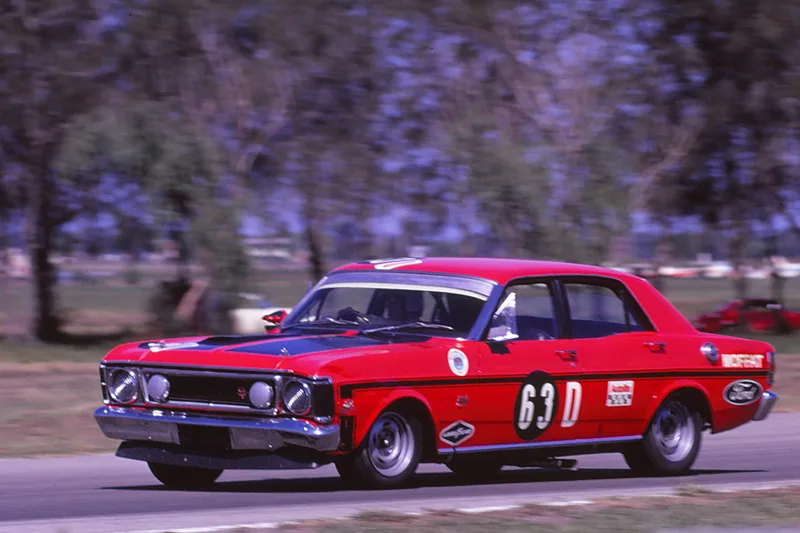
The park also has the longest-running campsite at the track, used by some fans for more than a week before a race. In 1971 Bill Brown's Ford Falcon XY GTHO Phase III suffered a blown front tyre there at more than 100 mph (161 km/h) and barrel-rolled along the fence. He escaped with minor cuts and bruises, largely because his driver's seat broke in the first impact. In 1981 Bob Morris and Christine Gibson, both in Falcons, collided and blocked the circuit, which stopped the race on lap 120, 43 laps short, so the win went to Johnson and French.
What happens on the way down?
Skyline is a sharply descending right-hander that marks the start of the descent from the top. Its name comes from the visual effect of looking up at the corner from below. Tony Roberts, co-winner in 1969, lost control of his Falcon XW GTHO in the 1970 Hardie-Ferodo 500 and flew backwards over the Skyline before rolling down the hillside.
In late 1997 the corner was renamed Brock's Skyline to honour the nine-time winner of the 500-mile and later 1000 km race. Brock died in a crash during a Western Australian car rally, and a statue of him, known to many as the King of the Mountain, stands beside the motorsport museum close to Murray's Corner.
The Esses run from Skyline down towards Forrest's Elbow, and the Dipper is the third corner in the sequence. It once had a dip in the road and a steep fall-away near the edge, and many cars managed to get two wheels off the ground, a sight often compared to the Corkscrew at Laguna Seca. In 2003 Jason Bargwanna and David Brabham made contact there and blocked the track, and Chaz Mostert had a heavy crash in the lower Esses during qualifying in 2015.
What safety changes have been made?
Changes have been steady, and they have followed the speed. Before the 1985 James Hardie 1000 the banking just off the outside of McPhillamy Park was removed and pushed back about 30 m (33 yd) at an angle. A sand trap and a concrete retaining wall went in, partly to avoid another accident like the one in 1981.
The trap has had to grow. Supercars and GT3 cars now lap the circuit 20 seconds or more faster than the Group A cars of 1985, with most of the gain coming from quicker running across the summit, so for safety reasons the sand trap has been enlarged over time.
Other changes are broader. Motorcycle racing is no longer held there, a result of stricter safety rules and a lower tolerance of risk, and open-wheel racing was absent for many years until a Formula 3 round joined the Bathurst 12 Hour programme in 2012. The concrete wall at Quarry, installed before 1979, replaced fencing made of railway sleepers and posts, and the Dipper lost its old dip and drop.
What is the Bathurst 12 Hour?
The Bathurst 12 Hour is a yearly endurance race at Mount Panorama for GT machinery and production cars. It began in 1991 for Series Production cars, moved to Sydney's Eastern Creek in 1995, was discontinued, and returned in 2007. GT3 cars were added in 2011.
Promoter Vincent Tesoriero spotted the opening in 1990 and ran the first race in 1991, with James Hardie as sponsor. Council would not allow a 9am to 9pm schedule, so the first race ran from 5:15am to 5:15pm with 24 cars entered, and 20 finished. Allan Grice, Peter Fitzgerald and Nigel Arkell won in a Toyota Supra. From 1992 factory-backed teams appeared, and Mazda's RX-7 won the next three races. Rising costs moved the 1995 event to Eastern Creek before the race was dropped in 1996.
Two Bathurst 24 Hour races in 2002 and 2003, dominated by Holden Monaro 427Cs of Garry Rogers Motorsport, ended when rising costs forced the organiser to give up. The 12 Hour returned in 2007 with 32 cars, and a BMW 335i won. Entries peaked at 48 in 2009 and fell to 42 in 2010, the last year for strictly production rules.
GT3 rules changed things. In 2011 only 26 cars raced, but by 2013 a record field of more than 50 appeared, and in 2017 the race drew 55 entries. The 2015 race had a record twenty safety car periods, and Nissan's Katsumasa Chiyo took the lead with two laps left. The 2016 edition opened the new Intercontinental GT Challenge, with Shane van Gisbergen setting a record pace in a McLaren 650S GT3.
The Allan Simonsen Pole Position Trophy, introduced in 2014 in memory of the driver killed at the 2013 24 Hours of Le Mans, goes to the fastest qualifier. Laurens Vanthoor set the fastest officially recorded time in 2015, and van Gisbergen beat it by over a second in 2016. The 2018 race ended early after a major crash at Sulman Park. The 2021 race was cancelled because of COVID-19, and the 2022 event moved from February to May. The 2026 race was red-flagged for about 55 minutes after a collision at Forrest's Elbow.
Where does Bathurst the town fit in?
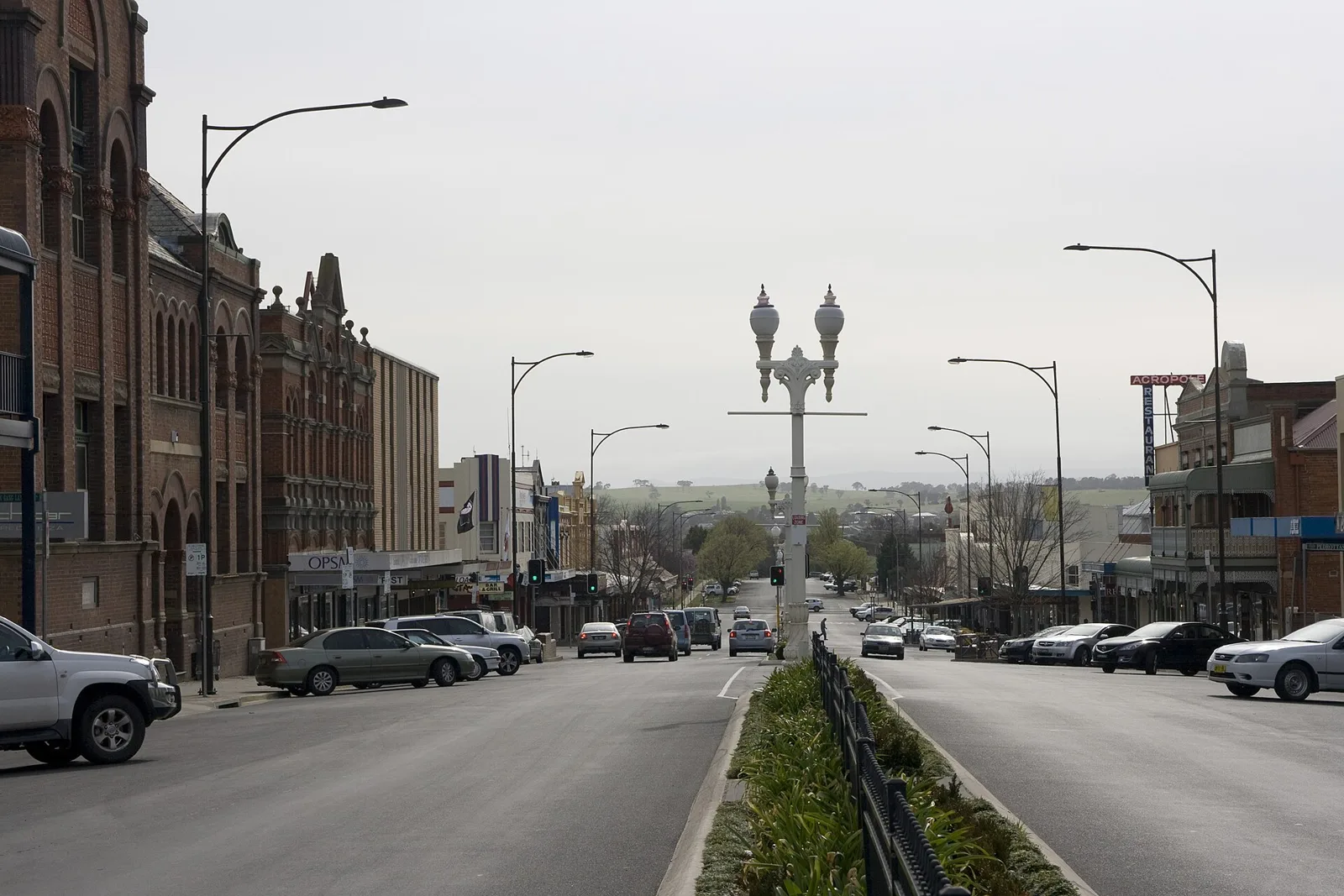
Bathurst is a city in the Central Tablelands, about 200 km (120 mi) west-northwest of Sydney. Founded in 1815, it holds the title of Australia's oldest inland settlement, with 44,621 residents in 2023. Governor Lachlan Macquarie named it after Henry Bathurst, 3rd Earl Bathurst, on 7 May 1815.
The city is known as the Gold Country. On 12 February 1851 Edward Hargraves declared that he had found payable gold nearby, beginning Australia's first gold rush. Education, tourism and manufacturing now power the local economy, and Mount Panorama is a landmark that brings visitors, especially in the week of the Bathurst 1000.
The mountain's long straight also carries a rivalry. Since late 2022 a campaign has aimed to rename Mountain Straight as Moffat Straight, after Ford driver Allan Moffat, whose fierce contest with Holden's Peter Brock personified the Ford versus Holden rivalry and helped turn the annual 500-mile race, later 1000 km, into a national event.