A 1952 gull-wing racer with ten built, a silver Group C car that touched 400 km/h at Le Mans and the carbon fibre C11 that followed.
The Mercedes-Benz W194 was a 1952 endurance racer with a 3.0 litre straight-six that won Le Mans. The Sauber C9 and Mercedes-Benz C11 were Group C prototypes with twin-turbo V8 engines, built by Sauber in 1987 and 1990, which won races and the 1989 and 1990 championships.
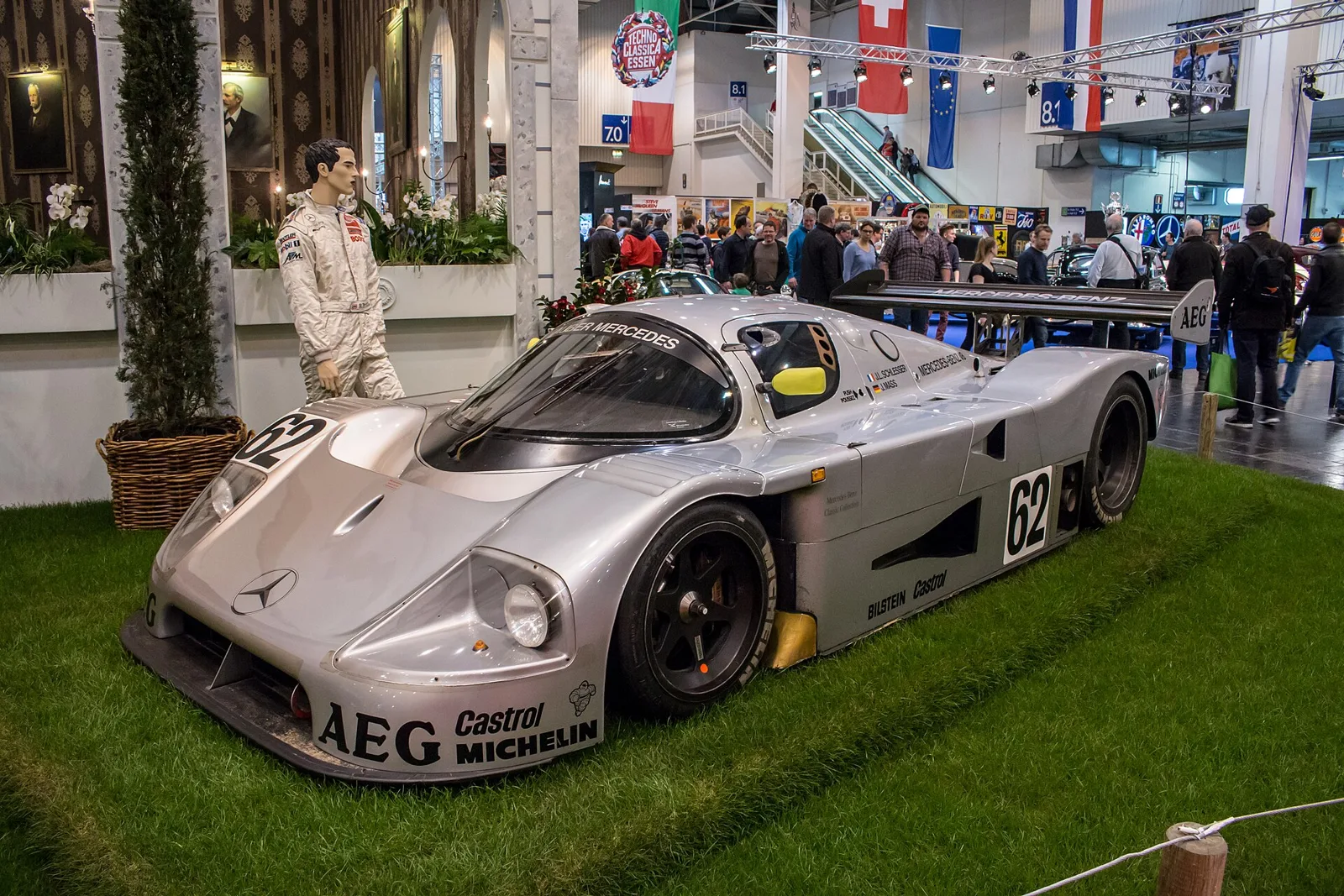
In qualifying for the 1989 24 Hours of Le Mans, a Sauber C9 reached 400 km/h (248 mph) on the Mulsanne Straight. Only one car in the history of the race has been recorded faster. Those speeds led to two chicanes being built into the straight from 1990. The C9 is one of three Mercedes sports racers worth knowing, along with the W194 and the C11, and they mark two very different eras of Mercedes endurance racing.
What were the Mercedes W194, Sauber C9 and C11?
The W194 was Mercedes-Benz's 1952 endurance racer, also called the 300 SL, built for its first season of sports car racing after World War II. The Sauber C9 and the Mercedes-Benz C11 were Group C prototypes from the late 1980s and 1990, built by the Swiss team Sauber around Mercedes engines.
The W194 had a straight-six and won Le Mans in its only season. The C9 and C11 used a twin-turbo V8 and won in the World Sportscar Championship. The C11 was the first of these Sauber cars to carry the Mercedes-Benz name instead of Sauber's alone, and it was the last Group C prototype the team built before the 3.5 litre category arrived.
Low weight and low drag kept the W194 fast enough to win endurance races.
Why does the W194 have gull-wing doors?
The W194 was designed by Rudolf Uhlenhaut, Daimler-Benz's chief development engineer, around a welded frame of SAE 4130 steel tube that weighed only 140-150 lb. The engine was not powerful, so lightness had to make up the difference. The frame wrapped around the cockpit, which made conventional doors impossible. That is how the gull-wing arrangement was born.
The first cars had only opening windows. Le Mans organisers considered the openings too small, so Mercedes had new chassis made with larger doors.
The engine was a 3.0 litre single overhead cam straight-six called the M194, a variant of the M186 first used in the luxury 300 saloon (W186, nicknamed the Adenauer) in 1951. It borrowed triple two-barrel Solex carburettors from the 300 S coupe and had an unusual diagonal aluminium head, which allowed larger valves, and it was canted at fifty degrees to fit under the low bonnet. It made 175 hp (130 kW), against 150 hp (112 kW) in the 300, and 207 N.m (153 lb ft) of torque. Top speed was about 257 km/h (160 mph) from a car that weighed 2,497 lb.
It handled better than most cars of the 1950s, with precise steering and four-wheel independent suspension. It also had a sting. The rear swing axle could turn treacherous at high speed or on imperfect roads, and the enormous fuel tank changed the handling noticeably as it emptied.
How did the W194 do in its single season?
The W194 raced only in 1952, a year before the World Sportscar Championship began. Four of that championship's later races were already on the 1952 calendar. Counting only those, Mercedes would have scored 22 points of a possible 32 and taken a hypothetical title, with Ferrari second on 19 points.
The first outing, the Mille Miglia on 2 May 1952, brought second and fourth place, beaten only by a new Ferrari 250 S. Two weeks later at the Bern Grand Prix support race at Bremgarten, Daimler-Benz brought four drivers: Rudolf Caracciola, Karl Kling, Hermann Lang and Fritz Riess. Some of the cars wore colours usually seen on other makes. A Daetwyler-Ferrari 340 America with a 4.1 litre V12 took pole, but Mercedes finished 1-2-3 with the field a lap down. Caracciola crashed on lap 14 while racing his old rival Lang, and the broken leg ended his career.
Luigi Fagioli, a grand prix winner for Mercedes in 1935, crashed and died weeks after the Monaco race, so he and Caracciola could not take part at Le Mans. The W194s there finished 1-2. Mercedes tested an air brake above the roof, but it was not yet allowed.
On 3 August, at a ten-lap sports car race supporting the German Grand Prix at the Nurburgring, Mercedes ran the original high-sided chassis as a roofless, doorless Spyder and finished 1-2-3-4. One car was tested with a supercharged M197 engine, though more power was not needed. In November, three gullwings went to the Carrera Panamericana in Mexico. They finished 1-2, and the third was disqualified.
These were surprising results. The carburetted M194 had less power than rival Ferrari and Jaguar engines, and far less than the fuel-injected road car developed from it two years later. Low weight and low drag kept the W194 fast enough to win endurance races.
What did the W194 lead to?
Max Hoffman, Daimler-Benz's official importer in the United States, suggested that a street version would sell well in America. The result, in 1954, was the 300 SL Gullwing (W198). It used a fuel-injected version of the engine, the M198, and about 1,400 were built. Over 80% of them found buyers in the United States, so the Gullwing became the first Mercedes-Benz to sell strongly beyond Germany. It is also credited with turning the company's American reputation from solid, staid saloons to fast sports cars. As a racing car the W194 was followed by the W196 300 SLR in 1955.
Some people rate the W194 as the most important Mercedes-Benz built after the war. Its Carrera Panamericana wins, they argue, gave the company a future in North America, where the Corvette had appeared in January 1953. Nobody knows how many of the ten original chassis survive. Chassis #00002 never raced and was used as a parts and training car. A Mercedes-Benz team has restored it completely, and in 2012 it drew several offers of US$15 million, although it is not for sale.
What was the Sauber C9?
The Sauber C9 was introduced in 1987 as a Group C prototype, continuing a partnership in which Sauber built the chassis and Mercedes-Benz supplied the engine for the World Sportscar Championship. It replaced the Sauber C8 and later became known as the Sauber Mercedes C9 or Mercedes-Benz C9.
Its monocoque stayed largely aluminium but was far stiffer. The rear suspension changed from vertical spring and damper units over the gearbox to a horizontal layout. The oil and water radiators moved into the nose, which let the designers use a modified splitter and remove the large NACA ducts from the door sills. The rear wing now sat on a single central support.
Aerodynamically the car came in two forms. Sprint circuits got one set-up, and the 5.8 kilometre Mulsanne Straight at Le Mans got a low-drag version. In sprint trim the C9 produced 2,222.1 kg (4,899 lb) of downforce at 320 km/h (200 mph) with 555.7 kg (1,225 lb) of drag, a lift-to-drag ratio of 4:1. The low-drag version managed around 3:1.
The first engines were prepared by the Swiss specialist Heini Mader, a name that is now known to have covered Mercedes's behind-the-scenes involvement. The 5.0 litre turbo V8 had a new crankshaft, KKK turbochargers and a liner-less block, which was a semi-stressed part of the chassis, with dry-sump lubrication. With 2.2 bar of boost it was rated at almost 800 hp (811 PS; 597 kW), but race boost was capped at 1.9 bar. It could reach 7,000 rpm, though drivers kept to 6,500 in races, and the torque curve was almost uniform between 3,000 and 6,000 rpm. For 1989 the older M117 gave way to the M119, which swapped steel heads for four-valve aluminium ones. Its Group C capacity equivalence was 8.454 litres. Six C9 chassis were built.
How did the C9 go from struggling to winning Le Mans?
The 1987 season was bleak. Kouros Racing ran the cars, named for a fragrance brand owned by Yves Saint Laurent and backed by Mercedes-Benz in a semi-official role, under a deal meant to cover five races. The team finished twelfth in the standings and scored points in only one round. The C9 finished on just three occasions, though its potential showed: Johnny Dumfries set a lap record at Le Mans but retired with a gearbox failure, Mike Thackwell started from pole at Spa, and Jean-Louis Schlesser won the non-championship Nurburgring Supercup.
For 1988 the Kouros deal ended and the team became Sauber Mercedes. A change of management at Mercedes saw the new deputy chairman, Prof. Dr Werner Niefer, announce in January that the company would back Group C. The sponsor was AEG-Olympia, and AEG was owned by Daimler-Benz at the time, which in effect meant full factory support. The management gained Jochen Neerpasch, formerly of BMW M, and the Swiss ex-driver Max Welti. The C9 won five races and finished second in the championship behind the Jaguar XJR-9, with Schlesser, Mauro Baldi and Jochen Mass second, third and fifth in the drivers' standings behind Jaguar's Martin Brundle. At Le Mans, however, the team withdrew when Klaus Niedzwiedz suffered a high-speed blow-out on Michelin tyres and concern over the rubber grew.
Then came 1989. The black livery gave way to Mercedes's traditional plain silver, and AEG became a minor sponsor. The C9 won every race but one, including the 24 Hours of Le Mans. The exception was the second round at Dijon-Prenois, where a Joest Porsche 962 driven by Bob Wollek and Frank Jelinski won. Sauber drivers filled the top four places in the drivers' championship, and Schlesser took the title. Reliability was the other half of the story: the car failed to finish only twice all year, and on both occasions the other team car won.
At Le Mans, Sauber C9s finished first, second and fifth. During qualifying the Baldi, Acheson and Brancatelli car had touched 400 km/h (248 mph) on the Mulsanne Straight, though pole position on race day went to the Schlesser, Jabouille and Cudini entry. Only the WM Peugeot P88 had been recorded faster, at 405 km/h (251.1 mph) in the 1988 race. The comparison needs context: both cars were built to chase top speed, but the Peugeot retired after only 13 laps, while the C9 ran the full 24 hours. Autosport named it Racing Car of the Year for 1989.
What changed with the Mercedes-Benz C11?
The Mercedes-Benz C11 was introduced for the 1990 World Sports-Prototype Championship. It was built by Sauber as the successor to the C9, but for the first time Mercedes-Benz put its own name on the car. It kept the 5.0 litre twin-turbo M119 V8.
The big change was the chassis. Where the C9 was mostly aluminium, the C11 was carbon fibre, drawn from a blank sheet by Leo Ress, a team member since the days of the Sauber C7. The first was built by the Swiss firm Nobrac, a name that is carbon spelt backwards. DPS Composites in Surrey, England, made the rest; its principal, Dave Price, doubled as a Sauber team manager. The car was slimmer, lighter and stiffer, with more downforce and a lower frontal area: 5,879 lbf (26.2 kN) at 320 km/h (200 mph), about 1,000 lbf (4.4 kN) more than the C9. It had no low-drag set-up for Le Mans because the race was not part of the 1990 championship.
Ballast brought it to the required minimum weight of 900 kg (1,984.2 lb), plus 5 kg for safety. Development included a rolling road wind tunnel, a facility no other Group C team had at the time. A new Mercedes five-speed transaxle was designed along with the rear suspension, which dropped the C9's longitudinal spring and damper layout for a transverse one operated by push rods. Brakes were Brembo, and the tyres switched from Michelin to Goodyear.
The V8 came directly from the Mercedes engine facility at Untertuerkheim and went back to Stuttgart after every race, while the transmission stayed at Sauber's base at Hinwil. Group C was a fuel allocation formula, so in race trim the engine was tuned for around 730 hp (540 kW; 740 PS) as the best mix of power and efficiency. At high boost of 2.4 bar it could make 850 hp at 7,000 rpm. Torque was 820 N.m (600 lb ft) at 3,500 rpm.
How did the C11 race in 1990 and 1991?
The first C11 was tested at Paul Ricard in early October 1989 but did not debut until the opening round at Suzuka the following April, where it did not actually race: Schlesser crashed it in practice and the team went back to the C9, which took one final win. At Monza in late April the C11 made its real debut. Baldi and Mass locked out the front row, Baldi nearly two seconds quicker than the next rival, and they finished first and second.
From there the C11 won all but one race and took the team's championship. The black spot was Silverstone, where Schlesser and Baldi, leading by about 50 seconds after 40 laps, suffered a rare engine failure; the sister car of Mass and Schumacher had been disqualified for outside assistance in practice. In Mexico the number 1 car was disqualified for exceeding its fuel allocation. The team skipped Le Mans in 1990 because the race was not on the championship schedule, and the race rejoined the championship in 1991.
Drivers liked it. Ress said the car was forgiving mainly because its aerodynamic centre of pressure stayed put when the driver braked or accelerated, and Baldi counted it among the best cars he had driven. Brundle remembered that his Jaguar XJR-11 could hang on to the Mercedes only by being driven flat out, and that it lacked the Mercedes's downforce. He also thought the larger engine with gentler turbocharging gave less lag and better economy. Price felt the engine and turbo combination gave the team much better fuel economy than anybody else, particularly with Schlesser at the wheel.
Five chassis were built, and C11-03 was the most successful, with four wins in 1990. The Mercedes-Benz C291 was due to replace the C11 for 1991, but problems with the new car's engine kept the C11 racing alongside it. It picked up three more class wins that season. In classic racing, a C11 won the Le Mans Legend in 2012 and 2014. The jump from C9 to C11 has its own story: the name C10 was skipped because of the difficulty of pronouncing it in German.
How do the three cars compare?
| Car | Year | Engine | Chassis | Built |
|---|---|---|---|---|
| Mercedes-Benz W194 | 1952 | 3.0 litre straight-six, 175 hp (130 kW) | Steel tube spaceframe | Ten |
| Sauber C9 | 1987 | 5.0 litre twin-turbo V8, almost 800 hp (811 PS; 597 kW) at 2.2 bar | Largely aluminium monocoque | Six |
| Mercedes-Benz C11 | 1990 | 4,973 cc twin-turbo V8, 730 hp (540 kW) in race trim | Carbon fibre | Five |
What came after each car?
The W194 gave way to the W196 300 SLR in 1955, and its road-going descendant, the W198 Gullwing, sold well beyond Germany. The C11 was set to be replaced by the C291 in 1991, but it kept racing beside it after engine problems with the newer car, and then gave way fully to the C291. The C9 appears in video games, including Gran Turismo and Forza Motorsport.
How many W194, C9 and C11 cars survive?
Only ten W194s were made and nobody knows how many survive. Chassis #00002, which never raced, drew several offers of US$15 million in 2012 although it is not for sale. The C9 and C11 were built in even smaller numbers, six and five chassis, and a C11 has won the Le Mans Legend classic race in 2012 and 2014.