A Korean compact that sold for half a Corolla's price in Indonesia, changed its name every few years in Australia and ended up as the Cerato, Forte and K3.
The Kia Sephia was a compact car built from September 1992 to 2003. Its successor, the Cerato, arrived in South Korea in 2003 and later became the Forte in North America and the K3 in South Korea. Along the way the car was also sold as the Mentor, Shuma and Spectra.
In Indonesia, a Korean saloon once sold for half the price of a comparable Toyota Corolla, and the reason was a tax exemption rather than clever engineering. The Timor S5 was a Kia Sephia in all but name, and because its importer was meant to be the national carmaker, it escaped the taxes and duties that burdened every other imported car. That oddity is one small corner of a larger puzzle. The car that began as the Kia Sephia has gone by Mentor, Shuma, Spectra, Cerato, Forte and K3, depending on the decade and the country, and often on who happened to be distributing it.
Kia Sephia history, from Capital replacement to export hope
Kia presented the first Sephia in September 1992 to replace the ageing Capital, a model that was quickly losing market share. It was the first car Kia designed itself on its own chassis, and the engines came from the B-series family: a 1.5-litre of 59 kW (79 hp), a 1.6-litre of 78 kW (105 hp) and, from 1994, a 1.8-litre BP of 91 kW (122 hp). The gamble worked. Kia sold more than 100,000 in the first full year at home, 1993, and 472,920 over the life of the original car.
Export came next. Sales in the United States began in late 1993 for the 1994 model year, which made the Sephia the first Kia sent there. The 1995 model year brought a restyled grille and tail lights, and every US car except the California RS and LS models gained the 1.8-litre DOHC BP engine as used in the Mazda Familia. Kia licensed that engine design from Mazda but built the units itself.
Europe saw the car in spring 1994, as the Sephia in some markets and as the Mentor in others, including the United Kingdom. It matched the size of a Ford Escort while carrying a price closer to a Ford Fiesta. Its rivals were budget imports from Eastern Europe and the Far East, including the Daewoo Nexia, Hyundai Accent, Proton Persona and Skoda Felicia.
Brazil, which got the car in March 1994, took more preparation. It was offered only with a 1.5-litre twin-cam engine of 112 PS (82 kW) and was seen as a competitor for the locally built Chevrolet Omega and Volkswagen Santana. Kia studied the local road surfaces and imported 1,000 litres (260 US gal) of Brazilian petrol so the engine management could be programmed properly. A conceptual convertible, the Sephia Cabrio, appeared at some auto shows.
The Timor S5 was a Kia Sephia that sold at half the price of a comparable Corolla.
The Timor S5, Indonesia's tax-free Kia Sephia
Indonesia took the Sephia as the Timor S5 from 1996, through PT Timor Putra Nasional, a company meant to become the country's national carmaker. Because of that status, the Timor was exempt from taxes and duties even though it was imported from South Korea, and it sold at half the price of a comparable Corolla.
The range had three main versions: the S515 with a single-cam carburetted engine, the S515i with a twin-cam fuel-injected unit, and the sporty S516i LE limited edition, licensed by Prodrive. A few SW516i wagons and SL516i limousines were also built. Parts were assembled at Purwakarta in West Java in 1998, briefly, before WTO disputes brought the project to an end. Sales then ran on until 2007, using cars produced up to 1998.
Second-generation Sephia and the Kia Spectra name
In 1997 Kia redesigned the car completely, this time as a four-door sedan and a five-door liftback created in-house with help from Mazda. It used a DOHC 1.5-litre engine and Kia's own new DOHC 1.8-litre, the T8D, originally developed for the Kia Elan, plus improved air conditioning. In South Korea the Sephia label was retired in 2000 in favour of Spectra. Production of this version totalled 628,168.
North America followed its own path. The Sephia sedan arrived for the 1998 model year, and the liftback launched for 2000 under the Kia Spectra name. The two were sold side by side until the 2002 model-year updates, when both were facelifted and the range was brought together under the single Spectra name, in S, GS and GSX trims.
The Spectra was built in other places too. Arab American Vehicles made it in Cairo, Egypt, around 2002, Izh-Avto in Russia produced it until 2011, and the liftback was assembled in Malaysia between 2001 and 2010, first at HICOM AMM in Pekan and later at Naza's plant in Gurun.
Australia, where the Kia Sephia was Mentor, Shuma and Spectra
Australia is the best example of the name carousel. The second-generation sedan and liftback were badged Mentor when they went on sale in May 1998. The entry SLX had a 1.5-litre four-cylinder engine, a five-speed manual gearbox or an optional four-speed automatic, power steering, air conditioning and cloth trim. The GLX added central locking, power windows and mirrors and better trim, with the larger 1.8-litre engine as an option on the liftback.
In June 2000 the distributor changed to Ateco, and the changes came quickly. Kia dropped the sedan and the 1.5-litre engine, along with the SLX and GLX labels, and renamed the liftback Shuma. A limited-edition Shuma FX added alloy wheels, central locking, power windows and mirrors, better audio and higher-grade trim. The Shuma also had a small facelift that changed the tail-lamp lenses, wheels and interior trimmings.
A further facelift in May 2001 brought another name, Spectra, along with new headlights, a new front bumper, adjusted suspension and a reworked four-speed automatic. The single LS specification gained a driver's airbag, seatbelt pretensioners and an immobiliser. Kia Australia discontinued the Spectra in 2004.
Kia Cerato generations, starting with the LD of 2003
The Kia Cerato came out in South Korea in 2003 and has been a compact car ever since. It replaced the Sephia and Mentor sedan and the Shuma hatchback. The first generation, the LD, shared its platform with the Hyundai Elantra (XD) and used Hyundai's Beta II (G4GC) four-cylinder engine with variable valve timing. Where the Sephia had leaned on Mazda for help, the Cerato took its platform and engine from Hyundai.
The name changed from market to market again. North America used Spectra from the 2004 model year, with the hatchback called Spectra5. Latin American buyers still got a car named Sephia until 2005, when it was dropped in favour of Spectra. In Europe the Cerato gave way to the Kia Cee'd. In Malaysia, the Spectra5 launched on 15 August 2007 in one trim, as a hatchback with a 1.6-litre 16-valve DOHC engine and a four-speed automatic.
A 2006 facelift brought revised Gamma engines. The bumper and headlamps lost their strong crease near the grille, the boot lid became rounder and the tail lights were reshaped. Before that, the Cerato Green Concept at the 2004 Geneva Motor Show carried a new 2.0-litre CRDi diesel engine, the first Kia passenger car to use diesel power. In China, Dongfeng Yueda Kia and the Shandong Kigee Racing Club entered a modified Cerato 1.6 in the 2006 National Automobile Track Championship 1600CC class, driven by Wang Shaofeng and Liu Yang.
China kept the first generation going for longer. The Cerato R was an extensive facelift meant to extend sales there, while the second-generation car was sold in China as the Forte at the same time. The Horki 300EV, a compact electric sedan unveiled at the 2016 Auto Guangzhou, is essentially a rebadged Cerato R on the first-generation platform, which is still produced in China as the Cerato R.
Kia Cerato vs Forte, and why the names differ
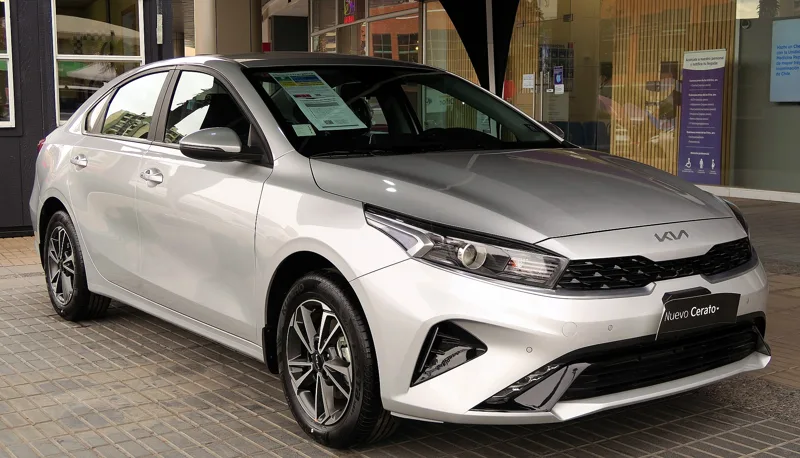
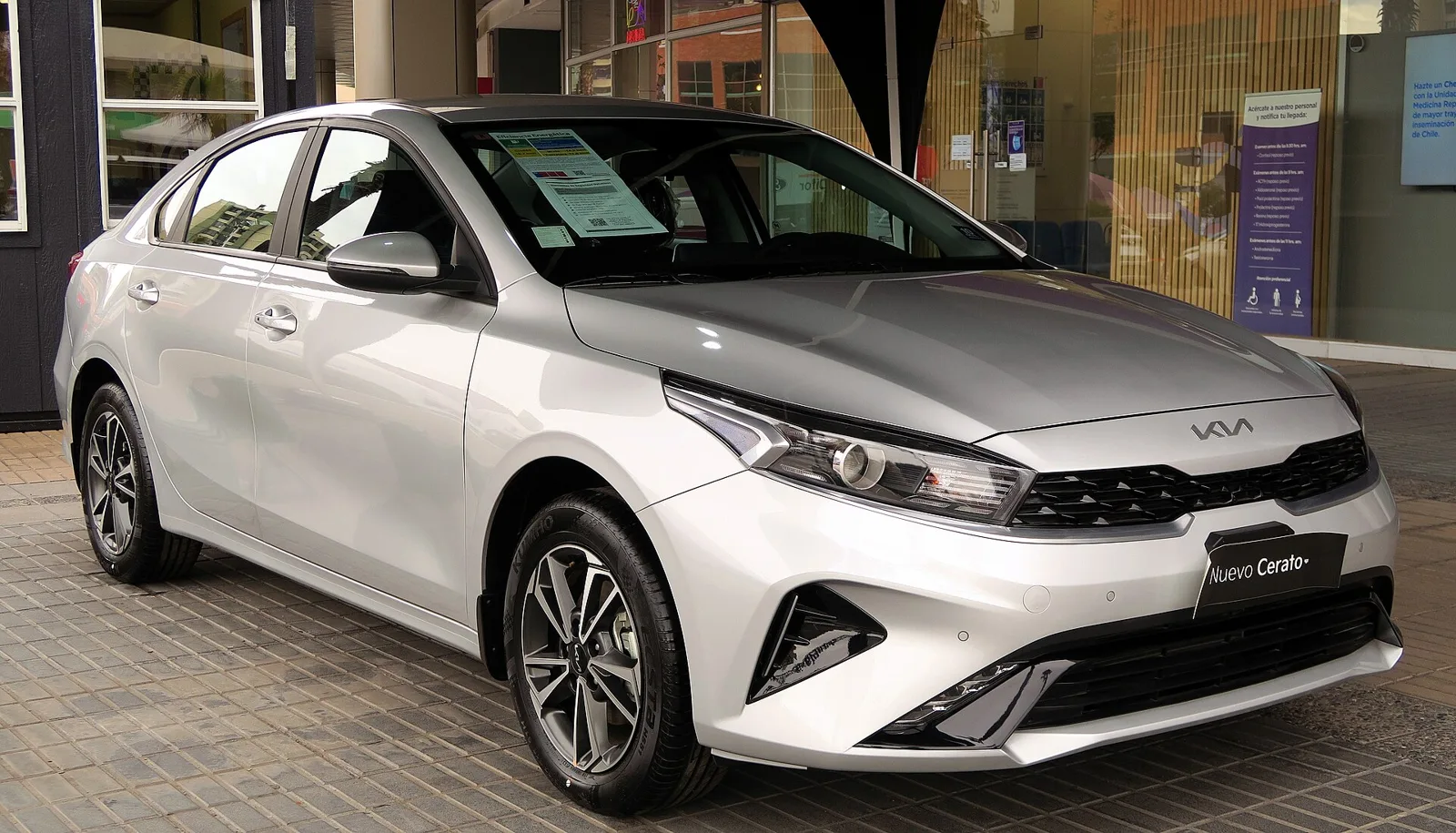
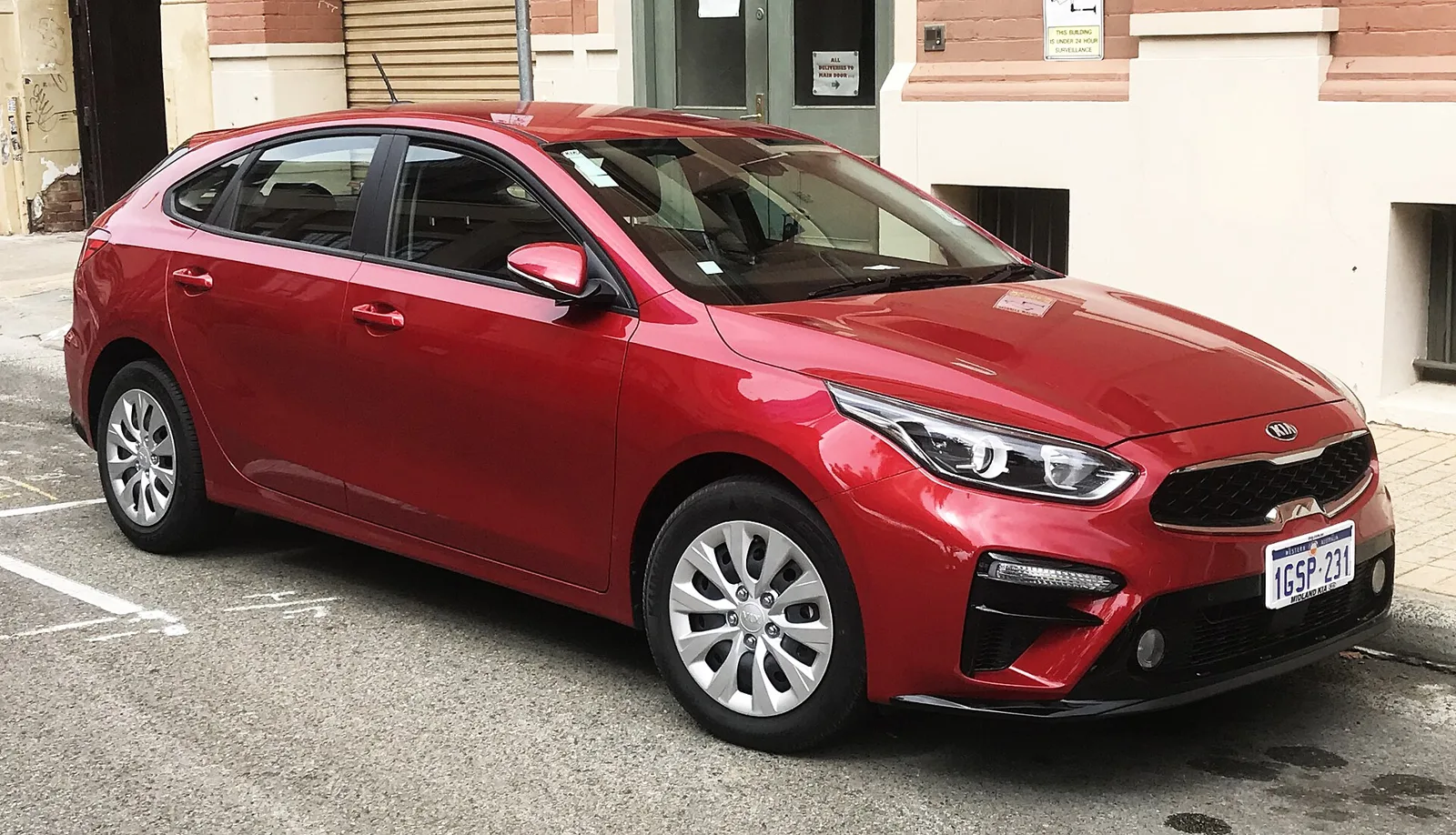
The second generation, the TD, was launched in South Korea in late 2008 as the Forte, the name used in most international markets. Kia kept Cerato in some places, including Australia, the Middle East, South Africa, Brazil and the Caribbean. Singapore calls it the Cerato Forte, a name also used in Colombia. Naza Automotive Manufacturing of Malaysia has assembled it since 2009 as the Naza Forte.
In North America the Forte took over from the Spectra. In South Korea the same car became the K3, and in China it appears as the Forte K3 or the Shuma. Europe is the exception: the Kia Ceed fills that slot there, though Russia and Ukraine sell both the Ceed and the Cerato. Put simply, if you are comparing a Kia Cerato with a Forte, you are usually looking at the same car with a different badge.
Third and fourth Kia Cerato generations
Kia showed images of the third generation, the YD, in late July 2012 when it revealed the Korean-market K3, for the 2014 model year. The car was new from the ground up and sat lower, wider and longer than before. The fourth, the BD, made its debut on 15 January 2018 in Detroit, where Kia showed it as the Forte. It takes styling cues from the Stinger, with a cab-rearward shape that gives a fastback profile and a short boot lid, and it is built with 54 percent advanced high-strength steel, which is stronger than the outgoing car's.
The Sephia name after the car
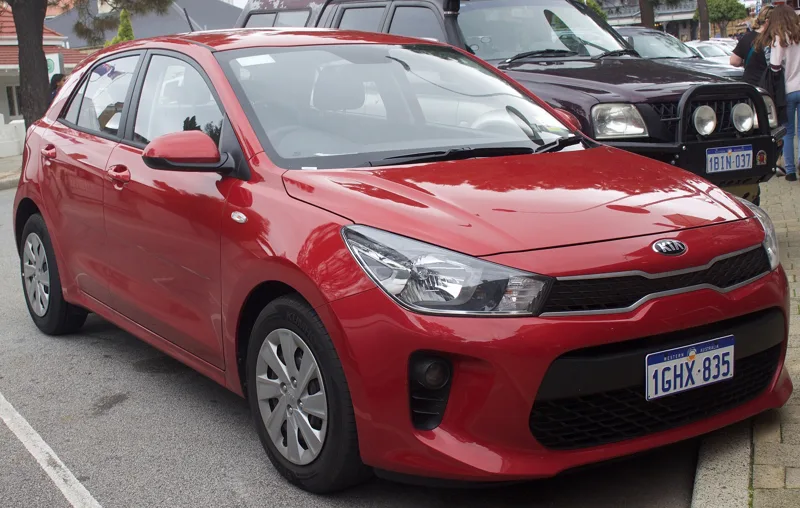
The Sephia name did not simply disappear. In Colombia and other South American countries, it became a taxi badge. Some first-generation Kia Rios were sold as the Sephia Taxi, prepared to meet taxi regulations with yellow paint, a 1.4-litre engine and a manual gearbox. Second-generation Rios were sold the same way from 2005 to 2011. From 2008 to 2012, the Grand Sephia was a Forte prepared for taxi work, with a 1.6-litre engine and a manual gearbox. Since 2020 the Sephia name has been back in Colombia as a taxi, now based on the Chinese-built Kia Pegas and Soluto.
Kia Sephia, Mentor, Shuma, Spectra, Cerato and Forte by market
| Name | Where used | When |
|---|---|---|
| Sephia | South Korea, United States, Europe, Brazil | 1992 to 2003, with Latin America to 2005 |
| Mentor | United Kingdom, Australia | Europe from spring 1994; Australia from May 1998 |
| Shuma | Australia, and as a Cerato name in China | Australia from June 2000 |
| Spectra | South Korea, North America, Australia | South Korea from 2000; North America from the 2000 model year; Australia May 2001 to 2004 |
| Cerato | South Korea first, then Australasia, Middle East, Latin America | Since 2003 |
| Forte and K3 | North America, South Korea, China | From 2008 |
What the Kia Cerato history means for buyers
One car can sit under several names. A Spectra in North America, a Cerato in Australia and a Forte in later North American cars can share a lineage, while a Mentor or Shuma may be a second-generation Sephia. The Cerato of 2003 is not sold in Europe, where the Ceed does the same job, and a first-generation car can still be built in China as the Cerato R. Taxi buyers in South America may meet the Sephia name on a car that is actually a Rio or a Forte. Malaysia adds another twist, since Naza sold its assembled car as the Naza Forte while Naza's plant had already been building the Spectra liftback.