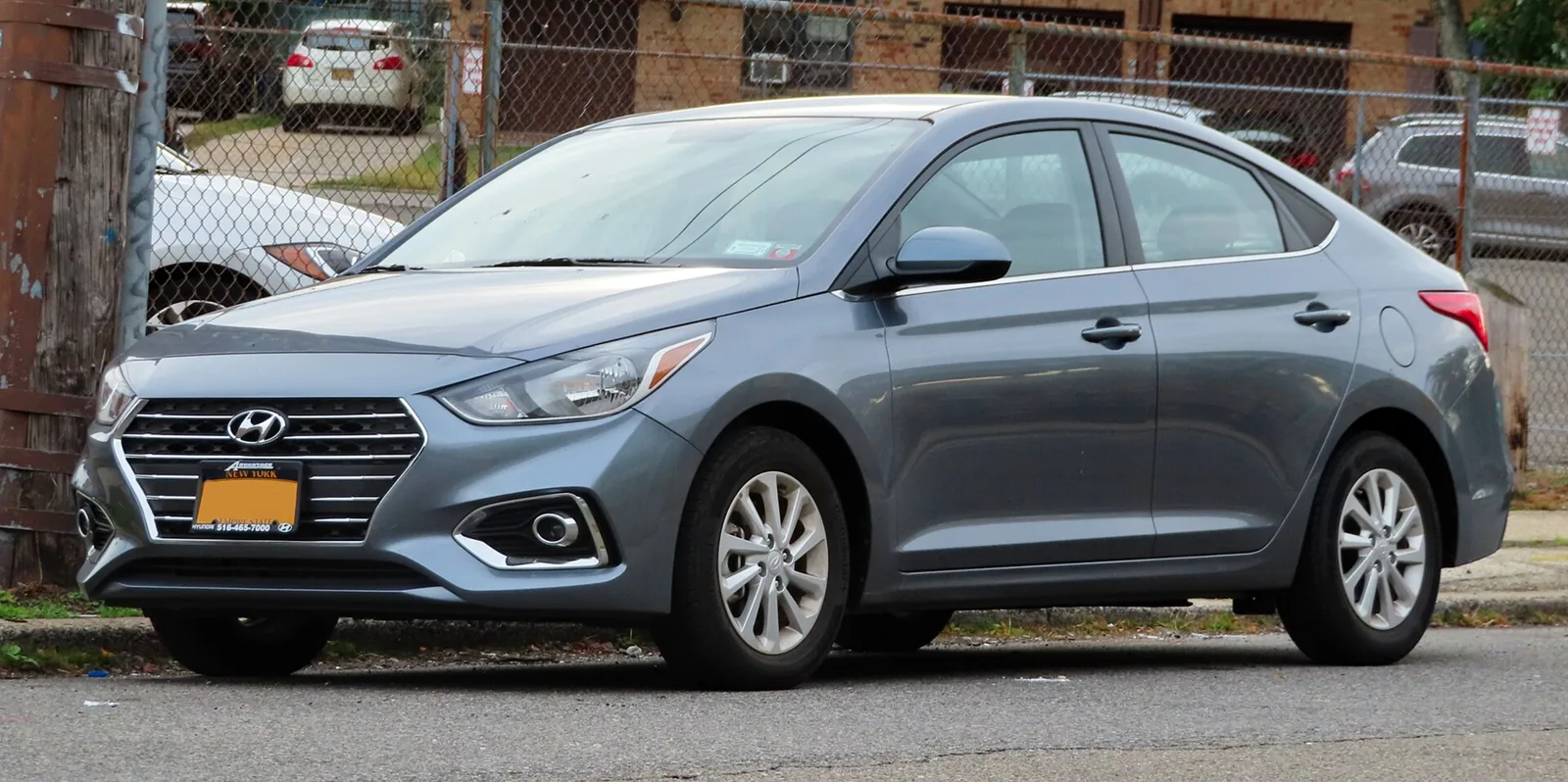
A subcompact that outlasted its rivals in North America, sold in more than a dozen forms, and was once Australia's third-best-selling vehicle.
Introduced in 1994 to replace the Excel, the Hyundai Accent went through six generations and sold in many markets under local names. It was a big seller in Australia and held the North American record as the longest-running small family car.
The Hyundai Accent started life as a cheap, dependable subcompact and grew into one of the longest-running small family cars in North America. Six generations on, it is still sold in parts of Asia, Africa and the Middle East, having first been a hit in Australia, where it was once the third best-selling vehicle.
Where did the Accent come from?
The Accent arrived in 1994 to succeed the Excel, going on sale for the 1995 model year. The name was built from initials that spell out a phrase about an advanced compact car with epoch-making technology. Australia kept calling the first generation the Excel, as its predecessor had been called.
The car was known under other names around the world. It was the Dodge Brisa in Venezuela, the Hyundai Pony in France and the Kia Qianlima in China, where the Excel was badged under Dongfeng Yueda Kia. In 2000 the model was replaced in South Korea by the Verna, though most international markets kept the Accent name.
A subcompact that began as a budget hatch, topped Australian sales charts and outlasted its rivals in North America.
How did the first-generation Accent sell in Australia?
The first generation reached Australia in November 1994, in Sprint and GX trims for the three-door liftback, and LX and GLX trims for the four-door sedan and five-door liftback. Hyundai's sales pitch leaned on free air-conditioning and driveaway pricing, which helped the Sprint three-door sell in big numbers.
The X3 finished third in Australia's sales race in 1996 and again in 1998. That second result came with more than 44,000 sales, roughly 5.5% of the market and a record for an import at that point. By June 1998 the X3 was the nation's leading seller, pushing the Holden Commodore and other big cars aside. Across 1994 to 2000 around 200,000 were registered.
What engines did the first-generation Accent use?
The April 1997 update changed the Australian line. Its 1.5-litre single-cam G4EK made 91 hp (68 kW). From November 1997 a twin-cam G4FK replaced it, delivering 74 kW (99 hp) at 6000 rpm, with 99 lb ft (134 N m) of torque at 4000 rpm. In America the Accent GT used a double-overhead-cam engine of 105 hp (78 kW), and cars with the twin-cam were badged Twin Cam.
British buyers picked from a 1.3 12v with 85 hp, a 1.5 12v with 92 hp or a 1.5 16v with 105 hp, all petrol, with no diesel alternative. Fuel use was not a strong point, and the 1.5 was rated at about 8.6 L/100 km (33 mpg-imp) on paper.
How safe was the first Accent?
Euro NCAP's 1998 test was a poor showing. The Accent managed only 4 points out of 16 in frontal impact, with two stars for adults and two for pedestrians. The structure moved during the frontal test, and the side impact result pointed to a dangerous chest-injury risk.
Later results were better. ANCAP tested a pre-2003 three-door liftback under Euro NCAP rules and recorded 10.76 of 16 points in frontal offset and 10.96 of 16 in side impact. Sweden's Folksam placed the first generation among the safest cars in its class.
What changed in the second generation?
Hyundai's second attempt, the LC, reached showrooms in 1999 with a squarer, sharper body and extra size. A light facelift in 2003 gave it the LC2 code. In 2006 the sedan was redesigned, but the liftback lingered in Canada for that year, having skipped the 2006 model year in the United States.
Engine refinements cut noise and vibration. In many markets a 1.6-litre DOHC 16-valve took over from the 1.5 in 2001, though some countries kept the smaller unit. This generation also brought the first Accent diesel, a three-cylinder 1.5 turbodiesel with direct injection and four valves per cylinder, sold as CRDi.
Trim levels were GSi, CDX and MVi, though European markets and others used local names. Some markets used LS and GLS.
How did the second generation sell in North America?
In North America the Accent came in GL, GLS and GT trims. The 1.5-litre engine was used at first, and the 1.6 arrived from 2002. The GT resembled the MVi sold in Europe and Oceania, though its body kit was less overtly hot-hatch.
Canada offered the liftback as a GS or a GSi in 2003, depending on the engine. By 2004 the GS had been fitted with the 1.6-litre unit, and the Accent had long been North America's longest-running small family car.
Accent generations at a glance
| Generation | Codename | Launch | Highlight |
|---|---|---|---|
| First | X3 | 1994 | Australian sales boom, DOHC Twin Cam |
| Second | LC | 1999 | First Accent diesel, 1.6-litre DOHC |
| Third | MC | 2005 | New exterior, CVVT engine, 3-door hatch in the US |
| Fourth | RB and RC | 2010 | Gamma GDi and Solaris variants |
| Fifth | HC and YC | 2016 | Chinese launch, then India and the US |
| Sixth | BN7 | 2023 | Sensuous Sportiness design, turbo option |
What was the third-generation Accent?
The MC generation was unveiled at the 2005 New York show, with a fresh look, a roomier cabin and CVVT valve timing. The US sedan came in one trim, the GLS. A three-door hatchback reached America in spring 2006 as a 2007 model.
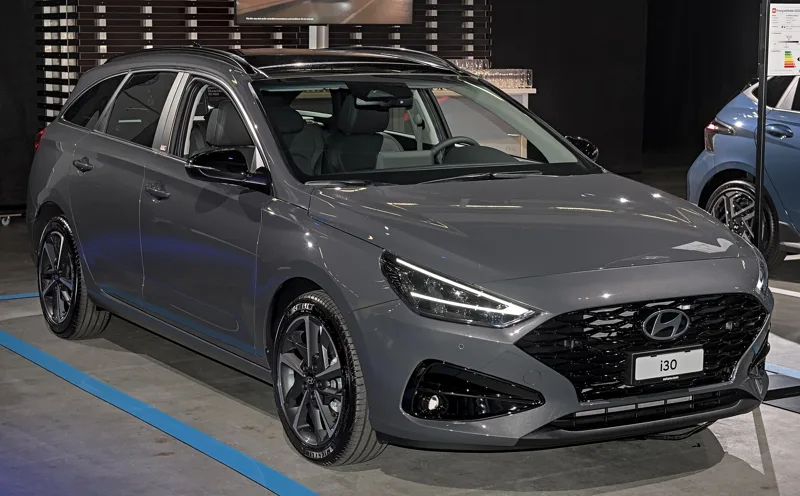
Europe treated the model as a stopgap. The press and Hyundai itself described it that way, filling a gap until a new small family car arrived in 2007. That car was the i30, which replaced both the Accent and the larger Elantra, and the name change helped shake off the Accent's budget image.
Forbes put the Accent on its 2010 list of the worst cars for depreciation. Hyundai answered with its own statistic: a strong showing in the 2008 J.D. Power dependability study, where the car had the fewest problems per 100 vehicles in the compact multi-activity class. The survey drew on more than 52,000 original owners of 2005 cars.
How did the fourth generation reach the market?
The fourth generation debuted under the Verna name at the 2010 Beijing show. Korean buyers got it from November 2010 with the 1.6-litre engine and either a six-speed manual or automatic, the same units as the fifth-generation Elantra. The Accent name returned in Korea, and a hatchback named Accent WIT took over from the Getz and Click.
In Australia the fourth generation arrived in August 2011 in Active, Elite and Premium grades, with a 1.6-litre MPi engine. An SR grade replaced the Elite and Premium in 2013, and in 2017 the range was reduced to a single Sport grade. The nameplate's final Australian year saw 9,963 units registered, and it was removed from the Hyundai Australia website in January 2020.
In Russia the car became the Solaris, built at a plant in Saint Petersburg from January 2011, while the Accent badge stayed with the older car made at TagAZ. In North America the car had a single engine, a 1.6-litre GDi unit rated at 138 hp (103 kW). Its head and block were aluminium.
What was the fifth-generation Accent?
The fifth generation was introduced in China as the Verna in late 2016, with sales from February 2017. Russia received it in March 2017 and India in August 2017, and it reached the United States in December 2017. Unlike its predecessors it was not sold in South Korea, where the Venue crossover took its place in 2019.
US buyers never saw the fifth-generation hatchback, since demand for its predecessor had been weak. Mexico and Canada had both body styles. American and Canadian cars shared the 1.6-litre GDi with the old model, though output dropped to 130 hp (132 PS; 97 kW) from 138 hp (140 PS; 103 kW). From 2020 a Smartstream 1.6 made 120 hp with a CVT.
Hyundai discontinued the Accent in Canada at the end of 2020, while the US sedan carried on. For 2022 the six-speed manual was dropped in the US. In June 2022 Hyundai said the Accent would end for the 2023 model year, with the Venue taking over the entry-level role.
What is the sixth-generation Accent?
The sixth generation went on sale in India on 13 February 2023 under the Verna badge. Hyundai calls its styling Sensuous Sportiness. The design draws on the Elantra, with a broad LED light bar of the sort seen on the Kona crossover.
The basic engine is a 1.5-litre naturally aspirated petrol making 115 PS (113 hp; 85 kW), and a 1.5-litre turbo petrol produces 160 PS (158 hp; 118 kW) with 253 N m (187 lb ft). The Indian car was facelifted in a March 2026 reveal, with a new bumper, larger grille, LED projector headlamps and a digital driver display.
Vietnam received the sixth generation on 30 May 2024, and the UAE followed in early 2025 with a 1.5-litre naturally aspirated engine and CVT. Accent sales have also been strong in Saudi Arabia, where the car became the best-selling model from 2023.
How did the Accent perform in motorsport?
Hyundai fielded the Accent WRC in the World Rally Championship between 2000 and 2003, and that car produced three generations of rally machinery. In India the company also supplied engines to Formula LGB Hyundai, a grassroots single-make series that runs Accent engines in stock form after ECU adjustments.
The X3 also found a second career in Australian motorsport. The Excel Rally Series began in 2005 with tight limits on modifications. In 2010 Queensland started the Excel Cup and South Australia launched Circuit Excels, and the class now runs in all six states. Organisers call it the most affordable racing class in the country for a production-based car.
How was the Accent sold in Asia?
In Indonesia the Accent was assembled locally from 1996 as the Bimantara Cakra, a four-door sedan with a fuel-injected engine of 1.5 litres and 12 valves, paired with a five-speed manual. After the 1997 Asian financial crisis, Hyundai took over the plant and sold the car under its own brand, adding a four-speed automatic option through 2001.
In China the Excel was sold as the Kia Qianlima, built by Dongfeng Yueda Kia from December 2002 until November 2006. Buyers could choose a 1.3-litre SOHC or a 1.6-litre DOHC engine, and the car only came as a four-door sedan. A 2005 facelift added a new grille and foglamps.
In India the older car stayed on as a cheaper alternative under the Accent name while the Verna took the new design. The Verna facelift reached India on 18 February 2015, with a new front fascia and changes to the styling.
Why did the Accent last so long?
The Accent's long life owed much to its place in the market. It offered affordable transport and a reputation for reliability that kept it on dealer lots for decades, even as rivals changed generations faster.
Its success in Australia and North America, plus strong sales in parts of Asia and the Middle East, meant Hyundai could keep building the car while its markets shifted. The Accent was never a glamorous car, but it was a durable one for buyers who wanted simple transport.