From a 998 cc three-cylinder to a 204 PS turbo 1.6, two families of aluminium petrol engines power many Hyundai and Kia small cars.
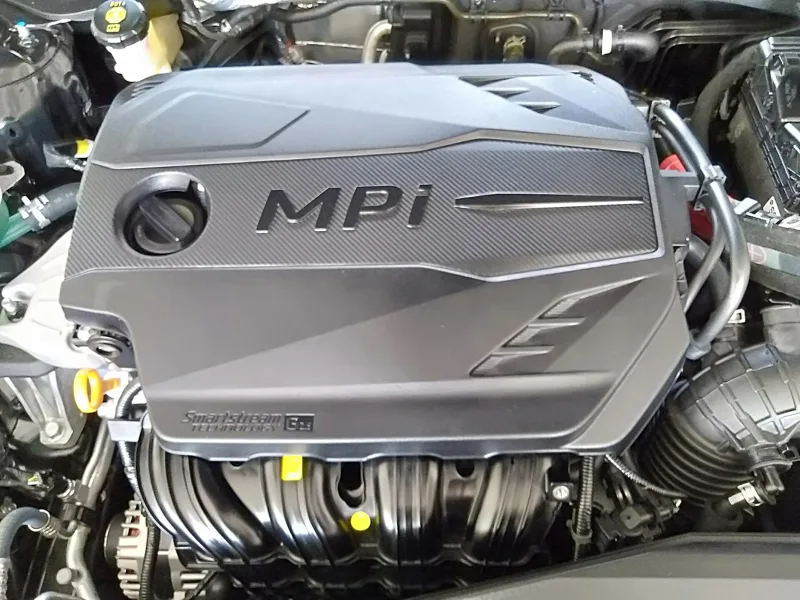
Gamma and Kappa are Hyundai's families of small petrol engines. Gamma, introduced in 2006, comes in 1.4 and 1.6-litre sizes and reaches 204 PS with a turbo. Kappa spans one-litre three-cylinder engines up to a 1.6-litre hybrid, all aluminium with 16 valves, and powers many Hyundai and Kia small cars.
Hyundai once took a 1,248 cc engine and shrank it on purpose, trimming it to 1,197 cc so that cars built in India would fall under a 1,200 cc tax bracket. The detail captures the character of the Hyundai Gamma and Kappa engines: unglamorous petrol units for small cars, shaped as much by tax rules and emissions limits as by engineering ambition.
What are the Hyundai Gamma and Kappa engines?
Gamma is a family of 1.4 and 1.6-litre petrol engines introduced in 2006 to replace the Alpha. Kappa is a family of three- and four-cylinder petrol engines with an all-aluminium block and 16 valves, which took over from the 12-valve, single-cam layout of the older Epsilon family.
Between them the two families span everything from the 998 cc three-cylinder in the Kia Picanto and Hyundai Grand i10 to the 204 PS turbocharged 1.6 found in the Hyundai Veloster and the Kia Soul. They also share a good deal of the same thinking: lighter metals, chain drives and valve timing that adjusts itself on the move.
Hyundai trimmed a 1,248 cc engine to 1,197 cc so that Indian-built cars fell under a 1,200 cc tax bracket.
What did the Hyundai Gamma engine change from the Alpha?
Gamma moved to an aluminium block and cylinder head, which cut 15 kg and left the whole engine just under 100 kg. It also replaced the Alpha II's timing belt with a chain, and it became the first Hyundai engine to use an offset crankshaft.
The offset crank is worth a moment, because it recurs throughout the Kappa story. In a conventional engine the cylinder sits directly above the crankshaft; here the two are nudged slightly out of line, which reduces the sideways shove each piston gives its cylinder wall as it travels.
Production of the Gamma is spread across four sites: Shandong in China, where Hyundai WIA builds it, Zilina in Slovakia, Hwaseong in South Korea and Irungattukottai in India.
How does the Hyundai Gamma 1.6 engine work?
The Gamma 1.6 keeps the 1.4's 77 mm bore but stretches the stroke to 85.4mm. In basic multi-point injection form it makes 124 PS (91 kW; 122 hp) at 6,000 rpm and 156 Nm (115 lb ft) at 4,200 rpm.
Bore is the width of each cylinder and stroke is the distance the piston travels, so a longer stroke sweeps out more volume. That change, from 75 mm to 85.4mm, is what lifts the 1.4's 1,396 cc to the 1.6's larger capacity, and it is the main difference between the two original petrol versions. The 1.4 itself, the G4FA, makes 111 PS (82 kW; 109 hp) at 6,300 rpm, though power drops to 100 PS (74 kW; 99 hp) in the Hyundai i20.
Both use double overhead cams, four valves per cylinder and chain-driven camshafts. The first-generation engines vary valve timing on the intake cam only. Think of it as a doorman who lets air in a little earlier or later depending on how hard the engine is working, so that it breathes well at low and high revs alike.
What changed when Gamma II arrived in 2010?
The 2010 Gamma II 1.6 added dual continuous variable valve timing, so both the intake and exhaust sides can now be adjusted. It displaces 1,591 cc and makes 123 to 134 PS (90-99 kW; 121-132 hp), depending on the car and the market.
The same year brought the first direct-injection Gamma, the 1.6 GDi. Squirting fuel straight into the cylinder rather than into the intake port lets the engine meter it more precisely, and output rose to 140 PS (103 kW; 138 hp), peaking at 6,300 rpm, with 167 Nm (123 lb ft) arriving at 4,850 rpm. Hyundai introduced it in the ix35 and the Kia Sportage.
Then came the turbo. Announced in 2011, the 1.6 T-GDi adds a twin-scroll turbocharger and an air-guided intercooler to the direct-injection engine and makes 204 PS (150 kW; 201 hp) at 6,000 rpm. Torque is 265 Nm (195 lb ft), available from 1,500 to 4,500 rpm, so the engine pulls from low revs rather than waiting for the top end. A detuned version makes 177 PS (130 kW; 175 hp) at 5,500 rpm. The 11th Hyundai-Kia International Powertrain Conference was where the engine made its debut.
The engine kept evolving. For the second-generation Veloster Turbo it gained a pressurised cooling system, a 10:1 compression ratio, an electronically actuated wastegate and a new engine computer. In 2019 an improved version with continuously variable valve duration appeared as the Smartstream G1.6T, coded G4FP.
Which fuels can the Gamma run on?
Besides petrol, the Gamma 1.6 comes in a flex-fuel form and an LPG hybrid form. The flex engine peaks at 130 PS (96 kW; 130 hp), alongside 162 Nm (119 lb ft) of torque at 5,000 rpm, and it powered the Hyundai HB20 and Creta.
The LPI version pairs a liquefied petroleum gas engine with an electric motor. It runs a higher compression ratio to exploit the fuel's higher octane rating, and it works on the Atkinson cycle, which keeps the intake valve open for longer. The result is a more complete burn from a smaller effective displacement. It was fitted to the Hyundai Avante and the Kia Forte.
Which cars use the Hyundai Gamma engine?
The Gamma sits under the Hyundai Accent, Elantra, i20, i30, ix20 and Veloster, and under the Kia Cee'd, Rio, Soul, Forte and Sportage, among others. The GDi and turbo versions also reached SUVs such as the Hyundai Tucson.
Some of those careers are long. The 1.6 MPi ran in the Elantra from 2006 to 2020, and the Kia Venga used Gamma power from 2009 to 2019. The Veloster was offered with the MPi, GDi and turbo versions at various points between 2011 and 2020. The turbo engine's list of applications even ends with Hyundai's rally cars, naming the i20 Coupe WRC, the i20 R5 and the i20 WRC.
What is the Hyundai Kappa 1.0 engine?
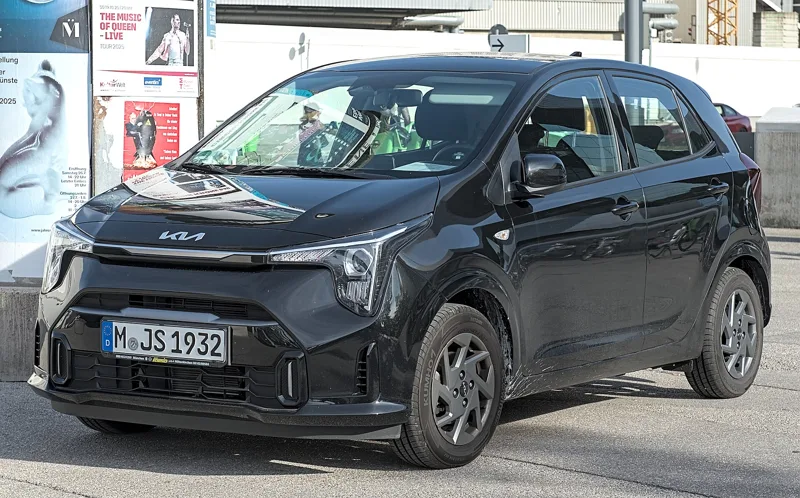
The Kappa 1.0 is a 998 cc three-cylinder petrol engine. The base G3LA version is rated at 69 PS (51 kW; 68 hp) and 95 Nm (70 lb ft), with power coming at 6,200 rpm and torque at 3,500 rpm. It powers cars such as the Hyundai Eon, Grand i10 and Kia Picanto.
This is the second-generation Kappa, whose main improvement over the first was variable valve timing. A flex-fuel F3LA version raises the figures to 80 PS (59 kW; 79 hp) and 100 Nm (74 lb ft), and an LPG version trades some power for the cheaper fuel, with 74 PS (54 kW; 73 hp) in the Kia Morning and Ray.
Adding a turbocharger changes the picture. The 1.0 T-MPi, coded G3LB, delivers 106 PS (78 kW; 105 hp) at 6,000 rpm while 137 Nm (101 lb ft) is on tap between 1,600 and 3,500 rpm. Kia used it in the Picanto and Ray. The direct-injection 1.0 T-GDi goes further, delivering 172 Nm (127 lb ft) from 1,500 to 4,000 rpm alongside 120 PS (88 kW; 118 hp) at 6,000 rpm. A 100 PS version, available between 4,500 and 6,000 rpm, is offered for some applications such as the Picanto, Grand i10 and Casper.
Why is there a Kappa 1.2 smaller than the Kappa 1.25?
The 1.2, coded G4LB, is a destroked version of the 1.25 built in India to sit below the 1,200 cc tax threshold. At 1,197 cc it makes 83 PS (61 kW; 82 hp) at 6,000 rpm.
The standard 1.25, at 1,248 cc, produces 77 to 78 PS in its early form and 87 PS (64 kW; 86 hp) in the European second-generation version, so output depends on the application and market. In European testing the early engine returns 5 L/100 km (47 mpg-US; 56 mpg-imp) on the combined cycle. Indian cars using the 1.2 include the Grand i10, Aura, Venue and Exter.
The 1.4, coded G4LC, displaces 1,368 cc and adds dual continuous valve timing and VIS. It makes 95 to 100 PS (70-74 kW; 94-99 hp) at 6,000 rpm and replaced the Gamma 1.4 in cars such as the Accent, i20 and Kia Rio. A turbocharged 1.4 T-GDi, announced in 2015, uses a 1,353 cc displacement to make 140 PS (103 kW; 138 hp) and 242 Nm (179 lb ft) from 1,500 to 3,200 rpm, with a 130 PS detuned option.
Hyundai Kappa vs Gamma side by side
| Engine | Code | Capacity | Power | Torque |
|---|---|---|---|---|
| Gamma 1.4 MPi | G4FA | 1,396 cc | 111 PS (82 kW; 109 hp) | 137 Nm (101 lb ft) |
| Gamma 1.6 MPi | G4FC | 1.6 L | 124 PS (91 kW; 122 hp) | 156 Nm (115 lb ft) |
| Gamma II 1.6 MPi | G4FG | 1,591 cc | 123-134 PS (90-99 kW; 121-132 hp) | 151-157 Nm (111-116 lb ft) |
| Gamma 1.6 GDi | G4FD | 1.6 L | 140 PS (103 kW; 138 hp) | 167 Nm (123 lb ft) |
| Gamma 1.6 T-GDi | G4FJ | 1.6 L | 204 PS (150 kW; 201 hp) | 265 Nm (195 lb ft) |
| Kappa 1.0 MPi | G3LA | 998 cc | 69 PS (51 kW; 68 hp) | 95 Nm (70 lb ft) |
| Kappa 1.0 T-GDi | G3LC | 998 cc | 120 PS (88 kW; 118 hp) | 172 Nm (127 lb ft) |
| Kappa 1.2 | G4LB | 1,197 cc | 83 PS (61 kW; 82 hp) | 114-118 Nm (84-87 lb ft) |
| Kappa 1.4 T-GDi | G4LD | 1,353 cc | 140 PS (103 kW; 138 hp) | 242 Nm (179 lb ft) |
| Kappa 1.6 hybrid | G4LE | 1,580 cc | 105 PS (77 kW; 104 hp) | 147 Nm (108 lb ft) |
How is the Hyundai Kappa engine built?
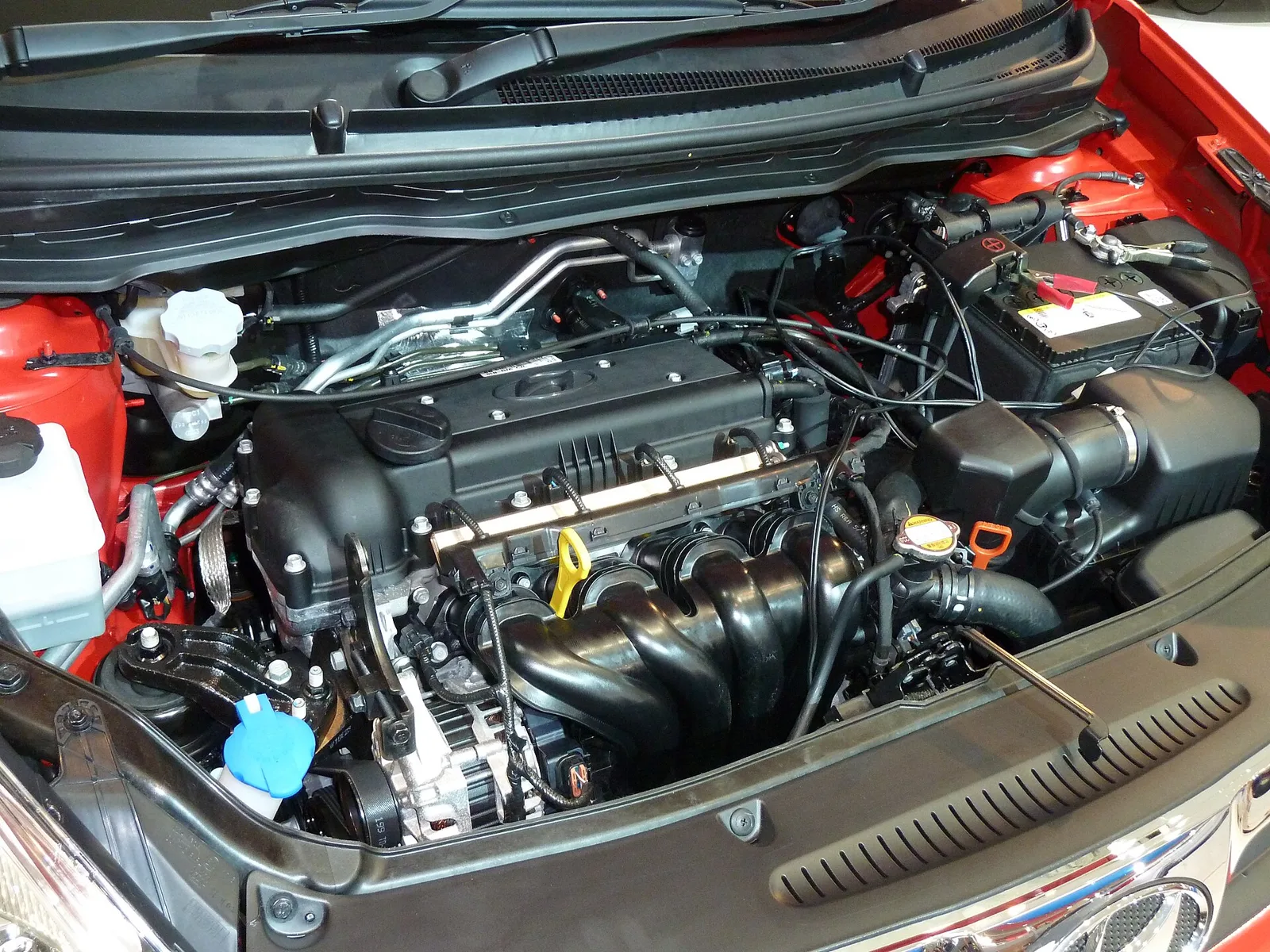
The Kappa block is high-pressure die-cast aluminium with cast-iron cylinder liners, built around a ladder-style frame for stiffness. The complete engine with a manual gearbox weighs only 82.4 kg (182 lb).
Much of the saving is in small things. The engine support bracket is moulded into the timing chain cover, the intake manifold is a heat-resistant plastic, and the piston skirts were reduced in size and given a molybdenum disulfide coating. The oil ring on each piston carries a thin chromium nitride layer applied by physical vapour deposition, a process borrowed from the earlier Hyundai Tau engine, and its tension was lowered to cut friction against the cylinder wall.
The ancillary drive is unusual too. This was the first Hyundai engine to use an accessory belt that needs no mechanical auto-tensioner, so there is less hardware to buy, fit and carry. With proper maintenance the belt should last 100,000 mi (160,000 km).
The spark plug is a longer-reach M12 type. That let engineers enlarge the water jacket around the plug and exhaust port, where the engine runs hottest, and also fit larger valves for better airflow. The fuel rail is a returnless stainless steel design, shaped inside to calm pulsation noise and to avoid evaporative emissions.
What does an offset crankshaft do?
An offset crankshaft sits slightly to one side of each cylinder's centreline. That reduces the sideways force the piston and connecting rod put on the cylinder wall, the effect that produces audible piston slap at its worst.
Picture pressing a plunger straight down a tube against pressing it at a slight angle: the angled push scrapes against the wall. The offset keeps the push straighter. The net effect is better fuel consumption and lower noise, vibration and harshness, and it should also help the engine last, since less sideways force means less wear in the bore.
What is inside the Kappa valvetrain?
The Kappa valvetrain pairs roller swing arms with hydraulic lash adjusters. The rollers cut friction, and the adjusters take up the clearance between valve stem and arm, which quietens valve tapping.
The valve springs are beehive shaped, narrowing towards the top, and they are used with a smaller retainer. Less weight and lower spring load mean less friction and better fuel economy. A silent-type steel timing chain, which needs no maintenance, replaces a roller-type chain and softens the impact as chain meets gear tooth. Control comes from two 16-bit, 32 MHz microprocessors that manage ignition timing, idle speed, knock and emissions.
How much did the Kappa project cost?
Developing the Kappa took $421 million over 48 months. The goal was better fuel economy while meeting the stringent Euro-4 emission rules of the time, and the latest versions comply with Euro-6DTemp.
Can the Kappa go hybrid?
It can, in a 1.6-litre version called G4LE, announced in 2016 for hybrids. It uses the Atkinson cycle, a higher compression ratio of 13.0:1, a cooler exhaust gas recirculation system and a higher-pressure fuel system.
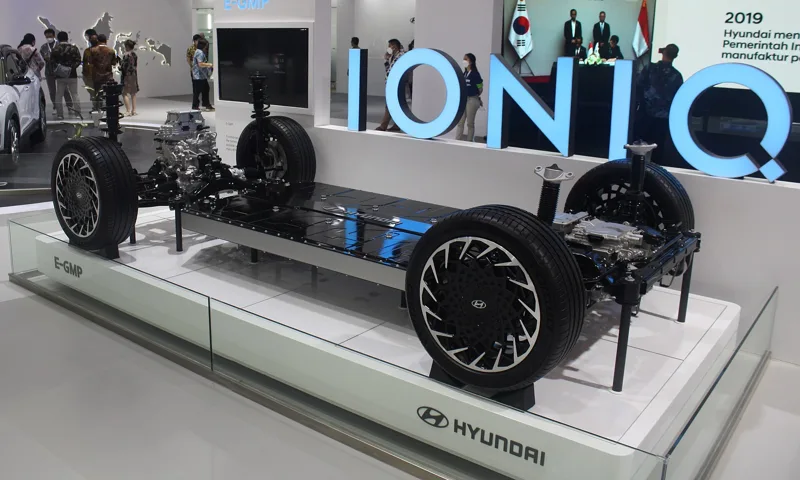
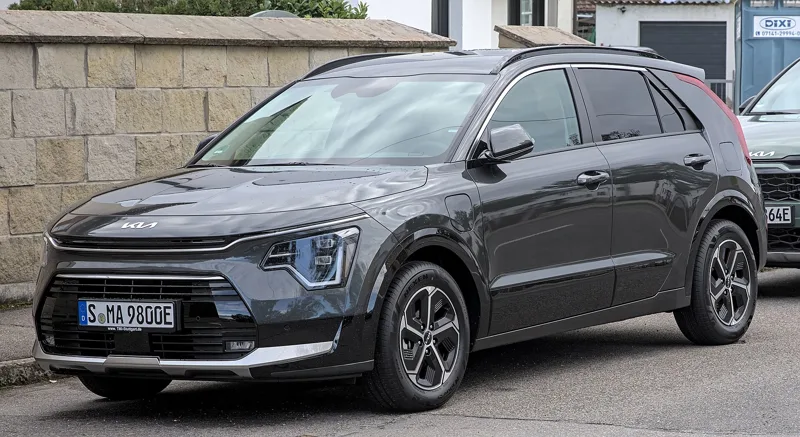
Its bore is 72 mm (2.8 in) and its stroke 97 mm (3.8 in), a long-stroke layout for 1,580 cc. On its own the engine gives 147 Nm (108 lb ft) at 4,000 rpm and 105 PS (77 kW; 104 hp) at 5,700 rpm. In the hybrid, a 1.56 kWh battery feeds an electric motor of 44 PS (32 kW; 43 hp) that delivers 170 Nm (125 lb ft) from standstill up to 1,800 rpm. The plug-in version has an 8.9 kWh battery and a 60.5 PS (44 kW; 60 hp) motor. Both hybrids make a combined 141 PS (104 kW; 139 hp) at 5,700 rpm, with 265 Nm (195 lb ft) at 4,000 rpm. Cars using it include the Hyundai Ioniq, the Kona Hybrid and the Kia Niro.
Which Gamma and Kappa engines are still in production
Several lines are still in production: the Kappa 1.0 in the current Grand i10, Picanto and Ray, the 1.2 in the Venue and Exter, the 1.4 in the Kia K3 and Hyundai Bayon, and the 1.0 T-GDi in the Casper and Sonet.
At the other end, some engines have already been superseded. The Kappa 1.4 replaced the Gamma 1.4, the Gamma II 1.6 replaced the original 1.6 in 2010, and the Smartstream G1.6T in 2019 improved on the 1.6 turbo. As for emissions, the newest Kappa engines meet Euro-6DTemp.