A B-segment crossover sold as a hybrid, plug-in and electric car, with a dual-clutch gearbox, a record fuel-economy run and a 2026 facelift.
The Kia Niro is a subcompact crossover SUV that Kia has built since 2016 in hybrid, plug-in hybrid and battery electric forms. It sits in the B segment, and its plug-in and electric versions were discontinued with the 2026 facelift, so the hybrid remains.
Kia designed the Niro around electrification from the start, and it borrowed its platform from the Hyundai Ioniq. Its dual-clutch gearbox made it an unusual hybrid, because most rivals used a continuously variable transmission.
When did the Niro arrive and where was it built?
Full production began in May 2016 at Hwaseong in South Korea, and European sales began in the third quarter of 2016. The hybrid was unveiled at the 2016 Chicago Auto Show, where Kia marketed its exterior design as un-hybrid, meaning more conventional than rival hybrids.
The Niro went on sale in South Korea on 31 March 2016, ahead of the full production start. Seven airbags came as standard, along with autonomous braking, smart cruise control and lane departure warning.
Android Auto was available from launch, which made the Niro the first Kia to offer it. Apple CarPlay followed late in 2016, and Europe could choose from seven colours with 16- or 18-inch wheels.
An electrification-first crossover that began as a hybrid with a dual-clutch gearbox and ended its plug-in life in 2026.
How does the hybrid powertrain work?
The hybrid system produces 104 kW (139 hp) and returns between 5.5 and 4.7 L/100 km (43 to 50 mpg-US). Its traction battery stores 1.56 kWh and weighs 33 kilograms (73 lb), and Kia says that gives up to 50 per cent more energy density than rivals.
Lightweight high-strength steel and aluminium helped the hybrid's economy. Kia also claimed 13 per cent better energy efficiency than rivals, and from 2017 the car dropped its lead-acid starter battery for a 12-volt lithium unit placed beside the traction battery.
In its first month on sale, the Niro set a sales record in South Korea's green car market, even beating the Hyundai Ioniq.
What did the plug-in hybrid offer?
The plug-in hybrid arrived in September 2018 with an 8.9 kWh battery and the same dual-clutch gearbox as the hybrid. Kia claimed 1.400 L/100 km (168.0 mpg-US), but real-world tests recorded 1.96 L/100 km (120 mpg-US) in one case and 4.9 L/100 km (48 mpg-US) in another.
The plug-in's market success was notable. It was the best-selling plug-in car in Denmark in December 2018, with 1,113 sales and a 24% share, ahead of the Nissan Leaf on 14%. In Sweden in February 2019 it finished second with 11%, behind the Mitsubishi Outlander PHEV on 17%.
Both the hybrid and the plug-in used a petrol engine alongside the electric drive. The 2019 facelift added new bumpers, lights and wheels, LED headlights as an option, and two new colours, red-orange and plum.
What are the Niro EV and e-Niro?
The battery electric version launched in 2018 at the International Electric Vehicle Expo in Korea. It was called Niro EV in Asia and North America and e-Niro in Europe, and it shares its powertrain and battery configuration with the Hyundai Kona Electric.
Two battery sizes were offered, 39.2 kWh and 64 kWh. The smaller pack drives a 100 kW (134 hp) motor, and it reaches 288 km (179 mi) on the WLTP cycle. The larger 64 kWh pack uses a 150 kW (201 hp) motor and reaches 455 km (283 mi) WLTP. Both versions produce 395 Nm (291 lb-ft).
Both versions are front-wheel drive with a CCS port that accepts DC rapid charging at up to 77 kW. The onboard charger is 7.2 kW, or 11 kW as an option. Batteries came from SK Innovation, whereas the Kona used LG Chem cells, and the US Niro EV is rated at 239 mi (385 km) by the EPA.
What changed in the 2022 Niro EV and Niro Plus?
The 2022 Niro EV took a 64.8 kWh battery and a heat pump, and it is rated at 463 km WLTP combined. Pre-orders began in South Korea on 3 May 2022, and the car also gained a battery conditioning function that adjusts battery temperature to outside conditions.
The Niro Plus, introduced on 3 May 2022, is a taller and roomier variant. It raises the height by 80 mm and the length by 10 mm, with 28 mm more second-row legroom. A taxi version lowers the driver's headrest by 43 mm and adds a power seat and a driver-side integrated display.
The Niro Plus is built by Donghee in Seosan, which also makes the Morning, Ray and Stonic. Two variants exist: the Niro Plus Taxi, sold only as a battery electric car, and the Niro Plus for all buyers, which is also exported.
What is the second-generation Niro?
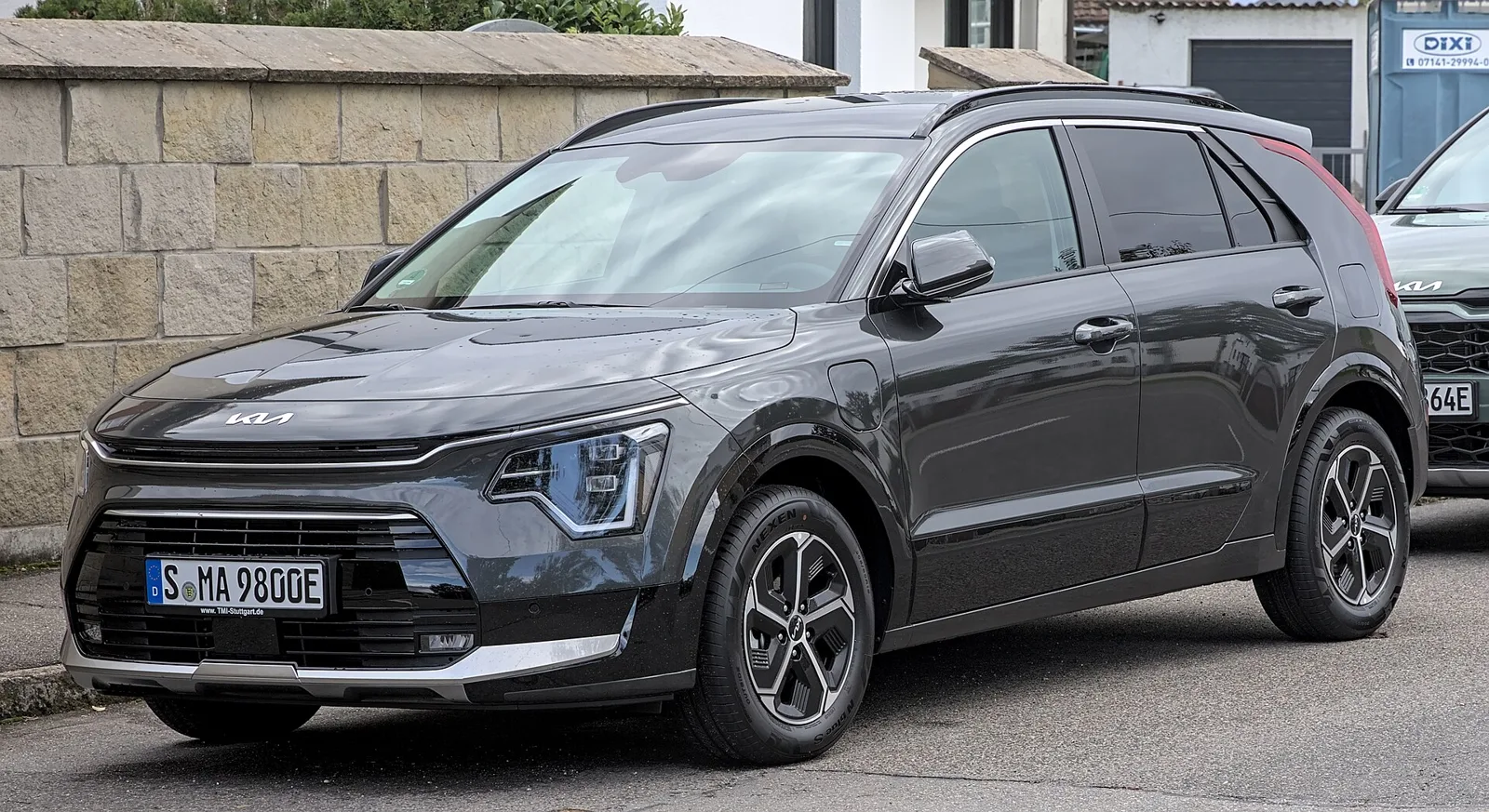
The second generation was revealed at the 2021 Seoul Mobility Show on 25 November and launched on 25 January 2022. It extended the Tiger Face grille from the bonnet onto the fenders, and its electric version followed in April 2022. Recycled fibres were used in the roof lining.
Inside, the second generation used water-friendly paint without benzene, toluene or xylene on the door panels, and a bio-artificial leather made with fibres from eucalyptus leaves. It also offered a head-up display, remote smart parking assistance and a smart power tailgate.
The facelift arrived on 20 January 2026, and it removed the plug-in hybrid and battery electric versions from the range, leaving the hybrid.
What awards did the Niro win?
Popular Mechanics named the 2019 Kia Niro EV its Car of the Year, praising its normal looks, 239-mile range and access to a major charging network. The UK's What Car? magazine named the e-Niro its 2019 Car of the Year, the first time that prize went to an electric vehicle.
The IEEE included the Niro among its Top 10 Tech Cars for 2018, and the Niro was named Best Urban Car at the 2023 Women's Car of the Year awards.
What concept cars came before the Niro?
The Niro concept debuted at the 2013 Frankfurt Auto Show, designed almost entirely by Peter Schreyer. The KX-3 followed at the November 2014 Guangzhou Auto Show as a larger compact SUV, and the HabaNiro concept appeared at the 2019 New York Auto Show.
The 2013 concept had a 1.6-litre Gamma four producing 160 hp (119 kW) that drove the front wheels through a seven-speed dual-clutch gearbox, while a 45 hp electric system drove the rear wheels on rougher roads. The KX-3 measured 4,260 mm (167.71 in) long and 1,765 mm (69.48 in) wide.
The HabaNiro used butterfly doors and previewed some design elements of the second-generation Niro.
What are the Kia Niro specifications?
| Specification | Detail |
|---|---|
| Type | Subcompact crossover SUV (B-segment) |
| Built since | 2016 |
| Hybrid power | 104 kW (139 hp) |
| Hybrid economy | 5.5 to 4.7 L/100 km (43 to 50 mpg-US) |
| Hybrid battery | 1.56 kWh, 33 kg (73 lb) |
| Plug-in battery | 8.9 kWh, from September 2018 |
| Electric battery | 39.2 kWh or 64 kWh |
| Electric motor | 100 kW (134 hp) or 150 kW (201 hp) |
| Electric range (WLTP) | 288 km (179 mi) or 455 km (283 mi) |
| DC charging | Up to 77 kW |
| 2022 Niro EV | 64.8 kWh, 463 km WLTP combined |