How James Hunt beat Niki Lauda to the 1976 Formula One title by a single point, what happened at the Nurburgring, and where the film Rush departs from what happened.
James Hunt won the 1976 title by one point after Niki Lauda, who had almost died in a fiery crash at the Nurburgring on 1 August, retired from the rain-soaked Japanese Grand Prix. Rush, the 2013 film, follows the season closely but exaggerates the rivalry and invents some scenes.
Niki Lauda was given the last rites in August 1976. Within three months he was back in his Ferrari, then quit a rain-soaked Japanese Grand Prix after two laps and lost the title to James Hunt by one point.
Who were James Hunt and Niki Lauda before 1976?
James Hunt was a British driver from Surrey, nicknamed "the Shunt", who landed a McLaren seat for 1976 only because his Hesketh team had run out of money. Niki Lauda was an Austrian from a wealthy Vienna paper-making family who borrowed his way into racing and joined Ferrari in 1974.
Hunt arrived in Formula One in 1973 with a reputation for reckless, action-packed racing and a playboy life off the track. His first win came at the 1975 Dutch Grand Prix for Hesketh. When the team ran dry and Emerson Fittipaldi left McLaren for his brother's outfit, McLaren had few top drivers to choose from. John Hogan brokered a deal worth a $50,000 retainer plus a good share of the prize money. Hunt signed at the last minute, and one report puts the money at $200,000, which made him one of the cheapest champions in the sport's history.
Lauda's route was financial rather than glamorous. His family disapproved of racing, so he took out a bank loan of 30,000 pounds, secured by a life insurance policy, to buy a place with March in 1971, and a second loan to get into BRM for 1973. Clay Regazzoni, who had left BRM to rejoin Ferrari, spoke so well of him that Enzo Ferrari signed him and paid him enough to clear his debts. Lauda won the Spanish Grand Prix in 1974, took the 1975 title with five wins in the Ferrari 312T, and became the first driver to lap the Nurburgring Nordschleife in under seven minutes.
Hunt needed fourth place or better; third brought four points and the title by one.
How did the 1976 Formula One season begin?
Hunt was fastest in qualifying early in the year, but Lauda kept winning. Hunt took pole in Brazil and South Africa and lost both races to Lauda, who went on to win in Belgium and Monaco as well. After Monaco he led the championship by 33 points over Regazzoni and Hunt.
The pattern repeated itself. Hunt would start on pole, Lauda would beat him off the line, and Ferrari's reliability would do the rest. Hunt crashed in Brazil with a sticking throttle, collided with Patrick Depailler at Long Beach, and retired from Belgium with transmission failure. Lauda finished second at Long Beach, behind Regazzoni, and won four of the first six races overall.
The season was 16 races long, from 25 January to 24 October. It also gave the paddock the six-wheeled Tyrrell P34, which debuted in Spain and won in Sweden with Jody Scheckter. Lauda was only third in Sweden, but he had more than doubled the points of Scheckter and Hunt by the British Grand Prix, and a second consecutive title looked a formality.
Why was the 1976 season so political?
Because the results kept changing after the flag. Hunt won in Spain and was disqualified; Ferrari then refused to race in Austria; and Hunt won in Britain and was disqualified again. By the end of the year the championship table had been rewritten by appeal panels as often as by the drivers.
The Spanish dispute began with a new rule. Before the Jarama race the governing body limited cars to a width of 215 cm (85 in), and McLaren was caught out: Hunt's car was judged 1.8 cm too wide. McLaren argued that the tyres had expanded during the race. Two months later the win was reinstated. Ferrari declined to enter the Austrian Grand Prix in protest at what it saw as preferential treatment of Hunt in Spain and Britain.
Britain was worse. At Brands Hatch Lauda took pole, but Regazzoni touched him at the start and spun, Hunt and Jacques Laffite hit Regazzoni, and the debris forced a restart. McLaren, Ferrari and Ligier all used spare cars for the second start, though Hunt's biography says his spare was refused and the original car was repaired. Hunt won after Lauda's gearbox failed with 15 minutes left. Ferrari, Tyrrell and the Fittipaldi team challenged Hunt's place in the restart, and he had also driven on an access road while returning to the pits, which the rules forbade. On 24 September the win was taken away from him and given to Lauda, along with three extra points.
What happened in Niki Lauda's crash at the Nurburgring?
On 1 August 1976, during the second lap of the German Grand Prix, Lauda's Ferrari swerved off at the very fast left kink before Bergwerk, hit an embankment, caught fire and was struck by Brett Lunger's Surtees-Ford. Lauda was trapped in the wreckage. He suffered severe burns and breathed in hot toxic gases.
A week earlier, though he was then quickest of all around that track, Lauda urged the other drivers to boycott the race. The Nordschleife was 23 km (14 mi) long, and he cited a lack of fire marshals, fire equipment and safety vehicles. A majority voted against. Tom Pryce in 1977, Ronnie Peterson in 1978 and Depailler in 1980: three of the men on that grid later lost their lives in Formula One.
Four drivers reached the scene: Arturo Merzario, Lunger, Guy Edwards and Harald Ertl. Merzario climbed in, released Lauda's seatbelt, which Lauda had been pressing hard against, and pulled him clear. Lauda later said he could not understand how it had been done. The damage by then was already severe. His modified helmet fitted badly, its foam had compressed, and it came off in the crash, which left his face open to the flames. He was conscious and able to stand straight after the accident, but later lapsed into a coma, and in hospital he was given the last rites.
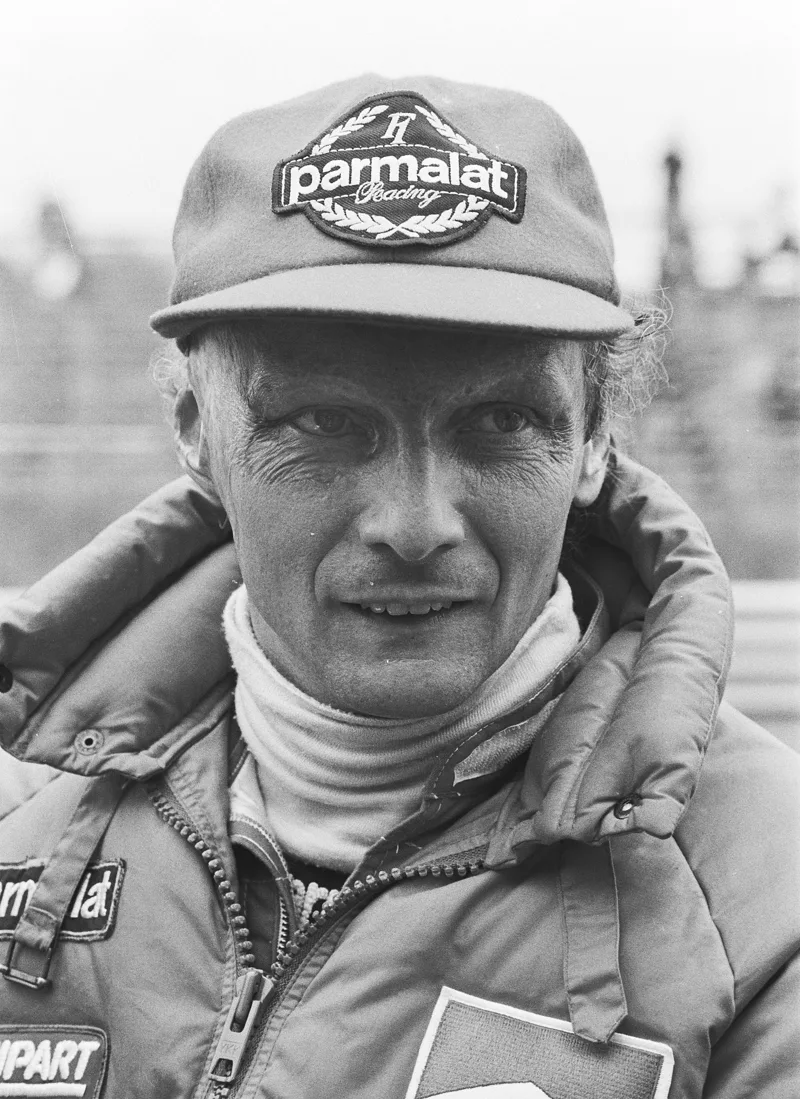
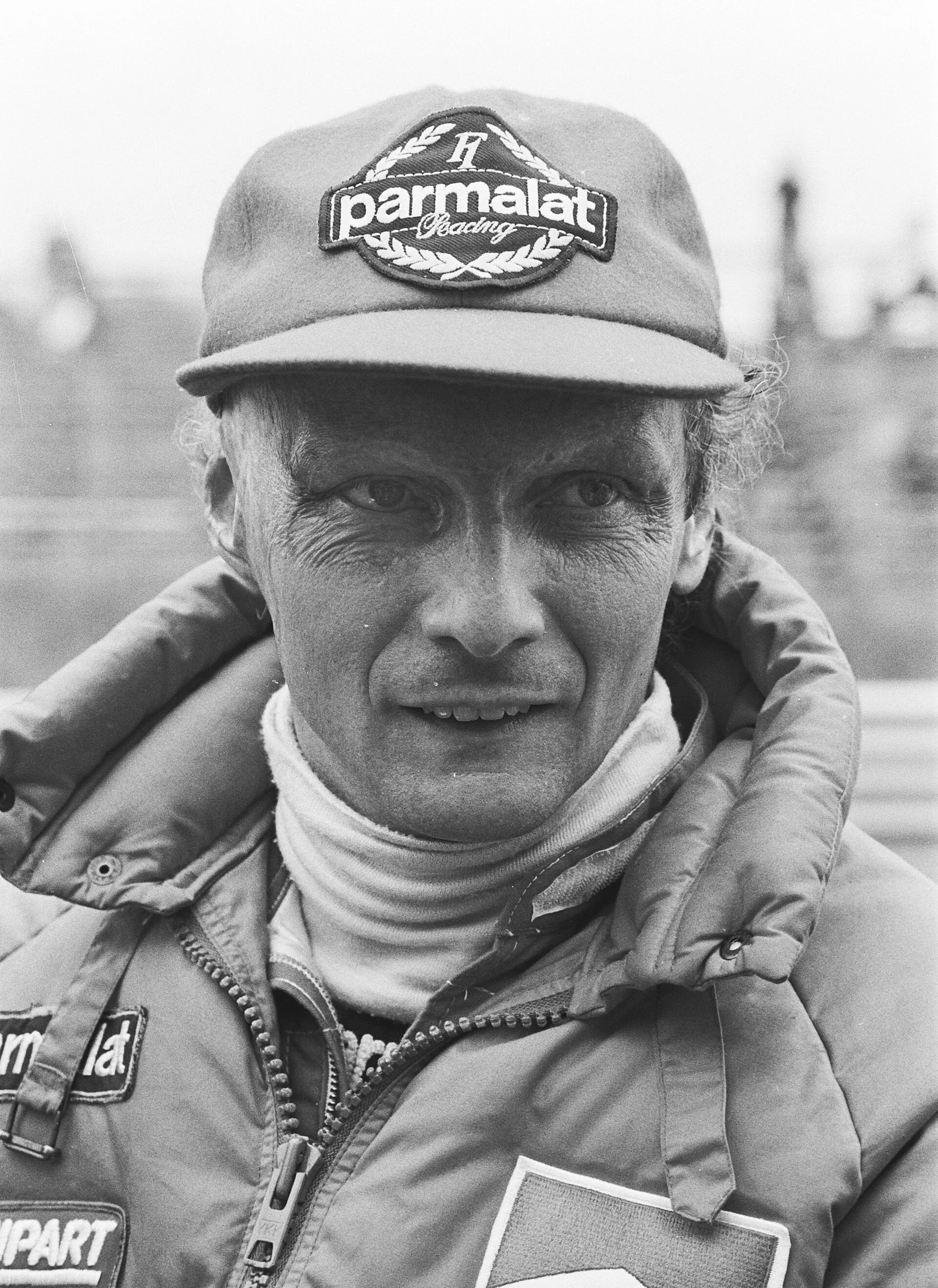
The burns cost Lauda most of his right ear, plus his eyebrows, his eyelids and the hair on that side of his scalp. He limited reconstructive surgery to restoring the eyelids. From then on he wore a cap over the scars and arranged for sponsors to use it for advertising. The corner where he crashed was later named Lauda Links, or Lauda Left. Carlos Reutemann took his Ferrari seat, and Hunt dominated the restarted race.
How did Lauda return so quickly?
He missed only two races. Six weeks after the crash he appeared at a press conference at Monza with fresh burns still bandaged, and he started the Italian Grand Prix, finishing fourth. By his own admission he was absolutely petrified.
The journalist Nigel Roebuck remembers seeing Lauda in the pits peeling blood-soaked bandages off his scarred scalp. He wore a specially adapted helmet to cut the discomfort. Hunt, in the meantime, had been closing the gap.
How did Hunt close the gap?
With a run of wins and a long list of protests. At Zandvoort Hunt passed Peterson on lap 12 and held off John Watson to win. At Monza the McLaren and Penske teams were told their Texaco fuel exceeded the octane limit, although it had been tested and appeared legal, and both started from the back of the grid. Hunt spun off trying to come through, and Lauda finished fourth.
In Canada Hunt learned that the British Grand Prix result had gone against him and that Lauda had been given the win. Furious, Hunt drove flat out at Mosport Park and won. At Watkins Glen he started from pole and beat Scheckter after a close fight. Away from the circuit the two were friends, and the rivalry, though fierce, was seen as clean and fair.
That left Lauda three points ahead going into Japan.
What happened in the Japanese Grand Prix?
Lauda retired after two laps in torrential rain, and Hunt finished third to win the championship by one point. Hunt needed fourth place or better; third brought four points. The result also made him the last British champion until Nigel Mansell in 1992.
Before the race, McLaren manager Alastair Caldwell hired the new Fuji circuit for a private test. The gearbox seized after a few laps, but the team had at least learned the track, which was unknown to every other crew. Lauda qualified third, one place behind Hunt, and on race day he pulled out. He said he felt it was unsafe to continue, partly because his fire-damaged tear ducts left his eyes watering and he could not blink.
Hunt led most of the race, then lost ground with tyre trouble, reported as either a puncture or blistering. He made a delayed stop, received mixed signals from the pit, and came home third. Ferrari took the Manufacturers' trophy, but its relationship with Lauda was badly damaged. He took the 1977 title through consistency rather than pace, clinched it at the United States Grand Prix, and left the team before the season ended after Ferrari decided to run Gilles Villeneuve in a third car in Canada.
Is the film Rush a true story?
Rush, which Ron Howard directed from a script by Peter Morgan, is built around the 1976 season, with Chris Hemsworth as Hunt and Daniel Bruhl as Lauda. Lauda himself called it very accurate, though some scenes are invented and some details shifted.
| Moment | In the film | In reality |
|---|---|---|
| The relationship | Bitter rivals | Friends who had once shared a flat in their early careers |
| Formula Three feud | The rivalry begins at a London race in 1970 | The Crystal Palace battle was between Hunt and Dave Morgan |
| Nurburgring nickname | The graveyard | Jackie Stewart called it the Green Hell |
| German GP grid | Laffite third | Depailler third |
| Japan, Hunt's late pass | Regazzoni for third | Alan Jones |
| Japan, fourth and fifth | Regazzoni and Laffite | Jones and Regazzoni |
| Hunt and a reporter | Hunt beats up a journalist on Lauda's behalf | Invented |
| Lauda's wife and his injuries | Her shock is downplayed | Her shock at his disfigurement was greater |
The drivers' meeting before the German race is turned around too. In the film Hunt argues against cancelling the race, saying Lauda is protecting a points lead. In the real run-up Lauda urged a boycott over safety, and the drivers voted it down. In the closing scene Hunt turns up on a bicycle with a flat tyre. In reality that meeting came when Hunt had run out of money, and Lauda handed him cash to rebuild his life.
Lauda first thought the unedited film portrayed him too negatively. That changed after Bernie Ecclestone told him he liked it, and Lauda was left impressed by how little Hollywood had altered. The film premiered in London on 2 September 2013, reached UK cinemas on 13 September 2013 with a score by Hans Zimmer, and grossed $98.2 million worldwide against a budget of $38 million. Critics gave it an 89% approval rating across 235 reviews.
Where did the two men go after 1976?
Hunt did not win another title. He won several races in 1977 but finished fifth in the standings, went winless in 1978, joined Wolf in 1979 and stopped after that year's Monaco Grand Prix with ten wins, 14 pole positions and 23 podiums. He became a BBC commentator and a columnist for The Independent, and mentored Mika Hakkinen. He died at home in Wimbledon of a heart attack on 15 June 1993, aged 45.
Lauda took a two-year break after leaving Brabham in 1979, came back with McLaren in 1982 and, after a winless 1983, won his third title the next season, beating Alain Prost by a record half-point. The seven-year wait between his second and third titles is the longest in the sport, beating Jack Brabham's six. He retired after 1985 with 25 wins and 54 podiums, built airlines, and from 2012 was co-owner and non-executive chairman of Mercedes, which won six consecutive Constructors' Championships from 2014 to 2019. He died on 20 May 2019.