A starter built to burn itself out, a battery that spends under three percent of its charge starting, and an alternator that makes alternating current first: the three parts explained.
The battery gives the starter motor a short burst of heavy current, the starter turns the engine until it fires, and the alternator then runs the electrical system and recharges the battery at 13.5 to 14.5 volts. Each part is built for a different kind of work, which is why they fail differently.
A car's starter motor is built to cook itself. In 1911 Charles Kettering and Henry Leland patented an electric starter on the idea that a small motor, driven harder than it could ever bear continuously, would still crank an engine, because it only has to do so for a few seconds. Leave it running for minutes and it burns out. That bargain is still in every petrol and small diesel car today, and the battery that feeds it is designed around the same short, savage burst.
Here is how the battery, the starter motor and the alternator divide the work of starting a car and keeping it running, what each one is designed to withstand, and what tends to go wrong with each.
Why does an engine need a starter motor?
An internal combustion engine is a feedback system. In a four-stroke engine the power stroke, the third, releases the fuel's energy, and that energy pushes through the exhaust stroke and then the intake and compression strokes of the next cycle. Once the loop is turning, it sustains itself. At the start of a journey, though, nothing is turning, so the first two strokes have to be powered some other way. The starter motor exists for that single job and is no longer needed once the engine is firing on its own.
Before it existed, drivers used wind-up springs, gunpowder cylinders, pull cords and the familiar hand crank. The crank was inconvenient, hard work and dangerous. An engine in the act of starting does not always behave, and a kickback sends it briefly into reverse, snatching the handle with it. Crank-handle injuries ranged from a broken thumb to a broken wrist or a dislocated shoulder. Operators were advised to hook fingers and thumb beneath the handle and pull up, yet gripping it with the thumb on the far side felt more natural. Larger engines with higher compression ratios made the job heavier still.
The English electrical engineer H. J. Dowsing built the first electric starter into a modified Benz Velo, the Arnold, in 1896. Clyde Coleman patented an American version in 1903, and Kettering and Leland of the Dayton Engineering Laboratories Company filed theirs in 1911. Five years before, he had swapped the cranks on NCR's cash registers for electric motors. Cadillac fitted the system to its Model Thirty in 1912, and Lanchester adopted it the same year.
Rivals were still in the race that year: Adams, SCAT and Wolseley used compressed-air starters, and Star and Adler a clockwork spring motor that could be wound by hand. The electric motor won. The Dodge Model 30-35 of 1914 made an electric starter and lighting standard on a fairly cheap car, on a 12-volt system when six volts was usual. It used one unit as both starter and generator, quiet and little worn, though sharing the job capped what it could do as either. Dodge kept it until 1929.
Ford's Model T was hand-cranked until 1919, and through the 1920s electric starters spread to almost every new car, which opened driving up to women and the elderly. A crank still came in the toolkit well into the 1960s, and the Citroen 2CV carried one until production ended in 1990. Chrysler's 1949 key-operated switch, which combined ignition and starter, replaced the dashboard button and the floor pedal that drivers had used before.
A starter is allowed to run for seconds because it would burn out in minutes, and the whole electrical system is built around that bargain.
How does a starter motor work?
Most petrol engines and small diesels use a direct-current electric motor, permanent-magnet or series-parallel wound, with a solenoid mounted on top. The solenoid is much like a relay. Turn the ignition key and the battery's current reaches it, and it does two things at once: a lever shoves the drive pinion out along the starter shaft until it meshes with the ring gear on the flywheel, and high-current contacts close so that the motor begins to turn. Think of it as a small gear on a short shaft nudging forward to grip a very large gear, then spinning it.
When the engine fires, the key is released, the switch opens, and a spring in the solenoid pulls the pinion clear. A sprag clutch, which transmits drive in one direction only, sits between the pinion and the shaft. It matters because a running engine turns far faster than a starter. If the pinion stays engaged, perhaps because the driver holds the key or a short keeps the solenoid closed, the clutch lets the pinion spin freely instead of driving the starter backwards, which would make the motor spin so fast it flew apart.
That overrunning-clutch pinion arrived from the early 1960s. Before it, the Bendix drive of the 1930s put the pinion on a helically cut shaft: inertia made the pinion ride forward and engage the ring gear, and once the engine overtook the starter, the pinion was forced back out of mesh. The weakness was that it let go the moment the engine caught, even when the engine then stalled. The Bendix Folo-Thru drive fixed that with a latch and flyweights that kept the pinion engaged until the engine was genuinely running on its own.
Gearing came next. In 1962 Chrysler introduced a starter with a gear reduction of 3.75:1 between motor and pinion shaft. That allowed a faster, lower-current, lighter and more compact motor while increasing cranking torque. Chrysler used variants on most rear- and four-wheel-drive models through 1987, and the unit's distinctive sound earned it the nickname "Highland Park Hummingbird". It became the template for the gear-reduction starters that predominate now, and many Japanese makers adopted the layout in the 1970s and 1980s. Direct-drive starters are almost obsolete because they are larger, heavier and hungrier for current.
Because it is meant for intermittent use, a starter's electrical parts are designed to run typically for under 30 seconds before overheating, which saves weight and cost. Owner manuals tell drivers of a reluctant engine to wait ten seconds or more between attempts of ten to fifteen seconds.
What does the battery actually do?
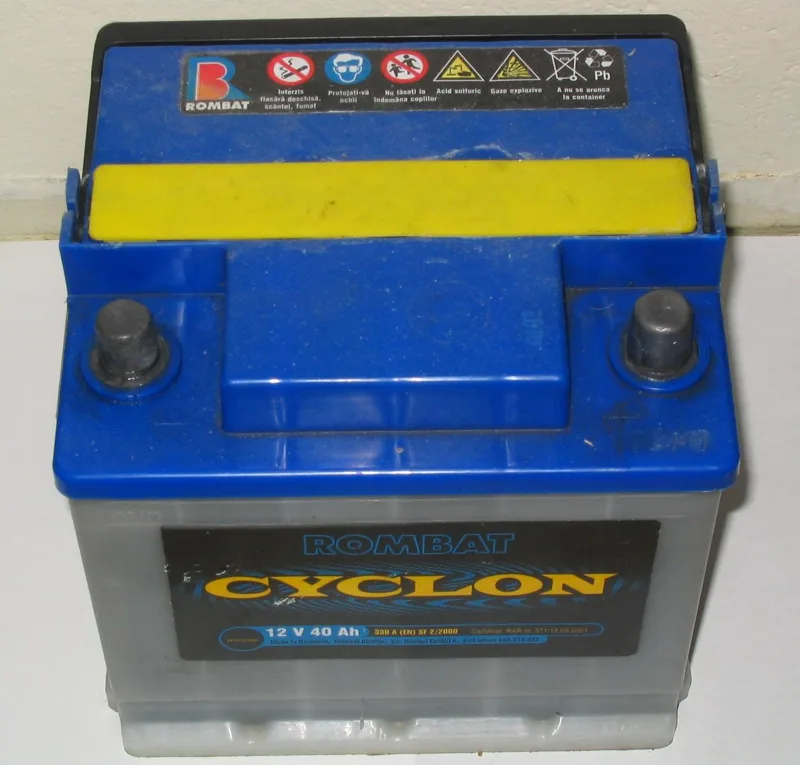
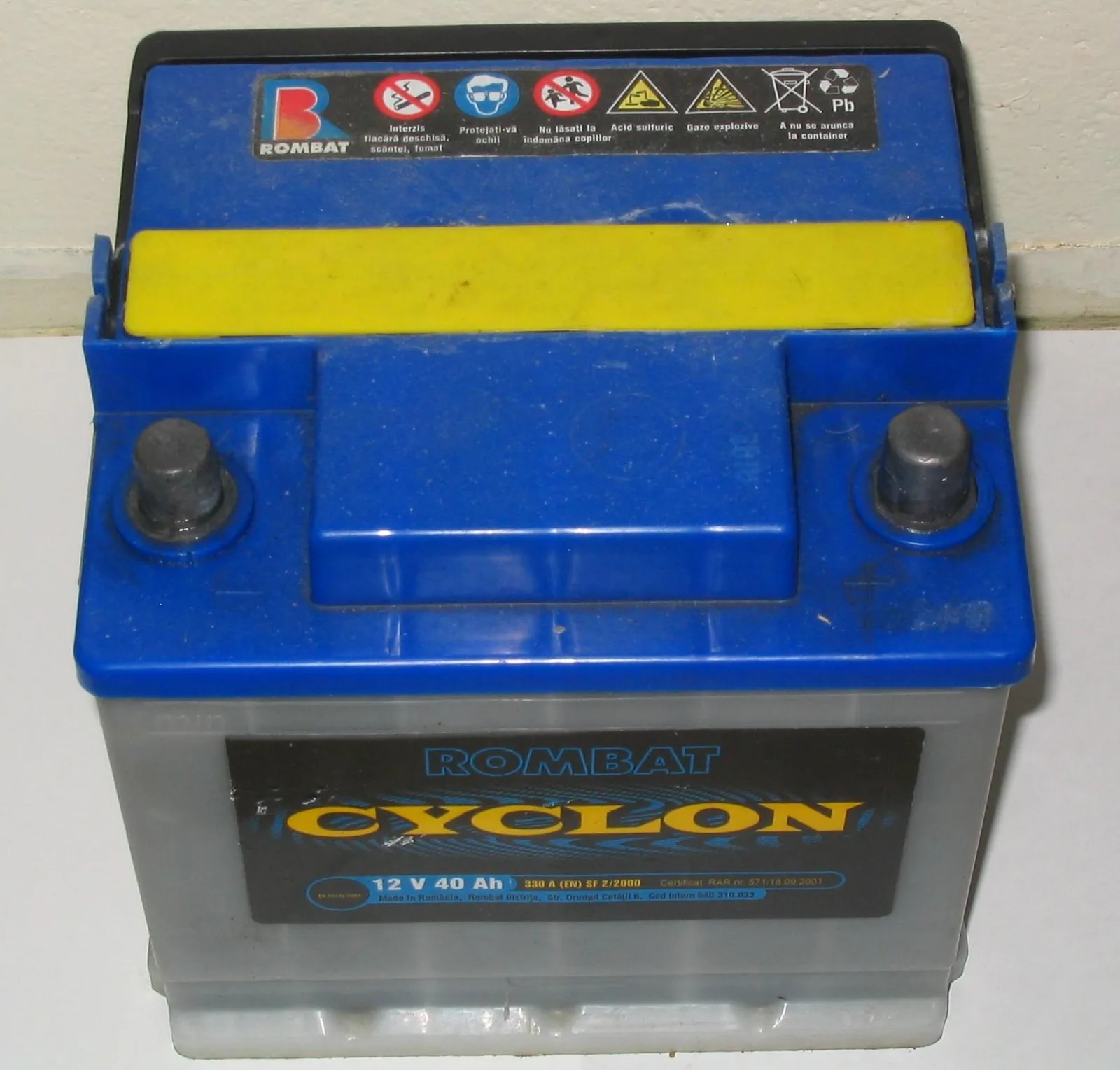
The battery in an ordinary car is a starting, lighting and ignition unit, usually of lead-acid type. Its main purpose is to supply current to the starter motor, which in turn starts the engine that actually propels the car. It also powers lights and wipers with the engine off, covers extra demand whenever the electrical system asks for more than the charging system provides, and evens out potentially damaging voltage spikes.
Starting typically uses less than three percent of the battery's capacity, so these batteries are built to deliver maximum current for a short time rather than a gentle trickle for hours. That is why they dislike deep discharge. Six cells in series, each producing 2.1 volts, give 12.6 volts at full charge, and the plates are made with a large surface area to offer high instant current. In each cell, discharging turns the plate surfaces to lead sulfate and recharging reverses the reaction, so that the plates are restored and the cycle can repeat. Heavy trucks and earth-moving machinery use twelve cells for a 24-volt system.
Batteries became common around 1920, as electric starters spread. Early systems were 6 volts, and cars used that voltage until the mid-1950s. The change to 12 volts came when bigger engines with higher compression needed more electrical power to start. Smaller cars held out: the Volkswagen Beetle stayed on 6 volts until the mid-1960s and the Citroen 2CV until 1970.
Ratings on the label are easier to read once you know what they measure. Cold cranking amperes give the current a battery can provide at -18 degrees C (0 degrees F) for 30 seconds while holding at least 7.2 volts. Modern computer-controlled fuel-injected engines start in a few seconds, so the figure matters less than it did. The amp-hour rating describes capacity: in theory a 100 Ah battery supplies 5 amps for 20 hours before the voltage falls below 10.5 volts, though a higher discharge rate or a colder day lowers that capacity.
How does the alternator recharge the battery and run the car?
Once the engine runs, the alternator takes over. It is a type of electric generator that charges the battery and powers the electrical system. Until the 1960s cars used DC dynamos with commutators. Once silicon-diode rectifiers turned cheap, and larger headlamps, electric wipers and heated rear windows raised the load, the industry moved towards alternators. Their modern form was first used in the military in the Second World War to power radio equipment, and Chrysler made it standard on the Valiant in 1960, years before Ford and General Motors.
Alternators won because they are lighter, cheaper and more rugged than dynamos, faster to replace, and able to give a useful charge at idle. A dynamo's brushes carry the machine's entire output. An alternator's brushes carry only a small excitation current through slip rings, so they last far longer. The engine turns the alternator by belt at two to three times crankshaft speed.
The surprise is that both machines first produce alternating current. A dynamo makes it in the spinning armature and converts it with a commutator; an alternator makes it in the stationary stator and converts it to direct current with a bank of diodes. Most car alternators use a claw-pole rotor, whose iron fingers interlock like the fingers of two hands around a single coil, and the resulting waveform is more efficient to rectify than a plain sine wave.
A voltage regulator keeps the output steady by adjusting the small field current feeding the rotor. The field current is a fraction of the output: a 70 A alternator may need only 2-3 A. The regulator holds the output between 13.5 and 14.5 volts, which is higher than the battery's resting 12.6 volts and is what pushes charge back in. Early designs from the 1960s and 1970s put the regulator in a separate box. The next generation, from the 1970s to the 1990s, built it into the alternator housing. Modern systems leave the job to the engine control unit, which in recent years weighs intake air temperature, battery temperature and engine load when it sets the voltage.
| Part | Its job | Figures to know |
|---|---|---|
| Battery | Powers the starter, supplies extra current when demand exceeds the charging system, smooths voltage spikes | Six cells of 2.1 V give 12.6 V; starting uses under 3% of capacity |
| Starter motor | Turns the flywheel through pinion and ring gear until the engine fires | Designed to run under 30 seconds before overheating; pause at least ten seconds between attempts |
| Alternator | Recharges the battery and powers the electrical system with the engine running | Regulated to 13.5-14.5 V; typically 50-70 A; 70-80% efficient at medium speeds |
Output has crept up over time. Older cars with minimal lighting could manage on 30 amperes. Typical passenger cars and light trucks are rated around 50-70 A, with higher figures becoming more common as air conditioning and electric power steering add load, while buses and emergency vehicles may need 300 A. At medium speeds today's alternators are 70-80% efficient, and efficiency falls steeply at high speed, mainly because of fan resistance. Compact modern designs enclose two fans and vent through radial slots to cool better and extract more power from a smaller machine.
Battery or alternator: which one is failing?
The two are linked, so the symptoms overlap, but their jobs differ. The battery starts the car and cushions the electrical system. The alternator runs the system and refills the battery. If a battery is too flat to turn the engine, the car can be jump-started from an external source, and the running engine can then recharge the battery, provided the alternator and charging system are undamaged. A battery that goes flat repeatedly in a car whose charging system is healthy points to the battery itself, and one that is sound but keeps running down points to the charging side.
The dashboard warning lamp tells you more than most drivers realise. The field windings are fed from the battery through the ignition switch and regulator, and a parallel circuit feeds the charge lamp, which is why it glows when the ignition is on and the engine is stopped. Once the alternator is generating, a diode feeds the field current from its own output, the voltage across the lamp evens out, and the lamp goes out. The drawback is that if the lamp burns out or the exciter wire comes loose, no field current flows and the alternator generates nothing. Some circuits fit a resistor in parallel to keep excitation flowing if the bulb fails. The advice is to confirm the lamp lights with the engine stopped; otherwise a failed belt, which can also be turning the coolant pump, could go unnoticed.
Batteries die in their own ways. Heat is a main cause of failure: it evaporates the electrolyte, shrinks the plate area exposed to it, leads to sulfation and accelerates grid corrosion, while low temperatures can also kill a battery. Sulfation, a hard layer of lead sulfate on the plates, builds up when a battery is left discharged, and a sulfated battery should be charged slowly. Leaving the lights on until a standard battery is completely drained coats the plates in sulfate and can cut its life by a third or more. AGM batteries tolerate deep discharge better, but cost more. Even a healthy battery can fail to start a car if corrosion at the terminals adds electrical resistance, which dielectric grease helps to prevent.
What this means for owners and drivers
Treat a battery with respect. Hydrogen gas can build up near the negative electrode if the vents are blocked or the space is poorly ventilated, and with an ignition source nearby it can explode. Explosions at engine start-up are typically linked to corroded or dirty terminals. The US National Highway Traffic Safety Administration studied battery explosion injuries in 1993 and found that 31% happened while charging. Other common scenarios were working on cable connections, jump-starting, and checking fluid levels. Jump-starting goes wrong when the lead is not attached to the dead battery first, or when it is connected to the grounded battery post and not to the vehicle chassis. Roughly two in three of the injured had chemical burns, and about three in four had eye injuries.
Hybrids and electric cars change the picture. An EV has no starter motor and no alternator, yet still carries a 12-volt battery to run standard accessories, which a DC-to-DC converter charges by stepping the high voltage down to around 14 volts. Because it needs so little energy, Tesla introduced a lithium-ion auxiliary battery in 2021 that stores only 99 Wh, and the 2010 Porsche 911 GT3 RS offered a lithium-ion starter battery as an option. A hybrid replaces alternator and starter with one or more motor/generators that start the engine, drive the wheels and charge the large battery; the Toyota Prius's Hybrid Synergy Drive is one example. It echoes the starter-generators of Dodge and Cadillac from the 1910s.
Where this goes next
Voltage is one area where the industry has changed its mind. In the 1990s a 42V standard was proposed to allow more powerful electric accessories and lighter wiring harnesses. More efficient motors, new wiring techniques, digital controls and a focus on high-voltage hybrid starter/generators have largely removed the push for changing the main automotive voltage. A different step has come from Tesla, whose Cybertruck began deliveries in 2023 on a 48-volt electrical system, which is reported to cut 70% of the vehicle's wiring.