From a 12-volt battery to lightning in a cylinder: how the coil builds tens of thousands of volts, what a plug is made of, and how the distributor gave way to coil-on-plug.
A spark plug uses a high voltage from an ignition coil, 12,000 to 25,000 volts or more, to ionise the gas in its gap and fire a spark at up to 60,000 K. Ignition has moved from magnetos to Kettering's distributor of 1912 and, since the 1990s, to coil-on-plug.
Every time a petrol engine fires, a bolt of artificial lightning leaps across the gap at the tip of a plug. The spark channel reaches 60,000 K, the gas around it expands so fast that it cracks like a small explosion, and a ball of fire is born that lights the rest of the cylinder. Getting there takes anywhere from 12,000 to 45,000 volts, drawn from an ordinary car battery.
How do spark plugs work?
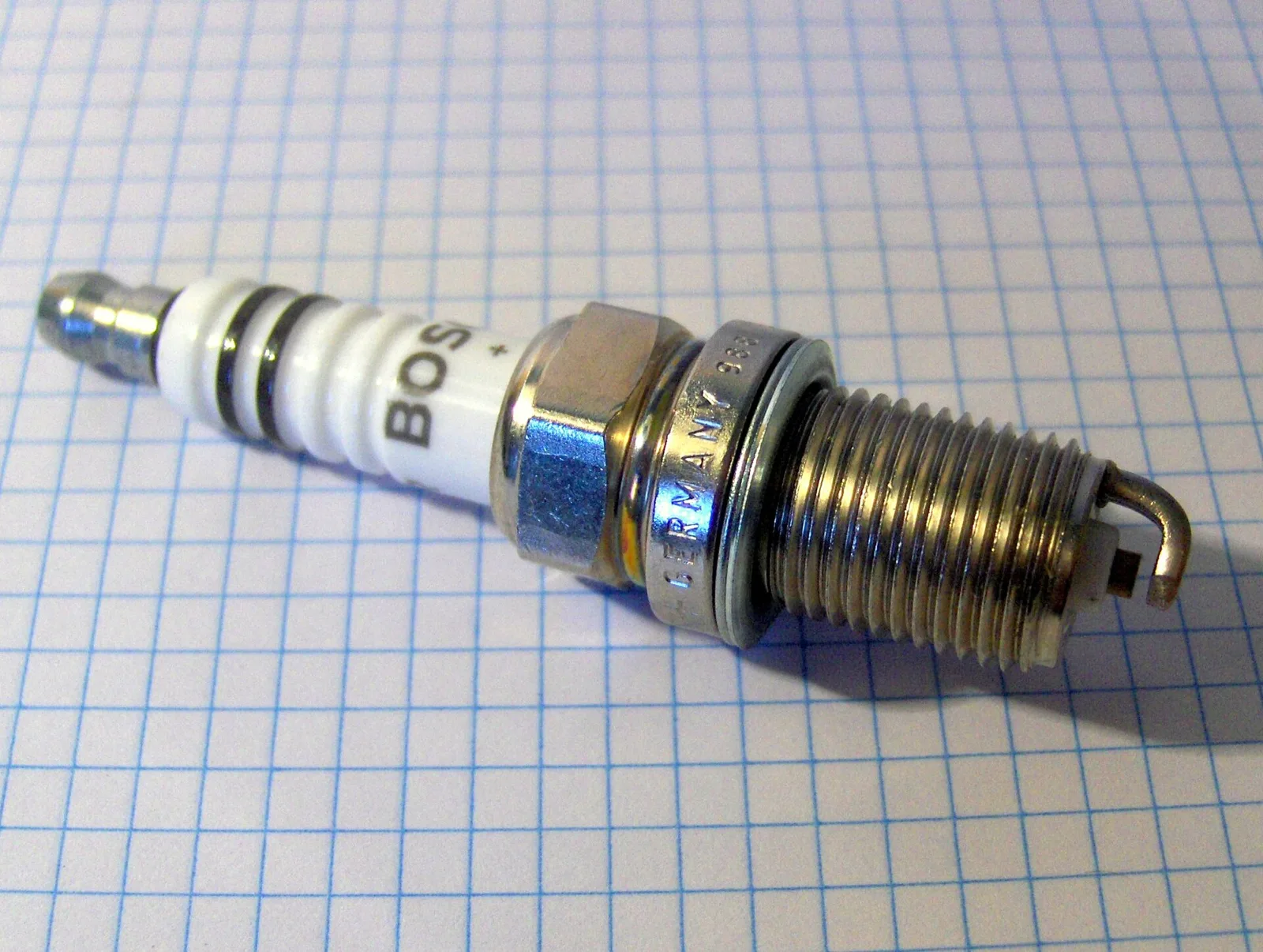
A spark plug delivers electric current from the ignition system into the combustion chamber, where it lights the compressed fuel-air mixture with a spark. It also has to contain the pressure of combustion. A threaded metal shell and a central electrode are held apart by a ceramic insulator, and the shell screws into the cylinder head, which earths it.
The gap between the central electrode and the side electrode starts out as an insulator, because the fuel and air sitting in it do not conduct. As the coil pushes the voltage higher, the structure of the gas begins to change. Once the voltage beats the gas's dielectric strength, the gas ionises and becomes a conductor, and current flows across the gap in a rush. Plugs usually need 12,000 to 25,000 volts or more to fire properly, and demand can reach 45,000 volts. A plug that supplies more current during discharge gives a hotter, longer-lasting spark.
The surge drives the spark channel up to 60,000 K. That intense heat makes the ionised gas expand very quickly, and the sharp click you hear if you watch a spark in the open is the same thing as lightning and thunder on a small scale. Heat and pressure push the gases to react, and when the spark ends a small ball of fire should remain in the gap, burning on its own.
Engineers call that ball the kernel. Its size reflects what the mixture between the electrodes is made of and how turbulent the chamber is when the spark arrives. A small kernel makes the engine behave as though the ignition timing had been retarded, and a large kernel as though it had been advanced. The spark is not a simple on-off event; the quality of the fireball it starts shapes how the whole combustion develops.
The spark is lightning on a small scale: a channel at 60,000 K that starts a ball of fire in the gap.
How does a coil turn battery voltage into a spark?
An ignition coil is a transformer built for one job: to lift the battery's voltage to the much higher level that a plug needs. It is two sets of copper windings around an iron core. The primary winding is a short run of thick wire. The secondary winding has thousands of turns of much finer wire, kept clear of the high voltage by enamelled wire and layers of oiled paper.
The process runs in two beats. First, a contact breaker or a transistor closes the circuit between the battery and the primary winding. Current flows, a magnetic field grows around the core, and energy builds up in the coil over a short period. Then the circuit is opened. The magnetic field collapses in a rapid oscillation, and that sudden change induces a huge voltage in the secondary winding. Think of it as a garden hose with a tap: build up the flow, slam the tap shut, and the water hammers back harder than the supply pressure ever was.
Timing is everything. The moment the circuit opens has to be synchronised with crank rotation, so the burst lands at the best instant to light the mixture. From the secondary winding the voltage may pass through a distributor and plug leads before it reaches the plug. A lawnmower coil delivers about 15 kV, while a larger engine's can reach 40 kV.
Modern electronic systems follow the same principle of charging and releasing, though capacitor-discharge versions store the energy in a capacitor charged to around 400 volts and not in the coil's induction. In a modern single-spark layout each plug has its own coil, and a diode or secondary spark gap inside blocks the reverse pulse that would otherwise cause a premature spark at the start of the primary pulse. Compared with the older magneto, a coil system gives a strong spark even at low rpm, which makes starting easier.
What is inside a spark plug?
A plug has three basic parts: the shell, the insulator and the central conductor. Together they must keep the chamber sealed under heavy pressure and heat, year after year, without breaking down. Plugs are specified by thread or nut size, by sealing type, either a taper or a crush washer, and by the size of the gap. Common European thread sizes are 10, 14 and 18 mm, and the plug must have the correct reach, or thread length, which can run from 0.095 to 2.649 cm (0.0375 to 1.043 in) across automotive and small-engine uses.
The insulator is typically sintered alumina, a very hard ceramic with high dielectric strength, glazed on the outside to resist surface spark tracking. Ribs along its length lengthen the surface path between the terminal and the grounded case, so that electricity has trouble leaking along it even when dirt and moisture are present. The tip that protrudes into the chamber is the same alumina but unglazed, designed to withstand 650 degrees C (1,200 degrees F) and 60 kV. Alumina also conducts heat well, which keeps the insulator from glowing hot enough to light the mixture prematurely.
Earlier insulators, particularly aircraft ones, were stacks of mica layers held under tension by the centre electrode. When leaded petrol arrived in the 1930s, lead deposits built up on the mica and shortened the interval between cleanings, and Siemens developed sintered alumina to counter the problem. Helen Blair Bartlett played a vital part in making the insulator in 1930. Alumina beat mica and porcelain because, for a ceramic, it is a fairly good thermal conductor, keeps its mechanical strength and shock resistance at high temperature, and can run hot enough to burn off deposits without breaking down.
The insulator's dimensions, together with the metal core, set the plug's heat range. Short insulators usually make a cooler plug, while a longer path to the metal body makes a hotter one. The metal shell withstands the torque of tightening, draws heat from the insulator and hands it to the cylinder head, and provides the earth path for the spark. Its threads are cold rolled to prevent fatigue from thermal cycling. Internal seals in modern plugs are made of compressed glass and metal powder, and outside, a crush washer normally does the sealing.
Copper, iridium or platinum?
The question has a history. By the late 1970s engine development had outrun the conventional plug with a solid nickel alloy centre electrode. A plug cold enough for high-speed driving could not burn off the carbon deposits of stop-start urban driving, so it fouled and the engine misfired. One warm enough for smooth town running could melt during long, fast motorway runs. Manufacturers answered with a new centre electrode that carried heat away from the tip more effectively, and they chose copper. Floform created a way to manufacture the copper-cored electrode.
The tip may be copper, nickel-iron, chromium or one of the noble metals. Noble-metal electrodes, using metals such as iridium, platinum, yttrium, tungsten, palladium and ruthenium, and also silver or gold, tolerate high temperature. That lets designers use a smaller centre wire with sharper edges that will not melt or corrode away, and sharp edges matter for a reason of physics. Electrons leave from wherever the surface curves most tightly, so a pointed or edged electrode fires more readily than a flat one. A needle-sharp point would erode within seconds, so the electrons emerge from the sharp edges at the end of the electrode instead, and as those edges wear the spark gets weaker and less reliable.
Polarity is chosen with the same logic. The central electrode is normally the negative one because it is the hottest part of the plug and its small radius concentrates the field, and a hot surface releases electrons more easily. Making the cooler, blunter side electrode negative would need up to 45 percent more voltage, which is why few ignition systems apart from wasted spark do it. Wasted-spark systems fire in both directions and wear metal away both ways, so cars using them should have precious metal on both electrodes, not just the central one, to lengthen replacement intervals.
As for the choice between iridium and platinum, the evidence supports a simple statement: plugs of either metal have longer lifetimes than copper ones, and both have become more common. Cleaning and filing old plugs has faded for good reasons. Scrubbing with a wire brush deposits metal on the insulator, giving a weak conduction path and a weaker spark, plugs cost little compared with labour, and long-life plugs make replacement the sensible choice. Plugs fitted with a resistor, usually marked with an R in the part number, suppress radio-frequency noise, while non-resistor plugs omit it.
Distributor or coil-on-plug?
| System | Introduced | How it works |
|---|---|---|
| Magneto and trembler coil | Early motoring: 1886 Benz, 1908 Ford Model T | Trembler coil gives a rapid series of sparks; the Model T had one coil per cylinder |
| Kettering distributor | Cadillac, 1912 | One coil, breaker points, a capacitor and a distributor directing the spark to each cylinder |
| Electronic ignition | Tested 1948; Fiat Dino standard 1968; Ford and GM 1975 | Same distributor and plugs, but no breaker points to wear |
| Coil pack and coil-on-plug | Nissan coil pack 1985; widespread since the 1990s | One coil per cylinder or per pair, controlled electronically |
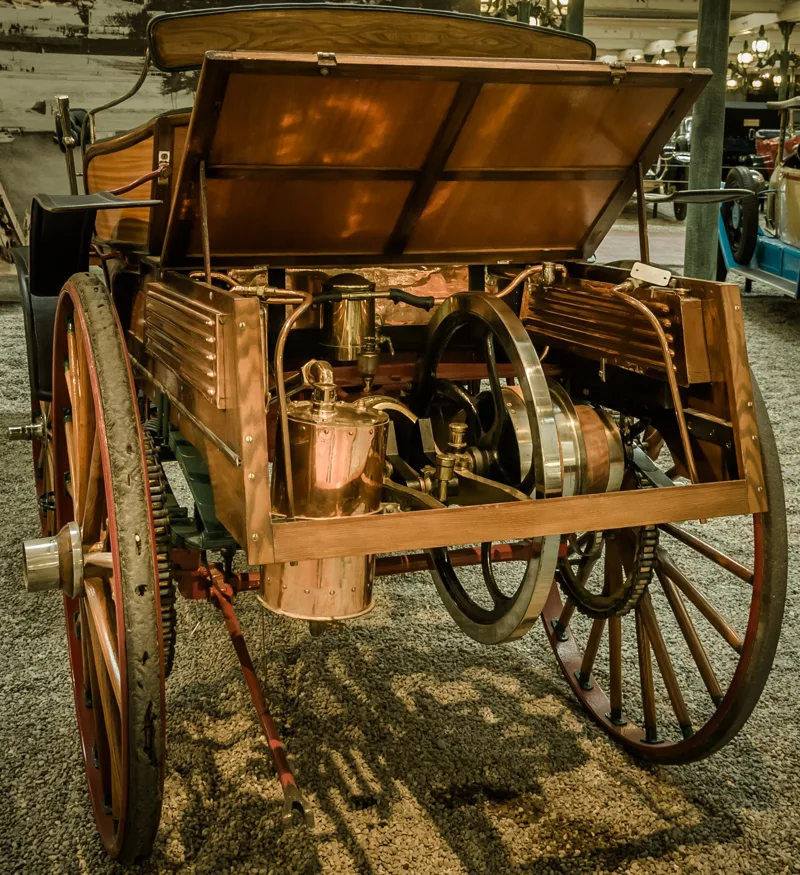
Early cars had magnetos because they had no electrical source worth the name. A magneto generates its own pulses of high voltage, and it survives today mainly in engines without a battery, such as lawnmowers and chainsaws, and in piston aircraft that want an engine independent of the electrical system. As batteries arrived with electric starter motors, induction coils took over. The Benz Patent-Motorwagen of 1886 and Ford's 1908 Model T both used trembler coils, which broke the current through the coil over and over so that each firing produced a quick burst of sparks.
Charles Kettering's system for Delco, introduced on Cadillac's 1912 cars, became the standard for decades because it was cheap and relatively simple. Its single coil fed a distributor, which routed the high voltage to each cylinder in turn, with breaker points to interrupt the primary current and a capacitor to stop the points arcing.
Electronics came next. Delco-Remy tested the first electronic ignition in 1948 and Lucas introduced a transistorised one in 1955, and in 1962 it was fitted to Formula One engines from BRM and Coventry Climax. Pontiac offered the breakerless Delcotronic as an option on some 1963 models. The Fiat Dino became the first production car with electronic ignition as standard in 1968. The Jaguar XJ Series 1 adopted it in 1971, Chrysler in 1973, and Ford and GM in 1975. Lacking moving parts, these systems are more reliable and need servicing less often.
Today the distributor is mostly gone. Ignition systems since the 1990s have largely moved to a design in which several smaller coils are electronically controlled, either one per cylinder or one for each pair in a wasted-spark layout. The coils may be combined in a pack and located away from the plugs, as Nissan first did in 1985 on its RB20DET and CA18DE engines. More and more engines use coil-on-plug, with a small coil attached directly to the top of each plug. If a coil fails, only that one needs replacing instead of the coils for every cylinder.
The wasted-spark arrangement pairs cylinders that reach top dead centre together: 1 with 4 and 2 with 3 on a four-cylinder, and 1/4, 6/3 and 2/5 on a six. One plug fires at the usual time while its partner sparks at the end of the exhaust stroke, and the only drawback is faster plug erosion. Other systems drop the distributor as a timing device altogether and use a magnetic crank angle sensor on the crankshaft to trigger each spark at the right time.
What this means for owners
For anyone looking at a petrol car, the ignition layout tells you what will wear. A coil-on-plug engine has no distributor cap and rotor to replace, and a failed coil is a single-part fix. A wasted-spark car should have precious metal on both electrodes. Diesels, for their part, need no spark plugs at all, since they ignite their fuel by compression, although they usually have glowplugs to preheat the combustion chamber and help starting in cold weather.
If you do pull a plug out, use the right one. Thread size, reach, sealing type and gap are all specified for the engine, and the heat range matters. A plug that is too cold for the duty will foul, and one that is too hot may melt. Both problems were the reason for the move to copper-cored electrodes.
Where this goes next
Several developments are still unfolding. A cup-style terminal introduced in very recent years allows a longer ceramic insulator within the same confined space. Noble metals keep pushing centre wires smaller and sharper without melting. And the plug itself is becoming a sensor: in Saab Direct Ignition, plugs that are not firing measure ionisation in the cylinders, and that measurement stands in for the cam phase sensor, knock sensor and misfire detection.
The control side has already merged. A modern engine control unit manages ignition and fuel injection in one device, where earlier engines ran the two as separate systems.