A smoking experiment that scored its first points in 1978 led, within a decade, to 800-horsepower qualifying engines, a turbocharged world champion and Honda's dominant Williams.
The F1 turbo era began when Renault used a rule allowing 1.5 litre turbocharged engines and entered the RS01 in 1977. It was unreliable at first, but a pole position at high-altitude Kyalami in 1979 showed its promise, and within three years Ferrari, BMW, Honda and Porsche supplied turbo engines. Nelson Piquet won the 1983 title with BMW power.
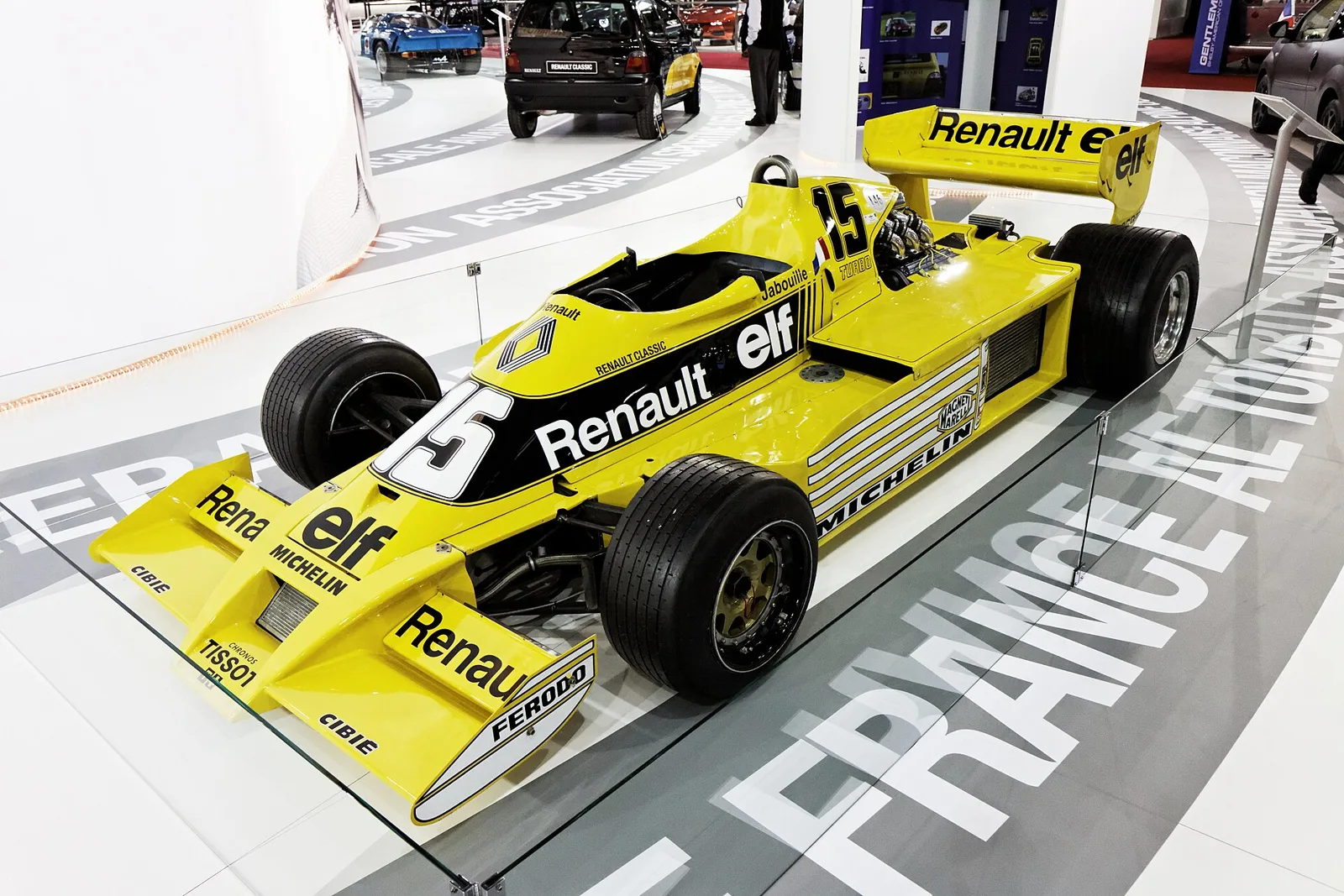
Renault's first Formula One turbo car was so fragile that rival teams named it the yellow teapot, after the cloud of white smoke it tended to leave when its engine blew. Six years after its first race, the same idea carried a driver to the world championship.
How did Renault turn a rule clause into a revolution?
The rulebook allowed 3.0 litre engines without forced induction, plus a little-used clause for 1.5 litre engines with a supercharger or turbocharger. Nobody had taken it up. Teams relied on Ford Cosworth DFV engines, while Ferrari, Matra and Alfa Romeo concentrated on flat-12 engines for themselves and for customers Ligier and Brabham. Renault chose to build a 1.5 litre turbo engine and a car to carry it.
It had evidence to go on. A turbocharged 2.0-litre V6 from Renault had finished second in the 24 Hours of Le Mans in 1977 and won it in 1978, showing that its turbo engines could be reliable as well as powerful. The company had also built the Alpine A500 in 1975 and 1976, a car that never raced but served as a rolling laboratory. Its engine team had even visited the United States to learn from turbocharging in USAC Sprint car racing.
The RS01
The RS01 was the first car from the new Renault Sport division, created when Alpine's and Gordini's competition arms were merged, and designed by Andre de Cortanze and Jean-Pierre Jabouille. It was the first turbocharged Formula One car and also the first to use radial tyres, supplied by Michelin. It made its debut at the 1977 British Grand Prix, and no car with forced induction had started a Grand Prix since the BRM Type 15 of 1951.
Early on it was bulky, overweight and plainly experimental. The cast-iron engine block was made to withstand turbo pressures, the steel-plate chassis was kept simple so as not to hinder engine work, and early cars used a single turbocharger with mechanical fuel injection. Brakes came from Lockheed and the gearbox from Hewland, so Renault leaned on British suppliers. Jabouille, the team's only driver, developed the car through the rest of 1977 and 1978.
The 1970s were years of invention. Lotus had brought in ground effects with its 78, and Tyrrell had built the six-wheeled P34, whose wide rounded nose and enclosed cockpit the early RS01 echoed. Underneath, the RS01 had a chassis of steel plates, double wishbone front suspension and a four-link rear. The look changed often as the team learned, and the car was entirely different by the time it was replaced.
The first points came with a fourth place at Watkins Glen, in the 1978 United States Grand Prix. By then the car barely resembled the machine that first appeared, and the huge turbo lag had been tamed with twin turbochargers. In 1979, Jabouille put a turbo car on pole for the first time, at Kyalami in South Africa. The circuit's altitude suited the turbos, since thinner air cost the naturally aspirated Ferrari and Alfa Romeo flat-12s, and the Cosworth V8, about 20 percent of their power compared with sea level.
At Kyalami's altitude the turbo cars breathed easily while the naturally aspirated field lost roughly a fifth of its power.
Who followed Renault?
The rest of the field took less than three years to follow. By then Ferrari, Alfa Romeo and other manufacturers, among them BMW, Honda and Porsche, were supplying turbocharged engines. The Ferrari, BMW and Honda stories follow.
What did Ferrari learn with the 126C?
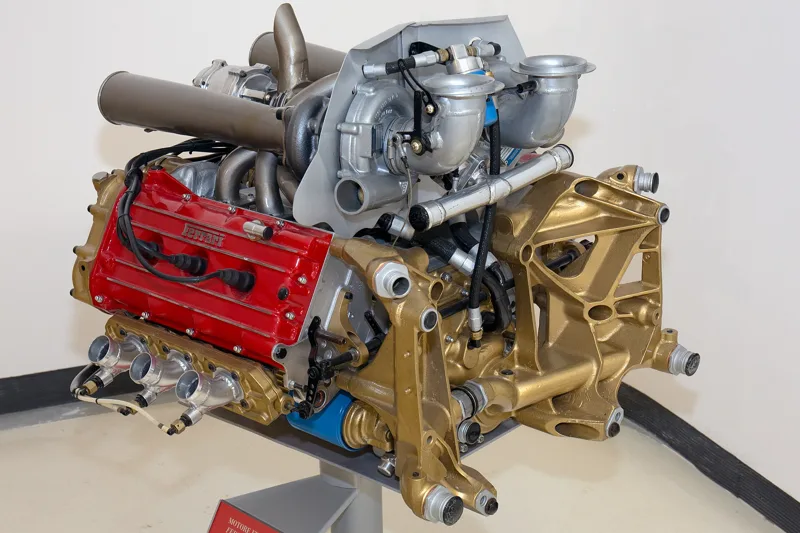
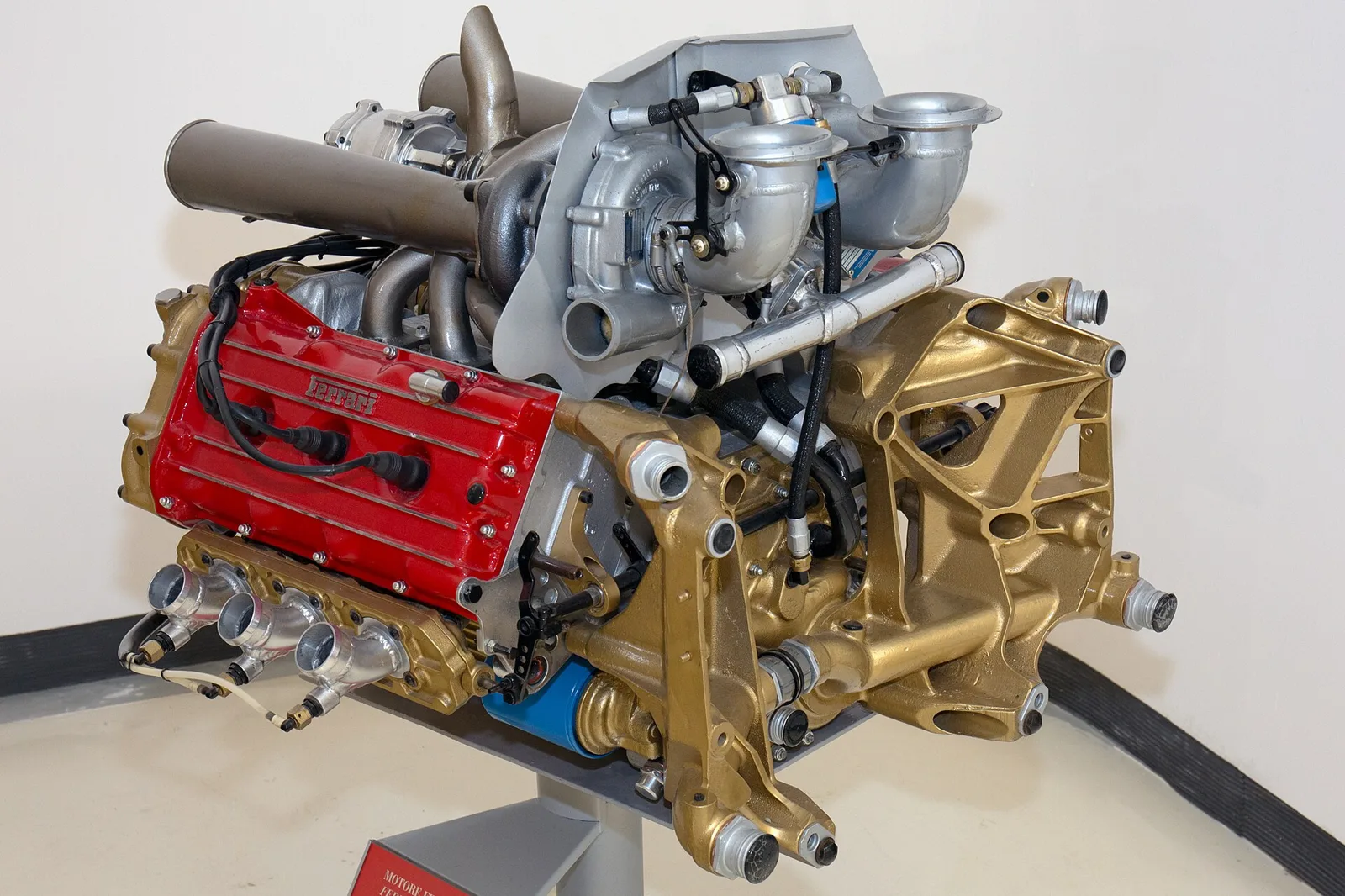
The Ferrari 126C raced from 1981 to 1984. It was Ferrari's first turbocharged F1 car, designed by Mauro Forghieri and Harvey Postlethwaite, with Nicola Materazzi in charge of the engine. A narrower V6 with forced induction suited the ground-effect aerodynamics of the day better than the old wide flat V12, which obstructed the airflow a ground-effect car needed.
Ferrari tested a Comprex pressure-wave supercharger from a Swiss company. Drivers liked it because it behaved like a naturally aspirated engine with a wider power range and no turbo lag. It was also tall in the car, and exhaust and intake gas could mix, so the team went with twin KKK turbochargers. That engine made around 600 bhp (447 kW; 608 PS) in qualifying and 550 bhp in race trim in 1981.
A big red Cadillac
The 1981 car was quick and difficult. Gilles Villeneuve won in Monaco and Spain, but he called it a big red Cadillac. Postlethwaite later said it had a quarter of the downforce of the Williams or Brabham that year. With a hard suspension, a violent surge of turbo power and poor aerodynamics, it slid into corners and chewed its tyres. It worked best on fast circuits such as Hockenheim, Monza and Buenos Aires, and on Monaco and Jarama, where mechanical grip counted for more than downforce.
For 1982 the car was overhauled. The 126C2 had Ferrari's first genuine full monocoque, built from honeycomb aluminium panels, and vastly improved aerodynamics. Power rose to 650 bhp (485 kW; 659 PS) in qualifying and about 600 bhp in races. At the Long Beach Grand Prix, Ferrari ran two thin rear wings, each as wide as the rules allowed, mounted next to one another but offset front to back, so that they acted as one double-width wing. It was a deliberate use of a loophole, in retaliation for the water-cooled brakes Williams had used at the previous race in Brazil, and a message to the governing body during the FISA-FOCA wars. Villeneuve finished third and was disqualified. It was a season of tragedy: Villeneuve died during qualifying in Belgium and Didier Pironi's career ended after a serious accident in Germany. Ferrari still won the constructors' championship, with Patrick Tambay and Mario Andretti drafted in.
Flat bottoms became mandatory in 1983, cutting ground effect. Postlethwaite fitted an oversized rear wing that recovered around 50 percent of the lost downforce, and the engineers lifted power to roughly 800 bhp (597 kW; 811 PS) when qualifying, and more than 650 bhp for racing, widely regarded as the best figures of that season. Tambay and Rene Arnoux scored four wins between them in the 126C3, and Ferrari took the constructors' title again. In 1984 the 126C4 produced about 850 bhp, enough to match BMW, Renault and Honda and to beat the TAG-Porsche engines used by McLaren, but the car lacked grip and McLaren dominated. Ferrari's one win came from Michele Alboreto at Zolder. Refuelling was banned in 1984 and cars were limited to 220 litres per race, so high wing settings, which hurt fuel economy, also forced drivers to ease off.
How did Brabham and BMW win the title?
The Brabham BT52 was designed by Gordon Murray for 1983 and powered by the BMW M12/13 four-cylinder turbo engine, which made roughly 850 bhp (630 kW) in qualifying trim and about 650 bhp (480 kW) in races. When ground-effect cars were banned and flat undersides were mandated for safety, Brabham had only six weeks before the opening race in Brazil, and three finished BT51 cars suddenly useless. Murray started again.
The BT52 had stubby, angular sidepods that kept lift down, about 70 percent of its weight at the rear for traction, a dart-shaped profile and an oversized rear wing to claw back downforce. Its monocoque combined aluminium and carbon fibre. Because refuelling stops returned in 1983, it carried a small fuel tank high behind the driver.
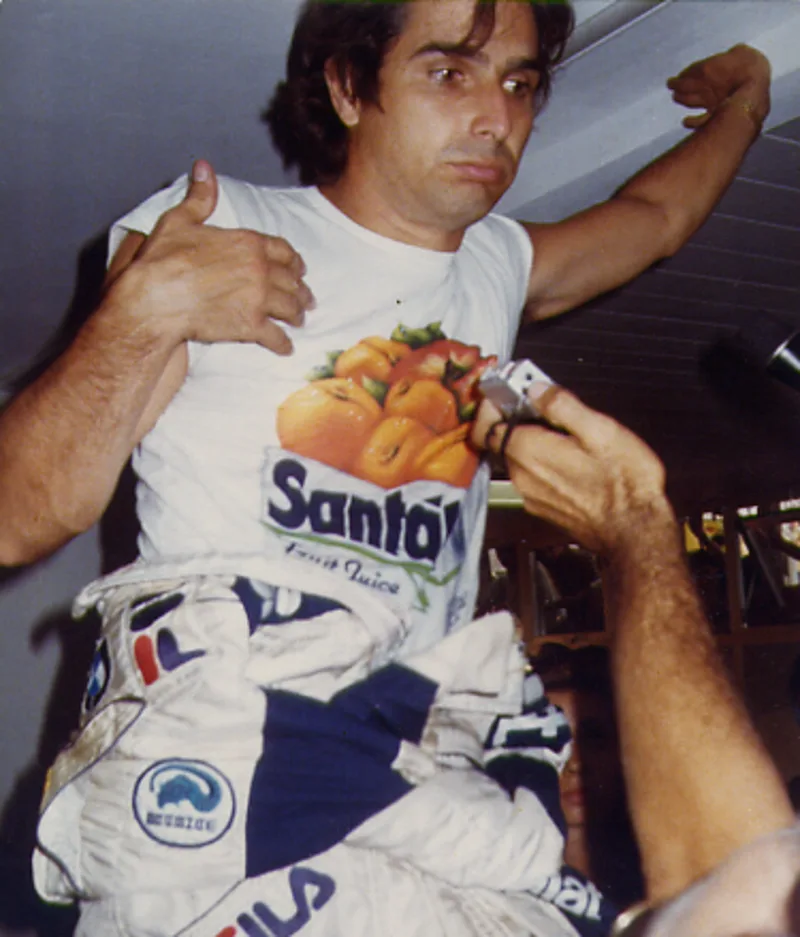
Nelson Piquet found it easy to drive. After a run of bad luck mid-season, and with a special batch of fuel from German company Wintershall plus further development, he won in Brazil, Italy and the European Grand Prix, and scored three second places and two thirds. His total of 59 points made him the first world champion to do it with turbo power. His team-mate Riccardo Patrese finished ninth on 13 points, and Brabham took third in the constructors' standings with 72 points, 7 behind Renault and 17 behind Ferrari.
What did Honda and Williams do with the turbo?
The Williams FW11, designed by Frank Dernie, ran in 1986 and, as the FW11B, in 1987. Both used Honda's 1.5-litre turbocharged V6, with Nigel Mansell and Piquet driving. The car won nine races in each season, and Williams comfortably took the constructors' title both years.
The 1986 season ended in disappointment. Both drivers challenged for the title and Mansell needed only third place at the final race in Australia, but a spectacular blow-out cost him, and Alain Prost's McLaren took the championship. The team was working through the aftermath of the near-fatal road accident of Frank Williams, who survived but was left a quadriplegic, with Patrick Head running the team until Williams was back in the pits late that year.
In 1987 the FW11B finished the job. Piquet was champion despite winning fewer races than Mansell, who took six victories, including a memorable pass for the lead at Silverstone with three laps left. Williams developed its own active suspension, named Reactive Ride because Lotus held rights to the active-suspension name. Piquet found the car superior to the conventional one. Mansell had little faith in the idea after trying a different version on the Lotus 92 in 1983. Dernie first fitted a hydraulic variant to a 1984 FW09, and Piquet reported that it rode smoothly but handled badly, so Dernie redesigned it as an electronic, computerised system with help from Paddy Lowe and Steve Wise. In a race simulation at Imola, Piquet completed 59 laps some 3 minutes faster than Mansell's winning time earlier that year, although he had the circuit to himself. The Williams system was lighter, simpler and drained far less of the Honda engine's output than Lotus's did. Piquet first used it in competition at Monza, where he recorded the season's highest speed, 218.807 mph (352.135 km/h), some 5 mph faster than Mansell's conventional car, and won from pole.
Over two seasons the FW11 took 18 wins, 16 pole positions and 278 points, on the back of sound engineering, outstanding aerodynamics, the engine's sheer power and fuel economy that was even better than the TAG-Porsche engines in the McLarens.
How do the turbo engines compare?
| Car | Engine | Qualifying power | Race power |
|---|---|---|---|
| Ferrari 126C (1981) | Twin KKK turbo V6 | About 600 bhp | 550 bhp |
| Ferrari 126C2 (1982) | Turbo V6 | 650 bhp | About 600 bhp |
| Ferrari 126C2B (1983) | Turbo V6 | About 800 bhp | Over 650 bhp |
| Brabham BT52 (1983) | BMW M12/13 four-cylinder turbo | About 850 bhp | About 650 bhp |
What happened next?
Honda announced during the 1987 season that it would move to McLaren for 1988, despite a year remaining on its Williams contract. The company was believed to be unhappy that Williams had not made Mansell give way to Piquet, and a second rumoured reason was that the team had declined to swap Mansell for Satoru Nakajima. At the Hungarian Grand Prix, Piquet revealed that he was joining Lotus for 1988, again with Honda power.
No Williams ran Honda power after the FW11B, and none used a turbo again until the FW36 of 2014. An interim car, the FW11C, was built only for testing, to prepare for the Judd V8 engine that powered the FW12 in 1988; it never raced.