Nations, football clubs, women drivers and retired Formula One stars each got a series of their own, and each ended in cancelled races and unpaid bills.
A1 Grand Prix, Superleague Formula, W Series and Grand Prix Masters all folded for financial reasons rather than sporting ones. A1GP was liquidated after its fifth season was cancelled, Superleague lost most of its 2011 races, W Series entered administration owing GBP 23 million, and Grand Prix Masters was wound up in 2007.
When the W Series went under, its administrators ended up auctioning 722 lots that ran from chassis and gearboxes to unclaimed trophies, race suits and vacuum cleaners, and the books showed debts of GBP 23 million owed to 151 creditors. Four racing series with four different big ideas, and not one of them died on the track.
A1 Grand Prix put nations on the grid, Superleague Formula put football clubs there, the W Series gave women a ladder, and Grand Prix Masters gave retired Formula One stars one more go. Each found an audience. Each also found a way to run out of money, and the way it happened says more about racing than any single result.
A1 Grand Prix: a World Cup of motorsport
The pitch was simple enough to explain on a napkin. In A1 Grand Prix, which ran from 2005 until 2009, competitors represented their country rather than a team or themselves, and the series was promoted as the World Cup of Motorsport. It was a single-make open-wheel championship ratified by the FIA, and it raced in the northern-hemisphere winter, when Formula One was idle.
The concept was dreamed up in 2003 by Sheikh Maktoum Hasher Maktoum Al Maktoum, from Dubai. With the FIA on board, Brian Menell and Tony Teixeira came in as executive directors to sell franchises. Thirty were on offer: twenty-three reserved for specified nations and seven opened to tender for countries that had not been targeted at the start. Twenty-five had sold in time for the first season, which began on 25 September 2005 at Brands Hatch in Kent.
How a weekend worked
Practice filled Friday and Saturday morning. Saturday afternoon brought a qualifying scheme split into four ten-minute sessions with three laps each, which left room for just one flying lap. The first two sessions set the grid for the Sprint Race and the last two set it for the Feature Race.
The Sprint Race ran for a maximum of 24 minutes plus a lap from a rolling start, with a mandatory stop between laps four and eight. The Feature Race was around 180 km (110 mi) from a standing start, with two compulsory stops, the second in a window that was only announced after the first had closed. A PowerBoost button gave drivers four uses in the Sprint and eight in the Feature.
Each found an audience, and each also found a way to run out of money.
How A1 Grand Prix ran out of road
The first season looked healthy. Nelson Piquet Jr won the opening race for Brazil, then France took control with wins at Estoril and in Malaysia, and in Shanghai France took the first world title with 172 points to Switzerland's 121 and Great Britain's 97. The planned twelve rounds had shrunk to eleven when a race at Curitiba was cancelled.
In the second season Team Turkey failed to find funding, and Austria, Japan, Portugal and Russia did not return, although Portugal came back for the final four rounds once it had secured cash. Germany won with 128 points, 35 clear of New Zealand. Sheikh Maktoum announced in September 2006 that he would step down, and his exit was confirmed in December, when RAB Capital took his position. RAB Capital paid $200 million for his 80 per cent stake even though the chief executive had reported a first-season loss.
Switzerland won in 2007-08 with Neel Jani, in the last year of the Lola-Zytek car, with two mandatory pit stops and E30 biofuel added. Then came a decision that, according to the champion Neel Jani, 90 per cent of the teams had warned against. In October 2007 Teixeira announced a six-year deal for Ferrari to build the engines and advise on the car, partly to calm worries about the series' finances and its ability to attract sponsors. The 2008-09 car, branded Powered by Ferrari, was used for one season only, and the teams had warned Teixeira in advance that the switch was untimely and a poor use of money.
Three rounds that season, in Italy, Indonesia and Mexico, were cancelled, and a proposed Brazilian race fell through. Ireland's Adam Carroll took the title. RAB Capital wrote down its A1GP investment for a third time before the season began, and team boss Alan Jones suggested that Teixeira had bought RAB out before the season, yet RAB branding stayed prominent until racing stopped in 2009.
The fifth season never began. The opening round, planned for Australia within an established race meeting, was called off just five days before practice, with the cars and infrastructure still stuck in London and no word from the series. The Queensland government had underwritten the event and raised the possibility of legal action. On 5 November 2009 the races in China and Malaysia were called off, and the last round, in the Netherlands, was handed to Superleague Formula instead. Reports said Ferrari would pull out over non-payment, and a restructuring was announced to secure the long-term future, and the already liquidated operating company was put forward for administration.
The aftermath played out in court. On 18 January 2010 the High Court in London heard a dispute over who owned the cars, and on 21 January it ruled that administrator Tim Bramston, with A1 Holdings, had won. The assets went to A1 Grand Prix Operations, and the liquidators appointed an asset-sale firm and sought GBP 10 million for them.
Superleague Formula: football clubs and V12 power
Superleague Formula, the work of businessmen Alex Andreu and Robin Webb, ran from 2008 to 2011 and sold itself as football at 300 km/h. Football clubs sponsored the cars by association. The league was announced in 2005 and won full FIA approval in December that year, with a target grid of twenty single-car teams and central sales, marketing and technology work to cut costs.
Every team used the same Panoz DP09 with a 4.2-litre V12 producing 750 bhp (560 kW) at 11,750 rpm. The cars had no traction control, launch control or anti-stall, and a Push to Pass button added in 2010 raised the rev ceiling to 12,000 rpm for at least 15 seconds, up to eight times across the two races. Unlike A1 Grand Prix, the season ran from April to November, alongside the other European series.
A year-by-year ladder
The first season, 2008, went to Beijing Guoan and Davide Rigon, across six double-headers with 18 clubs. The series said its debut race was seen in 62 countries and that 34,000 fans attended the finale at Jerez. In 2009 Liverpool won with Adrian Valles, with 19 clubs, and a Super Final shoot-out was introduced for the six fastest cars at four of the six rounds.
The 2010 season was the big gamble. The calendar doubled from six rounds to twelve, and the prize fund soared: 1 million euros for the champion, over 5 million euros in total, and up to 2.2 million euros for an entry that won everything. In July 2010 organisers announced that the series would leave Europe for the first time, for two weekends in China in October, and the Beijing street circuit had been built for the championship.
Why did Superleague Formula fold?
The football link faded first. In 2011 only six clubs continued, and by then more than half the teams had no connection with football at all. Andreu had already stepped down as president on 19 May 2010, replaced by Alfredo Brisac, and the Sonangol Group stopped as title sponsor after 2010.
Then the calendar fell apart. Over three-quarters of the 2011 events were cancelled, and in September organisers were still hunting for confirmation of their autumn races. After the Chinese rounds were cancelled there was no news about 2012, drivers and teams moved to other championships, the website stopped updating in 2011, and no further seasons were run. The series lasted four seasons.
The cars also trailed Formula One by a wide margin. At Monza in 2009, where dry conditions allowed a fairer comparison, the fastest Superleague lap was 13.5 seconds slower than the fastest Formula One lap.
The W Series: an all-female ladder
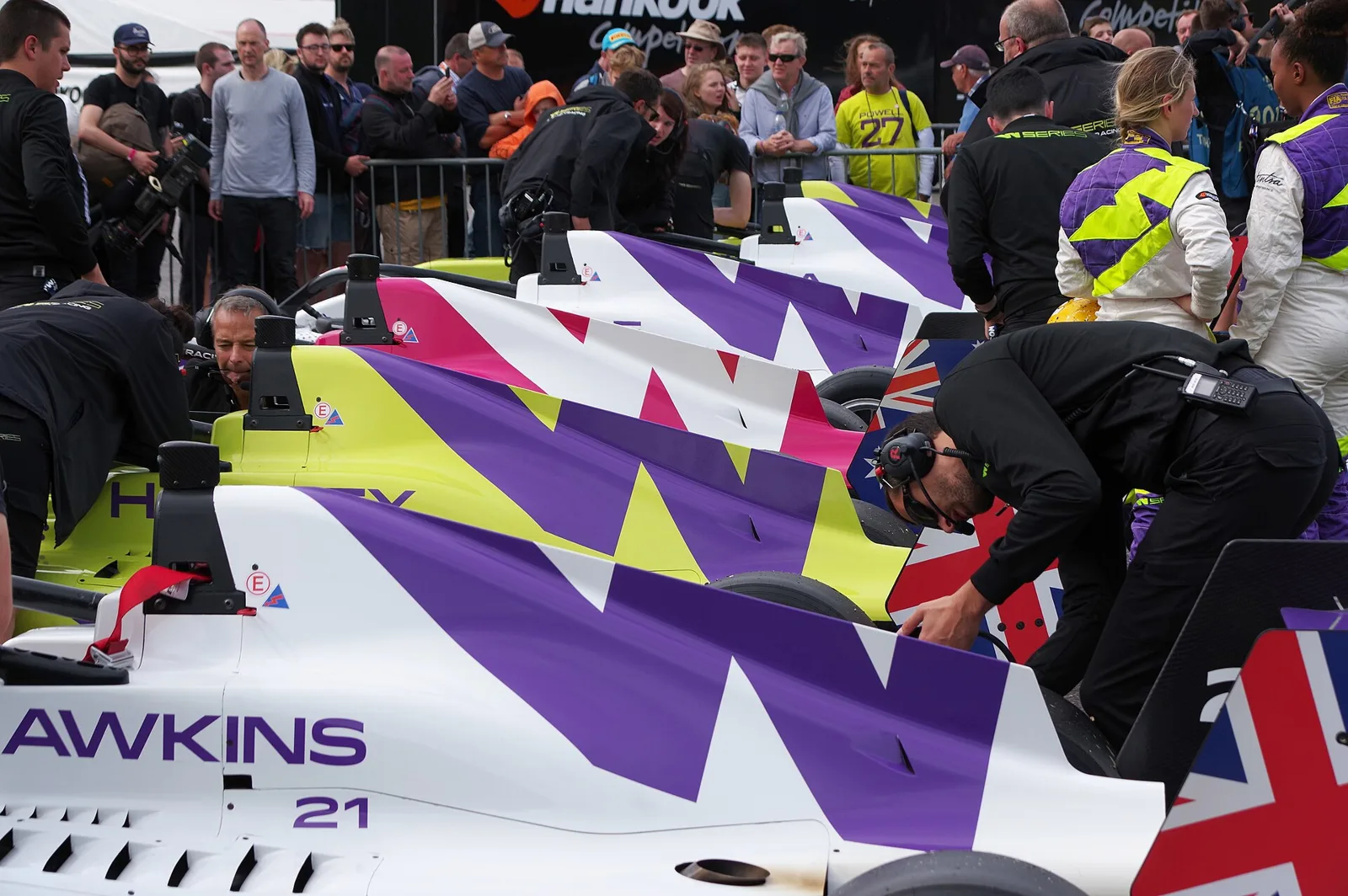
The W Series was launched publicly on 10 October 2018 in response to the lack of women progressing to the top of motorsport, and Formula One in particular. Scottish businessman Sean Wadsworth was the main financier, and solicitor Catherine Bond Muir was chief executive. David Coulthard and Adrian Newey were among the shareholders.
The 2019 season ran in support of the DTM touring-car series, with six rounds and every car run by Hitech Grand Prix. For the 18 full-time seats plus two reserves, 61 drivers were longlisted, 54 turned up for evaluation, and 28 shortlisted drivers tested the Tatuus-Alfa Romeo F3 T-318 cars. Jamie Chadwick took the first title, despite finishing behind Beitske Visser in the Brands Hatch finale.
The 2020 season was cancelled because of the pandemic and replaced by a ten-event online series, which Visser won. From 2021 the championship ran in support of Formula One, now with Double R Racing as technical partner and a system of nine commercial entrants, two cars each, designed to attract investment. Chadwick took the title again, and in 2022, on a calendar expanded to ten races, she was declared champion for a third time in a row. From 2020 the series also carried FIA Super Licence points, 15 of them for the champion.
How the W Series ran out of money
Trouble surfaced after the Hungarian round in 2022, when company filings dated 5 September showed net liabilities of more than GBP 7.5 million to the end of 2021, including debts to a media production company and a hospitality provider. The sixth round was moved from Suzuka to Singapore for what the organisers called operational challenges. On 10 October 2022, a week after Singapore, the last three races were cancelled over financial issues, which made Singapore the final race. Chief executive Bond Muir said she was confident the championship would return in 2023.
It did not. In November 2022 Formula One announced F1 Academy, a Formula 4-level series for young women, due to debut in 2023, and W Series stayed silent on its fate. On 15 June 2023 the series went into administration. Administrators Evelyn Partners confirmed two months afterwards that the last employee had gone and that assets, among them 19 Tatuus cars, were to be sold in late September. The closing position showed profits of GBP 515 against GBP 23 million of debts. Several drivers, among them Alice Powell, Abbi Pulling and Visser, said 2022 prize money had never been paid.
Auction followed in late January 2024. In July 2024 Formula E bought the series' intellectual property for GBP 110,000 as part of clearing the debts. Reports said the series was still owed US$20 million by 2021 commercial entrant The Bunker and US$52,000 by 2022 entrant Caitlyn Jenner.
Grand Prix Masters: retired stars, one more lap
Grand Prix Masters was modelled on the seniors tours of golf and tennis. To enter, a driver had to be retired from open-wheel racing, have completed two full Formula One seasons, pass a medical and be over 45 on 1 January of the next season, a limit lowered to 40 for 2006.
Everyone raced the same car, based on the 2000 Reynard 2KI, with a chassis from English constructor Delta Motorsport and a 3.5-litre, 80-degree V8 from Nicholson McLaren. The organisers claimed more than 650 bhp at 10,400 rpm, and promoters said the 650 kg (1433 lb) cars reached 200 mph (320 km/h). There were no electronic driver aids such as traction control, power steering or ABS, and the brakes were steel rather than carbon, deliberately lengthening braking distances. A Mecachrome 4.0-litre V8 making 600 bhp (450 kW) was planned for 2007.
Testing began with Delta's operations director Simon Dowson in late September 2005. In mid-October Nigel Mansell and Rene Arnoux tried the car at Pembrey in South Wales, and a multi-car test at Silverstone on 26 October put eight former Formula One drivers on track, with Andrea de Cesaris fastest and Patrick Tambay crashing.
Why did Grand Prix Masters fold?
The first race at Kyalami in South Africa, on 13 November 2005, went to Mansell from pole after a hard fight with Emerson Fittipaldi, with Riccardo Patrese third. Alan Jones, 1980 world champion, lapped up to ten seconds slower than Mansell in practice and pulled out of the race, officially with a neck injury. Fitness was a running question: Christian Danner had doubted the shape of Jones and Tambay.
Only two races were held in 2006, at Losail in Qatar on 29 April and Silverstone on 13 August. The Monza round was cancelled because of noise limits, and later Sepang and Kyalami fell away. For 2007 three races were scheduled, at the Bucharest Ring, Kyalami and Losail, and all were cancelled because of the organiser's bankruptcy.
On 18 September 2007 Delta Motorsport, the chassis supplier, petitioned the British High Court to put the operating company into liquidation over unpaid invoices. After a hearing on 28 November 2007 the series was officially wound up.
Four ideas compared
| Series | Years | Big idea | How it ended |
|---|---|---|---|
| A1 Grand Prix | 2005 to 2009 | Nations, not teams | Fifth season cancelled; operating company liquidated |
| Superleague Formula | 2008 to 2011 | Football clubs on identical V12 cars | Over three-quarters of 2011 events cancelled; no further seasons |
| W Series | 2019, 2021 and 2022 | All-female single-seater ladder | Last three 2022 races cancelled; administration in 2023 |
| Grand Prix Masters | 2005 and 2006 | Retired Formula One drivers in identical cars | 2007 calendar cancelled; wound up in November 2007 |
What the four got right and wrong
Each series spotted a gap. A1 Grand Prix used national pride to fill the Formula One off-season, and twenty-nine nations started at least one race. Superleague Formula borrowed the following of football clubs and promised the biggest prize fund in European motorsport. W Series answered a real shortage of women reaching the top. Grand Prix Masters offered nostalgia in a package built on the golf and tennis seniors model.
The failures also share a pattern, and it is financial rather than sporting. A1 Grand Prix switched to a new car in its last season, a move that according to champion Jani most teams had warned against. Superleague Formula raised its prize money in 2010, then saw its football clubs drift away. W Series relied on commercial entrants and left debts of GBP 23 million. Grand Prix Masters stopped when its chassis supplier went to court over unpaid bills.
Where this goes next
Several of the four have been rumoured or announced as returning. In July 2010 Autosport published a report on its rumours blog that A1 Grand Prix would be revived for 2011-12 with 18 countries and ten race weekends, using a GP2-style model in which teams find their own funding. In 2011 a successor called the A10 World Series was rumoured, pitched as a worldwide single-seater series on 600 bhp V10 power, but its holding company was formally dissolved in early 2012.
In 2014 ISRA took the 2005-08 Lola-Zytek cars and built Formula Acceleration 1. In May 2015 South Africa's AFRIX Motorsport said it had bought the last 21 Powered by Ferrari cars from a freight firm holding a lien over them, planning a one-make series for the southern summer. And in May 2023 a return for A1GP was announced with 100 million dollars of funding planned.
Delta Motorsport said in early 2008 that it intended to relaunch Grand Prix Masters as F1 Masters using the original car. For W Series the future now sits with Formula E, which owns the intellectual property, and with F1 Academy, which Formula One said would run a step below W Series from 2023. No plans have been reported for Superleague Formula.