A Canadian-built SUV, a Chinese Buick turned Chevrolet, a Brazilian pickup and a mini MPV with 23 seat arrangements.
The Tracker is a mini SUV from Ontario. The Sail is a subcompact built in China and later in Colombia and India. The Montana is a Brazilian-built pickup, and the Spin is a Brazilian-designed mini MPV. Each was developed for a specific market.
The first Buick ever made in China was not a luxury saloon. On 12 December 2000 a small, cheap family car rolled off a production line carrying the Buick badge, and it is the ancestor of the Chevrolet Sail now sold in Chile and a string of other markets. Small Chevrolets have a habit of ending up somewhere unexpected, and the Tracker, Sail, Montana and Spin show how.
What are the Chevrolet Tracker, Sail, Montana and Spin?
Four small Chevrolets, each aimed at a different part of the world. The Tracker is a mini SUV first built in Canada for North America. The Sail is a subcompact from General Motors' joint venture in China. The Montana is a front-wheel-drive pickup built in Brazil, and the Spin is a mini MPV designed in Brazil for South America.
They share a brand and little else: different continents, different factories and, in the Montana's case, different names depending on the country.
The first Chinese-made Buick was a small family car, and it became a Chevrolet.
Where did the Chevrolet Tracker come from?
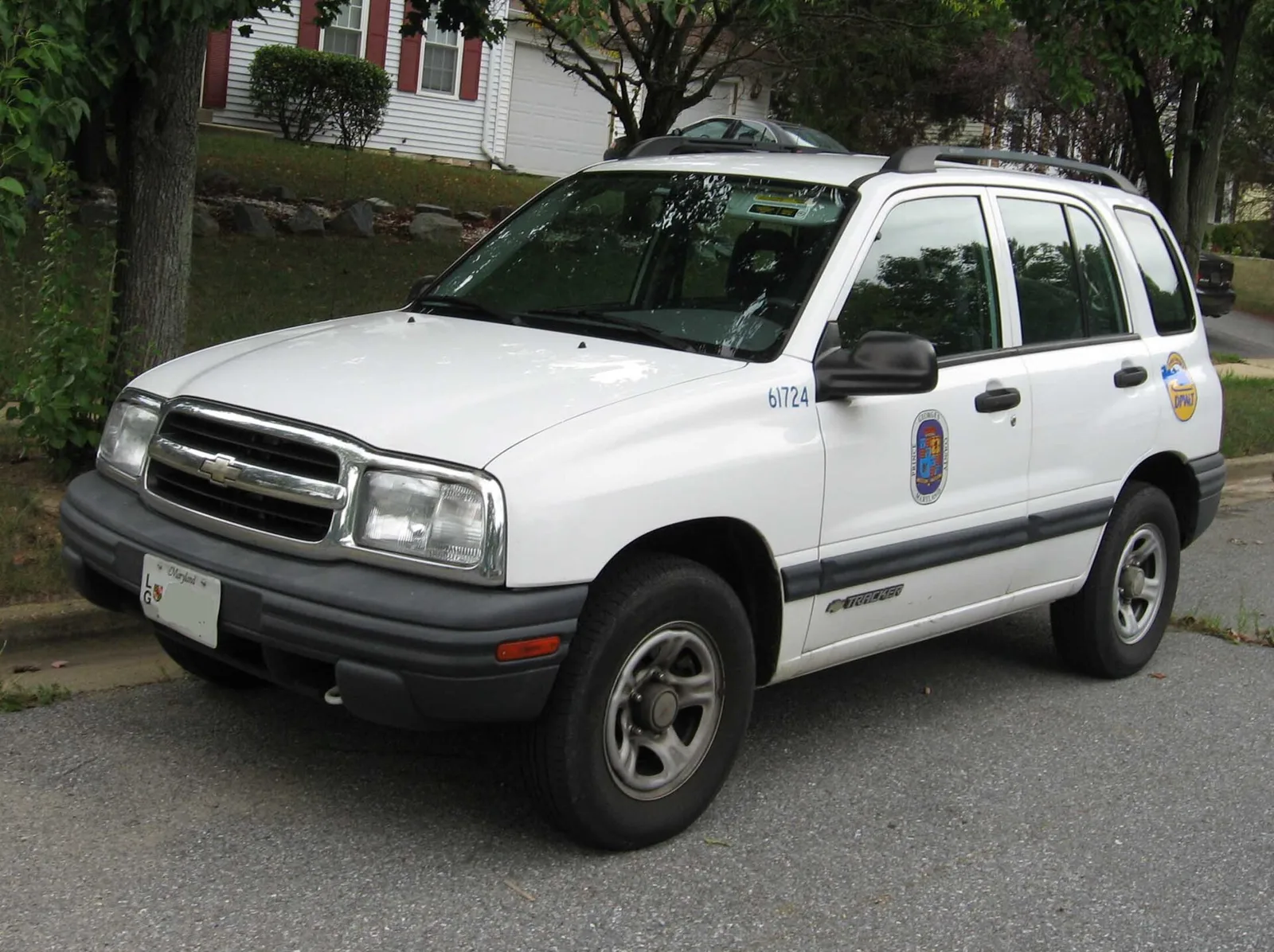
The Tracker began as the Geo Tracker, which went on show in late 1988 as a 1989 model. CAMI, a joint venture of General Motors of Canada and Suzuki, developed it and planned to build it in Ingersoll, Ontario beside its near-identical twin, the Suzuki Sidekick (sold elsewhere as the Escudo).
Delays at the Canadian factory meant nearly all 1989 cars and some 1990 cars came from Japan instead. Ingersoll began building Trackers in late 1989, about 6,100 of them at first, with annual output projected at around 200,000. For a time all Canadian-built Trackers were sent to the United States to get around the 25 percent Chicken Tax, while Canada itself was supplied from Japan.
What made the Tracker different?
It was a small SUV with a real truck underneath. The chassis was a light-truck design, the car was certified as a light truck, and the four-wheel-drive system included a hi-lo transfer case. The front suspension was strong, steering used a recirculating ball box, and the rear axle came from the light-truck parts bin and sat on coil springs.
The result was a fairly truck-like ride, but also notable durability in harsh conditions. The first engine was Suzuki's 1.6-litre four-cylinder with 80 hp (60 kW). Every Tracker had four-wheel drive until a two-wheel-drive convertible joined the range in 1992.
A four-door arrived for the 1996 model year with a 16-valve 1.6-litre making 96 hp (72 kW). The Geo name was folded back into Chevrolet in 1997, and cars were rebadged Chevrolet in 1998.
How did the Tracker end up with so many names?
In Canada, where the Geo brand did not exist at first, the Tracker went on sale in 1989 as both a Chevrolet and a GMC. Geo reached Canada in 1992. The GMC version turned into the Asuna Sunrunner for 1992, and after two years the Sunrunner became a Pontiac, sold until 1998.
Elsewhere the names multiplied. The second generation, introduced in 1999, was sold in North America as a Suzuki Vitara and in Mexico as the Chevrolet Tracker. In Latin America General Motors sold the Suzuki Vitara and Grand Vitara as Chevrolets, and cars built by GM Argentina went to Brazil and Mexico as the Tracker. CAMI built its last Tracker on 27 January 2004 and gave the line over to the Chevrolet Equinox.
What happened in Mexico, the Philippines and Brazil?
Mexico received the Geo Tracker from 1994, imported from Canada, dropped it in 1996, then brought it back in 1998 as a Chevrolet. A new generation arrived in 2000, a V6 option was offered from 2002 to 2004, and the car was facelifted in 2005. It stayed on sale in Mexico and Brazil after North America stopped and gave way in the summer of 2008 to the four-cylinder Captiva Sport.
In the Philippines, GM brought the Tracker in late 1999 from Canada with Suzuki's 2.0-litre engine and a four-speed automatic, and pulled it in 2001 because of low sales. In Brazil, official sales began only with the second generation in 2001, diesel and four-door only. Suzuki left the Brazilian market in 2003 as the dollar soared.
Was the Geo Tracker safe?
A 1995 Insurance Institute for Highway Safety report counted 21 driver deaths among 66,210 registered 1991 to 1993 two-wheel-drive Geo Trackers, the highest rate it reported, at 3.2 per 10,000 vehicles. Four-wheel-drive cars had 48 among 271,355 (1.8 per 10,000), against 1.6 per 10,000 for the small utility class overall.
The study was widely criticised for faulty comparisons, because it did not separate two-door from four-door cars. A later IIHS study found two-door Trackers had a slightly below-average injury rate, and four-door models were better than the average for utility vehicles.
What is the Chevrolet Sail, and how did it spread?
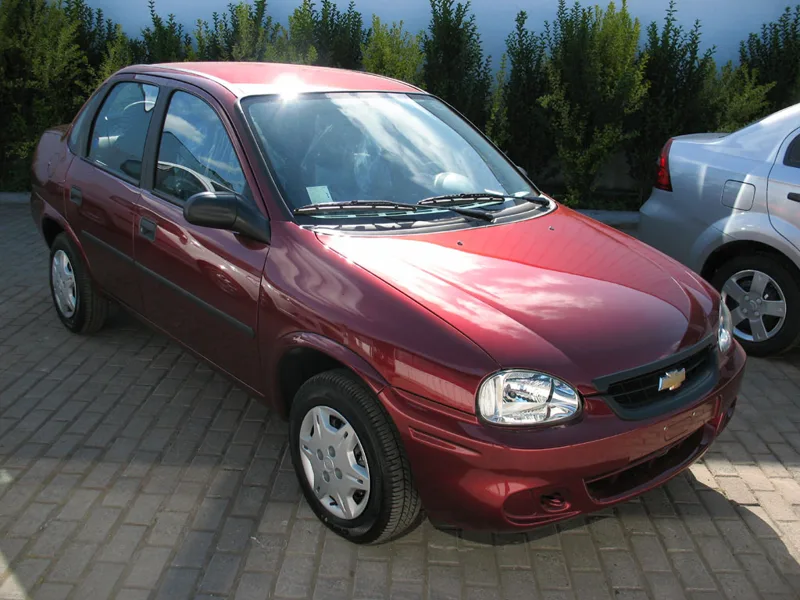
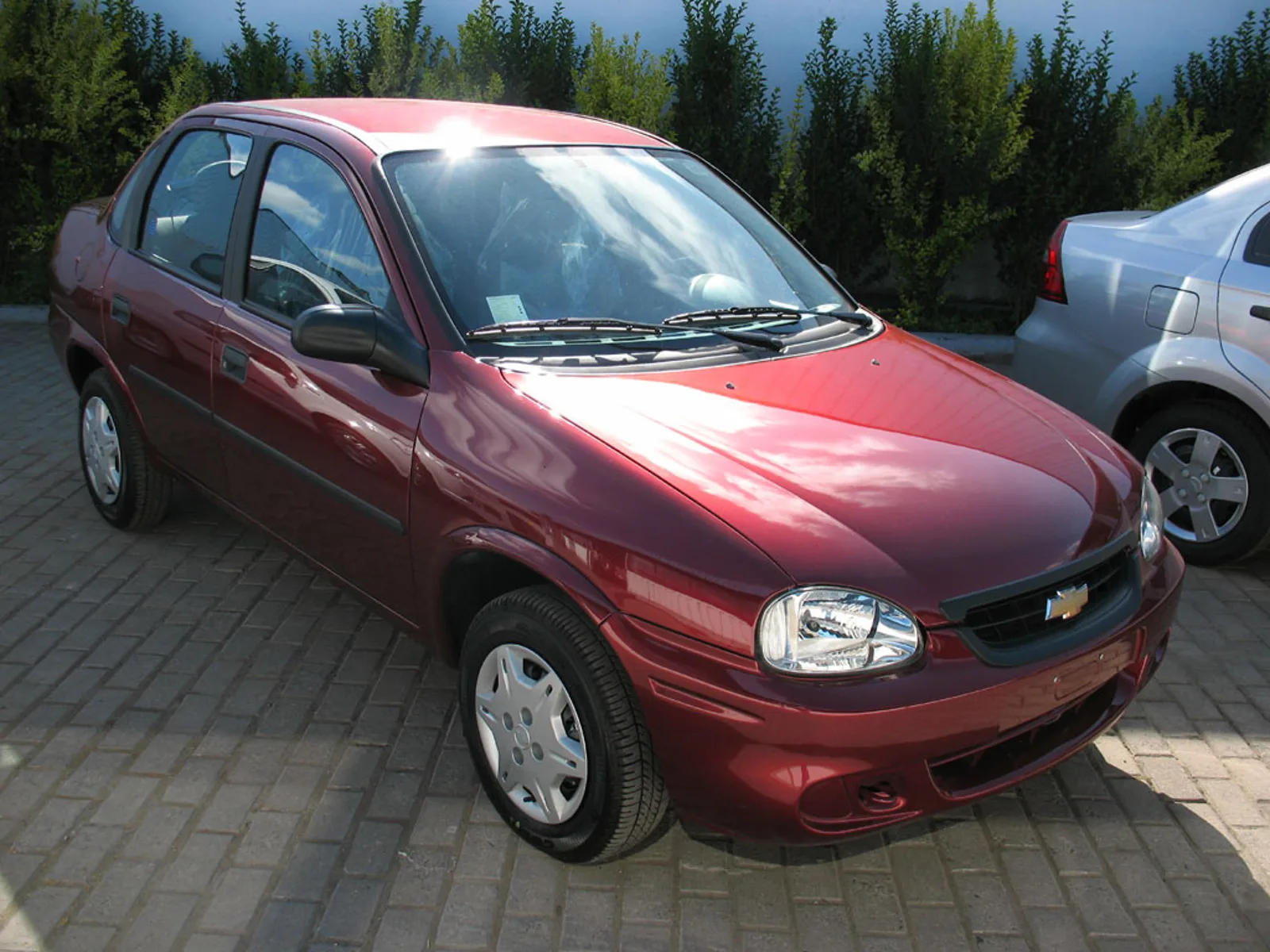
The Sail grew out of a Buick. The first Chinese-made Buick, in December 2000, was a four-door saloon based on the Opel Corsa B, and series production started in June 2001. Aimed squarely at young families, it was the first compact car from the SAIC-GM joint venture, with a 1.6-litre engine producing 92 PS (68 kW), a five-speed manual and a price under 100,000 RMB. A wagon, the Sail S-RV, followed in December 2001.
When Chevrolet returned to China in February 2005 after the failure of the Jinbei-GM venture, the Sail was the first Chevrolet passenger car that Shanghai GM built. The wagon grew to 4,097 mm, which is 71 mm longer than before, and the 90 PS (66 kW) engine stayed, joined later by a four-speed automatic. The claimed top speed for the manual car was 177 km/h (110 mph).
It travelled early. In autumn 2006 the Chinese-built car went to Chile as the Chevrolet Corsa Plus, with standard equipment that included dual front airbags, ABS, air conditioning, electric windows and central locking. The Chevrolet Classic, wearing Sail bodywork, reached Latin America as a 2010 model, and Argentina built the sedan until October 2016 with a 1.4-litre 8V engine rated at 69 kW (94 PS). Brazil got a 1.0-litre Flexpower engine producing 56.7 kW (77 PS) on petrol and 57.4 kW (78 PS) on alcohol.
How did the second-generation Sail change?
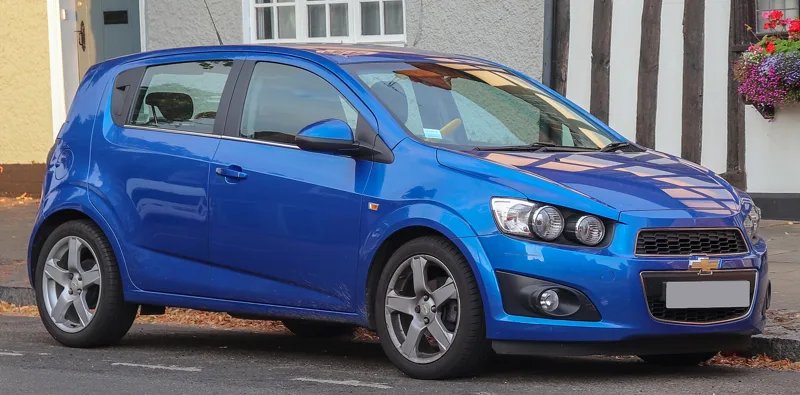
The all-new Sail arrived on 11 January 2010, with design and engineering by PATAC, the Pan-Asia Technical Automotive Center. It offered a 1.2-litre S-TEC II engine with 64 kW or a 1.4-litre S-TEC III with 76 kW, a five-speed manual or a five-speed electronic manual transmission, and standard airbags, central locking, USB input and power steering. Pricing started at 56,800 RMB. A hatchback followed at the 2010 Auto China show in Beijing, about 3,947 mm long with up to 1,215 litres of luggage space. The first exports left for Chile and Libya on 21 October 2010.
In its most basic Latin American form, lacking airbags, ABS and stability control, it scored zero stars for adults and two for toddlers from Latin NCAP 2.0 in 2016.
In India the Sail U-VA hatchback was launched nationwide on 2 November 2012 after a showing at the New Delhi Auto Expo. It offered 25 storage spaces and a 60:40 folding rear seat. A 1.3-litre turbodiesel returned 22.1 km/L and a 1.2-litre petrol 18.2 km/L. By 2018 the Indian cars were 80% locally sourced. On the Pacific coast of South America, the Sail is assembled from kits in Ecuador and made in Bogota by GM Colmotores, at least 90% in Colombia.
Was there an electric Sail?
Chevrolet showed the Springo EV, an electric Sail hatchback, at the 2010 Guangzhou show. It had a 65 kW (87 bhp) motor, 220 Nm of torque and a claimed range of 150 km (93 mi), reaching a top speed of about 130 km/h (81 mph). Shanghai General Motors then introduced the Springo EV at the 2012 Guangzhou show, priced at RMB 258,000 (US$41,460) before government incentives of up to RMB 60,000 from the central government and RMB 40,000 from Shanghai. Sales were planned for 2013 as a trial.
What are the third and fourth generations?
The third-generation Sail first appeared at the Guangzhou Auto Show in November 2014, and production began that December. It sits on a new small-car platform from SAIC-GM and measures 4,300 mm (169.3 in), 45 mm more than before, with a wheelbase of 2,500 mm (98.4 in) and a boot of 366 L (12.9 cu ft). Two petrol engines were offered: a 1.3-litre with 76 kW (103 PS) using 5.3 L/100 km, and a 1.5-litre with 83 kW (113 PS) using 5.4 L/100 km.
It is a saloon only and was exported to Chile, the Philippines, Peru, Mexico, where it is called the Aveo, and Myanmar. Chevrolet renamed it Aveo in Mexico and Central America to avoid an association with the second generation, which had scored zero stars. China dropped it in 2019, though production continued for export.
Latin NCAP gave the basic Chinese-made New Aveo, with two airbags and no stability control, two stars for adults and four for toddlers in 2018, and the updated car three stars for adults in 2019. The fourth generation, a rebadged Aveo built by SAIC-GM-Wuling, reached Chile and nearby countries in September 2023 as a 2024 model.
What is the Chevrolet Montana?
Chevrolet has built the Montana since 2003, mainly in Brazil, for Latin America. The first two generations are car-based coupe utilities, a small pickup with a car front. South Africa also took them, badged as the Opel Corsa Utility, later the Chevrolet Corsa Utility and the Chevrolet Utility.
In Mexico the name changes to Tornado, because Pontiac had already used Montana for a North American minivan. The first generation was a variation of the Opel Corsa, the second is based on the Chevrolet Agile, and the third is something else entirely.
What was the first-generation Montana like?
The 2003 Montana used a 1.4-litre Ecoflex or a 1.8-litre flex-fuel four-cylinder. South African buyers also got a 1.4 petrol and a 1.7 Isuzu turbodiesel, none of them flex-fuel. In 2007 there were Conquest and Sport versions, and the maker quoted a load capacity of 735 kg (1,620 lb). It was made at Sao Jose dos Campos until 2010, and in South Africa it was assembled from complete knock-down kits, meaning parts shipped from Brazil and put together locally.
In South Africa it replaced the Corsa B Utility in 2003 and was renamed Chevrolet Corsa Utility in June 2010 as General Motors prepared to phase out Opel in that country, with Base, Club and Sport trims. In Mexico it arrived for the 2004 model year as the Tornado, replacing the Corsa B-based Chevy Pickup, and was the only Brazilian-built car in the Mexican Chevrolet range.
What came after the first Montana?
In 2010 the Agile Utility took over from the Corsa C Utility in the second generation. The Tornado was discontinued in Mexico in 2020, and the South African Chevrolet Utility appeared in 2012.
Brazil saw the third-generation Montana on 1 December 2022, a larger pickup with four doors on the GEM platform. It has a 1.2-litre three-cylinder turbo petrol engine shared with the Tracker, that makes 133 PS (131 hp; 98 kW) and 210 N-m (155 lb-ft). Built at Sao Caetano do Sul, it went on sale in the first half of 2023, with plans to export beyond Latin America. A supply-chain shortage had delayed the project from 2022.
What is the Chevrolet Spin?
The Spin is a mini MPV developed by GM do Brasil, to replace both the Meriva and the Zafira in South America, with two-row or three-row seating. It has been built in Brazil since 2012, and exported across South America. From 2013 to 2015 GM Indonesia assembled it in Bekasi for Southeast Asia.
Engineers at the GM Brasil technical centre in Sao Caetano do Sul designed it under the code name PM5/PM7, using the platform of the Brazilian Chevrolet Cobalt. It shares the Cobalt's wheelbase of 2,620 mm (103.1 in).
How is the Spin laid out inside?
Three-row cars use theatre seating, with the rear rows higher than those in front so passengers can see out. With all seats in place the Spin holds 162 L of luggage, which grows to 553 L with the third row folded. Two-row cars hold 710 L. Chevrolet counts 23 possible seat arrangements.
Where is the Spin sold?
Brazil saw it revealed in June 2012, in LT and LTZ trims, the latter with an optional third row. The only engine was a 1.8-litre EconoFlex with 108 hp (109 PS; 81 kW) and a choice of a five-speed manual or the six-speed GF6 automatic from the Cruze. General Motors targeted monthly sales of 2,800. The Activ trim followed in November 2014, with decorative side claddings, restyled bumpers, ground clearance raised by 8 mm (0.3 in) and an external rear-mounted spare tyre.
Argentina received it in March 2013 with the same petrol engine or a Fiat-sourced 1.3-litre Multijet turbodiesel on the LTZ only. Indonesia got a locally assembled car in February 2013 with standard three-row seating and rear ventilation, and engines from a 1.2-litre Opel unit to a 1.3-litre turbodiesel making 75 PS (74 hp; 55 kW). Thailand took Indonesian imports from April 2013, and the Philippines unveiled the Spin in July 2013.
In late June 2015 GM ended Indonesian production and closed the Bekasi plant because of low demand and high manufacturing costs. Remaining stock sold out by May 2016.
How has the Spin been updated?
A first facelift reached Argentina in June 2018 and Brazil in July 2018, with new front and rear styling, a revised dashboard, three-point seatbelts, ISOFIX and a headrest for the middle passenger in the second row. The LTZ trim became Premier for 2020, and from the 2021 model year stability control, hill start assist and a new automatic gearbox became standard.
A second facelift debuted on 19th January 2024 on the Brazilian Chevrolet website. The 2025 Spin has interior updates with the latest MyLink infotainment, a new steering wheel and seats, extra safety equipment, a new front fascia and headlights, new fenders and a taller bonnet.
The four Chevrolets compared
| Model | Type | Built for | Main plant | First seen |
|---|---|---|---|---|
| Tracker | Mini SUV | North America, then Latin America | Ingersoll, Ontario | 1989 model year |
| Sail | Subcompact car | China, then Latin America, India and beyond | China, Colombia, India | 2001 |
| Montana | Coupe utility, then pickup | Latin America and South Africa | Sao Jose dos Campos, then Sao Caetano do Sul | 2003 |
| Spin | Mini MPV | South America and Southeast Asia | Sao Caetano do Sul, Bekasi | 2012 |
What is next for the Montana, Spin and Sail?
The Montana is the one with the clearest road ahead. Chevrolet plans to export the third-generation pickup, built at Sao Caetano do Sul since 2023, to markets outside Latin America as well.
The Spin keeps being refreshed: the January 2024 facelift brought the 2025 model, and the company planned to show it on Big Brother Brasil alongside five other cars. In China the Sail was discontinued at home in 2019, though production continues for export, and the fourth generation reached Chile in 2023.