Chrysler's LA family replaced the A engine in 1964, grew from a 273 to a 360 and led to the Magnum upgrades that carried the design into the early 2000s.
The Chrysler LA engine was a small-block wedge V8 family built from 1964 to 2003. It began with a 273 cu in V8 rated 180 hp, grew to 360 cu in, and led to the 1992 Magnum upgrade that carried the design to the end.
The Chrysler LA engine was a family of overhead valve, 90-degree petrol engines built by Chrysler Corporation from 1964 to 2003. Most were V8s, with one V6 and one V10 derived from the later Magnum series. The LA replaced the older Chrysler A engine across much of the range and ran in cars, vans, trucks, boats and industrial machinery for almost four decades.
Why was it called the LA?
The name stood for Light A, because the earlier A engine that the LA was based on was nearly 50 pounds heavier. Both share the same 4.46 in (113 mm) bore spacing, and many parts were carried over. The LA's wedge-shaped combustion chambers differed from the polyspheric chambers of the A and the hemispheric chambers of the Hemi.
Production overlapped for a few years. The LA and the A were both built from 1964 to 1966 in the United States, and the A 318 survived in export vehicles through 1967 before it was phased out. The LA was built at Chrysler's Mound Road plant in Detroit, and it was also made in Canada and Mexico.
A small-block wedge that began as a lighter A engine and survived into the Magnum era with fuel injection and OBD-II.
What were the first LA engines?
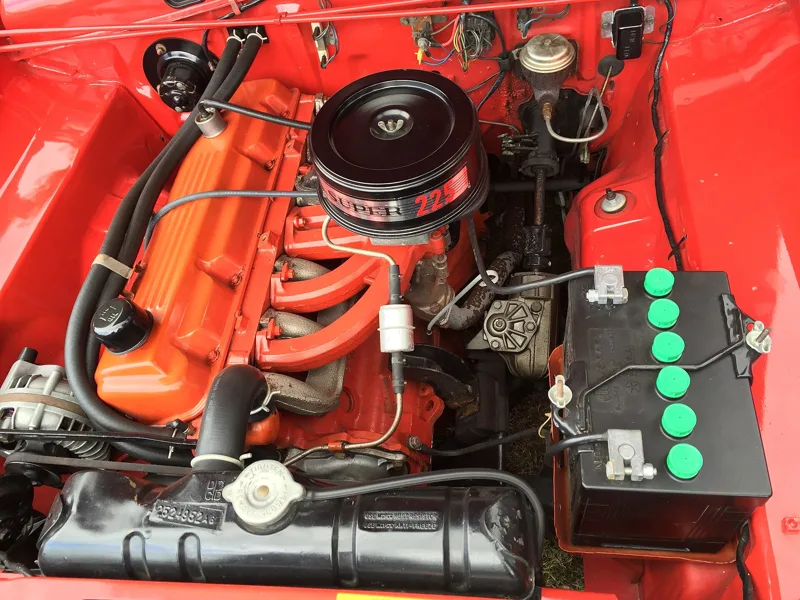
The first LA was the 273 cu in (4.5 L) V8, which began with the 1964 model year and was offered through 1969. It was rated at 180 hp (134 kW) and had a 3.625 in x 3.31 in (92.1 mm x 84.1 mm) bore and stroke. Its valvetrain used solid lifters until 1968, when hydraulic lifters arrived and made the engine quieter.
A high-performance 235 hp (175 kW) version called the Commando was offered from 1965 to 1967. It had a four-barrel carburettor, a higher-lift camshaft and 10.5:1 compression, and it was standard in the Barracuda Formula S. A 1966 Dodge Dart carried a special 275 hp (205 kW) version known as the D-Dart, built for NHRA D-stock drag racing.
How was the original LA valvetrain built?
The 273 used a cast nodular iron camshaft and solid pushrods, with malleable iron rocker arms on a shaft. Later hydraulic-cam engines switched to stamped steel rockers. Steel overhead valves worked above wedge-shaped chambers, and each cylinder had one intake valve and one exhaust valve, which kept the head design simple and light.
The spark plugs sat in the side of each head between the exhaust ports. The reciprocating assembly used cast aluminium pistons and forged steel connecting rods, with a cast or forged steel crankshaft. Taken together, these choices kept the family lighter than the A engine it replaced, which was the whole point of the LA name.
Which vehicles carried the LA engine?
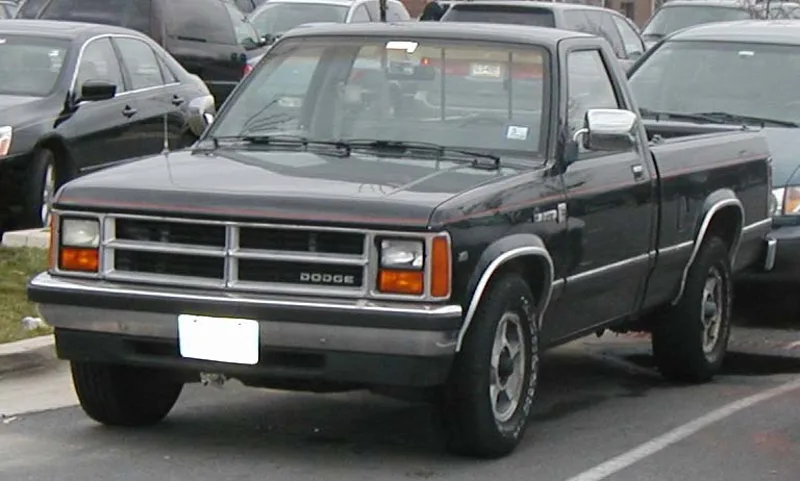
The LA was installed in passenger cars, trucks and vans, commercial vehicles, and in marine and industrial machinery. Dodge Dart and Barracuda cars carried LA engines in the 1960s, and the family later moved into the Dakota and the Ram pickups, where the 239 V6 replaced the older Slant-Six in 1988.
Because the LA was built in Detroit and at plants in Canada and Mexico, it reached a wide range of markets. That spread explains why so many examples are still found in working vehicles, boats and industrial applications, long after the last one left the production line.
How did the 318 and 340 fit into the family?
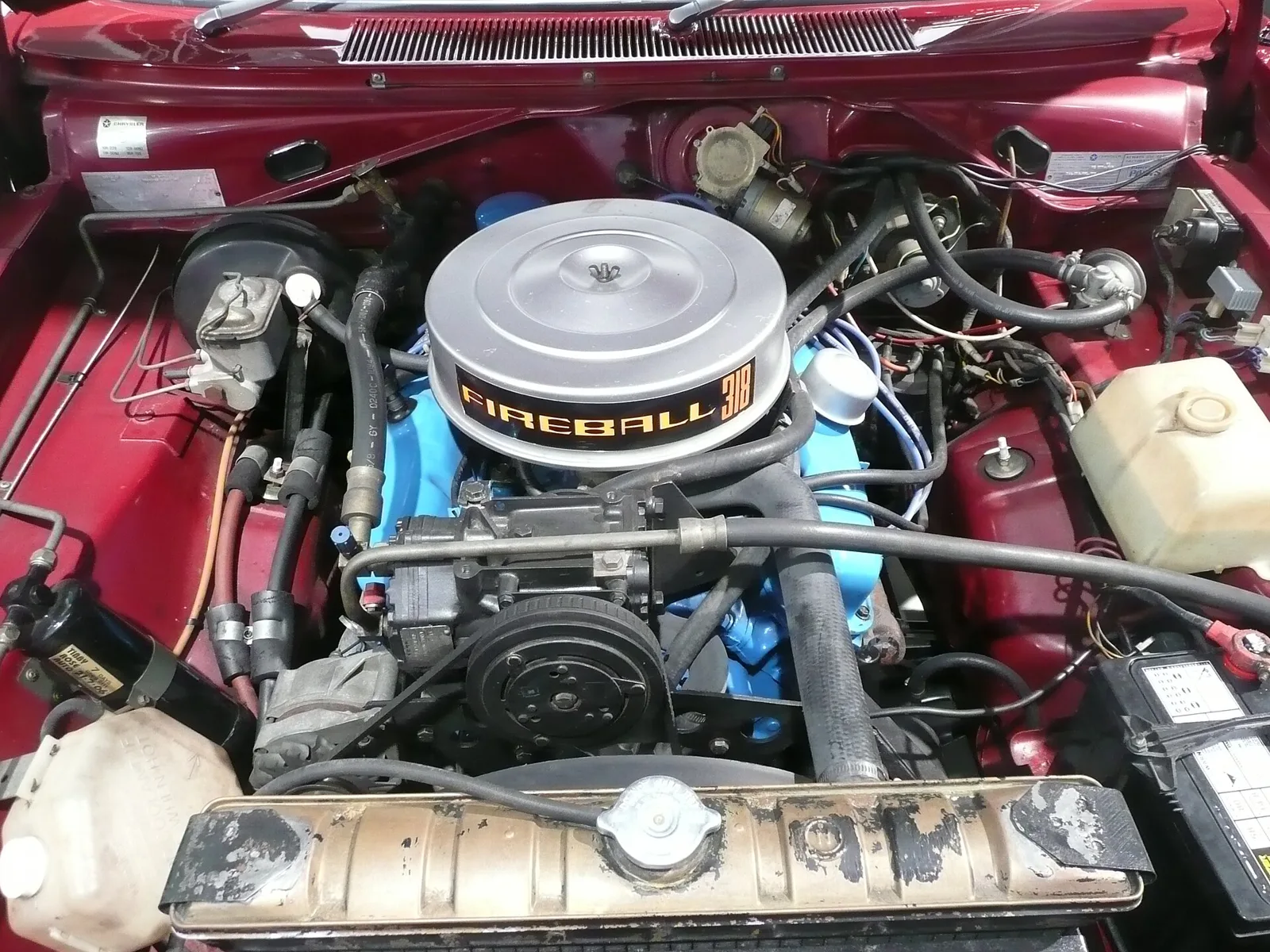
The 318 arrived for the 1968 model year, replacing the last export A 318 engines that had polyspherical chambered heads. At 317.6 cu in (5.2 L) it kept the same bore and stroke as the A 318 it came from, and it stayed in production until 1991, when the Magnum took over. Most 318s used hydraulic lifters and a two-barrel carburettor, while police versions received four-barrel units.
The 340 was the performance member of the family, introduced for 1968 with a 4.04 in (102.6 mm) bore on the same 3.31 in stroke. Its forged shot-peened crankshaft, hammer-forged rods and high-flow heads were built for racing. Output was officially 275 hp (205 kW) gross with a four-barrel, and the triple-carburettor Six-Pack version in 1970 was rated at 290 hp (216 kW) gross.
Emissions rules and fuel grades ended the 340's performance career. It was detuned in 1972 with 8.5:1 compression and small-valve heads, and it gave way to the 360 for 1974. Its cylinder heads are still regarded as among the best of that era, and the rugged bottom end gave the engine a strong reputation.
What was the 360 and what happened to it?
The LA 360 had a 4 in (101.6 mm) bore and a 3.58 in (90.9 mm) stroke, and it was released in 1971 with a two-barrel carburettor. It used the large-port 340 heads with a smaller intake valve. The 1974 E58 version with a four-barrel and dual exhausts made 245 hp (183 kW) SAE net, the highest rating of any LA engine.
Power then fell steadily as emissions controls increased, and the 1980 E58 made only 185 hp (138 kW) SAE net. From 1981 the 360 was used only in Dodge trucks and vans. A special 1978 to 1979 Li'l Red Express truck used a 225 hp (168 kW) EH1 version, which was a modified police-spec 360 that did not need catalytic converters.
What changed in the throttle-body era?
The last LA variation before the Magnum was the 1988 to 1992 throttle-body injected engine with roller cams. The 318 and the 239 V6 received it first, and a Holley-designed single-point, twin-injector throttle body sat on a redesigned cast-iron manifold. An in-tank electric pump replaced the old mechanical pump, and hydraulic roller lifters improved the valvetrain.
The 5.9 V8 followed in 1989 with the 308 cylinder heads, casting number 4448308, which had larger exhaust ports and a return to the original 1971 combustion chamber. Chrysler knew other makers had moved to multi-point injection, so it began a more drastic upgrade programme in the engineering department and released the first results in 1992.
What was the Magnum upgrade?
The Magnum was a series of V6, V8 and V10 engines introduced from 1992, with the name borrowed from the Dodge Magnum car and an earlier Dodge engine series. The Magnum V8s and V6 were based on the LA's 239, 318 and 360, although the cast-iron block stayed broadly the same. The most visible changes were the eight multi-point fuel injectors and a new double-quench cylinder head design.
Chrysler also changed the valvetrain, moving to roller-type camshafts, oil-through pushrods and stud-mounted rockers with a 1.6:1 ratio. The valve covers were held by 10 bolts and sealed with silicone, and the timing chain and serpentine accessory drive were updated for quieter running. A new intake manifold, nicknamed the beer keg, carried a twin-venturi throttle body.
Engine management moved to a single-board engine controller that governed the ignition, the injectors and the idle air valve. The system used an oxygen sensor and other inputs in closed-loop operation. From 1996 the OBD-II standard brought a new JTEC computer that could be reflashed through the diagnostic port, and the EGR system was dropped from Magnum engines at that point.
How did the Magnum V6 and V8s compare?
The Magnum family spanned V6, V8 and V10 engines, with the 3.9 L V6 at the bottom of the range and the 8.0 L V10 at the top. The table below shows the main Magnum models, with the introduction year, displacement and the peak output that applied when each was launched or later uprated.
| Engine | Introduced | Displacement | Peak output | Typical use |
|---|---|---|---|---|
| Magnum 3.9 L V6 | 1992 | 238.2 cu in (3.9 L) | 180 hp (134 kW) at 4,400 rpm | Dodge Dakota and Ram |
| Magnum 5.2 L V8 | 1992 | 318 cu in (5.2 L) | 230 hp (172 kW) at 4,100 rpm | Passenger vehicles and trucks |
| Magnum 5.9 L V8 | 1993 | 360 cu in (5.9 L) | 230 hp (172 kW) at 4,000 rpm, later 245 hp (183 kW) | Dakota R/T and Durango R/T |
| Magnum 8.0 L V10 | 1994 | 488 cu in (8.0 L) | 300 hp (224 kW), later 310 hp (231 kW) | Ram 2500 and 3500 |
Was the Magnum still an LA engine?
Strictly speaking, no. The Magnum 3.9, 5.2 and 5.9 were built around the 239, 318 and 360 but many of their parts do not interchange with the LA. The connecting rods were the only major parts that carried over unchanged, and the crankshaft, pistons and cylinder heads were all new or heavily revised.
The 5.9 L deserves special mention because it was the Magnum built on the 360 block. It made 325 lb ft (441 N m) of torque at 3,200 rpm when introduced in 1993, and its heavy-duty version pushed torque to 330 lb ft (447 N m). By 1998 it had grown to 245 hp (183 kW) and 335 lb ft (454 N m), and it was replaced by the 5.7 L Hemi in 2003.
What was the Magnum V10?
The Magnum V10 was an 8.0 L (488 cu in) cast-iron engine for Dodge Ram 2500 and 3500 trucks above 8,500 pounds GVWR. It debuted in the 1994 model year and was built through 2003. Its roots stretched back to the 5.2 Magnum V8 work of 1988, which makes it a sibling of the family rather than a separate design.
It was rated at 300 hp (224 kW) from 1994 to 1998 and 310 hp (231 kW) from 1999 to 2003, and its torque peaked at 450 lb ft (610 N m) low in the rev range, at 2,400 rpm. Its valve covers were die-cast magnesium rather than steel, which lowered noise and sealed better. Chrysler had already used an aluminium-block V10 in the 1991 Dodge Viper, so the truck engine took a different route.