How the refrigeration cycle reached cars, why the refrigerants keep changing, and what maintenance and fuel use mean for owners.
Automotive air conditioning uses a refrigeration cycle to move heat from a car's cabin to the outside air. Packard offered a factory option in 1940, Nash introduced an integrated unit in 1954, and R-12, R-134a and R-1234yf have since served as the main refrigerants.
Automotive air conditioning is a refrigeration system that moves heat out of a car's cabin and releases it into the air outside. It began as a costly option in the 1930s, spread across American showrooms over the next three decades, and has been reshaped several times by new refrigerants and environmental rules.
When did cars first get air conditioning?
A New York City company first installed air conditioning in cars in 1933, mostly for owners of limousines and luxury cars. Packard was the first manufacturer to offer it as a factory option, announced in 1939 for its 1940 model year cars. Those early units were bulky, expensive and quickly superseded.
Ralph Peo of Houde Engineering in Buffalo, New York, applied for a patent for an air cooling unit for automobiles on 7 October 1935. U.S. patent 2,099,227 was granted on 16 November 1937,.
Packard's option was built by Bishop and Babcock (B&B) of Cleveland, Ohio. Cars travelled from Packard's plant to the B&B factory for fitting, then went on to local dealers for delivery. The bulky Weather Conditioner also incorporated a heater, so one unit handled both jobs.
Packard warranted and supported the conversion, yet it never sold well. The option cost $274 (US$6,342 in 2025 dollars), which put it beyond the reach of most buyers in depression-era America. It was discontinued after 1941.
From a 1933 limousine option to R-1234yf, car air conditioning has been shaped by comfort and by the chemistry of its refrigerants.
Why did Packard's early system fail to sell?
Packard's system struggled for practical reasons rather than because of the idea itself. Its evaporator and blower filled half the trunk, it had no thermostat, and its plumbing ran several feet between the engine and the trunk. Those faults made it hard to live with, even among buyers who could afford it.
- The main evaporator and blower took up half the trunk space, a problem that eased as post-war trunks grew.
- The system had no thermostat, only a blower switch to shut it off.
- The drive belt stayed connected to the compressor, so cold air could still drift into the car as it moved.
- Several feet of plumbing between engine and trunk proved unreliable in service.
- Efficient systems superseded it in the post-war years.
Roughly 2,000 cars were ordered with the option before it ended. Later designs addressed several of these complaints, using electrically operated clutches to stop the compressor leaking cold air and compact units that kept the trunk free.
How did Chrysler's 1953 system differ from rivals?
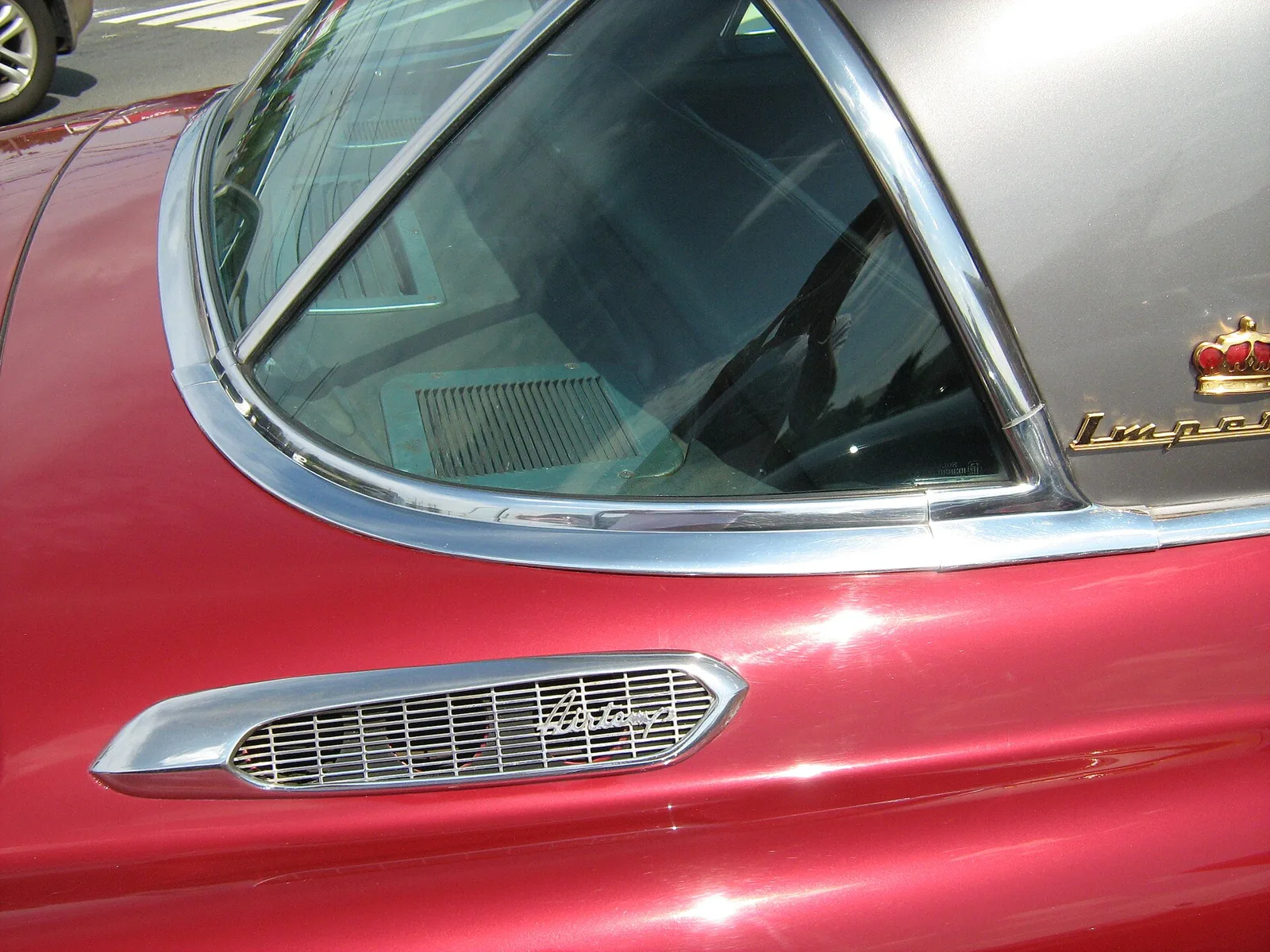
Chrysler's Airtemp was the highest capacity unit then available, and the 1953 Chrysler Imperial offered it as an option. It was one of the first production cars in twelve years to offer modern air conditioning. The system was more advanced than the competition, and it was easy to use.
Walter Chrysler had overseen the invention of Airtemp for the Chrysler Building in the 1930s. The company had also offered it on cars in 1941-42 and again in 1951-52. A single dashboard switch controlled low, medium and high settings, which kept the controls simple.
Airtemp drew in more outside air than rival systems, which reduced the stale feel common in cars of the period. Small ducts directed cool air toward the ceiling, where it drifted down around passengers instead of blowing straight onto them.
Cadillac, Buick and Oldsmobile also offered air conditioning on some 1953 models. Those Frigidaire systems used separate engine and trunk mounted components, so the parts were spread around the car rather than gathered into one unit.
What made the 1954 Nash system important?
The 1954 Nash Ambassador introduced the first fully integrated front-end heating, ventilating and air conditioning system in an American car. Called the All-Weather Eye, it combined the functions in one compact unit with dash controls and an electric clutch, and it cost $345.
Nash drew on its refrigeration experience to build the unit, which used a single thermostatic control and delivered cold air through dash-mounted vents. The system followed the company's Weather Eye fresh-air heating and ventilating system, first used in 1938. Every component fitted under the hood or in the cowl area, which made it compact and easy to service.
Its price undercut every rival system. Most competitors kept heating separate, used an engine-mounted compressor, and placed an evaporator in the trunk. General Motors' Harrison Division offered a front-mounted system on 1954 Pontiacs with straight-eight engines, but it was very expensive and kept separate controls and ducts for the heater.
The Nash arrangement became established practice for modern climate control. That single-unit layout, with heating, cooling and ventilation working together, underpins the more sophisticated automatic systems drivers use today.
How fast did car air conditioning spread?
Adoption was rapid in the United States, where about 20% of cars had air conditioning by 1960. The share reached 80% in the warm Southwest, and by 1969 54% of domestic cars were equipped. In Europe the spread was far slower, with less than 8% of cars sold in 1990 fitted with it.
Cadillac introduced the industry's first fully automatic Comfort Control for the 1964 model year. A dial thermostat set the heating and cooling automatically, which made the system far easier to use than manual controls.
American Motors made air conditioning standard on all Ambassadors from the 1968 model year, with base prices starting at $2,671. At the time it was standard only on Cadillac limousines and Rolls-Royces, so the move was a mass-market innovation that made the feature available to ordinary buyers.
Widespread use in the United States came from the 1980s onwards. Adoption elsewhere was slower, and it took a long time for the feature to reach most European cars.
What is an evaporative car cooler?
An evaporative car cooler, often called a swamp cooler, uses water evaporation rather than refrigeration to cool air. Most are aftermarket window-mounted metal cylinders with no moving parts, and they work best in dry climates, where humidity is low and evaporation is efficient.
Water inside the unit evaporates and absorbs heat from the surrounding air, and the cooled, moist air is then directed into the car. Because the cooling effect falls as humidity rises, these units suit dry desert regions. They were popular with summer tourists crossing California, Arizona, Texas, New Mexico and Nevada.
Internal units with electric fans, mounted under the dashboard or in the centre floor, were also available. They were an early form of automobile air conditioner, and modern cars do not use the method, relying instead on refrigerative systems.
How does a car air conditioner work?
A car air conditioner runs a refrigeration cycle. A compressor raises the pressure and temperature of a refrigerant gas, a condenser releases its heat, an expansion valve lowers its pressure so it cools, and an evaporator in the cabin absorbs heat from the air passengers breathe.
Refrigerant vapour leaves the evaporator and is compressed, usually by a pump in the engine bay. The hot vapour then passes through a condenser in front of the radiator, where airflow cools it into a liquid. The heat it carried leaves the car with that air.
The liquid then passes through a receiver-drier, a one-way cartridge that removes residual water and solid particles. From there it reaches the expansion valve, where part of the liquid flash evaporates and the mixture cools before it enters the evaporator coil.
- The compressor raises the pressure and temperature of the vapour.
- The condenser releases heat and turns the vapour into a liquid.
- The receiver-drier dehydrates and filters the liquid.
- The expansion valve drops the pressure, so part of the liquid flashes off and cools.
- The evaporator cools cabin air, and the moisture it removes drains outside the car.
- The heater matrix reheats the air to the temperature the driver has selected.
- The vapour returns to the compressor, and the cycle repeats.
A fan blows cabin air across the evaporator at a speed that controls how much air is cooled. Drivers can close the external air flaps to recirculate already cooled air for faster cooling. Compressors are usually driven by the engine through a belt and an electromagnetic clutch, although variable displacement units can run on a belt with no clutch at all.
The warmer the air reaching the evaporator, the higher the load on the compressor and the engine. Compressor load also rises with the condensing temperature.
Which refrigerants have cars used?
Car air conditioning has used three main refrigerant generations. R-12, invented in 1928, was the industry standard until the 1970s. R-134a took over in the early 1990s, and R-1234yf has been the most widespread refrigerant since the mid 2010s. Each change followed a new understanding of environmental harm.
| Refrigerant | Generation | Global warming potential | Notes |
|---|---|---|---|
| R-12 | First | About 11,000 | Production banned in the mid-1990s; now costly and hard to find |
| R-134a | Second | About 1,430 | Used in new cars from the early 1990s; contains no chlorine |
| R-1234yf | Third | About 4 | Most widespread since the mid 2010s; costs more per pound as of 2026 |
R-12 was the first safe, non-flammable refrigerant for cars, and a team led by Thomas Midgley, Jr. developed the family of compounds that included it. Scientists later found that its chlorine broke down ozone in the atmosphere. Production was banned in the mid-1990s, and R-12 can still be bought and sold, though it is no longer produced.
R-134a is a hydrofluorocarbon with no chlorine, so it does not deplete the ozone layer. It is still a greenhouse gas, with a global warming potential of about 1,430. Owners of older R-12 cars had to pay for a conversion, buy a new car, or find a technician to recharge the original system.
R-1234yf was developed by DuPont and Honeywell. Its global warming potential is about 4, the lowest of the three, but it costs more per pound than R-134a as of 2026. Costs are expected to fall as production volumes rise and R-134a supply declines.
R-1234yf is not directly cross-compatible with older systems. Like-for-like R-134a component sizes can lose up to 25% of performance, and the refrigerant is incompatible with some compressor oils. Evaporator certification for it follows SAE J2842.
Does air conditioning increase fuel use?
Yes, air conditioning draws on engine power. A modern car's system uses around 4 horsepower (3.0 kW) of engine power to reject the heat that builds up in the cabin, which increases fuel consumption. The overall effect is harder to pin down than that headline figure suggests.
Several factors interact. Wind resistance changes, the engine works less efficiently under load, extra heat enters the cabin, and the added equipment adds weight. A fair comparison has to account for all of them, along with any heat that the cooling system must shed.
Closed windows create less drag than open windows, so the choice between the two matters at speed. An overall rise in engine heat can also affect the cooling system, so the effect is not limited to the compressor alone.
How should car air conditioning be maintained?
Car air conditioning needs regular checks for leaks every two to four years, plus hygiene work covering drain lines, evaporator cleaning and filter changes. Filters should be replaced once or twice a year, and the evaporator should be professionally flushed every 24 months at the latest.
Lifetime refrigerant losses are normally small, so the system rarely needs topping up. A fall in cooling capacity is the signal to have it checked sooner.
VDI Standard 6032, published by the Association of German Engineers, sets out how to keep vehicle air conditioning hygienic. A professional check covers the drain lines, annual evaporator cleaning and a new interior pollen filter. If condensate cannot drain freely, moisture stays in the system and biological growth follows.
Pollen breaks down inside a filter within 12 weeks and releases allergens that reach the evaporator area. Fine particles also settle on the clean-air side of a worn filter, which is why the evaporator needs cleaning as well. Biological growth can only be held back for a limited time, so the work has to be repeated.
- Check for leaks every two to four years, or sooner if cooling weakens.
- Replace the interior pollen filter once or twice a year.
- Schedule a professional evaporator flush within 24 months.
- Make sure condensate drains freely from the evaporator.
- Avoid aerosol one-click cans and harsh cleaners, which scent the cabin or damage the fin coating.
Why is there a debate over car refrigerants?
The debate is about which refrigerant should replace R-134a. Advocates such as the Alliance for CO2 Solutions want carbon dioxide (R744) adopted, while others back new chemical blends or hydrocarbon mixtures. The argument is about cost, safety and climate impact at the same time.
The EU decided to phase out HFC-134a from January 2011. Carmakers typically need three to four years to develop and introduce a new platform with its air conditioning, which made the decision urgent. The German automotive association VDA chose CO2 in September 2007, and the ACEA working group proposed a common industry position.
The Alliance for CO2 Solutions argues that CO2 would cut emissions from new cars by 10%, and that this could spare the planet 1% of greenhouse gases. It says CO2 systems heat and cool a car faster, and that the initial investment is around EUR 20 per unit. CO2 is also cheap and widely available.
The EU-funded RACE project ran from 1994 to 1997 and cost nearly 2 million euros. It found that CO2 systems for small cars were 45% more expensive than HFC units, although for luxury cars the extra cost was described as irrelevant. Critics still argue that CO2 technology is neither cost-efficient nor safe, and they prefer new chemical blends.
Safety is central to the argument. CO2 is rated safety class A1 by ASHRAE, the highest class possible, and its charge of 200-400 g is small. Greenfreeze, a natural alternative based on purified butane and propane mixtures, is efficient and could be backward compatible with R-12 systems. Butane and propane are highly flammable, however, and the US EPA rejected flammable hydrocarbon blends as substitutes for CFC-12 on safety grounds.
What are the advantages and drawbacks?
Air conditioning cools the cabin quickly and removes moisture from the air as it passes over the evaporator. Modern refrigerants also carry far lower climate impact than R-12, and integrated units have made the feature compact and easier to service. The trade-offs are real, though, and they affect running cost and upkeep.
Advantages:
- Faster cooling than relying on open windows, with moisture removed as the air passes over the evaporator.
- Closed windows reduce drag compared with open windows.
- Modern refrigerants have a far lower global warming potential, with R-1234yf at about 4.
- Integrated units combine heating and cooling in one compact package that is serviceable.
Drawbacks:
- Running the compressor costs engine power, around 4 horsepower (3.0 kW) in a modern car.
- Neglected filters and evaporators cause hygiene problems and biological growth.
- Older refrigerants such as R-12 damaged the ozone layer.
- R-1234yf can lose up to 25% of performance in like-for-like R-134a systems.
- Refrigerant changes forced conversions, new purchases or recharges on owners of older cars.