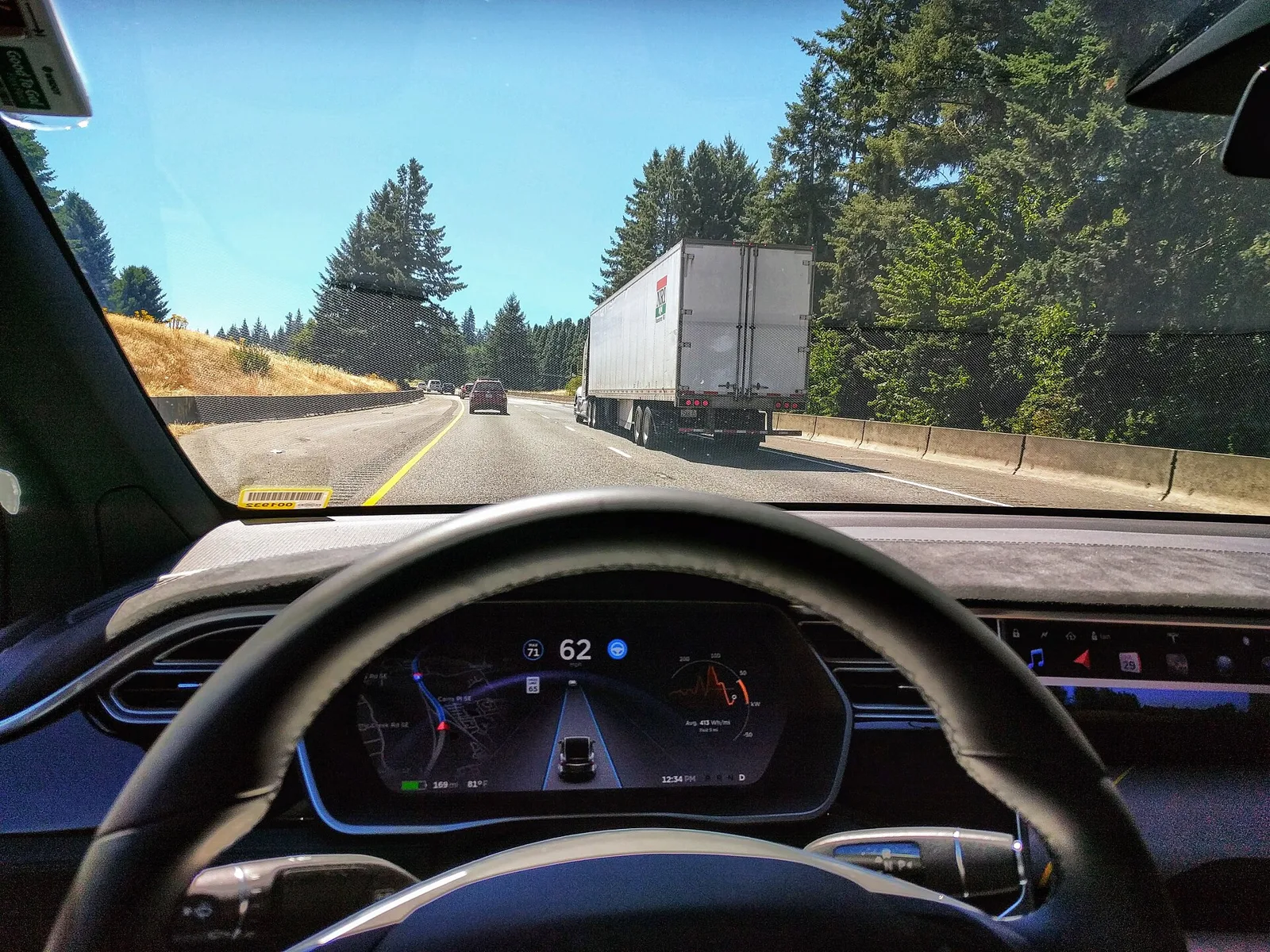
From a 1990s radar prototype to rules in Japan, the EU and the United States, a look at how automated emergency braking detects a crash, acts without the driver and changes the numbers.
Automated emergency braking detects a possible forward collision and brakes without waiting for the driver. UN rules define it, and mandatory dates now apply in Japan, the EU and Australia, with the US committing to near-universal fitment.
Automated emergency braking, or AEB, is a collision avoidance system that detects a potential forward crash and applies the brakes without waiting for the driver. Regulators now treat it as a core safety feature, and many countries have set dates by which it must be fitted. The technology has moved from prototype radar in the 1990s to a standard item on most new cars, and it has become one of the most studied safety systems on the road.
What is automated emergency braking?
AEB is the name used in many jurisdictions for the automated emergency braking system, which the World Forum for Harmonization of Vehicle Regulations calls AEBS. The system is designed to detect a possible forward collision and activate the brakes to slow the vehicle, with the aim of avoiding the crash or lessening its impact.
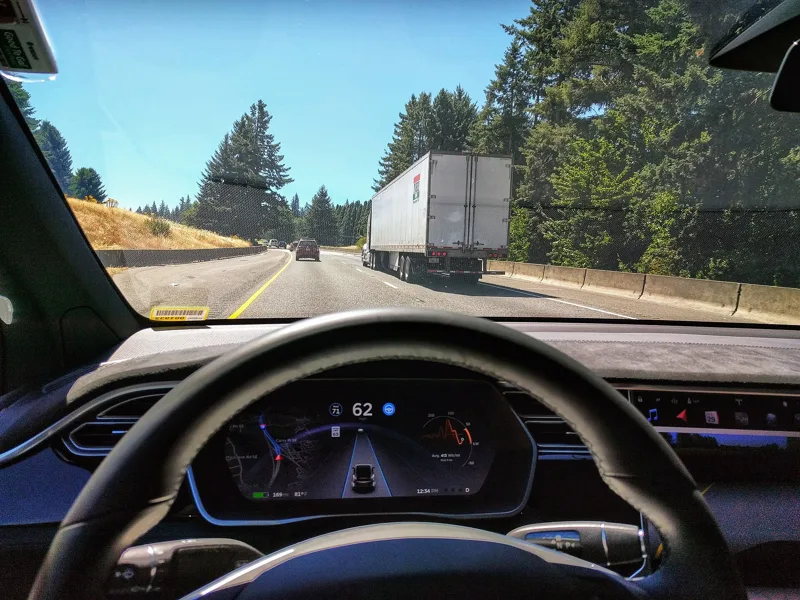
Once an impending collision is detected, the system warns the driver. If the collision becomes imminent, the car can act on its own by braking, steering or both, without any input from the driver. The approach relies on sensors looking ahead, and cars equipped with it may also use the same sensors for adaptive cruise control.
The first systems were too costly to build; today the same braking logic is written into law in several large markets.
How do the UN rules define AEB?
UN ECE regulation 131 requires a system that can automatically detect a potential forward collision and activate the braking to decelerate the vehicle. Its purpose is to avoid or mitigate the collision. UN ECE regulation 152 sets a minimum deceleration of 5 m/s2 for the braking itself.
The rules recognise that braking and steering suit different situations. Braking is the appropriate avoidance method at low speeds, for example below 50 km/h (31 mph). Steering may be more suitable at higher speeds if the lanes beside the car are clear. Steering-based avoidance is still a new concept, and some research projects are testing it.
| Feature | AEB | Forward collision warning |
|---|---|---|
| Warns the driver | Yes, before acting | Yes |
| Applies the brakes | Yes, if the driver does not respond | No |
| Steering intervention | Possible at higher speeds | No |
| Typical role | Avoids or reduces a crash | Prompts the driver to act |
What makes AEB different from a warning?
AEB differs from forward collision warning, which alerts the driver but does not by itself brake the car. Euro NCAP describes AEB as having three characteristics. It is autonomous, acting independently of the driver to avoid or lessen the accident. It is emergency-only, intervening only in a critical situation. And it is braking-based, trying to avoid the collision by applying the brakes.
Time-to-collision is one way to choose between braking and steering. A short time to impact favours braking, while a longer window with clear lanes allows steering. The system's logic therefore depends on speed, distance and the road layout at each moment.
Steering-based avoidance has limits of its own. It depends heavily on lane markings, it faces the constraints of its sensors, and it has to work with the driver rather than against them.
When was AEB first developed?
Early warning systems were attempted in the late 1950s. Cadillac built a prototype called the Cyclone that used radar behind its nose cones to detect objects ahead, but the cost of making it was judged too high. William L. Kelley received the patent for the first modern forward collision avoidance system in 1990.
A second modern system was shown in 1995 by a team at Hughes Research Laboratories in Malibu, California. The work was funded by Delco Electronics and led by physicist Ross D. Olney. The technology was marketed as Forewarn, and its radar antenna was built for automotive use at 77 GHz. The first production laser adaptive cruise control arrived on a Toyota Celsior in Japan in August 1997.
How did regulators and carmakers respond?
AEB was introduced in the British market in 2008, and between 2010 and 2014 Euro NCAP rewarded manufacturers whose cars had AEB features. In the early 2000s the US National Highway Traffic Safety Administration, known as NHTSA, examined whether frontal collision warning and lane departure warning should become mandatory. In 2011 the European Commission looked at collision mitigation by braking.
For commercial vehicles, mandatory fitting of advanced emergency braking was scheduled from 1 November 2013 for new vehicle types, and from 1 November 2015 for all new vehicles in the European Union. The impact assessment suggested this could prevent around 5,000 fatalities and 50,000 serious injuries each year across the EU.
In March 2016 NHTSA and the Insurance Institute for Highway Safety announced that manufacturers of 99% of US automobiles had agreed to include AEB as standard on virtually all new cars by 2022. The agency expected the wider rollout to avert about 28,000 crashes and 12,000 injuries. In 2016, 40% of US models already offered AEB as an option.
How widely is AEB fitted today?
Uptake has varied by market. In the United Kingdom, an estimated 1,586,103 vehicles had AEB as of January 2017, which was 4.3% of the British fleet. By 2021 Consumer Reports noted a rise in automakers making city-speed AEB standard. Six automakers included AEB on all models that year, up from two in 2020.
Australia's picture was more mixed. In April 2020, AEB was standard on 66% of new light vehicle models, available only on higher grade variants on 10%, offered as an option on 6%, and absent on 16%. Since 2015 NHTSA has recommended AEB, and although it was not mandatory in the US by 2021, the agency persuaded manufacturers to include it on 99% of new cars sold by 1 September 2022.
Japan moved faster. In 2017 AEB was one of the most popular forms of advanced driver assistance in the country, and more than 40% of new cars equipped with some ADAS had AEB. In 2018, 84.6% of cars had some kind of AEB, although not every maker met its certification goal.
When does AEB become mandatory?
Japan requires its domestic carmakers to fit AEB to all new and remodelled passenger cars from November 2021, as a response to rising accidents involving older drivers. Models already on sale must comply from December 2025. For imports, new vehicles must comply from about June 2024, and existing models from about June 2026.
In the European Union, advanced emergency braking has been required by law on new vehicle models from May 2022, and on all new vehicles sold from May 2024. India could make AEB mandatory on new cars by 2022. In the United States, carmakers committed voluntarily to fit AEB on all new cars and light trucks from 2022, three years earlier than a regulatory process would have required, and AEB is set to become mandatory by September 2029.
Australia has proposed that car-to-car and pedestrian AEB be standard on all new models launched from July 2022, and on all new vehicles sold from July 2024, matching the European timetable. Rules that apply from March 2023 for new models and from March 2025 for all models on sale are now in place.
What changes for heavy vehicles from 2025?
New UNECE standards improve AEB for heavy goods vehicles and buses, and from 2025 they apply to new types of vehicle in the EU. The changes followed crash inquiries which found that some lorry drivers switched off their AEB to drive closer to the vehicle in front. Under the new rules, deactivation is limited to 15 minutes, after which the system re-engages automatically.
What do the studies show AEB prevents?
A 2012 study by the Insurance Institute for Highway Safety, known as IIHS, examined how crash avoidance features affected insurance claims. It found two features gave the biggest benefits: autonomous braking that acts if the driver does not, and adaptive headlights that turn with the steering. Lane departure systems were found to be unhelpful and possibly harmful at that stage of development.
Later work pointed the same way. A 2015 IIHS study found that forward collision warning and automatic braking reduced rear collisions, and a 2015 study based on European and Australasian data suggested AEB could cut rear-end collisions by 38%. A study of police-reported crashes put the reduction in rear-end crashes at 39 percent. A 2012 estimate suggested that if every car had the system, accidents could fall by up to 27 percent and save up to 8,000 lives a year on European roads.
The 2016 Berlin truck attack offers a practical example: the truck used was halted by automatic braking. In a 2016 US study of trucks, the activations came from the lead vehicle's manoeuvres, whether braking, turning or merging.
Estimates of efficiency differ. The European Commission cited a 38% drop in accidents from one 2015 analysis, a 9% to 20% drop from Volvo, and a 44% drop from another study. In April 2019, IIHS and HLDI found that forward collision warning plus autobrake was linked to a 50% fall in front-to-rear crashes and a 56% fall in those involving injuries. Rear automatic braking was associated with a 78% decrease in backing crashes when combined with a rearview camera and parking sensors, although the repair costs for that equipment averaged US$109 more.
In Australia, AEB was associated with a 55 percent reduction in police-reported crashes, a 40 percent fall in rear-end crashes and a 28 percent reduction in occupant trauma. A 2020 Italian study estimated a 45% reduction in rear-end collisions, using event data recorders from a 2017 sample of 1.5 million vehicles and a 2018 sample of 1.8 million.
What are the limitations of AEB?
The US National Transportation Safety Board has raised concerns that some collision avoidance systems cannot detect damaged crash attenuators, so a vehicle may drive into one. The board considers detection of such hazards a must-have for partially automated vehicles. Heavy rain, snow or fog can also reduce the effectiveness of the systems for a time.
Over-trust is another issue. Japan recorded 72 such accidents in 2017, 101 in 2018 and 80 in the first nine months of 2019, each blamed on excess trust in automatic brakes. Eighteen of those resulted in injury or death. Unnecessary braking can also happen, for example when shadows, parked cars or metal road signs at the side of a curve, or steep driveways, are misread as hazards.
How do pedestrian systems fit in?
AEB systems use sensors to detect and classify objects in front of the car, software to interpret the data, and a braking system that can work without the driver. Pedestrian detection is a growing part of the field. Honda has developed a night vision system since 2004 that highlights pedestrians with an audible chime and a head-up display, although it works only below 30 degrees Celsius (86 Fahrenheit).
Volvo added a pedestrian airbag to the V40, introduced in 2012. Many manufacturers are developing pedestrian crash avoidance and mitigation systems. The IIHS found that AEB with pedestrian detection was associated with reductions of 25% to 27% in pedestrian crash risk, and 29% to 30% in pedestrian injury crashes. It found no evidence that the system worked well in dark conditions without street lighting, at speeds of 50 mph or more, or while the vehicle was turning.