How controlled deformation at the front and rear of a car slows the occupants more gently, and how the idea came from a Mercedes-Benz engineer in 1937.
A crumple zone is a part of a car built to deform in a controlled way during a crash. The deformation lengthens the time over which the car slows, lowering the peak force on occupants, while the passenger cabin stays rigid. Bela Barenyi patented the idea in 1937.
A crumple zone is a structural safety feature that deforms in a controlled way during a collision, mainly in cars. By lengthening the time over which the vehicle's speed changes, it reduces the force that reaches the people inside. Crumple zones are now also built into trains and railcars.
How do crumple zones protect occupants?
Crumple zones protect occupants by deforming in a controlled way, which stretches the time over which the car's velocity changes. Because the average force on people is inversely related to that time, a longer deceleration means lower peak forces. The passenger cabin itself is kept rigid so that it does not collapse onto them.
The governing relationship is simple. Average force multiplied by the time of impact equals the mass multiplied by the change in velocity, so spreading the same change over a longer period reduces the force. Engineers measure the resulting impulse in newton seconds, with force in newtons, time in seconds, mass in kilograms and velocity in metres per second.
The rigid passenger cell and the sacrificial ends work as a pair. The outer parts are weakened on purpose, while the inner body is strengthened with more reinforcing beams and higher strength steels. Impact energy that does reach the cell is spread over as wide an area as possible, which limits how much the cell deforms.
A crumple zone gives up its own shape so that the people inside keep theirs.
Where on a car do crumple zones sit?
Crumple zones usually sit at the front of a car to absorb head-on collisions, with others at the rear. A British Motor Insurance Repair Research Centre study found that 65% of impact damage was to the front, while 25% was to the rear and 5% to each side.
| Impact location | Share of impact damage | Typical protection |
|---|---|---|
| Front | 65% | Front crumple zone and bumper structure |
| Rear | 25% | Rear crumple zone and bumper structure |
| Left side | 5% | Side structure and side impact protection |
| Right side | 5% | Side structure and side impact protection |
Racing cars take a different approach. Many use aluminium, composite or carbon fibre honeycomb, or energy absorbing foam, to form an impact attenuator. These absorb crash energy in far less volume and weight than a road car's crumple zone, and some countries have fitted similar devices to highway maintenance vehicles.
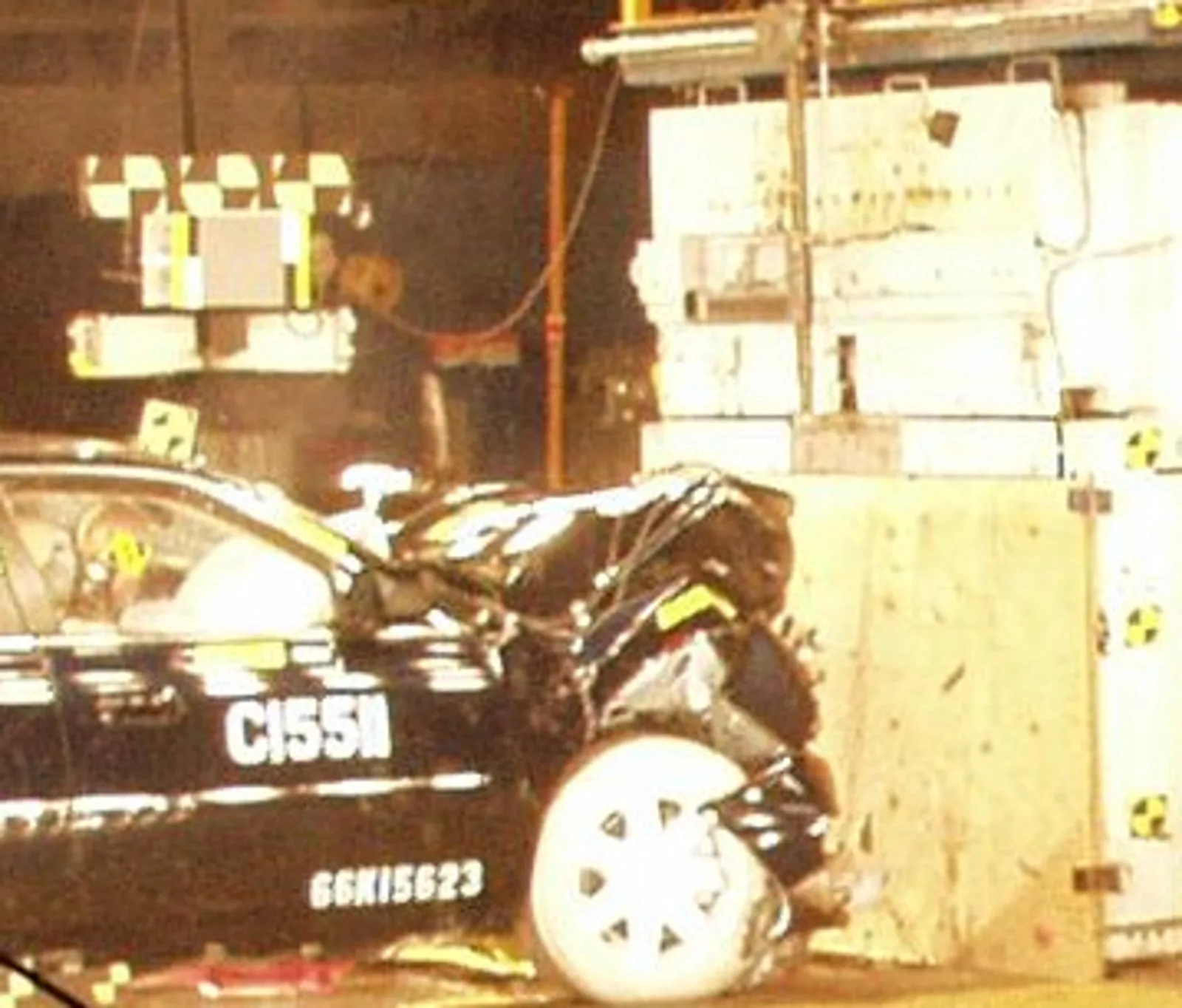
The principle is still demonstrated publicly. On September 10, 2009, ABC News broadcast a crash test by the US Insurance Institute for Highway Safety, in which a 2009 Chevrolet Malibu hit a 1959 Chevrolet Bel Air in an offset head-on collision. The test made the gap between 1950s design and modern cell-and-crumple structures plain to see.
Who invented the crumple zone?
The concept was invented and patented by Bela Barenyi, an Austrian Mercedes-Benz engineer, in 1937, and he developed it in a more complete form in 1952. Patent number 854157, granted in 1952, described the decisive idea that a safe car need not be rigid all the way through.
Barenyi divided the car body into three sections: a rigid passenger compartment that did not deform, and crumple zones at the front and rear. The 1953 Mercedes-Benz Ponton applied only part of his thinking, using a strong, deep platform to form a partial safety cell, a design that had itself been patented in 1941.
The first carbody built on the patent was the 1959 Mercedes W111 tail fin saloon. Its straight central longitudinal members formed a rigid cage with the body panels, while the curved front and rear members deformed in a crash and absorbed part of the collision energy. Later designs weakened those members with vertical and lateral ribs, creating telescoping crush tubes.
How do crumple zones work with seat belts and airbags?
Crumple zones work as one part of a system. Seat belts hold people in place, airbags cushion the head and chest, and padded interiors absorb the rest, each reducing the peak force on the occupant. Together they slow the body by a few tenths of a second, which drastically lowers the peak force.
The sequence of speed-reducing technologies runs from the crumple zone to the seat belt, then the airbag, then a padded or deformable interior. The NHTSA figure is a 50% reduction in fatal injury risk for belted occupants. Belts stretch while they restrain an occupant, so a repaired car needs new belts, and used belts should not be bought because they may already be stretched.
Pre-tensioned belts are now fired electronically, timed to work with the airbag. Even so, the final contact between an occupant's internal organs and the ribcage or skull remains one of the main ways crashes cause serious injury, which is why the whole system is designed to lower that final peak.
Do crumple zones make cars less safe?
No. A common misconception holds that crumple zones let the body collapse onto the occupants. In fact they sit in front of and behind the rigid safety cell, compacting within the engine bay or boot, and modern cars protect occupants far better than older cars or SUVs with a separate chassis frame and no crumple zones.
Compatibility is a separate issue. When a car with a crumple zone meets an SUV without one, the car absorbs most of the impact energy, so it may end up more damaged. Its occupants are usually less affected, however, and a collision between two vehicles without crumple zones tends to be more hazardous for both.
Impact incompatibility arises because the ends of an SUV's chassis rails sit higher than the hard points of a car, so the SUV can override the car's engine compartment. Volvo addressed this in the XC60 by adding a lower cross-member at the height of a car's beam, so the vehicle engages the other car's crumple zone as intended.
How do bumpers handle low-speed impacts?
Bumpers are designed to shrug off minor knocks such as parking bumps, using elastic elements like the front apron, and some are filled with foam. In collisions up to approximately 20 km/h, the aim is to protect the crumple zone and load-bearing structure so repairs stay as cheap as possible.
Crash tubes, also called crash boxes, are hollow steel profiles that mount the bumper and absorb energy by rolling up. Pedestrian impacts have become a design goal since NCAP added them to its testing regime, so designers reduce rigid supports in the areas most likely to strike a person.
How are crumple zones designed today?
Modern crumple zones are designed with computer simulation. In the early 1980s, German car makers began finite element crash studies, borrowing methods from the aerospace and nuclear industries, and eventually ran a full frontal simulation of a car overnight. Turnaround between runs fell to within one day, so engineers could refine body structures step by step.
A joint project by the Forschungsgemeinschaft Automobil-Technik (FAT), which brought together all seven German car makers, tested two emerging commercial simulation codes. The drive for better crashworthiness gathered pace across Europe after Euro NCAP arrived in 1997, with Formula One safety expertise involved in its work.
Can crumple zones sit inside the cabin?
Some designers have placed crumple zones inside the survival cell itself. The 2004 Pininfarina Nido Experimental Safety Vehicle used interior crumple zones to decelerate a sled-mounted cell, and Volvo developed a similar idea for small cars, with the driver's seat on a rail and shock absorbers in front of it.
In that Volvo concept, the seat and belted-in driver slide forward up to 8 inches (20 cm) while the shock absorbers dissipate peak energy, and the steering wheel and dashboard move forward too. Combined with a front crumple zone and an airbag, the design could greatly reduce the forces acting on the driver in a frontal impact.