Pixar's road story, the real car models behind its characters, a $480 million worldwide gross and the franchise that followed.
Cars is a 2006 Pixar film directed by John Lasseter. Its hero, a rookie racecar named Lightning McQueen, is stranded in the Route 66 town of Radiator Springs and learns to value friendship. The film grossed $480 million worldwide and launched a franchise.
Cars is a 2006 animated film from Pixar Animation Studios, directed by John Lasseter, about a brash racecar who is stranded in a forgotten Route 66 town. It opened strongly, earned mostly favourable reviews and grossed $480 million worldwide on a $120 million budget. The success also launched a franchise that now includes two sequels and spin-off films.
What is Cars about?
Lightning McQueen is a cocky rookie racer chasing the Piston Cup title. A three-way tie sends him racing toward California, where a mishap strands him in Radiator Springs, a town bypassed by the interstate. There he is sentenced to repave its road and slowly learns the history and friendships that make the place worth staying for.
The Dinoco 400, which ends the Piston Cup season, turns on a mistake. Lightning refuses a tyre change during a pit stop, so his rear tyres blow out on the final lap. He drives through the night toward California in his transport truck, Mack, and a mishap with street racers leaves him stranded in Radiator Springs, Arizona, where he damages the main road. Judge Doc Hudson, who is prejudiced against racecars, orders him to repave it.
Lightning rushes the job so he can leave, so Doc challenges him to a dirt-road race with a condition attached: if he loses, he must start the repaving over. Lightning, who has never raced on dirt, spins into a cactus patch. The race was set up to humble him, and the lesson slowly reshapes the young racer.
Radiator Springs had once been a busy stop on Route 66 before the interstate took its traffic. Lightning discovers that Doc was once the Fabulous Hudson Hornet, a champion with three Piston Cup championships whose career ended in a crash. That history changes how he sees the bitter judge and the quiet town around him.
When Doc alerts the media to Lightning's whereabouts, Lightning is forced to leave in time for the tiebreaker. At Los Angeles International Speedway, friends from Radiator Springs arrive to act as his pit crew, and Doc takes over as crew chief. Chick Hicks wrecks The King with a PIT manoeuvre, and Lightning stops just short of the finish to push The King across the line instead of winning. He then turns down the Dinoco sponsorship, stays loyal to Rust-eze, and returns to Radiator Springs to set up his racing headquarters there.
The emotional core is Lightning's change of heart. He starts out chasing a sponsor and a trophy, and by the end he values the people who helped him. That arc gives the racing scenes their weight, because each result now matters to a town rather than only to a driver.
A road film about a racer who learns that a town is worth more than the trophy.
Where did the idea for Cars come from?
The idea grew out of conversations inside Pixar. John Lasseter first talked about a cars film with Bob Pauley in 1993, while Toy Story was in production. Jorgen Klubien later drafted The Yellow Car, a story about an electric car in a gas-guzzling world, and development started in 1998, shortly after A Bug's Life had wrapped.
Lasseter's own road trip shaped the film. In 2000 he drove across the country with his wife and five sons, and afterwards he reached out to Michael Wallis, a historian of the route. Eleven Pixar animators then followed Route 66 on two separate trips, travelling in rented white Cadillacs. The team also drew on the documentary Divided Highways, which looked at small towns hit by the interstate.
The working title in 2001 was Route 66, but the studio changed it to avoid confusion with a 1960s television series that shared the name. Lightning's number went through a similar change. It was first planned as 57, then became 95, a nod to 1995 and the release of Toy Story.
Who voices the cast, and what cars are they?
Owen Wilson voices Lightning McQueen, a red 2006 racecar, and Paul Newman takes the part of Doc Hudson, a 1951 Hudson Hornet finished in navy blue. Larry the Cable Guy plays Tow Mater, a rusty blue tow truck, while Bonnie Hunt, Richard Petty and Michael Keaton voice Sally, The King and Chick Hicks. The model behind each character shapes its personality on screen.
| Character | Car model | Voice |
|---|---|---|
| Lightning McQueen | Red 2006 racecar | Owen Wilson |
| Doc Hudson | Navy-blue 1951 Hudson Hornet | Paul Newman |
| Sally Carrera | 2002 Porsche 911 Carrera | Bonnie Hunt |
| Tow Mater | Rusty blue tow truck, modelled loosely on a 1951 International Harvester L-170 | Larry the Cable Guy |
| The King | Blue 1970 Plymouth Superbird | Richard Petty |
| Chick Hicks | Green stock-style racecar | Michael Keaton |
| Luigi | Yellow 1959 Fiat 500 | Tony Shalhoub |
| Ramone | 1959 Chevrolet Impala lowrider | Cheech Marin |
Many supporting roles also draw on real models. George Carlin plays Fillmore, an aquamarine 1963 Volkswagen Type 2, and Michael Schumacher lends his voice to a red Ferrari F430. Richard Petty, a famous name in real-world motor racing, gives the veteran racer The King his voice. Each of these choices gave the animators a shape to work from, and the wider cast lends the town its variety.
Joe Ranft voiced Red and Jerry Recycled Batteries, which were his final roles. He died in an automobile crash in August 2005, while the film was in production, and the finished picture is dedicated to his memory. Paul Newman's last non-documentary film role came before his retirement in 2007.
Why are the eyes in the windshield?
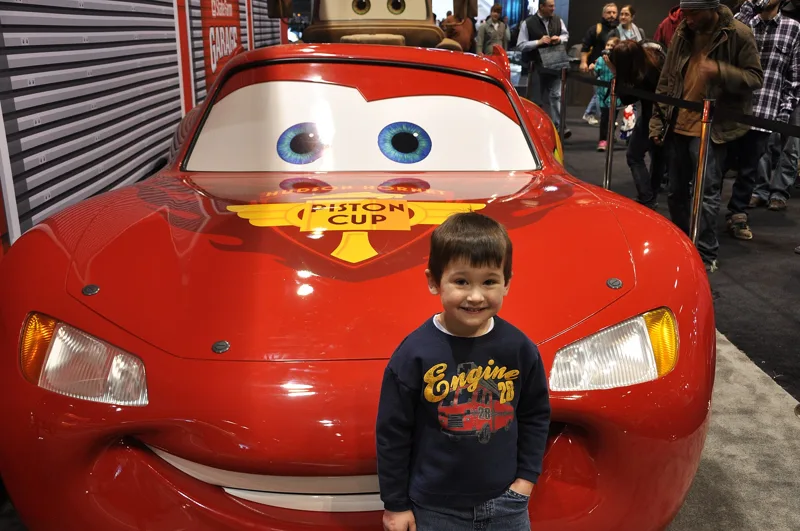
The characters' eyes sit in the windshield rather than inside the headlights, which sets them apart from the cartoon cars common in animation. The choice was made early and kept through the whole production. It drew mockery from the automotive blog Jalopnik, which criticised it in a facetious way.
The animators had to show emotion without arms or legs. They used steering and tyres to suggest gestures, and they gave the windshield an eyelid and an eyebrow for expression. Each car moved according to its age and type, so the sports cars handled tightly while the older models bounced and rolled more loosely.
How did the team make the cars look real?
The team studied real-world craft rather than relying on cartoon shortcuts. Thomas Jordan, the character shading supervisor, watched a local body shop mix and apply paint, then rebuilt the layers digitally: a base colour, a clearcoat for reflections, metallic flake and a pearlescent finish. Steel had to look and feel like steel, a principle Lasseter pushed throughout.
Lasseter visited the design studios of the Detroit automakers, including Ford's J Mays, to learn how real cars are styled. Pixar added ray tracing to its RenderMan program, which produced accurate reflections, shadows and irradiance. A ground-locking system kept each car planted on the road, so the models never seemed to float above the tarmac.
A dedicated matte painting department handled the desert landscapes and the sky. The computers behind the work were four times faster than the machines of The Incredibles, and 1,000 times faster than the ones used on Toy Story. Supervising animators Doug Sweetland and Scott Clark led the animation team through these tools and the new techniques they required.
How did the music and awards season unfold?
Randy Newman composed the score, and the soundtrack came out on Walt Disney Records on June 6, 2006. It paired nine songs by popular artists, with contributions from Sheryl Crow and Rascal Flatts, as well as John Mayer and Brad Paisley, alongside eleven Newman score cues. Newman's song Our Town won a Grammy for best song written for visual media.
Our Town also earned an Oscar nod in the Best Original Song category. The film itself was nominated for Best Animated Feature at the 79th Academy Awards, but it lost that category to Happy Feet. It did take the Annie Award in the animated feature category, and the inaugural Golden Globe for the genre, which was its most prestigious honour.
How did Cars perform at the box office?
Cars opened with $60.1 million from 3,985 US theatres. That opening held the record for the biggest weekend for a car-themed film for three years, until Fast & Furious arrived in 2009. The second weekend added $33.7 million, and the film reached $480 million worldwide over its run against a $120 million budget.
Cars finished as the sixth-highest-grossing film of 2006 and the second-highest-grossing animated film of that year, behind Ice Age: The Meltdown. A 20th-anniversary re-release in US cinemas on September 4, 2026 earned $11.1 million in the US and Canada, lifting the worldwide total to $480.2 million. Home video sales were just as strong, with the DVD selling five million copies in its first two days and 6,250,856 units in its first week.
How did critics react to Cars?
Critics were mostly positive. Rotten Tomatoes recorded 74% approval from 199 reviews, averaging 6.9/10, and Metacritic gave the film 73 from 39 critics. Audiences gave it an A on CinemaScore, a grade that points to strong word of mouth among families.
Roger Ebert awarded it three stars out of four, and Peter Travers gave it three and a half. Kenneth Turan praised the film for having heart. Variety's Brian Lowry was harsher, calling it the least visually interesting of Pixar's films, which stood out against an otherwise warm response.
What came after the first film?
Cars 2 arrived on June 24, 2011, and Cars 3 followed on June 16, 2017. The spin-off Planes was released on August 9, 2013, and Planes: Fire and Rescue followed on July 18, 2014. Cars Toons aired between October 27, 2008 and June 5, 2012, while the Disney+ series Cars on the Road debuted on September 8, 2022.
The original film still anchors the franchise. Its Blu-ray release came on November 6, 2007, and a 3D edition arrived in the Cars: Ultimate Collector's Edition on October 29, 2013. A 4K Ultra HD Blu-ray followed in 2019, showing how the film kept finding new audiences with every new format. Each follow-up expanded the world beyond Radiator Springs, but the first film remains the most intimate of the series.